
In Corfu Town the evening walk starts under the arcades of the Liston, where waiters carry coffee and ginger beer to tables set along the edge of the Spianada, and the sound of a brass band can drift over the old green. Behind the arcades the stone alleys of the Old Town twist between laundry lines, Venetian palaces and church bell towers. Corfu is an island for people who like to mix a historic town, a coast of coves and a long table of Ionian food.
What are the best things to do in Corfu?
The island is among the most popular in the Mediterranean, and the reasons are easy to see once you start ticking off the list.
- Wander the stone-paved alleys, squares and churches of Corfu Old Town, a UNESCO World Heritage Site.
- Have a coffee on the Liston, the arcaded pedestrian street along the Spianada.
- Explore the Old Fortress, the Venetian stronghold that anchors the town.
- Visit Mon Repos and its museum among the trees of ancient Palaiopolis.
- Look out over the town and the island from the terraces of the Achilleion.
- Spend a day on the bay at Palaiokastritsa, tied by local legend to Odysseus and Nausicaa.
- Try the island’s own dishes, from pastitsada to sofrito, in a taverna.
- Climb into the hills on Mount Pantokrator, the island’s highest point.
Most of these can be strung together from one base, and the island rewards slow days. A morning among the museums can lead to a long lunch, and a day at the beach can end with dinner in a village square.
Corfu is also well connected for a Greek island. Flights from Athens take 1 hour 15 minutes, and flights from Thessaloniki are shorter still, so it fits easily into a longer trip through the country.
Sights and landmarks in Corfu
Corfu Town is where the island’s layers show most clearly. Venetian fortresses, French-built arcades, British-era buildings and Greek churches stand side by side, and you see the sights mostly by walking from one to the next. Every corner holds another small square or a church doorway worth a look.
The Old Town and the Liston
The Old Town of Corfu was inscribed on the UNESCO World Heritage List in 2007, and it is easy to understand why. Palaces, stone-paved alleys, squares and churches pack the district, and the lanes narrow so much in places that two people with shopping bags have to turn sideways. Washing hangs between tall shuttered houses, and small shops sell kumquat sweets, olive-wood spoons and local liqueurs.
The Liston is the town’s social stage. It is a pedestrian street and district on the western edge of the Spianada, and it is one of the most popular sites in Corfu Town.
Its arcades shelter cafés where people sit for hours, and the long green of the Spianada spreads in front of them. Church squares such as the one around Aghios Spyridon, with its tall bell tower, are a short wander into the lanes behind.
The Old Fortress and the Spianada
The Old Fortress is a Venetian fortress rising beside the sea in Corfu Town. You cross toward it from the Spianada and walk up through gates, ramparts and stone passages, with the harbor and the town’s rooftops spread out behind you. Upper terraces give long views over the water and the tiled roofs of the Old Town.
Next to the fortress the Spianada itself is a place for strolling, with big shade trees and open lawns. The Municipality of Central Corfu and the Diapontian Islands has announced progress on the restoration of the Ionian Parliament and the Spianada Park, so you may see work under way on the historic buildings around it. The Public Library of Corfu sits in the old English Barracks at Palaio Frourio, a reminder of the island’s British years.
Mon Repos and ancient Korkyra
South of Corfu City, in the forest of Palaeopolis, stands Mon Repos, a palace built on the ruins of ancient Korkyra. The ruins of Palaiopolis lie on the same ground, so a walk here mixes tree-lined paths, a neoclassical house and traces of the island’s oldest city. Since 2001 the house has held the Museum of Palaiopolis, which tells the story of the ancient town.
The ancient story continues elsewhere in town. The Temple of Artemis, an Archaic Greek temple built around 580 BC, once stood in what is now the suburb of Garitsa. On Analipsi Hill, at the spot called Kardaki, another Archaic temple was built around 500 BC. Kardaki Temple is considered the only Doric Greek temple without a frieze. Both are part of the story that the Archaeological Museum tells.
Museums in town
The Archaeological Museum in Corfu city houses the Gorgon pediment from the Temple of Artemis, excavated at Palaiopolis in the early twentieth century. It is the piece to see first, a large carved sculpture with a fierce central figure and animals flanking it.
The Museum of Asian Art of Corfu is set in the Palace of St. Michael and St. George and holds over 12,000 artifacts, a collection that surprises many first-time visitors. The Banknote Museum, in Aghios Spyridon square, has a complete collection of Greek banknotes from independence to the adoption of the euro in 2002. It is a small, curious stop with a church tower overhead.
Beaches and outdoor things to do in Corfu
Corfu’s coastline has beaches of golden sand and white pebbles, and the island is long enough that each stretch of coast has its own mood. Some are tucked into bays under green hills, others sit beside villages with a row of tavernas. Olive groves climb the slopes behind many of them, and in the hills you find stone villages and old paths.
Palaiokastritsa
Palaiokastritsa is a village in northwestern Corfu, set around a bay that locals consider to be the place where Odysseus disembarked and met Nausicaa for the first time. Whether or not you care about Homer, the story gives the shoreline a sense of age, and the green headlands around the bay add to it.
It is a place for swimming, for lingering over lunch in a taverna and for wandering around the bay, where several small inlets sit one after another. Pack a mask if you like looking under the surface, and bring sandals for the stones. The sea changes from day to day, so judge the water when you arrive rather than counting on a particular mood.
Agios Gordios
Agios Gordios is a coastal village on the west coast of Corfu, known locally as Ai Gordis. It makes a good base for beach days, with a seafront of cafés and tavernas and plenty of space to spread out a towel. The hills above frame the village, and the walks that start there lead through olive trees and scrub.
A day here follows an old island rhythm. You swim, you eat grilled fish or a Greek salad with a thick slice of feta, you swim again and you finish with a coffee as the lights come on along the shore. West-coast beaches take the open sea, so the water can feel livelier here than in the sheltered bays.
Walks and viewpoints
Outside the beaches, Corfu has plenty to explore on foot. Village lanes, olive terraces and hillside churches make good short rambles, and the island’s green interior is what sets it apart from many drier Greek islands. Mount Pantokrator, covered below, is the great vantage point, and the terraces of the Achilleion open another wide view.
In Corfu Town, the Spianada and the ramparts of the Old Fortress act as open-air viewpoints over the sea, and the harbor edge is a pleasant place to walk along the water. Carry sun protection and water on any outing away from the town, and wear shoes with a good grip on stone paths.
Day trips from Corfu
Corfu is long and narrow, so most outings are drives from the town to a beach, a village or a hilltop. The ones that appear on nearly every list are the Achilleion, Mount Pantokrator and the resort villages of the north.
The Achilleion
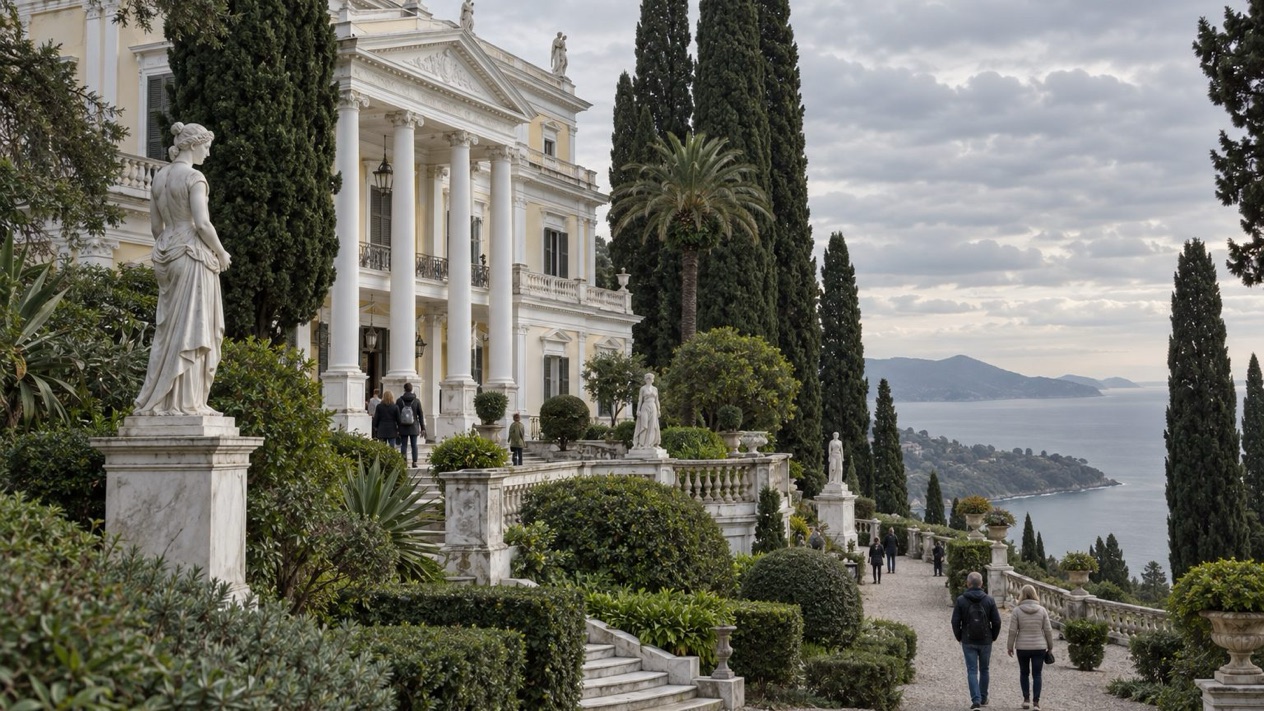
The Achilleion is a palace named after the hero Achilles of Greek mythology, and its motif centers on him. Statues and paintings of the warrior fill the gardens and rooms, so the visit feels like walking through a story. Pale walls, terraces and carefully tended gardens give the setting a stagey, romantic air.
The prize is the view. From the Achilleion there is a panoramic view of Corfu city to the north and the southern part of the island, framed by the Ionian Sea to the east. Bring a camera, and take time to stroll the terraces rather than hurrying through the rooms.
Mount Pantokrator
Mount Pantokrator is the highest point on Corfu, and from the top the whole island seems to unroll in front of you, with the sea on every side. The slopes carry old stone villages, olive groves and cypress trees, and the road up winds through several of them. Cafés in the villages are good places to stop for a coffee or a plate of something grilled.
A trip here suits anyone who wants a break from the beach and a different look at the island. The air on the heights can feel different from the coast, so a light layer is useful. Expect a mix of rocky ground and well-kept village squares, and wear shoes that suit both.
Sidari and the north coast
Sidari is a resort village on the northern part of Corfu, a community in the municipal unit of Esperies in the municipality of North Corfu. It has a lively seafront with tavernas, bars and shops, and it is the base for many north-coast excursions. Beach time, a stroll along the shore and a long dinner are the usual pleasures.
The north coast rewards a wander beyond the village too. Rocky headlands, small coves and olive-covered slopes line the road, and every few miles another cluster of houses appears. It is a day for stopping where you like, since the coastline offers many places to pause.
Smaller outings
A half-forgotten palace, a village church or a seaside lunch can make a satisfying outing too. Mon Repos and its wooded grounds, described above, sit just south of the town and combine easily with a coffee in the Old Town. Palaiokastritsa and Agios Gordios, on the west side of the island, work well as full beach days.
What to eat in Corfu
Corfu’s table has a flavor of its own, shaped by the Ionian Sea, the olive groves and the long years of Venetian influence. Spices appear in places where a mainland Greek menu would not use them, and the sauces are often rich and red. A meal here feels related to the food in the rest of Greece, but with a distinct accent.
Island dishes
Pastitsada is the dish people connect with Corfu: pasta, usually with rooster or beef, in a spiced tomato sauce that smells of cinnamon and cloves. It is a Sunday kind of dish, served in hearty portions. Sofrito is another local favorite, thin slices of veal cooked in white wine, garlic and vinegar until tender, and often served with potatoes or rice.
Bourdeto is a peppery fish stew, rich with red pepper and tomato, and a good one leaves your lips tingling. Look too for savory pies, grilled octopus, fried small fish and the usual Greek meze plates of tzatziki, grilled vegetables and olives. Moussaka, souvlaki and gyros appear everywhere on the island, in tavernas and snack shops alike.
Drinks and sweets
Corfu is known for its kumquat. The small orange fruit appears as a liqueur, in jars of preserves and in candied form, and shops in the Old Town sell all of it. A glass after dinner is a pleasant way to end a meal, and the sweet goes well with strong Greek coffee.
Ginger beer, called tsitsibira locally, is a legacy of the British years and still turns up on café menus, especially around the Liston. Ouzo and local wines appear in tavernas, and a cold Greek beer fits a day at the beach.
Where to sit down
Tavernas are the heart of eating on Corfu, from family-run places in village squares to seafront terraces in Palaiokastritsa, Agios Gordios and Sidari. In Corfu Town you find small restaurants in the lanes of the Old Town, cafés under the arcades of the Liston and bakeries selling pies and sweets. A kafenio, the traditional Greek coffee house, is the place to spend a long, slow morning.
Markets and food shops in the town sell olive oil, honey, herbs, cheese and local sweets, which make easy gifts. Pick up some kumquat preserves or a bottle of olive oil, and you carry a taste of the island home.
Things to do in Corfu at night
Evenings in Corfu start in Corfu Town, on the Liston, where people gather as lights come on under the arcades. Terraces fill with friends drinking coffee, wine or cocktails, and the long Spianada beside them becomes a place for strolling. The mood is relaxed, and it is as easy to spend the night over one long table as to move from bar to bar.
Evenings in the Old Town
Lanterns light the stone alleys, church towers stand out against the sky and small squares become open-air dining rooms, with tables spread under strings of lights.
The Old Fortress and the squares around Aghios Spyridon look striking when lit, and a night walk along the waterfront is a pleasure of its own. Music sometimes drifts from a café or a street corner, and on festival evenings the town’s brass bands may play on the Spianada.
Bars, music and late dinners
For a livelier night, Corfu Town has bars and clubs in the lanes behind the Liston, and the resort villages such as Sidari have seafront bars and music venues. Some tavernas have live Greek music, and in a few places you may hear bouzouki or guitar over dinner. Dinner itself tends to be a long affair, with dishes arriving in waves.
A cocktail at a rooftop or terrace bar, a glass of wine with a view of the fortress or a late plate of grilled fish by the sea are all easy ways to spend an evening. If you prefer a gentler night, a coffee and a sweet on the Liston do the job nicely.
Quiet evenings by the sea
Outside the town, evenings in Agios Gordios and Palaiokastritsa center on the water. Tavernas set tables near the shore, and the night revolves around grilled food, a bottle of local wine and the sound of the sea. These are good places to unwind after a beach day.
The hill villages on Mount Pantokrator have their own after-dark mood, with a handful of tavernas serving home-style dishes to a small crowd. If you drive, plan the return trip carefully on winding roads.
Things to do in Corfu with kids
Children find plenty to do in Corfu, from clambering around a fortress to splashing at the beach and eating ice cream on the Spianada. The island works best when you balance sightseeing with beach time, and pack in a snack or two for the stretches in between.
Castles, parks and palaces
The Old Fortress is the obvious hit with kids. Stone gates, ramparts and passages invite exploring, and the high terraces give them a sense of looking down on the whole town. The Spianada beside it has wide lawns and shade trees, so there is space to run around and a place for a snack after the climb.
The grounds of Mon Repos, among the trees of Palaeopolis, offer another outing, with wooded paths and a house that holds a museum. At the Achilleion, statues of heroes and the story of Achilles give older children a way into Greek mythology, while the terraces provide room to move.
Museums with something to see
A few of Corfu’s museums suit curious children. The Museum of Asian Art fills its rooms with a large collection of objects from far-off places, which makes for a good treasure hunt.
The Banknote Museum, in Aghios Spyridon square, is small and unusual, and it is a fun way to see how Greek money changed over the years until the euro arrived in 2002. Keep museum visits short and mix them with outdoor time.
Beach days and things to keep in mind
Beach days are the heart of a family stay. Palaiokastritsa, Agios Gordios and Sidari all have villages behind the shore where you can find lunch and ice cream. Check the water on arrival, since conditions change, and keep an eye on younger children near the edge. Sun hats, sunscreen and plenty of water are worth packing for every outing.
Distances on Corfu add up, since the island is long and the roads wind through hills. Plan one main outing a day and leave room for rest. Stone-paved lanes in the Old Town can be hard on strollers, so a carrier may be easier there.
Good to know before you go
Corfu is the northernmost of the Ionian Islands, off the far northwest coast of Greece, and Corfu Airport ‘Ioannis Kapodistrias’ receives flights from Athens in 1 hour 15 minutes and from Thessaloniki in 55 minutes. Greece uses the euro.
The island is long and narrow, with the main town on one side and villages and beaches scattered along its length, so plan your days by area rather than trying to cover everything at once. Summer heat is a fact of life on the coast, so build in shade breaks and plenty of water.
Sources
- Corfu official tourism site (https://www.corfu.gr/), checked October 12, 2026
- Visit Greece (GNTO), Corfu (https://www.visitgreece.gr/islands/ionian-islands/corfu/), checked October 12, 2026
- Wikipedia, Corfu (city) (https://en.wikipedia.org/wiki/Corfu_(city)), checked October 12, 2026
- Wikivoyage, Corfu (https://en.wikivoyage.org/wiki/Corfu), checked October 12, 2026
- Wikipedia, Corfu, section Archaeology (https://en.wikipedia.org/wiki/Corfu#Archaeology), checked October 12, 2026
- Wikipedia, Corfu, section Culture (https://en.wikipedia.org/wiki/Corfu#Culture), checked October 12, 2026
- Wikipedia, Old Fortress of Corfu (https://en.wikipedia.org/wiki/Old_Fortress_of_Corfu), checked October 12, 2026
- Wikipedia, Achilleion (Corfu) (https://en.wikipedia.org/wiki/Achilleion_(Corfu)), checked October 12, 2026
- Wikipedia, Mon Repos, Corfu (https://en.wikipedia.org/wiki/Mon_Repos,_Corfu), checked October 12, 2026
- Wikipedia, Liston (Corfu) (https://en.wikipedia.org/wiki/Liston_(Corfu)), checked October 12, 2026
- Wikipedia, Agios Gordios (https://en.wikipedia.org/wiki/Agios_Gordios), checked October 12, 2026
- Wikipedia, Sidari (https://en.wikipedia.org/wiki/Sidari), checked October 12, 2026
- Wikipedia, Paleokastritsa (https://en.wikipedia.org/wiki/Paleokastritsa), checked October 12, 2026