
Pine resin hangs in the air, cicadas drone from the trees, and a path through the needles drops suddenly onto a small cove where the water is the color of bottle glass. Halkidiki is the part of northern Greece that people go to for exactly this: long beach days, grilled fish at a table by the sand, and evenings that stretch late.
Where is Halkidiki and what is it like?
Halkidiki is a wide peninsula of northern Greece that extends east of Thessaloniki into the Aegean Sea, and it is a summer beach region of resorts, pine forests and fishing villages. On a map it looks like a trident or a three-fingered hand, and the name of each finger tells you what kind of trip you are choosing: Kassandra, Sithonia and Mount Athos.
Kassandra is the most developed and the most cosmopolitan of the fingers. It has sandy beaches, resorts and a reputation for nightlife, and its beaches and scenic villages are beautiful, though crowded. If your idea of a vacation includes a beach bar, a lively promenade and a choice of restaurants every evening, this is where you will feel at home.
Sithonia, the middle finger, lies between Kassandra and the Mount Athos peninsula. It is less developed, with secluded coves, pine-covered landscapes and a name for pristine nature and beaches. The pace is slower and the days are organized around where you will swim next and where you will eat afterward. Travelers who need a busy scene every night may find it too low-key.
Mount Athos, the easternmost finger, is a different world altogether. It is an autonomous monastic state, and entry is allowed only to men with a special permit called a diamonitirion. For everyone else it stays a presence on the horizon and a sight from the water.
The administrative capital of the region is the town of Polygyros, while the largest town is Nea Moudania. Both are working towns more than resorts, useful to know when you want a market, a pharmacy or a taste of everyday Greek life between beach days.
What is there to do in Halkidiki?
The big reasons to come are the beaches, the contrast between the peninsulas, a handful of ancient and natural sights, and a look at Mount Athos from a distance. What sets Halkidiki apart is that one region lets you choose between a lively resort coast and wild, forested shoreline, and between swimming days and a little history.
Beaches and coves of Kassandra and Sithonia
Kassandra has the sandy stretches, set beside resorts and beach clubs, with sunbeds, music and restaurants at hand. Its beaches draw crowds, which suits anyone who likes company and a bit of buzz. The villages behind them give you somewhere pleasant to wander once you have had enough sun.
Sithonia offers the opposite mood: coves tucked into pine-covered hills, reached by winding rural roads. The pleasure here is exploring, stopping at a bay that looks promising and deciding whether to stay. Bring a rental car, since there are no direct bus routes between the Kassandra and Sithonia peninsulas.
A view of Mount Athos and a cruise around it
A spectacular view of Mount Athos can be had from the Kartalia cliff cape in Sithonia, where the mountain rises across the water. It is a good stop for photographs and for understanding the geography of the trident.
For a closer look, there are cruises from Ouranopolis that circle the Mount Athos peninsula, and from the boat you can see some of the monasteries. This is the way for women and for anyone without a permit to glimpse the monastic state. The monasteries appear along the shore, perched above the sea.
Ancient Olynthos and the Canal of Potidea
The excavations of ancient Olynthos produced the oldest mosaics found in Greece, dating to the 5th century BC. It is a site for those who like to see how an ancient town was laid out, with floors that still carry their patterns.
The Canal of Potidea separates the Kassandra peninsula from the mainland. A report from the 1st century AD already mentions it, and in 1407 the Byzantine Emperor repaired it and built fortifications on its south side. You cross it on the way into Kassandra, so it is worth noticing as you pass.
Petralona Cave and the villages
Petralona Cave lies about 22 miles south-east of Thessaloniki on the peninsula, a cool underground change from the beach. Combined with a meal in a village taverna, it makes a varied day when you want a break from the sea.
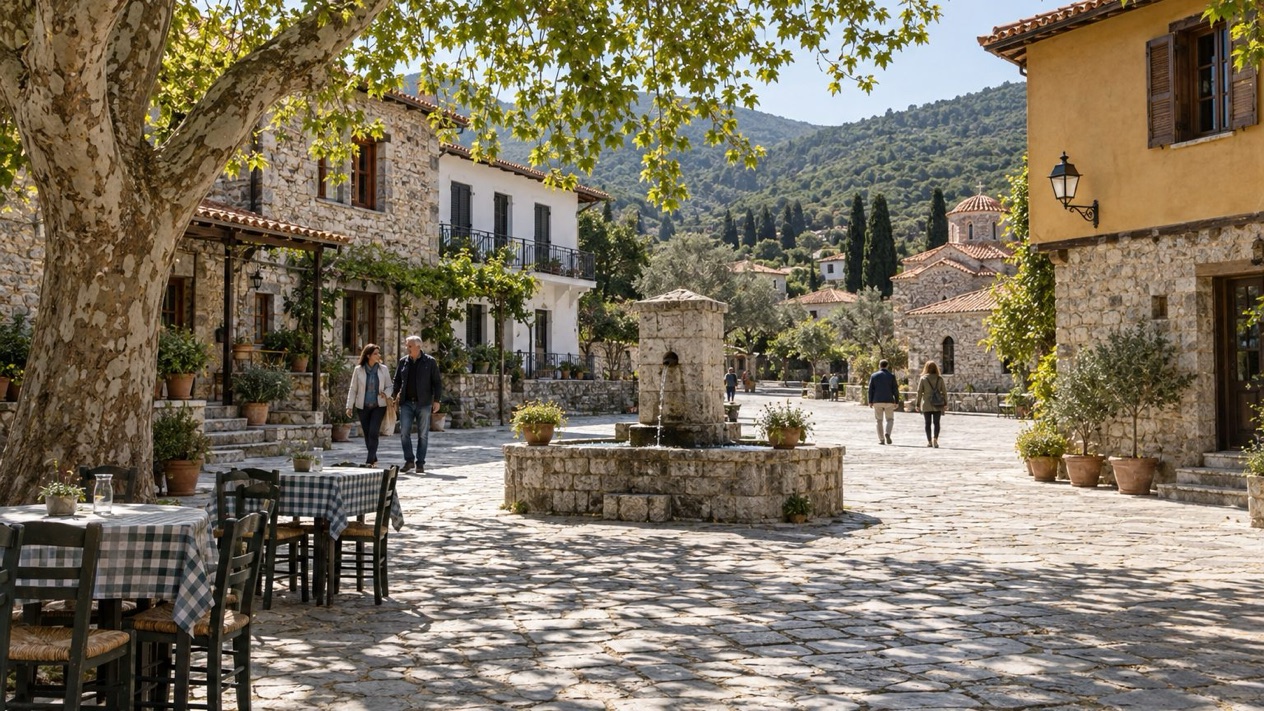
In the villages, think of local honey, olives, grilled octopus and glasses of tsipouro, the clear grape spirit that arrives with small plates of meze. A table under a plane tree is as good a sight as any on the list.
How many days do you need in Halkidiki?
Halkidiki rewards slow travel, so the more days you give it, the more coves, villages and long lunches you can fit in without rushing from one to the next.
With a short stay, pick a single base and stay put. If you choose Kassandra, you have beaches, restaurants and evenings out within easy reach of your hotel, and a day to cross the Canal of Potidea and explore its villages. If you choose Sithonia, you spend the days moving between coves along the coast road, with a stop at the Kartalia cliff cape for the view of Mount Athos.
With a week, divide your stay. Spend some nights on Kassandra for the beaches and nightlife, then drive to Sithonia for the quieter shoreline. Because no direct bus runs between the two peninsulas, plan the move by car, and let it take the time it takes, with a beach stop on the way.
Add an outing to Ouranopolis for the cruise that circles the Mount Athos peninsula, one of the few ways to see the monasteries from the sea. Add a visit to the excavations at ancient Olynthos for the mosaics, and a stop at Petralona Cave, which makes a good counterpoint to a week of salt water.
Polygyros, the regional capital, and Nea Moudania, the largest town, are practical stops for errands and for a meal away from the beach scene. Thessaloniki, east of which the peninsula stretches, bookends the trip at either end, so a night or two there before or after the beaches fits naturally.
Where to stay in Halkidiki
The main choice is between Kassandra and Sithonia, and it comes down to how you like your vacation evenings. Staying here puts you in the most developed leg of the peninsula, where the infrastructure for a beach vacation is most abundant.
Sithonia suits those who would rather wake up near pine woods and a hidden cove. It is less developed than Kassandra, known for pristine nature and beaches, and its wilder character shows in the shoreline and the landscape behind it. Couples, hikers of the coast roads and anyone looking to switch off will find the slower rhythm a relief.
Mount Athos is not a place to stay for visitors, since entry is limited to male pilgrims with a diamonitirion who intend to visit the monasteries. Ouranopolis, from which cruises circle the peninsula, is the base for seeing it from the water instead.
If you are traveling by bus, Kassandra is the more practical base, since its destinations are generally better served than those in the rest of the peninsula. If you have a car, any of the three areas opens up, and Sithonia becomes much easier to explore, given that some bus routes there are significantly slower than driving.
A split stay is a good compromise: a few nights in Kassandra for the beach scene, then a few in Sithonia for the coves. That way you get both moods of Halkidiki without committing to one.
How do you get to Halkidiki and get around?
You reach Halkidiki from Thessaloniki, the city west of the peninsula, either by bus or by car. KTEL Chalkidikis operates buses from Thessaloniki to destinations all across Chalkidiki, and the buses are modern and clean. Destinations in Kassandra are generally better served than those in the rest of the peninsula.
A bus trip from Thessaloniki to Toroni takes 3 hours, while the same trip by car takes 1.5 to 2 hours. That gap shows up across Sithonia, where some bus routes are significantly slower than traveling by car.
Once you are there, a car provides the easiest way of getting around Chalkidiki. The road network mostly comprises rural roads in acceptable condition, which suit a trip that is about reaching coves and villages rather than ticking off big sights. Drivers should not get carried away by people speeding or performing illegal overtakes.
Buses are possible but limited. KTEL Chalkidikis runs routes between destinations in the region, but the number of departures might be limited and buses can often be late, which makes them inconvenient for day trips further away. There are no direct bus routes connecting Kassandra and Sithonia, so exploring more than one peninsula by bus is not ideal.
On the water, the cruises from Ouranopolis that circle the Mount Athos peninsula are the boat trip to know. They let you see some of the monasteries from the sea, a view otherwise reserved for male pilgrims who have a permit.
When is the best time to visit Halkidiki?
Summer is the season Halkidiki is built for, since it is a popular summer tourist destination in Central Macedonia. That is when the beach clubs of Kassandra, its nightlife and its resort life are in full swing, and when a day on a Sithonia cove is the whole point of the trip.
Summer is also when Kassandra’s beaches are most crowded, so the choice of peninsula matters more than the choice of week. If you want company and energy, Kassandra delivers it. If you would rather have space, Sithonia, less developed and known for pristine nature, gives you more room to spread out.
Outside the summer months, the draw shifts from the sea to everything else: the drive along the rural roads through pine-covered hills, the excavations at ancient Olynthos, Petralona Cave, the view of Mount Athos from the Kartalia cliff cape and meals in the villages and towns such as Polygyros and Nea Moudania. These sights do not depend on beach weather, though the beach scene itself belongs to summer.
Whatever the month, plan around the car. With limited bus departures and no direct link between Kassandra and Sithonia, having your own wheels gives you the freedom to chase a good light on a cove or a late lunch in a hill village.
Good to know before you go
Halkidiki is a place to drive carefully: the roads are mostly rural and in acceptable condition, and drivers should not get carried away by people speeding or performing illegal overtakes. Mount Athos remains closed to women and to men without a diamonitirion, so plan a cruise from Ouranopolis if you want to see the monasteries. Keep the whole trip loose, since the best of the peninsula is found by wandering from cove to village at your own pace.
Sources
- Visit Greece (GNTO), Halkidiki (https://www.visitgreece.gr/mainland/macedonia/halkidiki/), checked October 12, 2026
- Wikipedia, Halkidiki (https://en.wikipedia.org/wiki/Halkidiki), checked October 12, 2026
- Wikivoyage, Halkidiki (https://en.wikivoyage.org/wiki/Halkidiki), checked October 12, 2026
- Wikipedia, Petralona cave (https://en.wikipedia.org/wiki/Petralona_cave), checked October 12, 2026
- Wikipedia, Sithonia (https://en.wikipedia.org/wiki/Sithonia), checked October 12, 2026