
TROY SPRING, FLORIDA · MAY · THE MONTH GUIDE
Troy Spring in May gives you the contrast people drive north Florida’s back roads for: afternoons averaging 86.7°F over water that read 71.4°F the last time the USGS gauge in the spring was checked. That is roughly fifteen degrees of shock on the first step in, and in May you want every one of them.
What the month takes away is your margin for error on a Saturday. The state counts 25 parking spaces at Troy Spring State Park, and when the lot fills, the gate closes. Anything not dated by the month (how you reach the spring, where you sleep, what a Florida week runs) lives in our getting-around guide and our trip-cost guide.
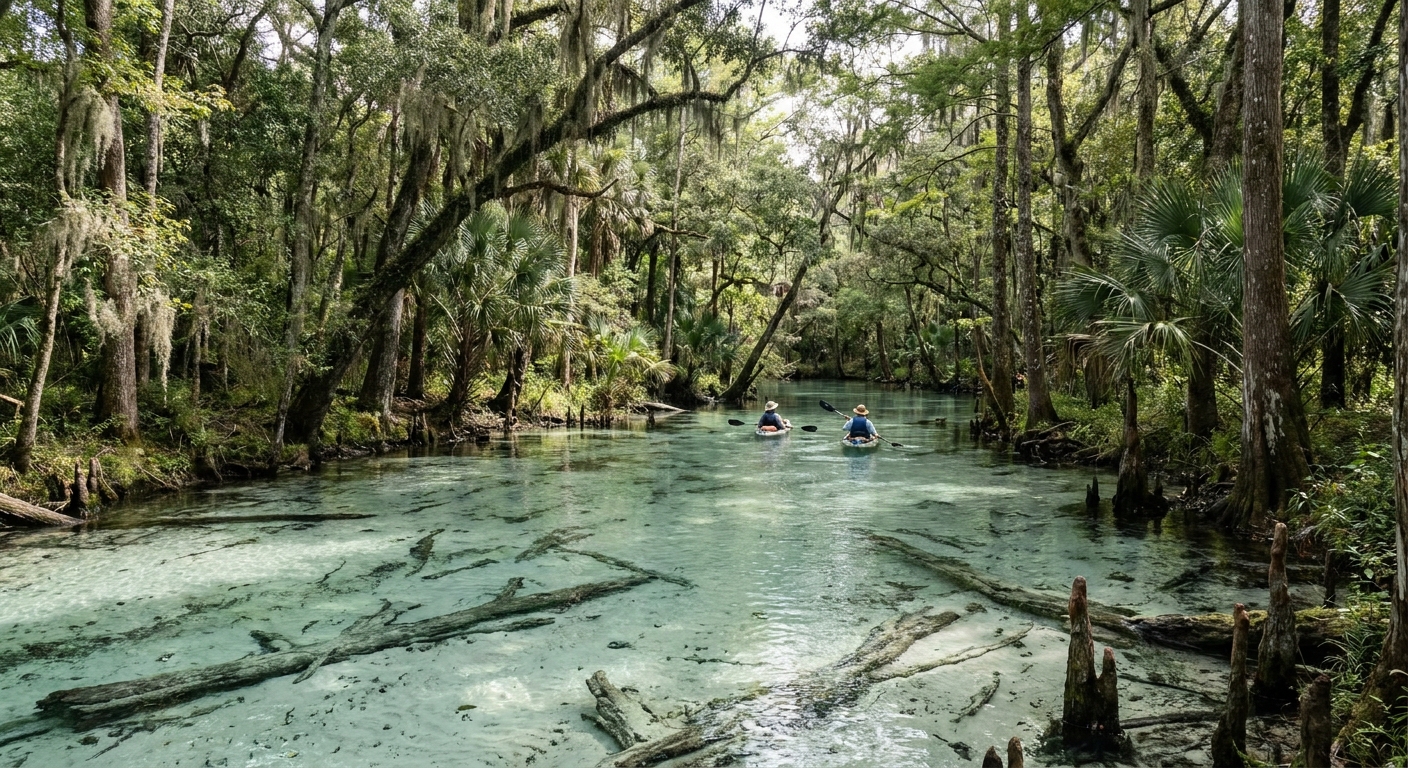
THE MONTH AT A GLANCE · TROY SPRING · MAY
May pairs 86.7°F afternoons with 71.4°F spring water and just 2.74 inches of rain, which makes it the last easy month before June’s 7.00 inches.
AIR 86.7°F / 62.7°F · WATER 71.4°F · 4.7 WET DAYS · 25 PARKING SPACES
Go for: cold-water swimming with warm air above it, 4.7 wet days instead of June’s 9.1, and light until 8:20 p.m.
Think twice before: driving up on a Saturday afternoon: 25 spaces is the whole lot, and the gate closes when it fills.
Air: NOAA NCEI 1991-2020, Cross City AP · Water: USGS gauge 02320250 · Counts: Florida DEP 2024 inventory
On this page
- Troy Spring weather in May86.7°F highs, 62.7°F lows, 4.7 wet days
- Morning and afternoon temperaturesA 24-degree swing, and what to pack
- Parking and the busiest days25 spaces, and the hour to arrive
- Things to do at Troy SpringOne swim area, 0.7 miles of trail, one launch
- A two-day plan for Troy SpringHour by hour, from 6:36 a.m.
- May, April or JuneThe three months compared with figures
- Is May worth it?Yes for swimmers, no for hikers
Two thermometers matter here, and they sit 27 miles apart. The air normals below come from the airport at Cross City. The water figure comes from a gauge in the spring itself, and the two behave nothing alike: the spring holds near 71.4°F all year while the air swings 24 degrees between dawn and mid-afternoon.
Troy Spring weather in May: average highs, lows and rain days
| May at Troy Spring | Figure |
|---|---|
| Average high | 86.7°F |
| Average low | 62.7°F |
| Precipitation | 2.74 in |
| Days with 0.10 in or more | 4.7 |
| Days with 1.00 in or more | 0.9 |
| Daylight, May 15 | 13h 43m · 6:36 a.m. to 8:20 p.m. |
| Spring water | 71.4°F (21.9°C), gauge reading of Sept 11, 2026 |
Every air figure here comes from one thermometer: NOAA’s 1991-2020 monthly normals for station USW00012833 at Cross City AP, about 27 miles (44 km) from the spring. Those normals put May at an average high of 86.7°F and an average low of 62.7°F, with 2.74 inches of rain over the month. They describe the air above an airfield, not the basin under the cypress. The water is measured separately, by a USGS gauge at the spring itself.
Measurable rain shows up on 4.7 days in an average May, or about one day in six. The other twenty-six days come up dry in the record, and the month’s 2.74 inches falls mostly on that small handful of afternoons. For a trip whose core is two or three hours in the water, those odds are forgiving: lose one afternoon and the rest of a long weekend still stands.
That 86.7 and that 62.7 are 24.0 degrees apart, and the gap is felt at 7 a.m. rather than at noon. Pack for two climates in the same day: long sleeves and a towel that dries fast for the first swim, a hat and more water than you think for the walk back across the lot. Swim before nine and you climb out of 71.4°F water into air that may not have reached 70°F yet.
On May 15 the sun rises at 6:36 a.m. and sets at 8:20 p.m. local time, 13 hours 43 minutes of daylight by the sunrise-sunset.org calculation. That buys a genuine second session. Heat peaks in mid-afternoon, and there are still hours of usable light after six for a paddle or a slow loop of the trail.
How warm is Troy Spring in May?
The month’s two poles are 86.7°F and 62.7°F. April sits lower at both ends, at 80.1°F and 55.0°F, and June squeezes its own gap down to 18.9 degrees because nights stop cooling below a 70.6°F average. May is the last of the three where the dawn is honestly cool and the afternoon is honestly hot.
In practice you dress twice. Long sleeves for the first hour, then nothing but swimwear and sunscreen from late morning on. Between 11 a.m. and 5 p.m. the shade of the hardwoods does more for you than any forecast, and the 15-degree drop into 71.4°F water changes character somewhere around noon: at eight it is a dare, at two it is the reason you came.
Nobody needs a frost plan. We found no count of freezing nights at Cross City for May in the normals we read, and against a normal low of 62.7°F a freeze would be a record-book curiosity rather than a packing decision. April’s 55.0°F normal low is the cold end of spring in this part of Florida.
How busy is Troy Spring in May? Crowds, prices and the busiest weekends
We found no occupancy series and no room-rate series for this stretch of north Florida, so we crown no month cheap and no month expensive. What we can date is the calendar around May: it falls after the spring-break weeks and before the summer school holidays. The constraint at the spring is physical rather than financial, and the Florida DEP’s 2024 facilities inventory names it: 25 parking spaces.
Twenty-five cars decides a warm Saturday faster than any booking window. The gate closes when the lot fills, and we could verify no reservation system that holds a space for you. Arrive in the morning, and take a weekday if your dates bend at all. Lodging is the part that rewards planning ahead, and our where-to-stay guide sorts the regions around it.
We could not verify a lodging-tax rate for the county, so we give no percentage. The park is the same story: on September 11, 2026 the Florida state parks site returned a 403 to our automated reads, so we carry no entrance fee and no opening hour for Troy Spring. Call the park before you build a number around it, and do not transfer a price quoted for some other Florida spring.
The one place money changes this month is flexibility. A cancellable weeknight room costs a little more than a locked-in Saturday, and it buys the right to slide the swim by a day when one of May’s 4.7 wet days lands on yours. The rest of the budget conversation sits in our trip-cost guide and, for the wider calendar, in the 12-month verdict.
Things to do in Troy Spring in May
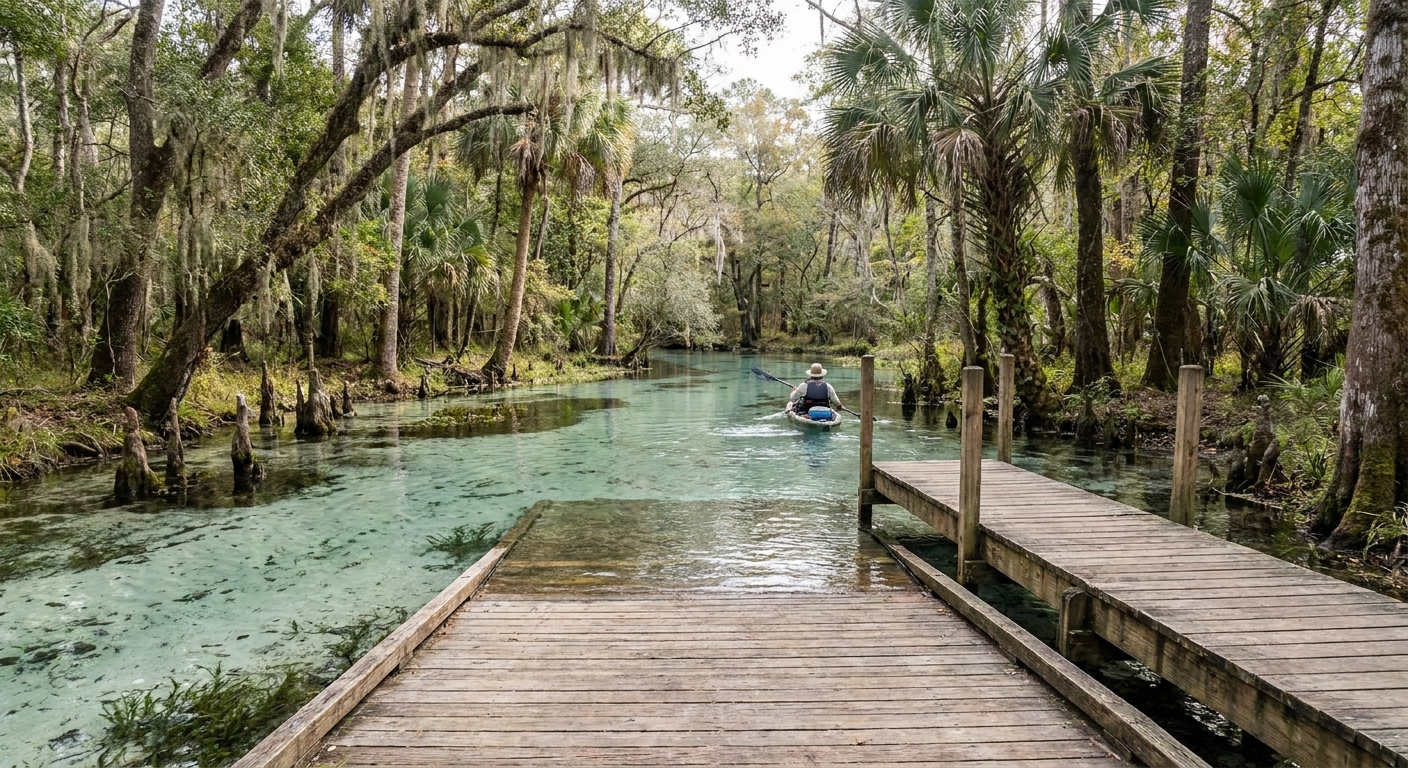
May is the month when the distance between the air and the water is wide enough to be fun and narrow enough to be bearable. April’s afternoon norm of 80.1°F sits only 8.7 degrees above the spring. June’s 89.5°F norm sits 18.1 degrees above it, but arrives with 7.00 inches of rain over 9.1 wet days. May splits the difference at 15.3 degrees and 2.74 inches.
The state’s inventory counts what the park holds: one designated swimming area, one launch for canoes, kayaks and tubes, 0.4 miles of paddling trail, 0.3 miles of hiking trail, 50 feet of boardwalk and those 25 spaces. It is a small park and the count says so.
None of those counts move with the month, and neither does the water. The USGS gauge read 71.4°F (21.9°C) on September 11, 2026, a single instantaneous reading rather than a monthly average, and the agency notes it reads close to that every day of the year. The air above it is the variable. The same 0.3-mile trail that is a pleasure at seven under a 62.7°F dawn becomes a sweaty errand at three under 86.7°F.
We cannot call anything here free, because no gate price was readable in September 2026 and the park may well charge. What the inventory does show is that no rental counter is counted at the launch, so bring your own tube, board or boat for the 0.4-mile paddling trail. Manatees are another blank: the FWC page that would carry counts renders client-side and we could not read it, so start with our manatee guide instead.
Troy Spring in May: a two-day itinerary
Day one runs on the light. Sunrise at 6:36 a.m. lets you drive in the cool and reach the gate early, which matters when 25 spaces are the entire capacity. Swim between roughly nine and eleven, once the air has pushed past 70°F but before the lot is full. Walk the 0.3-mile trail before noon, take the 0.4-mile paddling trail in the late afternoon, and stay through the soft light toward the 8:20 p.m. sunset.
Day two is shorter by design: a second swim at the same hour, then the road onward, because 0.7 miles of trail in total will not fill two full days. If rain lands on one of May’s 4.7 wet days, the swim itself is untouched and the walking is not, so move the paddle to the morning and leave the afternoon open. Our getting-around guide has the drive times.
Troy Spring in May vs April and June
| Measure | April | May | June |
|---|---|---|---|
| Average high | 80.1°F | 86.7°F | 89.5°F |
| Average low | 55.0°F | 62.7°F | 70.6°F |
| Precipitation | 2.90 in | 2.74 in | 7.00 in |
| Days with 0.10 in or more | 4.1 | 4.7 | 9.1 |
| Spring water | No seasonal swing | 71.4°F, one gauge reading | No seasonal swing |
| Afternoon air above the water | 8.7°F | 15.3°F | 18.1°F |
Line the three up and the heat climbs steadily while the rain waits for June. Highs run 80.1, 86.7 and 89.5°F. Lows climb faster still, from 55.0 to 62.7 to 70.6°F. Rainfall barely shifts between April and May, 2.90 inches against 2.74, then more than doubles into June’s 7.00 inches across 9.1 wet days. Across all three months the water stays near 71.4°F on the single USGS reading we hold.
Shift four weeks earlier and you gain a cooler, quieter park while losing 6.6 degrees of afternoon warmth, which is exactly the warmth that makes cold water feel like a good idea. Shift four weeks later and you gain 2.8 degrees at the top and much milder dawns, at a cost of 4.26 extra inches of rain and 4.4 more wet days than May.
Is May a good time to visit Troy Spring?
Yes, if the trip is built around getting in the water. An 86.7°F afternoon turns a 71.4°F spring into a reward, and at 2.74 inches May is drier than both neighbors. No, if you want a park to fill your days: one swimming area, 0.7 miles of trail and 50 feet of boardwalk make a half-day, and stretching that into a week would be an unhappy piece of arithmetic.
If the answer is no, take April instead, with 80.1°F afternoons, 55.0°F nights, 4.1 wet days and an easier run at those 25 spaces. Our April page has the detail. June buys warmer mornings at 70.6°F and charges 7.00 inches of rain over 9.1 days for them.
What May holds that neither neighbor does: a 15.3-degree drop from the afternoon air into the spring, on a month that still keeps its rainfall under three inches.
The last word
Decide the hour rather than the month. May at Troy Spring is a morning trip with a long, bright afternoon attached, and the surest way to spoil it is to roll up at two o’clock behind 25 parked cars. One figure we have not spent yet: an average May logs 0.9 of a day at an inch or more of rain, so nearly every May hands out one real soaking. Pick a weekday, leave in the dark, bring your own tube.
Sources & data for this guide
- May air normals, rain days and the April and June figures · NOAA NCEI monthly normals 1991-2020, station USW00012833, Cross City AP, FL, about 27 miles (44 km) from the spring · checked Sep 24, 2026
- Daylight, sunrise and sunset for May 15 · sunrise-sunset.org, converted to local time · checked Sep 24, 2026
- Spring water at 71.4°F (21.9°C), one instantaneous reading · U.S. Geological Survey, National Water Information System, station 02320250 Troy Spring · checked Sep 24, 2026
- Parking spaces, swimming area, launch, paddling and hiking trail lengths, boardwalk · Florida Department of Environmental Protection, Recreational Facilities Inventory, 2024 annual report · checked Sep 24, 2026
- Outstanding Florida Springs definition · Florida Statutes 373.802(5) · checked Sep 24, 2026
- We could not read an entrance fee, an opening hour or a manatee count: floridastateparks.org returned a 403 to automated reads and the FWC manatee page renders client-side on Sept 11, 2026. Call the park before you budget.