
SILVER SPRINGS · FLORIDA · BEST TIME TO VISIT
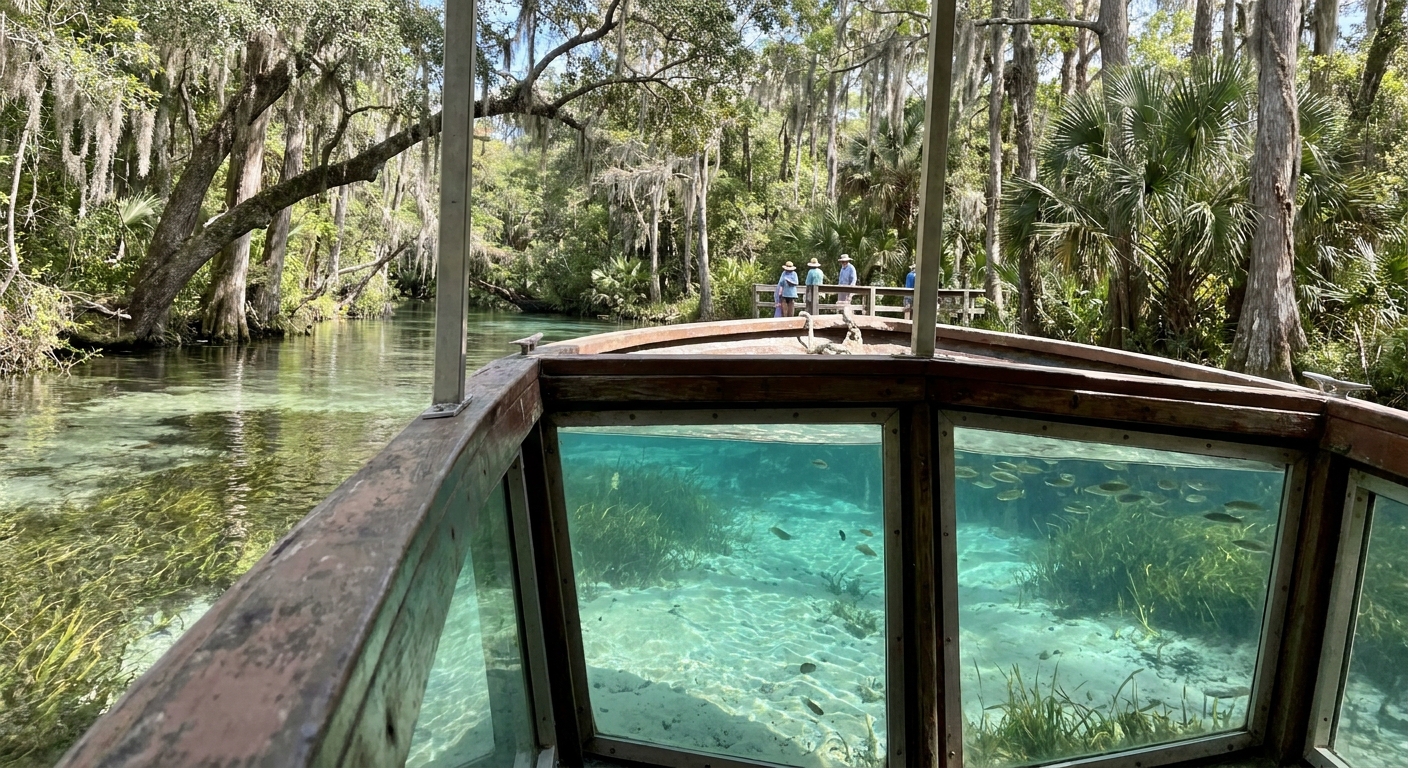
Silver Springs sells one thing above everything else: water clear enough that the boats have glass floors. The spring rises out of the aquifer at a temperature the calendar barely touches, so the month you pick does not change the swim, the paddle or the view down through the eelgrass. It changes the air around all three, and the air in this corner of central Florida moves a lot: the average high climbs from 69.9°F in January to 91.7°F in August.
So the real choice is what you want wrapped around the water. April gives 82.7°F afternoons and under four wet days. August gives 91.7°F and more than ten. Both trips work, both are worth the drive, and they are not the same vacation to book, pack or plan a day around.
THE YEAR AT A GLANCE · SILVER SPRINGS
April is the pick for most travelers: 82.7°F afternoons, 2.04 inches of rain and a spring that feels in April exactly as it does in July, minus July’s storms.
BEST: APRIL · QUIETEST: SEPTEMBER & EARLY DECEMBER · AIR NORMALS MEASURED 44 KM AWAY
Go for: a spring whose temperature ignores the calendar, spring-season afternoons at 82.7°F, and an easy day or overnight out of Ocala on a wider Florida drive.
Think twice before: booking June through August for outdoor time beyond the water: 10.4 to 10.7 wet days a month and nights that average 73.1°F to 75.0°F.
Air normals: NOAA NCEI 1991-2020, Leesburg Muni AP · Daylight: sunrise-sunset.org · full sources at the end
On this page
- The best month, with numbersApril: 82.7°F and 2.04 inches
- Summer heat at the springJune to August, highs near 91°F
- Quiet weeks without school crowdsSeptember and early December
- The month to skipAugust: 6.63 inches over 10.4 days
- Shoulder months worth the driveApril against late October
- Rain and temperature month by monthAll twelve months in one table
Most people see Silver Springs on a day trip: fly into Orlando or Jacksonville, collect the rental car, drive up to Ocala for the morning boats. One night in town turns it into a weekend with the Silver River paddle and the state park trails attached, and it slots neatly into a wider Florida drive. Either version books the same way. What the season decides is the air, the daylight and the company you share the boardwalk with.
Silver Springs weather month by month: highs, lows and rainfall
| Month | Avg high | Avg low | Rain | Days ≥ 0.10 in |
|---|---|---|---|---|
| January | 69.9°F | 48.9°F | 2.51 in | 3.9 |
| February | 73.3°F | 52.0°F | 2.08 in | 4.0 |
| March | 77.3°F | 56.0°F | 3.22 in | 3.8 |
| April | 82.7°F | 61.7°F | 2.04 in | 3.9 |
| May | 88.1°F | 67.7°F | 2.68 in | 4.1 |
| June | 90.7°F | 73.1°F | 6.98 in | 10.7 |
| July | 91.1°F | 74.9°F | 5.88 in | 10.7 |
| August | 91.7°F | 75.0°F | 6.63 in | 10.4 |
| September | 89.7°F | 73.1°F | 5.21 in | 8.1 |
| October | 84.5°F | 66.1°F | 2.62 in | 4.0 |
| November | 77.3°F | 57.1°F | 1.76 in | 2.5 |
| December | 72.4°F | 52.0°F | 2.17 in | 3.6 |
From November through April the average high runs between 69.9°F and 82.7°F, rainfall between 1.76 and 3.22 inches, and wet days between 2.5 and 4.0 a month. From June through September every average high is 89.7°F or more and the rain multiplies: 6.98 inches in June, 6.63 in August, better than ten wet days in each of the three summer months. That is Florida’s dry season and its wet one, showing up in one spot in the interior.
May and October are the hinges. May still reads like spring at 2.68 inches over 4.1 wet days, then June lands with 6.98 inches over 10.7, a jump of 6.6 rainy days in four weeks. October runs the film backward: rainfall drops from September’s 5.21 inches to 2.62, wet days from 8.1 to 4.0, and the average low falls 7.0 degrees to 66.1°F. Nothing in between softens either turn.
August is the year’s heaviest lift for anyone planning a full day out of the water: 91.7°F afternoons, nights averaging 75.0°F, 6.63 inches of rain across 10.4 wet days and 1.7 days collecting an inch or more. Swimmers feel none of that. At the other end, January stays mild by northern standards but bites at dawn: 48.9°F average lows, 1.4 nights a year at or below freezing, and 10 hours 31 minutes of daylight on the 15th.
Every figure here comes from NOAA’s 1991-2020 monthly normals, measured at Leesburg Muni AP, about 44 km (27 miles) from the spring. Those normals describe the air. The spring itself has no season, and we hold no long-run water-temperature series to print beside the air numbers, so none is quoted. A normal is a thirty-year average too, meaning a single April week can land warmer, colder or far wetter than any of these averages.
When is the best time to visit Silver Springs?
April, and for a first visit it is not close. Afternoons average 82.7°F, warm enough that the constant spring water reads as relief rather than shock, and the month brings 2.04 inches of rain over 3.9 wet days, the second-lowest rainfall total of the year behind November’s 1.76 inches. Daylight runs 12 hours 56 minutes in mid-month: a morning on the boats, lunch, and an afternoon on the trails still fits before the light goes.
May is the tempting neighbor and it charges at both ends. Highs climb 5.4 degrees to 88.1°F, nights hold at 67.7°F instead of April’s 61.7°F, and rain rises to 2.68 inches. March pulls the other way: 77.3°F afternoons are fine for walking and thin for swimming, and at 3.22 inches March is the wettest month of the entire dry half. April carries the lowest rainfall of those three.
One timing caveat inside April: spring-break weeks are the busiest stretch of the Florida spring, so a weekday arrival in the second half of the month buys back most of the quiet. For how April stacks up against the other eleven months across the peninsula, see our statewide calendar, and for the drive up from the theme parks or down from Jacksonville, getting around Florida covers the car, the tolls and the parking layer.
How hot does Silver Springs get in summer?
June, July and August average 90.7°F, 91.1°F and 91.7°F, and the nights barely retreat: average lows of 73.1°F, 74.9°F and 75.0°F. Mid-July still delivers 13 hours 52 minutes of daylight, so there is plenty of time to be hot in. Rain arrives as a daily habit rather than a washout, with 10.7 wet days in June and July, 10.4 in August, and only 1.7 July days collecting an inch or more.
Humidity is the gap in the record. The monthly normals we hold give temperature and precipitation, not dew point or heat index, so 91.1°F at Leesburg understates what the walk from the parking lot to the water feels like in July. The near-daily afternoon thunderstorm pattern across the wet season is documented by the National Weather Service and summarized in our state calendar. Book the boat ride and the paddle for the morning, and give the afternoon to the water.
When is Silver Springs quietest?
The quiet weeks follow the school calendar. Late August and September, once classes restart across Florida and Georgia, empty the weekdays out. The first three weeks of December sit in the same hollow before the holidays fill it. Mid-January into early February makes a third pocket, once New Year has passed and outside the Presidents’ Day weekend. None of those windows is about weather, which is why one of them is hot and another one is cold.
A September weekday puts you on a glass-bottom boat without the weekend line, and the swimming is identical to April’s, since the spring is unchanged by the calendar. September afternoons still average 89.7°F, so the contrast between air and water is at its strongest of the year, and mid-month daylight of 12 hours 22 minutes is only 34 minutes short of April’s 12 hours 56.
September also carries 5.21 inches over 8.1 wet days and sits inside the Atlantic hurricane season, June 1 to November 30, with the statistical peak around September 10 (the storm detail lives in our statewide calendar). The January pocket charges daylight instead: 10 hours 31 minutes on the 15th, plus 1.4 nights a year at or below freezing. And we carry no price or attendance series for the park, so treat all three as crowd windows rather than discounts.
Which month should you avoid at Silver Springs?
August, and it matters a great deal who you are. A family planning trail time, a picnic and a full day outdoors faces 91.7°F afternoons, 75.0°F nights and 10.4 wet days, which adds up to a lot of retreating to the car. Anyone intending to spend the visit in the water notices almost none of it. The group with no case at all: photographers hoping for clear skies, against 6.63 inches, the year’s second-highest total after June’s 6.98.
What redeems August is the contrast itself. Air at 91.7°F beside a spring that holds its temperature through the year is the strongest argument anywhere for a Florida spring over a Florida beach, and 13 hours 13 minutes of mid-month daylight leaves the evening usable once the storms clear out. If school dates fix the trip to August, start at opening, swim through the middle of the day, and keep the indoor options listed in our Florida with kids guide within reach.
Is the shoulder season worth it at Silver Springs?
April and late October are the two shoulders, and the gap to midsummer is wide on both. April’s 82.7°F average high runs 8.4 degrees below July’s 91.1°F, and its 3.9 wet days are 6.8 fewer than July’s 10.7. October’s 84.5°F sits 7.2 degrees under August’s 91.7°F, with 4.0 wet days against 10.4. Rainfall tells the same story: 2.04 and 2.62 inches against 5.88 and 6.63.
Rain in April and October falls on roughly four days a month, so an afternoon plan survives contact with the sky. A 2 p.m. walk on the boardwalk stays a walk. October nights averaging 66.1°F make dinner outside in Ocala pleasant rather than sticky, and with schools in session the weekday parking lot and the boat dock both thin out.
Mid-October gives 11 hours 30 minutes of daylight, against 14 hours 03 minutes in mid-June, so a late paddle on the Silver River ends well before dinner. Mornings start cooler too: an average low of 66.1°F in October, 61.7°F in April, cool enough that the first swim of the day wants a towel and a patch of sun afterward. November drops further, to 57.1°F lows and 10 hours 43 minutes of light.
Split it this way. Take April if the visit is built around water and long days: 12 hours 56 minutes of daylight and 2.04 inches of rain. Take the last ten days of October if it is built around paddling, trails and elbow room, accepting 1 hour 26 minutes less daylight for warmer afternoons at 84.5°F and warmer nights at 66.1°F. Neither month asks you to plan around the weather twice.
The last word
Book April and stop refreshing the forecast. If April is already spoken for, February is the quiet alternative nobody puts on a shortlist: 73.3°F afternoons, 2.08 inches of rain across 4.0 days, 11 hours 13 minutes of daylight by the 15th, and just 0.5 nights at or below freezing against January’s 1.4. Whichever month wins, arrive at opening with a towel and a dry layer, because the water will feel the same and the parking lot will not.
Sources & data for this guide
- Monthly air normals 1991-2020 (highs, lows, precipitation, days at 0.10 inch and 1 inch, freeze nights) · NOAA NCEI, station USW00012819, Leesburg Muni AP, FL · checked Sep 12, 2026
- Daylight length, sunrise and sunset on the 15th of each month, converted to local time · sunrise-sunset.org · checked Sep 12, 2026
- Atlantic hurricane season dates and the September 10 statistical peak · NOAA National Hurricane Center, via our Florida calendar · checked Sep 12, 2026
- Wet-season afternoon thunderstorm pattern · National Weather Service, via our Florida calendar · checked Sep 12, 2026
- Scope note: the station sits about 44 km (27 miles) from the spring and measures the air. We found no long-run water-temperature series for Silver Springs to publish alongside, so no water figure is quoted here.
- Crowd windows (school terms, spring break, holiday weeks) are editorial. We carry no price or attendance series for the park. Boat schedules, hours and fees change · check the operator before you drive.