
FLORIDA · SILVER GLEN SPRINGS · 29.2° N
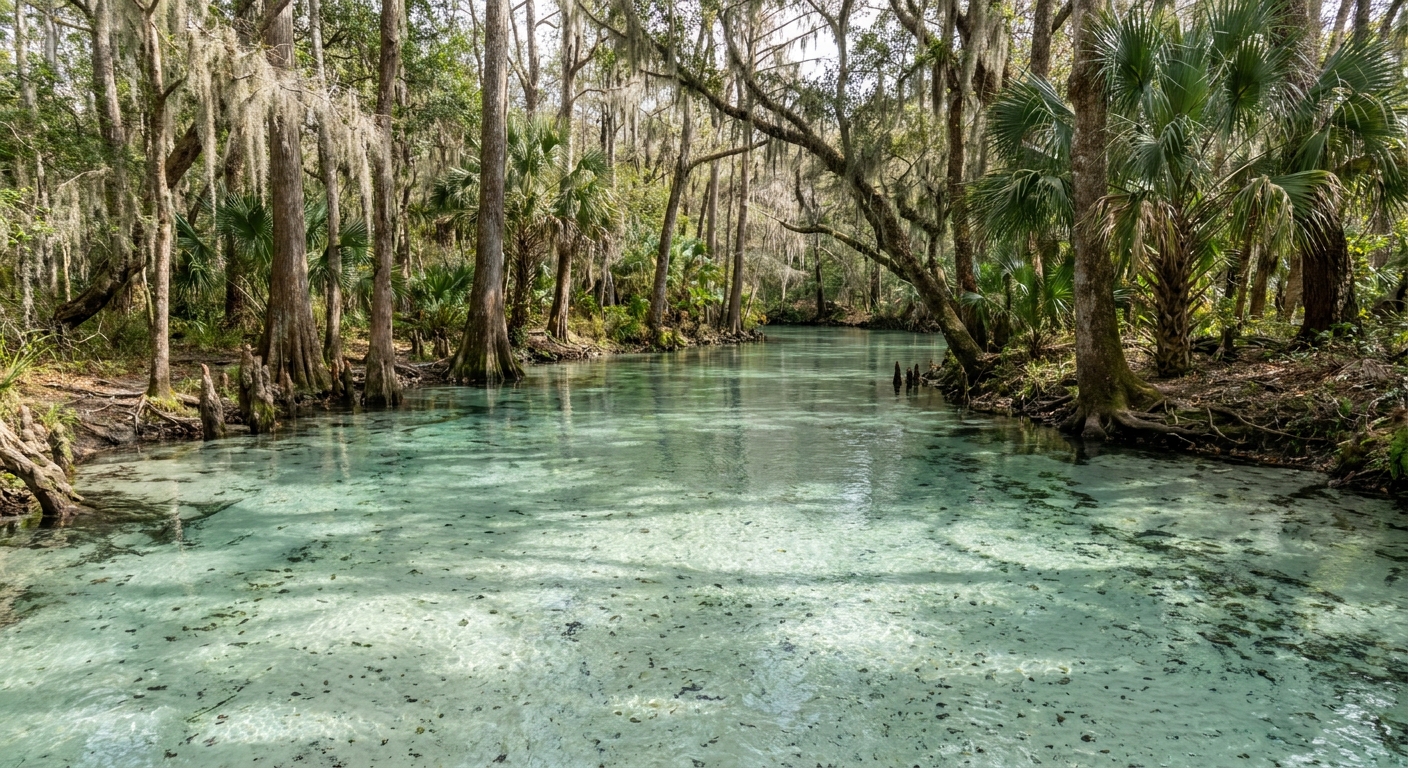
The spring run at Silver Glen empties into Lake George, and the water leaving the boil holds one temperature all year. That single fact reorganizes the trip. Choosing a month at this spring is a decision about the air you stand in when you climb out, the drive up from Orlando, and which weekends the rest of Florida has off school.
Between January and July, the average afternoon at the nearest long-record station climbs from 67.1°F to 91.1°F, and monthly rain goes from 3.29 inches to 6.68. Those swings decide whether the walk from the day-use lot is pleasant, whether your afternoon ends under a thunderstorm, and how much light is left for the drive home.
THE YEAR AT A GLANCE · SILVER GLEN SPRINGS
Go in April: 81.5°F afternoons, 3.8 days of measurable rain and 12 hours 56 minutes of light, over water that is the same in April as it is in August.
BEST MONTH: APRIL · WETTEST: JUNE, 7.56 IN · AIR NORMALS FROM A STATION 48 MILES AWAY
Go for: a swim that ignores the calendar, spring afternoons in the low 80s, and a forest stop that slots into a wider Florida drive without a second airport.
Think twice before: booking a June weekend around the water: 11.0 days of that month record 0.10 inch of rain or more, and 2.1 record a full inch.
January puts 6.2 nights at or below 32°F on the record. The water is unaffected. The towel walk back to the car is not.
Air normals: NOAA NCEI 1991-2020, Gainesville Rgnl AP · Daylight: sunrise-sunset.org · full sources at the end
On this page
- Twelve months of highs, lows and rainThe full table
- The best month to visitApril, 81.5°F and 3.8 wet days
- Summer heat and night temperaturesJune to August, above 90°F
- The quietest weeks of the yearJanuary and February, by the calendar
- The month to avoidJune, 7.56 inches of rain
- April or October for a shoulder tripApril, by 1 hour 26 minutes of daylight
Grading a spring by month comes down to air, rain and daylight, since the water underneath the swimmers does not vary. On those three terms the year at Silver Glen breaks into a long comfortable spring, a hot wet summer, a dry bright fall, and a winter that frosts a windshield more often than visitors expect.
Silver Glen Springs weather month by month: highs, lows and rainfall
| Month | Avg high | Avg low | Rain | Days ≥ 0.10 in | Daylight (15th) |
|---|---|---|---|---|---|
| January | 67.1°F | 42.6°F | 3.29 in | 5.2 | 10h31 |
| February | 70.9°F | 45.9°F | 2.67 in | 4.1 | 11h13 |
| March | 75.8°F | 49.7°F | 3.49 in | 5.3 | 12h02 |
| April | 81.5°F | 55.5°F | 2.74 in | 3.8 | 12h56 |
| May | 87.4°F | 62.6°F | 3.08 in | 4.5 | 13h40 |
| June | 90.3°F | 69.5°F | 7.56 in | 11.0 | 14h03 |
| July | 91.1°F | 71.6°F | 6.68 in | 10.5 | 13h52 |
| August | 90.5°F | 72.0°F | 6.40 in | 10.4 | 13h13 |
| September | 88.1°F | 69.4°F | 5.05 in | 6.9 | 12h22 |
| October | 82.1°F | 60.6°F | 2.68 in | 4.0 | 11h30 |
| November | 74.7°F | 50.6°F | 1.79 in | 3.0 | 10h43 |
| December | 69.3°F | 45.2°F | 2.88 in | 4.5 | 10h20 |
Eight months of the year sit between 1.79 and 3.49 inches of rain. Then June brings 7.56 inches across 11.0 days of measurable rain, with July at 6.68 and August at 6.40. Temperature moves far less than water does: the gap between the warmest and coolest average high is 24.0°F, while June carries nearly three times April’s rainfall.
May still reads like spring at 87.4°F with 4.5 wet days, and then June adds 2.9°F and 6.5 more days of rain. Going the other way, September’s 5.05 inches over 6.9 wet days still belongs to summer, and October drops to 2.68 inches over 4.0 days with highs 6.0°F lower. October nights fall to 60.6°F, 8.8 degrees under September’s 69.4.
For anyone planning a full afternoon outdoors, June carries the year’s worst odds: 7.56 inches of rain, 11.0 days at 0.10 inch or more, 2.1 days at a full inch, and an average low of 69.5°F that keeps the night air heavy. A swimmer who parks, walks in and gets wet barely notices. A family with a cooler, a canoe and a whole Saturday planned around the sand notices every storm, because central Florida’s wet season runs on afternoon thunderstorms.
Every figure here comes from NOAA’s 1991-2020 monthly normals for Gainesville Regional Airport, about 48 miles (78 km) from the spring, and the normals below measure the air: average daily high, average daily low, total precipitation, and the count of days reaching 0.10 inch. Nothing in that record describes the water in the run, which keeps its temperature through all twelve months. Daylight is a separate calculation, made for the 15th of each month.
When is the best time to visit Silver Glen Springs?
April, and the numbers are not close. The average high is 81.5°F, warm enough that the swim is the point rather than an act of nerve. Nights average 55.5°F for anyone camping nearby. Rain totals 2.74 inches over 3.8 days, the fewest wet days of any month except November. And April 15 carries 12 hours 56 minutes of daylight, which leaves room for a late swim and a drive out before dark.
May is the obvious rival and loses on comfort: highs 5.9°F higher at 87.4, nights up 7.1 degrees at 62.6, and 4.5 wet days against April’s 3.8. May does pay back 44 minutes of daylight. March runs the other way at 75.8°F with 5.3 wet days, the wettest count outside June through September, and it collects the spring break weekends that fill the Ocala National Forest day-use lots.
April also falls inside Florida’s dry season, November through April, which our statewide 12-month verdict sets out in full. If the spring is one stop on a longer drive, the Florida road trip places it between Orlando and St. Augustine, each roughly 90 minutes away by car (est.). Flights point at Orlando for most visitors, and the cost guide prices the nights around the stop.
How hot does Silver Glen Springs get in summer?
July tops the year at an average high of 91.1°F, with August 0.6 behind it at 90.5 and June at 90.3. Nights are the part first-timers underestimate: average lows of 69.5°F in June, 71.6 in July and 72.0 in August, so the coolest hour of an average August night sits 4.9 degrees above a January afternoon high of 67.1°F. Daylight runs long with it, 13 hours 52 minutes on July 15, and that extra light falls on the hottest hours.
The NOAA normals carry temperature, precipitation and rain-day counts. They do not carry humidity, dew point or heat index, so the number summer visitors actually feel is missing from every column above. What the record does show is 10.4 to 11.0 wet days a month from June to August alongside lows above 69°F, the signature of air that never dries out overnight. Swimming is the one hour of the day that heat cannot reach, since the water leaving the boil in August is the water you met in February.
When is Silver Glen Springs quietest?
Quiet here follows the school calendar: the three weeks after Thanksgiving, then January into February once holiday travel ends. No price series is published for this spring, so the claim is a calendar one, not a bargain one. Those same weeks carry the year’s shortest days, 10 hours 20 minutes on December 15 and 10 hours 31 minutes on January 15.
A January swim is identical to a July swim, and it happens without competing for a weekend parking spot in a forest that draws its biggest crowds between June and August. Winter adds a second reason to be in central Florida: manatees move into warm spring water across the region in exactly these months, and our manatee guide covers where swimming with them is allowed. November runs driest on the record, 1.79 inches across 3.0 wet days.
An average January puts 6.2 nights at or below 32°F and February another 2.8, so the walk back to the car can be close to freezing. Afternoon highs of 67.1 and 70.9°F make sunbathing theoretical. January 15 gives 10 hours 31 minutes of light, three and a half hours less than June 15’s 14 hours 03, which shortens a day trip more than the cold does.
Which month should you avoid at Silver Glen Springs?
June, for anyone who needs the day and not just the water. Rain hits its annual maximum at 7.56 inches, 11.0 days reach 0.10 inch, 2.1 days reach a full inch, and the 90.3°F afternoons come with 69.5°F nights. For a swimmer who parks, walks in and swims, June costs nothing. For a family with a grill and a plan for the whole afternoon, it is the month that most often rewrites the plan. Hurricane season opens June 1 and runs to November 30, as the statewide calendar spells out.
June 15 also carries 14 hours 03 minutes of daylight, the longest of the year, which puts an after-work swim within reach for anyone living a couple of hours away. And 11.0 wet days still leaves 19 days that record less than 0.10 inch. The 7.56 inches arrive mostly in afternoon storms, so mornings stay the reliable half of a June day.
Is the shoulder season worth it at Silver Glen Springs?
April and October sit about nine degrees under the July peak, at 81.5°F and 82.1°F against 91.1. Rain falls away harder than heat does. April’s 2.74 inches and October’s 2.68 compare with July’s 6.68, and the wet-day counts read 3.8 and 4.0 against 10.5.
With 3.8 wet days, April’s odds of a washed-out afternoon run roughly one in eight, against better than one in three in July. October brings the other kind of relief: nights at 60.6°F, a full 11.0 degrees cooler than July’s 71.6, which is the difference between a tolerable night in a nearby campground and a motel search at 9pm.
The shoulder takes back light and warm air. October 15 gives 11 hours 30 minutes of daylight, 2 hours 22 minutes less than July 15. April does better at 12 hours 56 minutes, still 1 hour 07 short of the June peak. And the air no longer dries you on the bank: an 82.1°F October afternoon over a 60.6°F night means the first ten minutes out of the water are genuinely cold.
Take the trade, and take April over October. The two are within 0.6°F on the afternoon high and within 0.06 inch on monthly rain, and April carries 1 hour 26 minutes more daylight on the 15th. October keeps one advantage worth naming for campers: nights at 60.6°F against April’s 55.5, five degrees of comfort after dark.
The last word
Book April and stop tuning: 81.5°F, 3.8 wet days, 12 hours 56 minutes of light, and a swim no different from the one you would get in August. If April is spoken for, the fallback order runs October, then November for its 1.79 inches of rain, then February once the freeze count has dropped to 2.8 nights. And the first day of the year long enough to justify the drive lands around March 15, when daylight crosses twelve hours again at 12h02 for the first time since late September.
Sources & data for this guide
- Monthly normals 1991-2020, highs, lows, precipitation, days at 0.10 inch and 1 inch, freeze nights · NOAA NCEI, station USW00012816, Gainesville Regional Airport, FL · checked Sep 12, 2026
- Sunrise, sunset and daylight length on the 15th of each month · sunrise-sunset.org · checked Sep 12, 2026
- Florida dry season (November to April) and hurricane season (June 1 to November 30) · NOAA and the National Weather Service, via our Florida guide · checked Sep 12, 2026
- Editorial admission: the nearest long-record station is about 48 miles (78 km) from the spring, so every air figure above is a regional approximation, and no measured water temperature for Silver Glen is included here.
- Day-use fees, opening hours, capacity closures and boat access are set by the Ocala National Forest and its concessionaire, and they are not part of the weather record · check before you drive.