
HOMOSASSA SPRINGS · FLORIDA · THE 12-MONTH VERDICT
Homosassa Springs sits on Florida’s Gulf side, north of Tampa Bay, in a stretch of the state where the air and the water keep separate calendars. The air runs a full seasonal swing: 90.9°F afternoons in an average August, 5.4 nights at or below freezing in an average January. The spring itself holds steady through all of it, which reshuffles the usual advice about when to come.
The short answer is November, the driest month of the twelve at 1.59 inches and 3.0 days of measurable rain, and the last month of the year with afternoons in the high 70s. July is the month that punishes a loosely built itinerary: 9.41 inches spread over 13.1 wet days, and nights whose average low is 72.0°F.
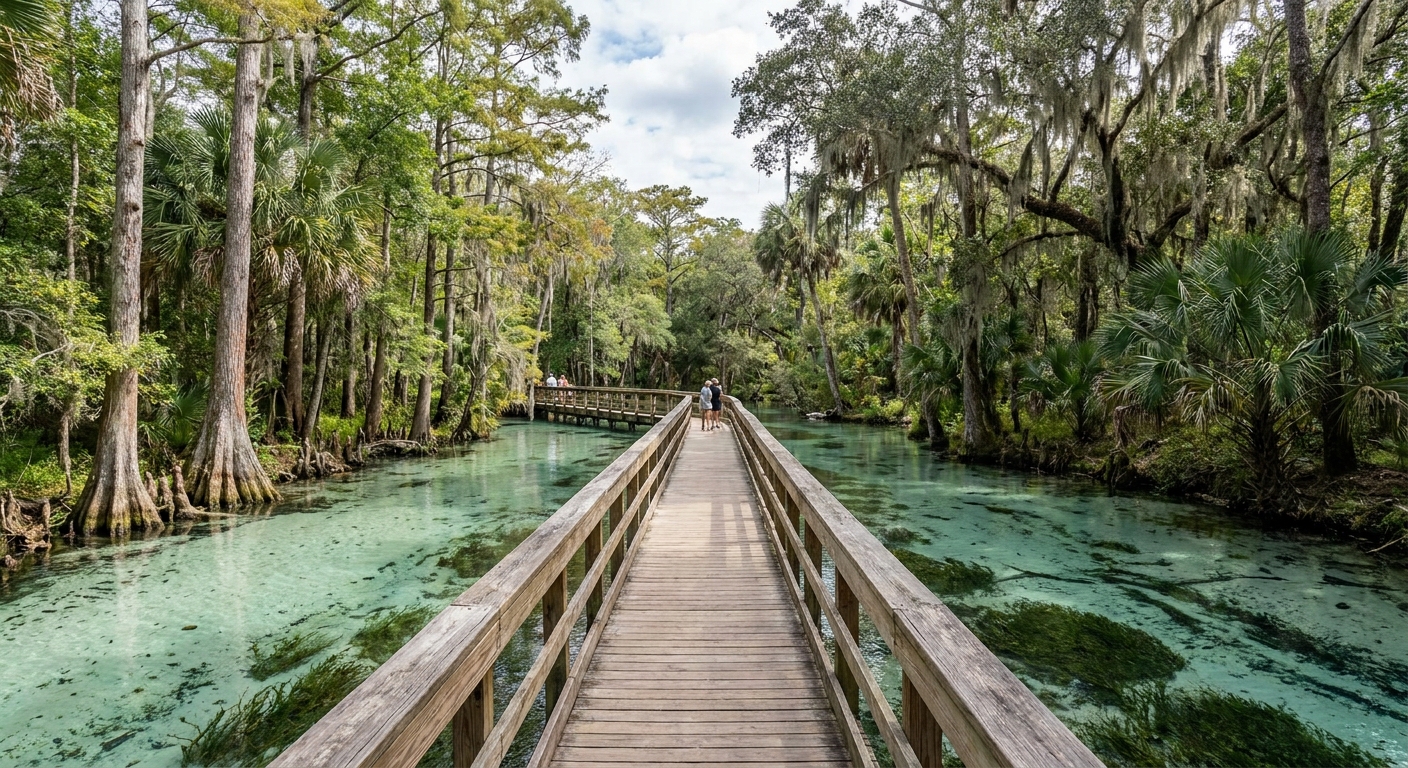
THE YEAR AT A GLANCE · HOMOSASSA SPRINGS
Take November: 1.59 inches of rain, 3.0 wet days, 77.9°F afternoons, and a spring that ignores the season anyway.
BEST: NOVEMBER · HOTTEST: AUGUST 90.9°F · WETTEST: JULY 9.41 IN · COLDEST NIGHTS: JANUARY
Go for: November and early December, when rain totals sit under 2.6 inches, wet days under 3.5, and the warm spring run does what it does all year.
Think twice before: filling mid June to mid September with boardwalk hours and boat plans: those four months carry 31.23 of the year’s 51.94 inches.
Air normals: NOAA NCEI 1991-2020, Brooksville Hernando Co AP · Daylight: sunrise-sunset.org · full sources at the end
On this page
- Best month, in one answerNovember: 77.9°F days, 1.59 inches
- Highs, lows and rain days for all twelve monthsThe 12-month normals
- How hot does it get in July and August?90°F days, nights near 72°F
- The quietest weeks of the yearSeptember and early December
- The month to skipJuly: 9.41 inches, 13.1 wet days
- Is the shoulder season worth it at Homosassa Springs?What the quieter months trade away
- Manatees in the warm spring waterSwimming with manatees
- When to visit Florida overallThe statewide dry-season calendar
Monthly averages describe the air. The spring run does not follow them, and that single fact bends the calendar: the coldest stretch of the year, the one carrying those 5.4 freezing nights, is exactly when manatees crowd into Florida’s warm spring water, as our manatee guide lays out. Choose a month for the air if you plan to spend the day walking. Choose it for the water and winter wins.
Homosassa Springs weather month by month: highs, lows and rainfall
| Month | Avg high | Avg low | Rain | Days ≥0.10 in | Daylight (15th) |
|---|---|---|---|---|---|
| January | 70.7°F | 44.3°F | 3.01 in | 4.2 | 10h33 |
| February | 73.7°F | 47.5°F | 2.57 in | 3.5 | 11h14 |
| March | 77.6°F | 50.8°F | 2.66 in | 3.7 | 12h02 |
| April | 82.8°F | 55.7°F | 2.18 in | 3.4 | 12h55 |
| May | 88.1°F | 62.6°F | 3.35 in | 4.4 | 13h39 |
| June | 90.2°F | 69.9°F | 7.91 in | 10.9 | 14h01 |
| July | 90.6°F | 72.0°F | 9.41 in | 13.1 | 13h50 |
| August | 90.9°F | 72.1°F | 8.12 in | 12.3 | 13h12 |
| September | 89.5°F | 70.1°F | 5.79 in | 8.1 | 12h22 |
| October | 84.5°F | 61.7°F | 2.79 in | 4.0 | 11h31 |
| November | 77.9°F | 52.3°F | 1.59 in | 3.0 | 10h45 |
| December | 73.0°F | 47.6°F | 2.56 in | 3.4 | 10h22 |
Seven months of the twelve, April through October, hold average highs above 80°F, and four of them (June through September) carry 31.23 of the year’s 51.94 inches of rain: three-fifths of the total in a third of the year. The rest of the calendar is dry and mild rather than cold, with eight months averaging under 3.5 wet days.
Two hinges do most of the work. Between May and June the afternoon high rises just 2.1°F, from 88.1°F to 90.2°F, while rainfall more than doubles, 3.35 inches to 7.91, and wet days jump from 4.4 to 10.9. The reverse hinge falls between September and October: rain drops from 5.79 inches to 2.79, wet days from 8.1 to 4.0, and the average low falls 8.4°F, from 70.1°F to 61.7°F.
July is the hardest month, and it is hard for a specific traveler: the one whose day is built outdoors. Beyond its 13.1 days at 0.10 inch or more, July averages 2.9 days receiving a full inch or more, the year’s highest count, and its nights average 72.0°F, so the morning never resets. For someone whose plan is to get in the water and stay there, none of that matters much.
Every figure here comes from NOAA’s 1991-2020 monthly normals for BROOKSVILLE HERNANDO CO AP, station USW00012818, about 44 km (27 miles) from the spring. Two limits ride along. These normals measure the air, not the spring, whose water has no season. And a station 27 miles away is a regional signal, not a reading taken at the spring run. The rain counts use NOAA’s own thresholds: days reaching 0.10 inch, and days reaching a full inch.
When is the best time to visit Homosassa Springs?
Come in November. It is the driest month on record at 1.59 inches, with 3.0 days reaching 0.10 inch and only 0.4 day reaching an inch, the lowest of the twelve. Afternoons average 77.9°F, nights 52.3°F, and the freeze risk is down to 1.0 night for the whole month. Walking weather, in other words, in the month least likely to interrupt it.
March comes within 0.3°F of the same afternoon (77.6°F against 77.9°F) and loses on everything else: 1.07 more inches of rain, 0.7 more wet days, and 1.4 freezing nights instead of 1.0. October is the warmer rival at 84.5°F, but pays 1.20 inches and one extra wet day for those 6.6 degrees. November takes both comparisons without needing an argument.
The cost is light. On November 15 the sun rises at 6:52am and sets at 5:37pm local, 10h45 of daylight, 46 minutes short of mid October and 3h16 short of mid June, so a late-afternoon arrival is an arrival at dusk. The statewide dry-season picture sits in our Florida calendar, and the driving logic for the Gulf side in the road-trip guide.
How hot does Homosassa Springs get in summer?
Three months average above 90°F: June at 90.2°F, July at 90.6°F, August at 90.9°F. The nights are the part people underestimate. Average lows run 69.9°F in June and 72.0°F and 72.1°F in July and August, so the air is still in the low 70s at dawn. Those same three months collect 25.44 inches of rain across 36.3 days reaching 0.10 inch, out of 92 days.
What these normals do not carry is humidity, and we will not put a fabricated heat index on the page to fill the gap. The reliable statewide context: Florida’s wet season runs a near-daily rhythm of afternoon thunderstorms, and hurricane season spans June 1 to November 30 with a statistical peak around September 10, both covered in our Florida orientation. Plan summer mornings, and keep the afternoon flexible.
When is Homosassa Springs quietest?
The quiet weeks are a matter of the school calendar, not a price ranking, and no price series backs this page. Florida’s crowd peaks fall on holiday weeks and spring break, as the statewide calendar sets out. That leaves two soft windows on the Gulf side: September, once the school year restarts, and the first half of December before the holiday weeks begin.
September still delivers a summer day, 89.5°F, but with 8.1 wet days against July’s 13.1, and 5.79 inches against 9.41. Early December swaps that for the mildest kind of winter: 73.0°F afternoons, 47.6°F nights, 2.56 inches across 3.4 wet days. On December 15 the sun is up from 7:15am to 5:36pm local.
Both windows charge something. September sits directly on the hurricane season’s statistical peak, which is why booking refundable in that month is standard advice. December hands you the shortest daylight of the year, 10h22, and 3.4 nights at or below freezing, enough to make a pre-dawn start on the water genuinely cold for anyone who packed for Florida.
Which month should you avoid at Homosassa Springs?
July, if your days are meant to be spent outside. It leads the year in every wet category: 9.41 inches, 13.1 days at 0.10 inch or more, 2.9 days at an inch or more. Add average lows of 72.0°F and 90.6°F afternoons and you have the month where boardwalk time, boat plans and small children stop cooperating at roughly the same hour.
It is not a write-off. July still gives 13h50 of daylight on the 15th, second only to June’s 14h01, with the sun up from 6:41am to 8:31pm local, so a rained-out afternoon leaves a long evening behind it. Florida’s wet-season storms are an afternoon pattern rather than an all-day drizzle. And the spring water runs the same in July as it does in January.
Is the shoulder season worth it at Homosassa Springs?
The two shoulder months are April and October. April averages 82.8°F by day and 55.7°F at night, with 2.18 inches over 3.4 wet days, the second driest month of the year behind November. October runs 84.5°F and 61.7°F, with 2.79 inches over 4.0 wet days: 6.6 degrees warmer than November, and 1.20 inches wetter.
What they add is daylight and a night you can sit out in. April gives 12h55 on the 15th, 2h22 more than mid January’s 10h33, and its freeze risk is effectively gone at 0.1 night, against January’s 5.4. October matches that 0.1 and still holds 11h31 of light, three-quarters of an hour more than November.
What they remove is the winter itself. April is outside the season when manatees gather in the warm spring water, the reason many people come at all, and it sits one month from May’s jump to 88.1°F and 3.35 inches. October, for its part, is the tail of the wet season: 4.0 wet days is one third more than November’s 3.0, and hurricane season runs to November 30.
Pick April for length of day and warm air on a spring-water trip with kids. Pick October if a slightly wetter month buys you afternoons at 84.5°F. If neither constraint binds you, both months lose to November on rain, and October loses to it by more than a full inch.
The last word
Book November and stop optimizing. If November is impossible, February is the understudy nobody bothers to check: 73.7°F afternoons, 2.57 inches across 3.5 wet days, and 2.8 freezing nights against January’s 5.4, the same winter with half the frost. Pack a towel and a fleece either way. The air can sit in the 40s at first light while the water you are stepping into does not move with the season at all.
Sources & data for this guide
- Monthly air normals, highs, lows, precipitation, rain-day and freeze-night counts · NOAA NCEI 1991-2020 monthly normals, station USW00012818, BROOKSVILLE HERNANDO CO AP, FL US, about 44 km (27 miles) from the spring · checked Sep 12, 2026
- Rain-day thresholds used above are NOAA’s: days reaching 0.10 inch, and days reaching 1.00 inch · checked Sep 12, 2026
- Daylight length and local sunrise/sunset for the 15th of each month · sunrise-sunset.org, converted to local time · checked Sep 12, 2026
- Wet-season storm pattern, hurricane season dates and the September 10 peak · our Florida orientation, sourced to NOAA · checked Sep 12, 2026
- Editorial admission: we hold no water-temperature reading for the spring run itself, no humidity or heat-index series for this station, and no price data for local lodging, so this page ranks no month by cost.