
FORT LAUDERDALE · THE 12-MONTH VERDICT · 26.1° N
Fort Lauderdale never really closes. The coolest month of the year still averages 75.6°F by day, the sea never drops below 77.5°F, and no month on the calendar sends you looking for a coat. That makes the timing question sharper rather than easier: if every month works, the choice comes down to what each one costs you in rain, heat and storm risk.
Two facts sort the year. Rainfall multiplies by four between February and June (2.38 inches against 9.55), and the Atlantic hurricane season runs June 1 to November 30, peaking on September 10. Everything below follows from those two, month by month, with each month’s own page carrying the detail we don’t repeat here.
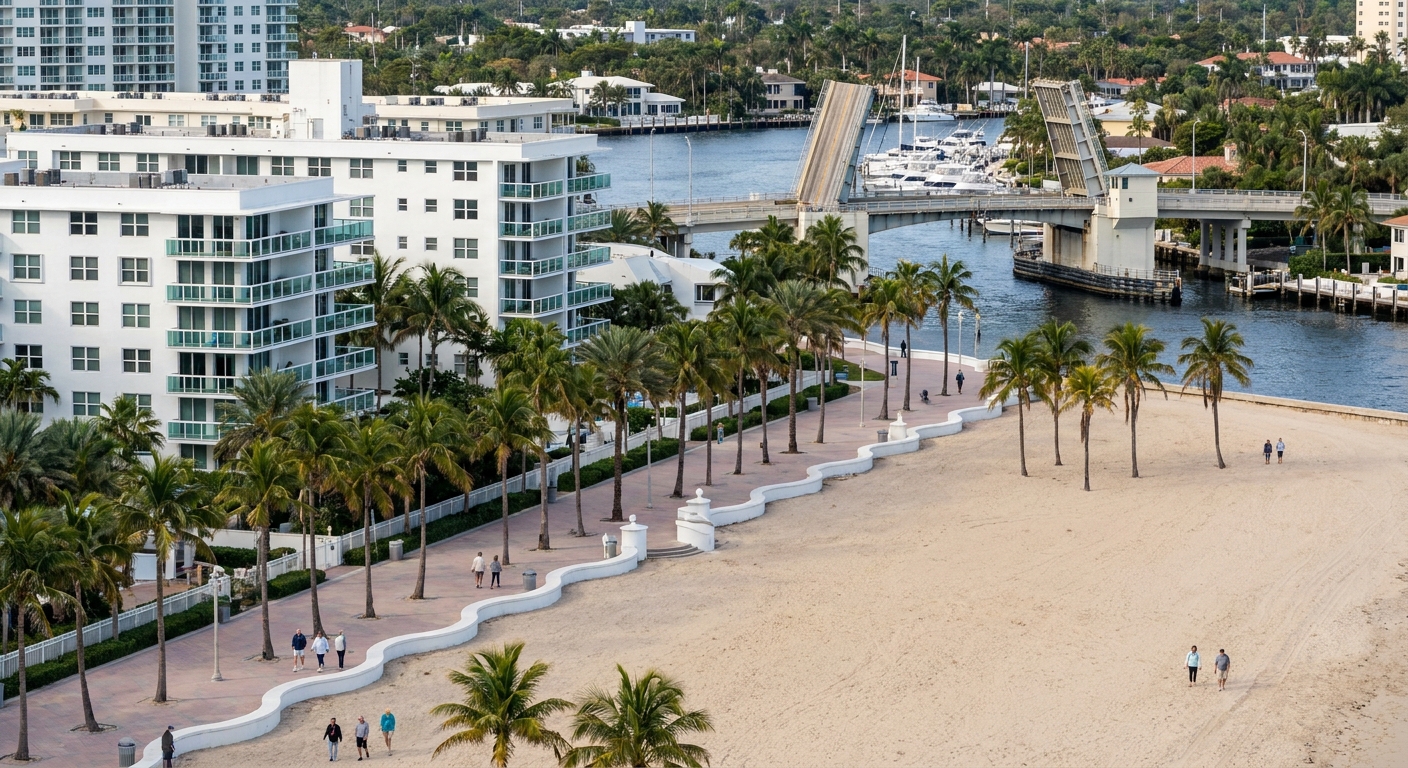
THE YEAR AT A GLANCE · FORT LAUDERDALE
March is the month to book: 79.7°F days, 2.38 inches of rain spread over 3.4 wet days, water at 78.6°F, and the whole month sitting outside hurricane season.
BEST: MARCH · WARMEST WATER: AUGUST, 88.2°F · WETTEST: JUNE, 9.55 INCHES · HURRICANE SEASON: JUN 1 TO NOV 30
Go for: dry warm winters (February and March take 2.38 inches each), water that never falls below 77.5°F, and a beach town with twelve usable months.
Think twice before: locking non-refundable nights in September: the hurricane season peaks on the 10th and the month averages 8.02 inches over 10.8 wet days.
Air and rain: NOAA station USW00012849 · Sea: Open-Meteo Marine, 2015-2024 · Hurricanes: NOAA NHC · full sources at the end
On this page
- Month-by-month highs, lows, rain and seaThe 12-month table
- The single best month to bookMarch, with its numbers
- Sea temperature for swimmingThe months above 80°F
- The quietest weeks of the yearSeptember and October
- The month with the most storm riskSeptember, hurricane peak
- Shoulder season: April or NovemberThe two compared, with the gaps
The short version for readers with a flight to book: March for the safest weather, November for the warmest water outside the winter peak, September if you want the beach half empty and can keep your nights refundable. The state-wide frame, dry season against wet season, sits in our Florida calendar.
Fort Lauderdale weather month by month: highs, lows, rain and sea temperature
| Month | Avg high / low | Rain | Days ≥ 0.10 in | Sea (mean daily max) | Daylight on the 15th |
|---|---|---|---|---|---|
| January | 75.6°F / 60.9°F | 2.90 in | 3.8 | 77.6°F | 10h43 |
| February | 77.4°F / 63.3°F | 2.38 in | 3.4 | 77.5°F | 11h19 |
| March | 79.7°F / 65.6°F | 2.38 in | 3.4 | 78.6°F | 12h03 |
| April | 82.9°F / 69.9°F | 3.02 in | 4.1 | 79.7°F | 12h50 |
| May | 85.8°F / 73.5°F | 5.56 in | 7.4 | 83.1°F | 13h29 |
| June | 88.4°F / 76.6°F | 9.55 in | 10.5 | 85.4°F | 13h49 |
| July | 90.0°F / 77.6°F | 5.41 in | 10.6 | 88.1°F | 13h39 |
| August | 90.0°F / 77.9°F | 7.89 in | 11.2 | 88.2°F | 13h05 |
| September | 88.3°F / 77.1°F | 8.02 in | 10.8 | 87.7°F | 12h20 |
| October | 85.4°F / 74.4°F | 7.37 in | 7.9 | 84.5°F | 11h35 |
| November | 80.8°F / 68.3°F | 3.69 in | 4.8 | 82.1°F | 10h54 |
| December | 77.7°F / 64.7°F | 2.78 in | 4.2 | 79.3°F | 10h33 |
Two Fort Lauderdales share one calendar. From November through April, no month tops 3.69 inches of rain or 4.8 days recording at least 0.10 inch. From May through October, none comes in under 5.41 inches or 7.4 wet days. The thermometer does far less sorting: only 14.4°F separates January’s 75.6°F days from the 90.0°F of July and August, and every month of the year would count as beach weather anywhere north of Orlando.
May is where it flips. Rain climbs from April’s 3.02 inches to 5.56, wet days from 4.1 to 7.4, and highs add 2.9°F to reach 85.8°F. The return trip is slower. October still delivers 7.37 inches over 7.9 wet days, and only in November does the count drop to 4.8 and the rain to 3.69 inches, which is why a November vacation feels like winter’s opening and an October one does not.
June is the hardest month in the table, and mostly for people who plan afternoons outdoors. It brings 9.55 inches over 10.5 wet days, including 3.0 days with an inch or more, the highest such count of the year. Nights give nothing back at a low of 76.6°F. Florida’s wet season runs on afternoon thunderstorms, as the state guide lays out, so a pool morning survives June far better than a booked boat trip at three.
Every air temperature and rainfall figure here comes from NOAA’s 1991-2020 normals at station USW00012849, the gauge at Fort Lauderdale-Hollywood International. That is an airport instrument, not a reading taken on the sand, and the sea breeze can leave the shoreline a degree or two off the airport number on a given afternoon (est.). The sea column is a different animal entirely: a marine model averaged over 2015-2024, not a station measurement.
When is the best time to visit Fort Lauderdale?
March. It pairs the driest rainfall total on the calendar, 2.38 inches over 3.4 wet days, with highs of 79.7°F and lows of 65.6°F, water at 78.6°F and 12 hours 03 minutes of daylight on the 15th. It also sits three months clear of hurricane season in both directions. The catch is demand: March is peak winter season in Broward County, and the beachfront rooms go first, so book nights early rather than watching for a late deal.
February matches March’s rain exactly, 2.38 inches and 3.4 wet days, and still loses on every other line: 2.3°F cooler by day, water 1.1°F cooler at 77.5°F, and 44 minutes less daylight on the 15th. April goes the other way, adding warmth at 82.9°F but also 0.64 inch more rain and an extra wet day. March sits between the two with nothing to apologize for.
The month has its own complications, spring break weeks among them, and they belong on their own page: Fort Lauderdale in March carries the detail, week by week, along with sunrise and sunset times and what a wet day looks like when it comes.
When can you swim in Fort Lauderdale? Sea temperature month by month
Take 80°F as the line where the water stops being a decision, and seven months clear it: May at 83.1°F, June 85.4°F, July 88.1°F, August 88.2°F, September 87.7°F, October 84.5°F and November 82.1°F. April misses by 0.3°F at 79.7°F and December by 0.7°F at 79.3°F, which in practice means a brisk first minute and nothing worse. The floor is February at 77.5°F, a full 10.7°F below August. Nobody in Fort Lauderdale treats that as unswimmable, but children notice it.
One caveat on those readings. They come from the Open-Meteo marine model averaged over 2015-2024, and they are the mean of daily maxima, meaning the warmest point of each day rather than a flat 24-hour average. A real 7am swim off Las Olas runs cooler than the column says, and the figure describes open sea surface, not the shallow water at your ankles, where the sand can add heat by afternoon.
When is Fort Lauderdale quietest?
September and October, by the calendar rather than by any price list. American schools are back in session, the winter arrivals have not started, and the hurricane season is at its statistical peak on September 10. Broward’s beachfront fills again from the late-November holidays onward and stays full through March, so the genuinely low weeks are the ones between Labor Day and Thanksgiving.
What you get for that is space: beach without a parking hunt, restaurant tables at eight without a reservation, and the warmest water of the year still on the menu at 87.7°F in September and 84.5°F in October. Daylight holds up too, 12 hours 20 minutes on September 15, enough for a full beach day and dinner outside afterward.
What you give up is the weather itself. September averages 8.02 inches over 10.8 wet days, with 2.9 of those days recording an inch or more, and lows of 77.1°F mean no cool nights at all. By October 15 daylight is down to 11 hours 35 minutes. Add the storm-track watch that runs to November 30 and the quiet months come with one non-negotiable condition: refundable bookings, and a look at the tropics before you fly.
Which month should you avoid in Fort Lauderdale?
September, and specifically for the traveler with fixed dates and prepaid nights. The Atlantic season peaks on the 10th, the month delivers 8.02 inches over 10.8 wet days, and a single named storm rearranges a week that cannot be moved. Nothing about that makes it a bad month in the absolute: for a swimmer content with 87.7°F water and an uncrowded stretch of sand, September is one of the best weeks of the year to be here.
It also rains less violently than its reputation suggests. September records 2.9 days at an inch or more, just under June’s 3.0, so the heaviest downpours belong to early summer rather than to the storm peak. And the month improves as it goes: October drops wet days from 10.8 to 7.9 while the sea gives up barely 3°F. If your dates are flexible by two weeks, slide them later rather than canceling.
Is the shoulder season worth it in Fort Lauderdale?
The two shoulders are November and April, and they sit on opposite sides of the dry season. November averages 80.8°F by day against January’s 75.6°F, a gap of 5.2°F, with the sea 4.5°F warmer at 82.1°F. The price is 0.79 inch more rain and one extra wet day. April runs 3.2°F warmer than March at 82.9°F, with water 1.1°F warmer at 79.7°F, and adds 0.64 inch of rain over its own extra wet day.
Both give something the winter peak simply cannot. November’s 82.1°F water beats anything January or February manages by more than four degrees, which turns swimming from a dare into the default. April hands you 12 hours 50 minutes of daylight on the 15th, two hours and seven minutes more than January 15, and that extra light is the difference between one beach session and two. Neither month carries March’s spring-break volume.
The subtraction is real on both ends. November sits inside hurricane season until the 30th, so the same refundable-booking rule applies as in October. April’s 4.1 wet days and 3.02 inches are already climbing toward the wall that follows immediately: May jumps to 5.56 inches over 7.4 wet days, the single biggest month-to-month deterioration in the table. An April trip in the last week of the month is a different gamble from one in the first.
Our verdict: the shoulders beat the peak if the water is what you came for, and lose to it if rain is what you fear. Take November when the swim decides the trip, since 82.1°F water with 4.8 wet days is the best combination of the two the year offers. Take April for long evenings. Stay in February or March, at 2.38 inches apiece, if you want the driest week available and are willing to book it months out.
The last word
Book March if the weather has to behave, November if the sea has to be warm, and September only with a cancellation clause in hand. Then do the arithmetic nobody does at the booking stage: Broward County levies a 6.0% transient rental tax on every hotel night, filed alongside Florida’s 6% state sales tax, so a nightly rate quoted at any season carries roughly twelve percent on top before parking. Our Florida trip cost guide puts the rest of the bill in order.
Sources & data for this guide
- Monthly air normals, rainfall and wet-day counts, 1991-2020 · NOAA NCEI, station USW00012849 (Fort Lauderdale-Hollywood International) · checked Sep 12, 2026
- Sea surface temperature, mean of daily maxima 2015-2024 · Open-Meteo Marine API · checked Sep 12, 2026
- Daylight length, sunrise and sunset on the 15th of each month · sunrise-sunset.org · checked Sep 12, 2026
- Hurricane season dates and the September 10 peak · NOAA National Hurricane Center · checked Sep 12, 2026
- Lodging tax: 6.0% Broward transient rental tax filed with 6% state sales tax · Florida Department of Revenue, form DR-15TDT · checked Sep 12, 2026
- Editorial admission: the 80°F swim line is our own threshold, not a published standard, and we hold no price series for Fort Lauderdale, so the quiet months here are described by the calendar and never ranked by cost. Crowd descriptions are editorial.