
FORT LAUDERDALE · FEBRUARY · DRY SEASON
February gives Fort Lauderdale a 77.4°F afternoon and a 63.3°F night, and it does it on 2.38 inches of rain spread across the whole month. The Atlantic off the beach averages 77.5°F. Warm water plus dry air is the combination the Florida winter was built to sell, and this is the middle month of it.
The date changes less than the brochures suggest in one direction and more in another: the ocean barely moves between January and March, while the average high climbs 4.1 degrees over the same stretch. February takes the middle position on both, and it falls outside the Atlantic hurricane season, which does not open again until June 1.
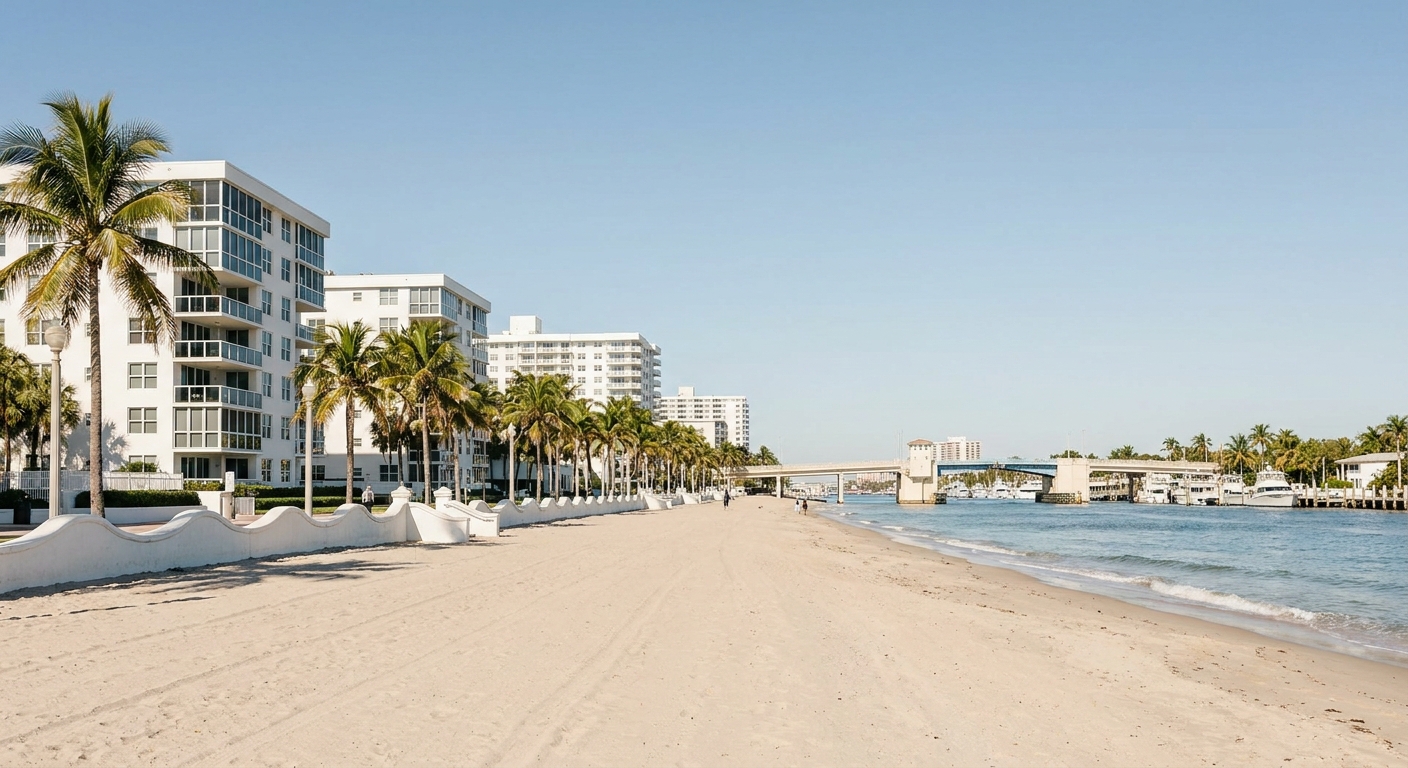
THE MONTH AT A GLANCE · FEBRUARY
February is the dry-season middle in Fort Lauderdale: 77.4°F days, 63.3°F nights, 2.38 inches of rain and an ocean at 77.5°F, warm enough to swim in and cool enough to walk in at noon.
DRY SEASON · 3.4 WET DAYS · SEA 77.5°F · OUTSIDE HURRICANE SEASON
Go for: swimming at 77.5°F, midday walking at 77.4°F, the 2.2 miles of beach at Mizell-Johnson, and a month that sits outside hurricane season entirely.
Think twice before: planning hour-long snorkel sessions or a children’s beach day around water averaging 77.5°F, and before budgeting park fees or bus fares, which we could not read from the operators.
Normals: NOAA NCEI station USW00012849 · Sea: Open-Meteo Marine API · Tax: Florida form DR-15TDT · full sources at the end
On this page
- Average highs, lows and rain daysFort Lauderdale weather in February
- Sea temperature in February77.5°F, and how it reads in the water
- Crowds, room tax and bookingWhere February sits in the dry season
- Things to do in FebruaryHugh Taylor Birch, Mizell-Johnson, Oleta River
- A two-day plan for FebruaryTwo days timed to a 6:14 p.m. sunset
- February or March?How the three months compare, degree by degree
- Is February a good time to visit?Who the month suits, and who should shift
- The rest of Florida in FebruaryFlorida’s dry season, month by month
The scope is the date. Where to sleep, what a week costs and how to move around without a car do not change with the calendar, and they sit in where to stay, trip costs and getting around Florida. February’s business on this trip is the air, the water and the two months on either side of it.
Fort Lauderdale weather in February: average highs, lows and rain days
| February measure | Value |
|---|---|
| Average high | 77.4°F |
| Average low | 63.3°F |
| Precipitation | 2.38 in |
| Days with 0.10 in or more | 3.4 |
| Days with 1.00 in or more | 0.7 |
| Sea surface (mean of daily maxima) | 77.5°F |
| Daylight on Feb 15 | 11 h 19 min |
| Hurricane season | Outside it (Jun 1 to Nov 30) |
Every figure here comes from one thermometer rather than a grid cell: NOAA’s 1991 to 2020 monthly normals for station USW00012849, listed as FT LAUDERDALE HOLLYWOOD AP. February averages a high of 77.4°F and a low of 63.3°F, on 2.38 inches of precipitation. The gauge sits at the airport, about three miles inland from the sand, so an afternoon on the beach with the sea breeze running will not read exactly like the official line.
Those 2.38 inches arrive in a handful of installments. A normal February records measurable rain, meaning at least 0.10 inch, on 3.4 days, close to one day in nine. A genuine soaking of an inch or more shows up 0.7 times, so count on roughly two of them across three Februaries. The rest of the month is dry enough that the question is rarely whether you get beach time, only which afternoon you spend under a roof.
The gap between 77.4°F and 63.3°F is 14.1 degrees, and it lands after dark. Days run in shirtsleeves. The hour after sunset is the one that catches people out on an open terrace or a boat deck, and wet skin makes it worse. One long-sleeve layer, one towel you can actually wrap up in, and a February bag here is done. Nothing in these normals calls for a coat.
On February 15 the sun rises at 6:54 a.m. Eastern and sets at 6:14 p.m., for 11 hours 19 minutes of daylight. That is an evening rather than a night at the end of a beach day: dinner starts in the dark, but a 5 p.m. swim still has light in it. Time any trail so you are walking back before a quarter past six.
Can you swim in Fort Lauderdale in February? Sea temperature and what it feels like
The Atlantic off Fort Lauderdale averages 77.5°F in February in the Open-Meteo Marine API series, taken as the mean of daily maxima over 2015 to 2024. That matters for reading the figure: a daily maximum runs a shade warmer than a 24-hour mean, so tables built on full-day averages will show something cooler for the same month. Treat 77.5°F as the warm end of a typical February day in the water, not the temperature at 7 a.m.
In practice, water at 77.5°F against air at 77.4°F puts the ocean and the afternoon within a degree of each other, so entry is undramatic. Swimmers used to a Gulf summer will call the first minute brisk and then forget about it. For a long snorkel, an hour rather than twenty minutes, a rash guard or a shorty keeps the session going; small children chill faster than the number suggests.
Wind and swell are where our sources run out. We could not read a February wind or wave series for this stretch of coast, and we are not going to estimate one. What is documented is the calendar: the Atlantic hurricane season runs June 1 to November 30 and peaks on September 10, so February sits clear of it. Day-to-day surf and rip currents still change with the weather, and our Florida safety guide covers the beach flag system.
How busy is Fort Lauderdale in February? The dry season, the room tax and what to book
February sits in the middle of Florida’s dry season, the November to April stretch the state’s winter economy runs on, and outside hurricane season entirely. What we will not do is rank the month on price. Our sources carry climate normals, a state tax form and a park inventory, not a monthly occupancy or room-rate series for Broward County. Anyone telling you February is the cheapest or dearest week of the Fort Lauderdale year is reading a chart we could not find.
Book the things that are counted before the things that are not. Oleta River State Park holds 14 cabins for the whole southern end of the metro area, on the bay side rather than the ocean, and fourteen of anything in a dry-season month goes early. We could not read the state’s reservation window, so check it rather than trust a figure from us. Flights into the airport and rooms on the sand are their own exercise, handled in our Florida flights guide and the cost guide.
The lodging line does have a number we can quote. Broward County levies a 6.0% transient rental tax on short-term stays, filed and paid alongside the 6% state sales tax, which is twelve cents on the dollar of room rate between the two, as set out on Florida form DR-15TDT. That is before anything a property adds on its own account: resort fees and parking charges sit outside the tax form and outside our source, so read the confirmation line by line.
One kind of spending genuinely changes February, and it is the walk to the sand. With sunset at 6:14 p.m., the last hour of light is the best hour of the day, and a bed you can walk back from turns it into beach time instead of a drive and a parking search. The upgraded rental car and the high-floor view move the bill more than they move the month. Where to stay in Florida sorts the bases.
Things to do in Fort Lauderdale in February: Hugh Taylor Birch, Mizell-Johnson and Oleta River
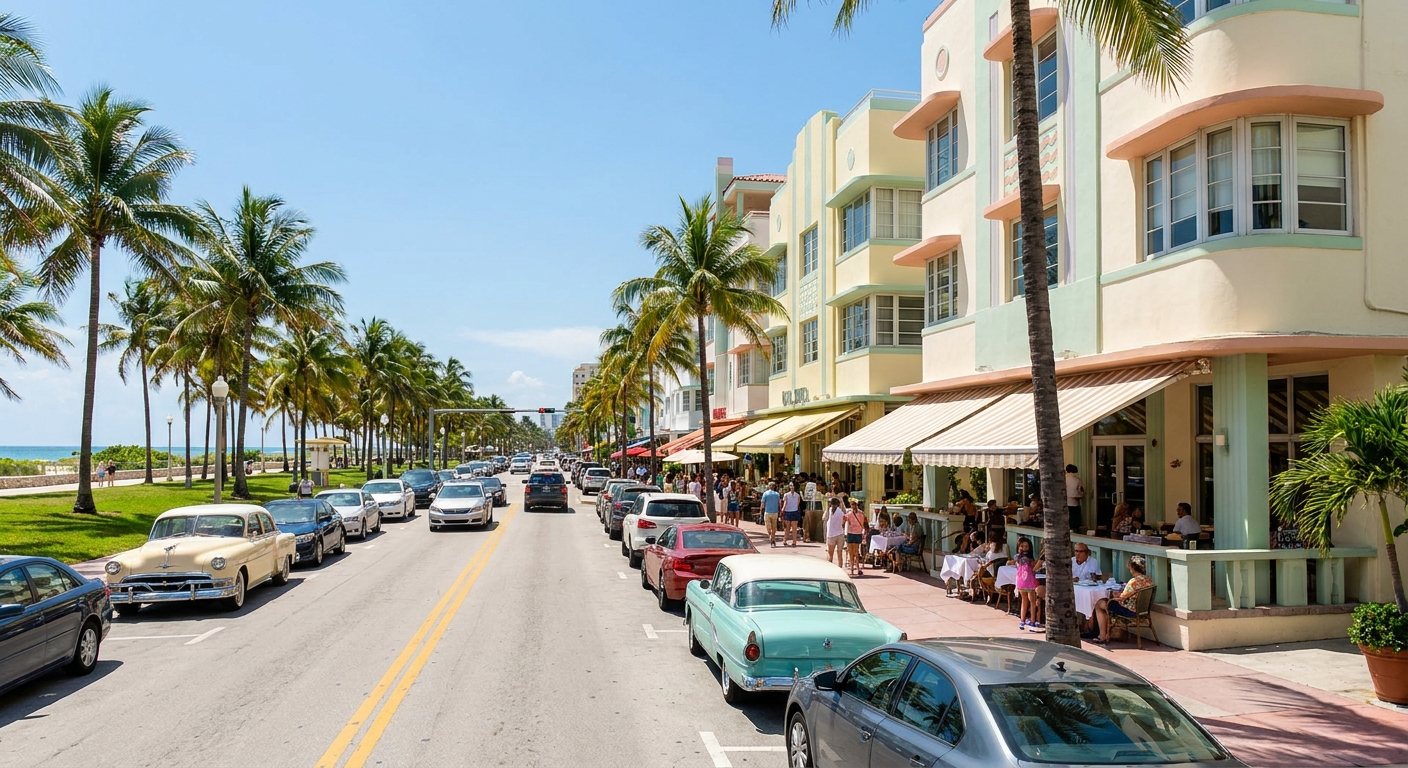
February hands you full days outdoors that the wet half of the year cannot. At 77.4°F, midday is walking weather rather than something to be endured, so the 2.6 miles of hiking trail at Dr. Von D. Mizell-Eula Johnson State Park can be taken at noon instead of at dawn. No tropical system is on the board either: the season that produces them does not open until June 1.
Florida’s Department of Environmental Protection counts the three state parks in reach item by item. Mizell-Johnson is the big one: 1,410 parking spaces, 2.2 miles of beach, 4,531 feet of boardwalk and one designated swimming area. Hugh Taylor Birch is the pocket version inside the city, with 275 spaces, 0.1 mile of beach, 60 feet of boardwalk, 0.3 mile of trail and a launch for canoes, kayaks and tubes. Oleta River, down on the bay, counts 925 spaces, two launches and 0.3 mile of beach.
What the month changes at all three is the air, not the water. The marine series puts the ocean at 77.6°F in January, 77.5°F in February and 78.6°F in March, a spread of one degree across a whole quarter, while the average high climbs 4.1 degrees over the same three months. A swim off the 2.2 miles at Mizell-Johnson reads much the same in any of them. The difference you feel is the walk back with wet skin once the 63.3°F night starts.
On what any of this costs at the gate, we have to declare a gap. The operators’ pages would not give us park entrance fees or opening hours on September 11, 2026, and Broward’s transit fares were no more readable. So no dollar figure for a park entry or a bus ride appears here, because we could not verify one. Call the ranger station or check at the entrance, and build the day around hours you have confirmed yourself.
Fort Lauderdale in February: a two-day itinerary
Day one runs on the light. Out by 8 a.m., while the air is still short of its 77.4°F peak, and into Hugh Taylor Birch first, because 275 parking spaces is a small allowance for a city park on a dry-season morning. Walk the 0.3 mile of trail and the 60 feet of boardwalk, cross to the beach for a midday swim at 77.5°F, then take a late lunch indoors through the warmest hour. Back on the sand by 4:30 p.m., with the sun gone at 6:14.
Day two goes to Mizell-Johnson for the 2.2 miles of beach and the 4,531 feet of boardwalk, where 1,410 spaces absorb a later start. If you draw one of the 3.4 wet days, remember that only 0.7 day in an average February brings an inch or more, so a shower usually buys an hour indoors rather than a lost day. The bay-side alternative is Oleta River and its two paddling launches; Miami is the wet-weather fallback an hour south.
Fort Lauderdale in February vs January and March
| January | February | March | |
|---|---|---|---|
| Average high | 75.6°F | 77.4°F | 79.7°F |
| Average low | 60.9°F | 63.3°F | 65.6°F |
| Precipitation | 2.90 in | 2.38 in | 2.38 in |
| Days with 0.10 in or more | 3.8 | 3.4 | 3.4 |
| Sea surface (marine API) | 77.6°F | 77.5°F | 78.6°F |
February’s 77.4°F high sits 1.8 degrees above January and 2.3 below March, and the 63.3°F low splits the difference the same way. Rainfall is where January stands apart: 2.90 inches over 3.8 wet days, against 2.38 inches over 3.4 days in both February and March. The ocean hardly participates at all. The marine series gives January 77.6°F, February 77.5°F and March 78.6°F, so January is a tenth of a degree warmer in the water than the month you are reading.
Shift four weeks forward and you gain 2.3 degrees of daytime air and 1.1 degrees of water for identical rainfall, and you take on the spring-break traffic our Florida guide flags as one of the two annual peaks. Shift four weeks back and January costs you nearly two degrees by day plus half an inch of extra rain over an extra wet day, for water that is functionally the same. The full case for each sits in January and March.
Is February a good time to visit Fort Lauderdale?
Yes, with one condition. For a trip built on swimming, walking and eating outdoors, 77.4°F air over 77.5°F water is close to the best this coast manages without the wet season’s afternoon storms. If you need 85 degrees and bathwater, no February here will supply it. Cold tolerance decides the rest: an hour in the ocean at 77.5°F is comfortable for most adults and too long for most young children.
If the answer is no, March is the fix rather than April or May. It adds 2.3 degrees by day and a degree of water while keeping February’s 2.38 inches of rain, and it is still clear of hurricane season. The trade is company, since March is when the beach towns absorb their spring-break traffic.
What February holds alone is the pairing: March’s rainfall with air 2.3 degrees cooler, a sea within a tenth of a degree of January’s, and a hurricane season three and a half months from opening.
The last word
Settle the base before the itinerary and February looks after itself: a bed you can walk to the sand from turns the 6:14 p.m. sunset into the best hour of the day rather than a traffic problem. For a sense of who else had the idea, FLL boarded 17,096,131 passengers in calendar year 2024, an FAA large hub, and February falls inside the season that fills it. Reserve one of Oleta’s 14 cabins or the room by the beach, then check the park hours yourself, because we could not.
Sources & data for this guide
- February normals (77.4°F / 63.3°F, 2.38 in, 3.4 and 0.7 rain days) · NOAA NCEI monthly normals 1991-2020, station USW00012849, FT LAUDERDALE HOLLYWOOD AP · checked Sep 12, 2026; station identity verified by name via NCEI Search, Sep 11, 2026
- January and March normals · same NOAA NCEI series and station · checked Sep 12, 2026
- Sea surface 77.5°F (and 77.6°F / 78.6°F for the neighboring months), mean of daily maxima 2015-2024 · Open-Meteo Marine API · checked Sep 12, 2026
- Daylight and sun times for February 15 · sunrise-sunset.org, converted to America/New_York · checked Sep 12, 2026
- Hurricane season dates and September 10 peak · NOAA National Hurricane Center · checked Sep 12, 2026
- Park counts (parking spaces, beach miles, boardwalk feet, launches, 14 cabins) · Florida Department of Environmental Protection, Recreational Facilities Inventory, 2024 annual report · checked Sep 12, 2026
- 6.0% Broward transient rental tax filed with the 6% state sales tax · Florida Department of Revenue, form DR-15TDT · checked Sep 12, 2026
- FLL passenger boardings, calendar year 2024, large hub classification · Federal Aviation Administration · checked Sep 12, 2026
- Editorial admission: we found no readable bus or train fare, park entrance fee or opening hour for Fort Lauderdale on Sep 11, 2026 (gohart.org returned 404, broward.org/BCT renders client-side only), so none is quoted here and none is invented.