
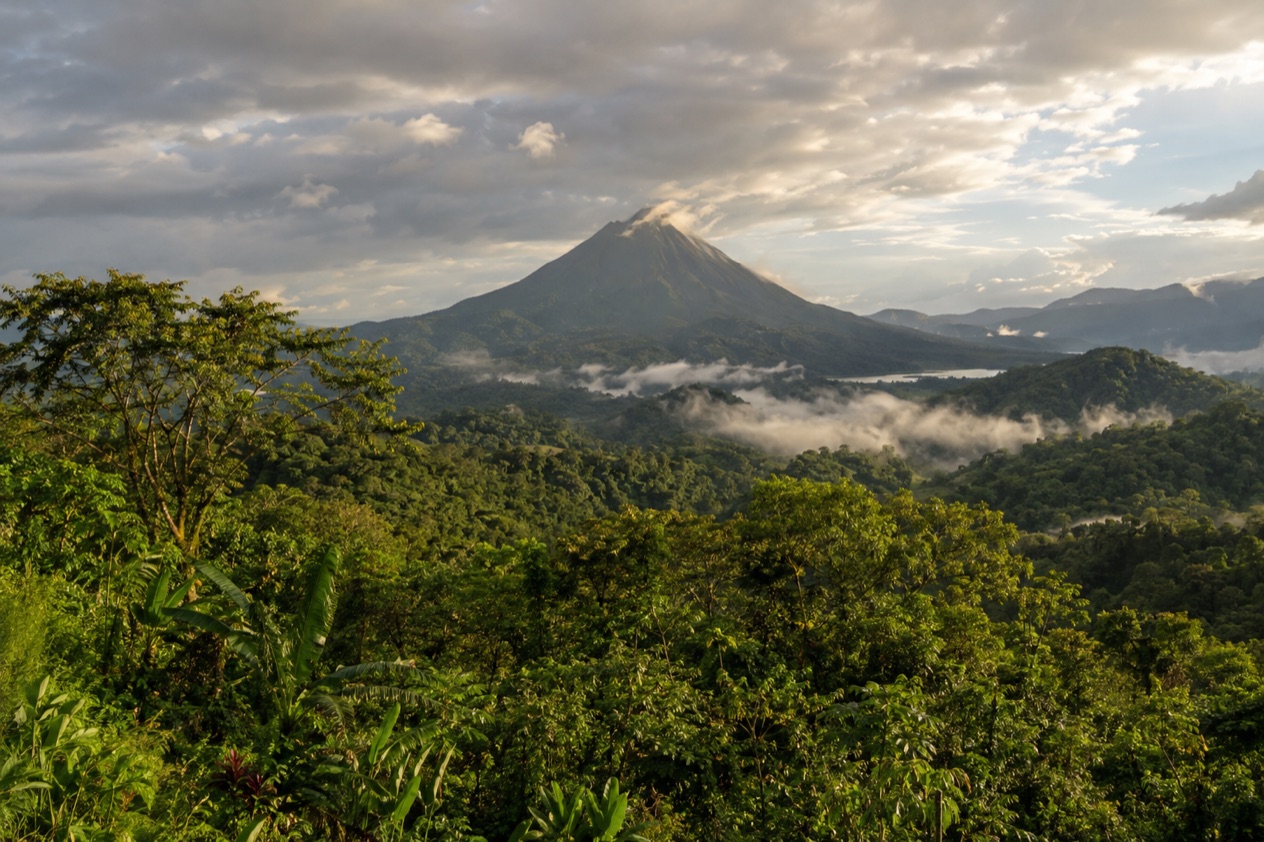
On the evening of September 14, children in towns across Costa Rica walk the streets with paper lanterns called faroles, their little flames bobbing past wet pavement and shuttered shops. The hills are intensely green, the clouds pile up over the volcanoes by early afternoon, and the beaches are wide and half empty. September is the heart of the rainy season, and it suits travelers who like a lush, quiet country and plan their days around the weather.
What is the weather like in Costa Rica in September?
September is warm, humid and wet almost everywhere, but the wetness changes a great deal from one region to the next: the central Pacific coast around Manuel Antonio is the soggiest, the northern Pacific and the highlands get regular afternoon downpours, and the Caribbean side is the least rainy of the five places below. Mornings are often the best part of the day, and the sky tends to close in after lunch.
| Place | Region | Average high (°F) | Average low (°F) | Rain (in) | Rain days | Sea (°F) |
|---|---|---|---|---|---|---|
| San Jose | Central Valley | 75.3 | 63.8 | 15.76 | 26.2 | Inland |
| Monteverde | Cloud forest highlands | 75.3 | 65.4 | 13.29 | 24.8 | Inland |
| Tamarindo | North Pacific coast | 83.2 | 75.8 | 13.23 | 26.7 | 86.1 |
| Manuel Antonio | Central Pacific coast | 79.4 | 70.6 | 31.66 | 29.4 | 85.7 |
| Puerto Viejo de Talamanca | Caribbean coast | 82.0 | 72.4 | 11.74 | 24.9 | 87.1 |
The highlands are the cool corner of the country. Daytime highs in San Jose and Monteverde hold around the mid-70s, nights turn cool enough to call for a light layer, and mist frequently cloaks the cloud forest in Monteverde even during lulls in the rain. The rain here comes in showers more than in storms, with a long gray spell now and then.
The coasts are hot and sticky, and the sea is as warm as it gets all year. Manuel Antonio stands apart: its rain total is more than double the other places in the table, and it has many more days of heavy rain, the kind that turns trails to mud and can keep boats in port. Puerto Viejo, on the Caribbean side, has rain nearly as often as the others, but it falls in lighter amounts, which is why the Caribbean follows its own calendar.
Where to go in Costa Rica in September
The Caribbean coast
The Caribbean coast gets rain all year long and follows a different pattern from the Pacific’s, so September is often less rainy here than on the far side of the mountains. Puerto Viejo de Talamanca is the base most visitors choose, a laid-back town of dark sand beaches, rice-and-beans cooking with coconut milk, bicycles on the beach road and reggae drifting out of open bars. The Afro-Caribbean character of the coast is strongest here, and a plate of rondón, a slow-cooked seafood stew, is worth finding.
The drive from the capital is long, so this is a place to settle in for a few nights rather than rush. Days are best spent early: a bike ride to the next beach, a walk in the jungle behind the shore, a visit to a chocolate farm. The Atlantic hurricane season is at its peak this month, so watch the forecast and the beach flags, since waves can be big and rip currents are real on beaches without lifeguards.
The Pacific coast
The Pacific side is in the middle of its green season, and it is where the weather asks the most of you. Around Tamarindo, on the Nicoya Peninsula, mornings are usually bright and good for surf lessons or a long beach walk, then the clouds build and the rain arrives in the afternoon. Sunsets still happen between showers, and the town is calm, with restaurant tables to spare.
Farther south, Manuel Antonio is lush and loud with birds, and its national park is full of green. It is also the place where you should plan around the rain most carefully, with museum-like patience for gray days and flexible dates for any boat trip.
Seeing monkeys or sloths is never guaranteed, and for most visitors a guided walk is the way they catch sight of such wildlife. Most beaches on this coast have no lifeguards, so ask locally about the surf before swimming.
The central highlands
San Jose is a city of markets, coffee shops and museums, and September rain suits a day indoors. Eat a casado at a neighborhood soda, the small family restaurant, or a breakfast of gallo pinto with eggs and sour cream, and let the afternoon shower pass. The capital is also where the Independence Day lantern parade feels most like a family night out.
Monteverde is the other highland favorite, a cool, misty cloud forest where hummingbirds and hanging bridges are the draw. Go for the early hours, when the forest is quiet and the light is soft, and keep the afternoons for coffee, chocolate and a book. Mist can hide the views completely, so treat any lookout as a bonus.
What to do in Costa Rica in September
Independence Day and the lantern parade
September 15 is Independence Day, and the celebration starts the evening before. On September 14, children carry paper lanterns, the faroles, through their towns in the Desfile de Faroles, singing and walking in school groups with parents beside them. It is a gentle, local scene, more neighborhood than spectacle, and worth planning an evening around.
The next day brings school bands and flags in the streets, with drums, marching and a good deal of blue, white and red. Find a spot on the main street of the town you are in and you will see it. Shops and some services may run on a holiday rhythm, so keep that day flexible.
Green season in the forest
The rainy season is when the forest looks its best, while September also brings green sea turtles to Tortuguero and humpback whales to the southern Pacific. In Monteverde, that means hanging bridges and night walks, and on the Pacific side it means checking official entry and reservation rules before planning the national park trails near Manuel Antonio. Rain gear is part of the experience, and the quiet trails are one reward.
Rainy-day eating and slow days
Costa Rican food is made for gray afternoons. Coffee farms in the highlands are an easy indoor-outdoor outing.
Use rainy afternoons for a cooking class, a market or a café, and save surf lessons around Tamarindo for the morning. Keep a second option for each day, such as a cooking class, a market or a café, so a storm does not cost you the day.
Is Costa Rica busy in September?
No, September is one of the quieter months for visitors, because it sits in the middle of the green season. Beaches are open, trails are less crowded, and restaurants rarely have lines. Many travelers choose it for exactly that reason, and the mood in the towns is relaxed.
The U.S. Labor Day weekend at the start of the month brings some American visitors, mostly to the best-known beach and volcano areas. After that the pace eases. Families with children are mostly back in school, so the visitors you meet are more often couples, birders, surfers and retirees.
The one local rush is Independence Day. Costa Ricans take the holiday to travel, and beach towns and popular hotels can fill with domestic visitors around September 15. Towns with a big parade, including the capital, have a festive feel with more people in the streets and on buses. If you want that atmosphere, book early. If you want calm, schedule your beach days away from that date.
The calmest places are the Caribbean coast and the cloud forest towns, where the crowds are light. The busiest are the Pacific resort areas near Tamarindo and Manuel Antonio around the holiday. Either way, September gives you more room than the dry months.
What to pack for Costa Rica in September
Packing depends on where you sleep. Along the coasts, pack lightweight clothes that dry fast plus a little something for the rain each afternoon, but in the highlands you will want a warm layer after dark and footwear ready for mud. You can use your American plugs just as they are, which means you do not need to pack an adapter.
- A light rain jacket or a compact poncho, within reach every day, since the afternoon showers arrive on schedule.
- For the coast, bring shirts and shorts that dry fast, and for evenings in Monteverde and San Jose, add a fleece or sweater.
- For trails that turn to mud, bring closed shoes that have traction, plus beach sandals designed to handle water.
- Sunscreen and a hat, because the sun is strong in the hours before the clouds build.
- Pack a dry bag or zip-top bags so sudden rain will not harm your phone, passport and camera.
Good to know before you go
The U.S. State Department rates Costa Rica Level 2, ‘Exercise increased caution,’ due to crime; it says petty crime is common throughout Costa Rica and that violent crime also affects tourists, including armed robbery, homicide and sexual assault.
The Atlantic hurricane season, which covers the Caribbean Sea, runs from the start of June to the end of November, and its peak falls around September 10, so this month sits at the busiest stretch. Keep an eye on forecasts if you plan a Caribbean stay, and keep travel plans flexible. The U.S. State Department rates Costa Rica Level 2, exercise increased caution, because of crime, and it notes that petty theft is common, so keep valuables out of sight and read the advisory for the regions you plan to visit.
Is September a good time to visit Costa Rica?
Yes, for travelers who accept rain in exchange for green scenery and light crowds, and the Caribbean coast and the highlands are the best choices this month. The Caribbean side gets lighter rain than the Pacific, and the highlands are cool and calm. The central Pacific is the part to be careful with, since it has the heaviest rainfall of the places in the table.
Compared with August, September feels like a continuation, with the same afternoon rain and the same lush landscape. Compared with October, it is a little earlier in the wet pattern, and the Atlantic storm season is still near its peak. Both neighbors are green and quiet, so the choice often comes down to what else is on your calendar.
A good September trip plans around the clock. Start early for hikes, boat trips and surf, keep the afternoon for food, coffee and rest, and leave a free day for weather. Pick one or two bases rather than racing around, because roads in the rain are slower and the pleasure is in staying put.
What makes the month its own is the evening of September 14, when small lanterns glow along wet streets and children march in the dusk. Seeing that, with the hills green behind the rooftops, is something the dry season does not offer.
Sources
- Open-Meteo / ECMWF ERA5, normals 1991-2020 computed for the grid cell at 9.9281N 84.0907W, checked October 8, 2026
- Open-Meteo / ECMWF ERA5, normals 1991-2020 computed for the grid cell at 10.3009N 84.8248W, checked October 8, 2026
- Open-Meteo / ECMWF ERA5, normals 1991-2020 computed for the grid cell at 10.2993N 85.8371W, checked October 8, 2026
- Open-Meteo Marine API, average 2015-2024, checked October 8, 2026
- Open-Meteo / ECMWF ERA5, normals 1991-2020 computed for the grid cell at 9.392N 84.1366W, checked October 8, 2026
- Open-Meteo / ECMWF ERA5, normals 1991-2020 computed for the grid cell at 9.6558N 82.7541W, checked October 8, 2026
- U.S. Department of State, Costa Rica Travel Information, Safety and security (https://travel.state.gov/content/travel/en/international-travel/International-Travel-Country-Information-Pages/CostaRica.html), checked October 8, 2026
- NOAA National Hurricane Center, Climatology (https://www.nhc.noaa.gov/climo/), checked October 8, 2026
- U.S. Department of State, Costa Rica Travel Advisory, issued April 1, 2026 (https://travel.state.gov/content/travel/en/traveladvisories/traveladvisories/costa-rica-travel-advisory.html), read via the State Department open data API on October 8, 2026
- U.S. Department of State, Costa Rica Travel Information, Entry and exit requirements (https://travel.state.gov/content/travel/en/international-travel/International-Travel-Country-Information-Pages/CostaRica.html), checked October 8, 2026
To plan your stay
- Things to Do in Costa Rica: Volcanoes, Beaches, Wildlife and Day Trips
- Where to Stay in Costa Rica: Beach Towns, Cloud Forest, Volcano Views and Which Base Fits Your Trip
- Costa Rica Airports: San Jose or Liberia? Beaches, Drive Times and Getting to Your Hotel
- Know Before You Go to Costa Rica: Entry Rules, Money, Getting Around and Local Customs