
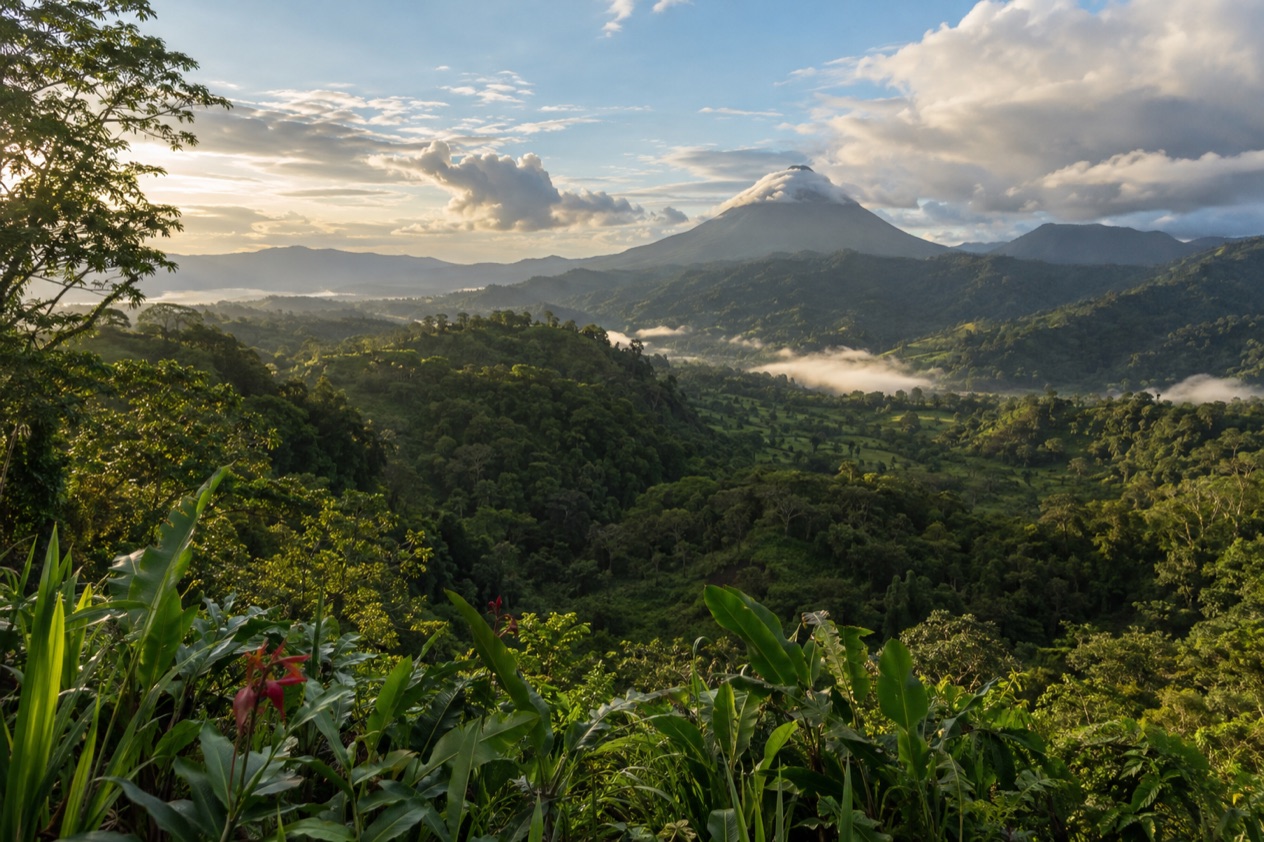
By July, the afternoon sky above the Central Valley goes slate gray, thunder comes rolling down off the volcanoes, and half the street makes a dash for the awning of a soda, those little family lunch counters, where a plate of casado steams on the counter. An hour later the clouds break and the hills steam in the sun.
The whole country is deep green, the beaches are wide and uncrowded, and the school break keeps Costa Rican families on the road. It is a month for rainforest, rivers and warm water, with a plan built around the morning hours.
What is the weather like in Costa Rica in July?
July is green season on the Pacific side and in the Central Valley, while the Caribbean follows a different pattern: warm and showery in the Central Valley, cool and misty in the mountains, hot with afternoon storms on the North Pacific coast, very wet on the central Pacific coast, and gray-and-sunny by turns on the Caribbean side.
| Place | Region | Average high (°F) | Average low (°F) | Rain (in) | Rain days |
|---|---|---|---|---|---|
| San Jose | Central Valley | 75.3 | 64.4 | 11.70 | 22.6 |
| Monteverde | Northern mountains | 75.7 | 65.8 | 8.28 | 17.1 |
| Tamarindo | North Pacific (Guanacaste) | 85.0 | 76.4 | 7.96 | 18.0 |
| Manuel Antonio | Central Pacific | 79.8 | 70.8 | 35.65 | 29.9 |
| Puerto Viejo de Talamanca | Caribbean coast | 81.0 | 72.1 | 17.34 | 27.8 |
No two spots on the Pacific coast differ more than these two beaches. Tamarindo is the hottest and among the least rainy places on the list, and its showers usually come as an afternoon storm after a bright morning. Manuel Antonio, a few hours down the coast, gets several times as much rain, with wet days piling up one after another and the jungle behind the beach dripping most of the time.
The highlands are the mild part of the map. In the afternoon San Jose and Monteverde feel pleasant, and by night they turn cool enough that you will want a light layer, but most days bring rain to San Jose, usually during the later part of the day.
On the Caribbean coast, the schedule is completely different from the Pacific: nearly every day brings rain to Puerto Viejo, with warm conditions and sunny breaks between some showers. The sea on all three coastal places sits in the mid-80s, warm enough to swim without a second thought about temperature, though the waves are another matter.
Where to go in Costa Rica in July
A chain of volcanic peaks runs down the middle of Costa Rica, so the weather can differ a lot between two spots only an hour apart. In July that is an advantage: you can build a trip around the mornings and pick the region that suits the kind of day you want.
The North Pacific and Guanacaste
Guanacaste is the part of the Pacific side where July is easiest to live with. Mornings are hot, bright and made for the beach, a surf lesson or a walk along the sand at Tamarindo, and the clouds tend to build after lunch. The landscape has gone from golden to green, and the cattle country inland looks almost Irish after a few weeks of rain.
The closest airport is Liberia (LIR). Many of these beaches offer lively surf, and on most of them there are no lifeguards or warnings about unsafe conditions, while rip currents prove very dangerous and claim the lives of several U.S. tourists every year.
Ask your hotel about the day’s conditions before you go in. This region suits beach lovers who like heat and are happy to schedule storms as siesta time.
The central Pacific coast around Manuel Antonio
Manuel Antonio is the wettest place on the table, and July here is a rainforest month in the full sense. The reward is a thick, loud, intensely green national park edge, with monkeys, birds and the odd sloth showing up for guided walkers. Seeing a sloth or a monkey is never guaranteed, but a guided walk can improve your chances.
Plan the beach and the walks for the first part of the morning, then spend the wet hours over a long lunch of fresh fish and fruit on the hillside above the coast. Heavy rain can turn trails muddy and slow the road along the coast, so keep the schedule loose. It suits travelers who want jungle atmosphere more than a dry beach day.
The Caribbean coast around Puerto Viejo
On the Caribbean coast, the seasons follow a rhythm all their own, so you get rainfall every month and nowhere to escape to when a true dry spell never arrives. In this easygoing town of Puerto Viejo de Talamanca, you will see bikes, hear reggae drifting out of open doorways, and taste rice and beans simmered in coconut milk, while July brings warm rain showers that give way to sunny breaks. Many travelers find it a good counterweight when the Pacific is at its soggiest.
The beaches stretch south from town, with dark sand and strong surf in places, so the same rip-current caution applies. Between showers there is cycling along the coast road, chocolate and cacao tastings, and jungle walks with plenty of frogs and birds. Keep in mind that the Atlantic hurricane season is under way, so keep an eye on the forecast.
The Central Valley and the cloud forest of Monteverde
San Jose and the valley around it have mild days, a rain shower nearly every afternoon, and mornings that are usually the best time for markets, coffee farms and museums. The Mercado Central, the cafés of Barrio Escalante and a coffee plantation tour are options for the morning, leaving the wet afternoon for a long lunch or a museum.
Monteverde is cooler, damp and often wrapped in cloud, which is exactly what a cloud forest should look like. Hanging bridges, hummingbird gardens and night walks in search of frogs and insects are the pleasures, and a rain jacket is a daily companion. The volcanoes near the Central Valley, Poas and Irazu, often have their summits hidden by clouds by midday, so an early start matters, and each has its own access rules.
What to do in Costa Rica in July
Guanacaste Day on July 25
The national holiday of the month is July 25, the Annexation of the Partido de Nicoya, which marks Guanacaste joining Costa Rica. It is a public holiday across the country, and it is felt most in Guanacaste itself, where the province takes real pride in its folk music, its dress, its cowboy heritage and its cooking.
In towns such as Nicoya and Santa Cruz, expect local celebrations and a festive mood, and in restaurants look for corn-based Guanacaste dishes such as tamales, tortillas and sweet corn treats. The holiday also makes for a busy long weekend on the roads and beaches, so book rooms early if your trip crosses that date.
Rainforest, rivers and volcano country
July is for rainforest walks and the green turtle nesting season around Tortuguero. Morning is the time for guided walks, hanging bridges, canopy lines and river trips, when the light is good and the animals are most active. Around La Fortuna, the Arenal volcano towers over hot springs and waterfalls, and a soak in warm water after a rainy day is one of the great pleasures of the country.
Every volcano follows its own entry rules, and those rules shift, so before you go, look up the official page for the park of the volcano you intend to visit. By noon, clouds frequently cover a peak, so head out early and consider a clear look into the crater a lucky extra.
Beaches, surf and long lunches
Warm water makes the coast easy to enjoy at any hour. Surf schools along the Pacific work with the swell, and boat trips along the coast are a good way to see the shoreline from the water. Rainy afternoons are for fresh ceviche, a plate of casado (rice, beans, plantains, salad and a choice of meat or fish) and a coffee in a small café while the storm passes.
Is Costa Rica busy in July?
It is moderately busy, with a different crowd than in the dry months: U.S. families on summer vacation and Costa Rican families on their own school break. The schools take a two-week mid-year break in July, and that keeps local families traveling, especially to the beaches and the hot-spring towns.
The places that fill up are the easy-to-reach beaches of Guanacaste and the central Pacific, the area around La Fortuna and any coast town on a long weekend, especially the one around July 25. Rooms and tours there are easier to find if you book ahead. Beach towns can feel lively on weekends with domestic visitors, and quieter midweek.
The calm places are the ones off the classic route: the Caribbean south of Puerto Viejo, small mountain villages, quiet stretches of the Pacific coast and the cloud forests outside the busiest hours. Overall the rainy-season mood is relaxed, with no high-season crush at the volcanoes and parks, and a more local flavor in the towns.
What to pack for Costa Rica in July
Pack for rain everywhere and for heat on the Pacific coast, with a warm layer for the mountains and the Central Valley evenings. Beach days call for light, quick-drying clothes, while Monteverde and the volcano areas want long sleeves and a real rain jacket.
- A lightweight, truly waterproof rain jacket, since an umbrella does poorly on windy cloud-forest trails.
- Quick-drying shirts and shorts, plus a spare set that stays dry in your bag.
- Shoes with a good grip for muddy trails, and sandals that can get wet for the beach and the river.
- A light sweater or fleece for Monteverde, San Jose evenings and the volcano areas.
- Sunscreen and a hat for bright Pacific mornings, and insect repellent for the forest and the evenings.
- A dry bag or plastic pouch for your phone, passport and camera.
Good to know before you go
The U.S. State Department rates Costa Rica Level 2, ‘Exercise increased caution,’ due to crime; it says petty crime is common throughout Costa Rica and that violent crime also affects tourists, including armed robbery, homicide and sexual assault.
July falls inside the Atlantic hurricane season, which runs from June 1 to November 30 and covers the Caribbean Sea, though its peak comes later, around September 10. Watch the forecast if you are heading to the Caribbean coast.
The U.S. State Department rates Costa Rica Level 2, exercise increased caution, due to crime, noting that petty crime is common throughout the country and that violent crime also affects tourists. Check the advisory and the guidance for the regions you plan to visit before you travel.
Is July a good time to visit Costa Rica?
Yes, for travelers who like green landscapes, warm sea and fewer crowds at the major sights, and the North Pacific coast of Guanacaste is the best region to aim for, with its hot mornings and relatively modest rainfall. The Central Valley and Monteverde are good second choices for coffee, cloud forest and mild temperatures, while Manuel Antonio and the Caribbean call for a flexible attitude toward rain.
Compared with June, July sits in the same green-season pattern, with afternoon rain on the Pacific side and the Central Valley and rain all year on the Caribbean coast. August follows the same rhythm, so the choice between the three months comes down more to your calendar and school schedules than to a big change in the weather. Some years bring a short lull in the rain in the middle of the green season, and locals sometimes call it the veranillo, a little summer, but it is a chance and not something to plan a trip around.
What makes July its own month is the combination of the school break, the Guanacaste holiday on July 25 and a landscape at its greenest. Wake early, spend the mornings outdoors, and let the afternoon storm decide when lunch begins. A day that ends with a warm soak near Arenal or a cool evening in the cloud forest is exactly the kind of day this month does well.
Sources
- Open-Meteo / ECMWF ERA5, normals 1991-2020 computed for the grid cell at 9.9281N 84.0907W, checked October 8, 2026
- Open-Meteo / ECMWF ERA5, normals 1991-2020 computed for the grid cell at 10.3009N 84.8248W, checked October 8, 2026
- Open-Meteo / ECMWF ERA5, normals 1991-2020 computed for the grid cell at 10.2993N 85.8371W, checked October 8, 2026
- Open-Meteo Marine API, average 2015-2024, checked October 8, 2026
- Open-Meteo / ECMWF ERA5, normals 1991-2020 computed for the grid cell at 9.392N 84.1366W, checked October 8, 2026
- Open-Meteo / ECMWF ERA5, normals 1991-2020 computed for the grid cell at 9.6558N 82.7541W, checked October 8, 2026
- U.S. Department of State, Costa Rica Travel Information, Safety and security (https://travel.state.gov/content/travel/en/international-travel/International-Travel-Country-Information-Pages/CostaRica.html), checked October 8, 2026
- NOAA National Hurricane Center, Climatology (https://www.nhc.noaa.gov/climo/), checked October 8, 2026
- U.S. Department of State, Costa Rica Travel Advisory, issued April 1, 2026 (https://travel.state.gov/content/travel/en/traveladvisories/traveladvisories/costa-rica-travel-advisory.html), read via the State Department open data API on October 8, 2026
- U.S. Department of State, Costa Rica Travel Information, Entry and exit requirements (https://travel.state.gov/content/travel/en/international-travel/International-Travel-Country-Information-Pages/CostaRica.html), checked October 8, 2026
To plan your stay
- Things to Do in Costa Rica: Volcanoes, Beaches, Wildlife and Day Trips
- Where to Stay in Costa Rica: Beach Towns, Cloud Forest, Volcano Views and Which Base Fits Your Trip
- Costa Rica Airports: San Jose or Liberia? Beaches, Drive Times and Getting to Your Hotel
- Know Before You Go to Costa Rica: Entry Rules, Money, Getting Around and Local Customs