
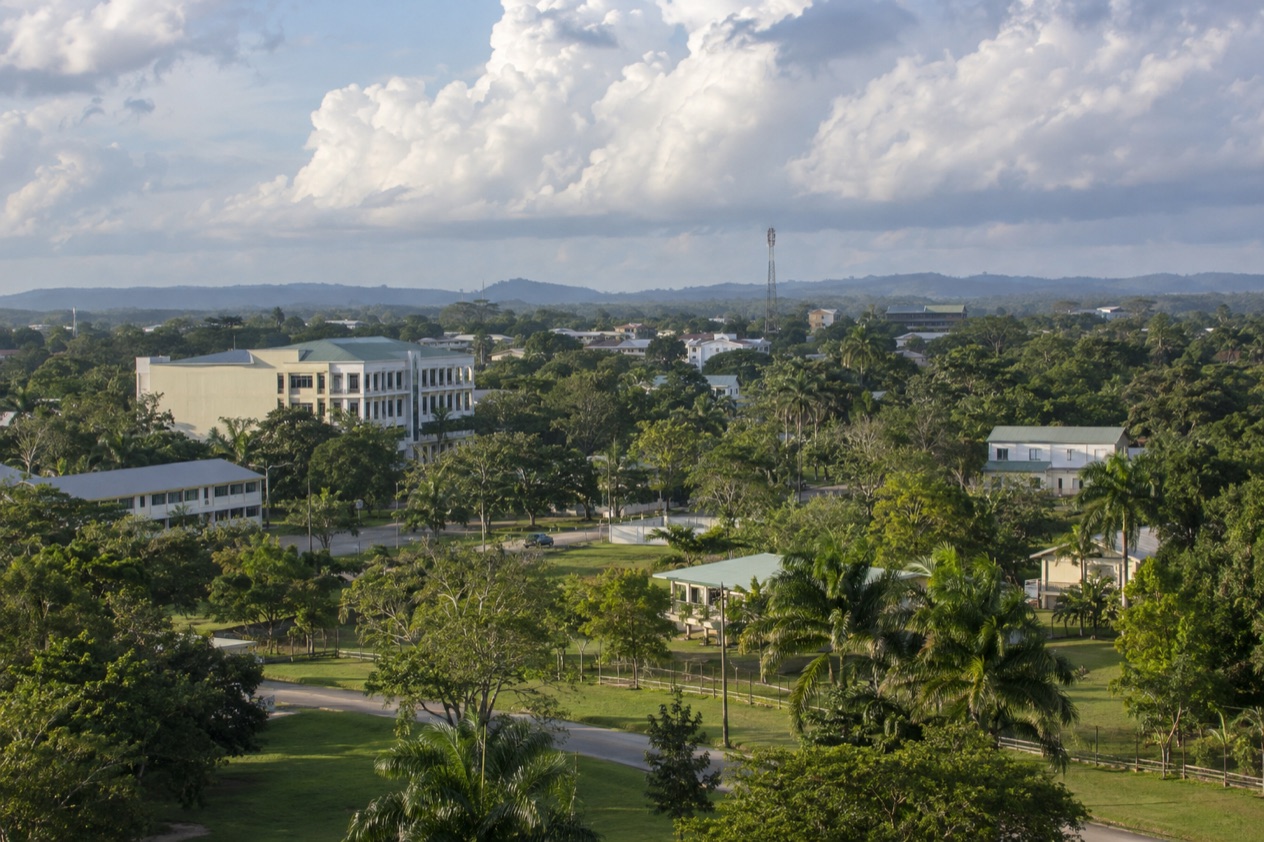
In July the hills around Belmopan are as green as they get, and the air smells of wet leaves and woodsmoke from kitchens where stew chicken is simmering. Rain has soaked the Cayo District into full leaf, the trees along the Hummingbird Highway are heavy with growth, and the town moves at an unhurried pace. It is a month for jungle parks, home cooking and slow days inland, away from the reef.
What is the weather like in Belmopan in July?
July in Belmopan is hot, green and wet: the rainy season is in full swing, and the days are long and bright between the showers.
| Month | Daylight on the 15th |
|---|---|
| June | 13 hours 12 minutes |
| July | 13 hours 06 minutes |
| August | 12 hours 44 minutes |
The rainy season in Belize typically lasts through November, so July sits in its early stretch. Expect a month of showers rather than a month of drizzle, with sunshine in between. The forest around town drinks it all in, and the light after a downpour turns the hillsides a deep, glossy green that photographs well.
In Belize City, highs average about 89°F in July, and that gives you the feel of the season: warm, humid and made for light clothes. Belmopan sits well away from the coast, so there is no sea to plan around. What shapes your days here is the rain and the long daylight, which leaves plenty of time for a park, a market and a late dinner.
July also falls within the Atlantic hurricane season, which runs from June 1 to November 30. The peak of that season comes in September, with most activity between mid-August and mid-October, so July is an early month in the calendar.
A tropical system can still bring days of heavy rain far from the coast, which is worth remembering when you plan outdoor days. Pack as if every day might be wet, and enjoy the dry ones as a bonus.
What to do in Belmopan in July
July is the month of lobster coming back. The closed season for lobster in Belize runs from March 1 to June 30, so by July the first lobster of the new season is back on menus across the country, and cooks are glad to have it.
Inland, you will more often meet it grilled or in a creamy sauce at a restaurant that buys from the coast. Alongside it, you eat what Belize eats every day: rice and beans with stew chicken, fry jacks, hot sauce on the table, and fruit juice from whatever is ripe.
The rainy season is also when the forest is at its loudest. Frogs, insects and birds fill the evenings, and the rivers run full. Outdoor plans in July work best when you build in slack. Treat the rain as part of the day, not as a reason to cancel, and keep a covered lunch stop in mind.
St. Herman’s Blue Hole National Park
The park lies twelve miles southeast of Belmopan, on the right side of the Hummingbird Highway as you drive south, and it is the outing that most defines a stay here. It protects a stretch of forest with two cave systems, St. Herman’s and Crystal, and a jungle pool called the Blue Hole for its vivid color. In July the forest around it is thick and dripping, and the pool takes on a deep, saturated tone under the canopy.
The park covers about 575 acres of forest rich with wildlife, so even on a gray day there is plenty to look at: roots, ferns, birdsong and the sound of water. It was first declared a national park in 1986 and renamed in 2005 so it would not be confused with the Blue Hole Natural Monument at sea.
That distinction matters, because the sea-going Blue Hole is a completely different place. This one is a green, shaded park inland, and rain only adds to its atmosphere.
Belmopan’s town center and market
Belmopan is a planned town with wide streets, low government buildings and a calm feel, and its pleasures are small and local. The market is where the month shows itself: stacks of ripe mangoes and other seasonal fruit, vegetables from Cayo farms, and stalls selling hot lunches. Locals and visitors share the same benches, and a plate of rice and beans with stew chicken is the standard order.
Rain is no obstacle here, because much of the day’s life happens under roofs and awnings. Wander the stalls, try a fresh juice, and sit in a café or small restaurant until the shower passes. In the evening, family-run places serve Belizean plates alongside Maya, Mestizo and Creole dishes, reflecting the communities that make up the Cayo District.
Green spaces and forest walks
Belmopan has pockets of forest that suit a rainy month, and Guanacaste National Park, a small wooded reserve at the edge of town, is one of them. Its great tree gives it the name, and the birds are the draw. In July the canopy is full and the paths are damp, so sturdy shoes make the visit more comfortable.
The same green season that makes the forest lush also fills the air with insects, and the sounds of the evening are part of the experience. Birdwatchers will find the rainy months rewarding, with trees in fruit and birds busy in the branches. Between showers, the forest feels freshly washed.
A two-day itinerary for Belmopan in July
Day 1 belongs to the town itself. Start early with a Belizean breakfast of fry jacks, eggs and fresh juice at a small local place, then walk the center of Belmopan while the streets are quiet. Move on to the market for fruit and a look at what is in season, and keep the rest of the morning loose for the forest at Guanacaste National Park, where the trees are fully leafed in July.
Have lunch at a family-run restaurant, where rice and beans with stew chicken is the safe choice, and let any shower pass over you with a second juice. With 13 hours of daylight, there is no rush, so the afternoon can stretch into a slow walk or a rest. In the evening, find a restaurant serving lobster, now back on the menu after the closed season, and sit late.
Day 2 goes south to St. Herman’s Blue Hole National Park on the Hummingbird Highway. Aim to arrive early, walk through the forest to the jungle pool, and take in the cave systems from the park’s paths. Stay for the quiet that follows a rainfall, when the forest drips and the birds are loudest.
Head back toward Belmopan for a late lunch and an evening at a local restaurant. If the rain turns heavy, trade the forest for a long lunch, a café stop and a stroll through the market stalls, then try the park again if the weather clears.
Is Belmopan busy in July?
Belmopan keeps a steady, quiet rhythm in July, and it is a town that never feels crowded in any season. It sits inland, away from the reef, so the beach-driven rush belongs to the coast and the cayes. Here, the day goes to errands, markets and lunches, with travelers passing through on their way to caves, rivers and ruins in the Cayo District.
July falls outside the February to May dry season, which makes the month a green-season stay. The forest parks are in full leaf, the roads run through lush country, and a rainy afternoon is part of the plan. A traveler who comes now meets the countryside in its most vivid state, and meets Belmopan as it is for the people who live there.
What fills up is whatever is smallest: a table at a favorite restaurant on a weekend evening, or a room at a small lodge near a park. Keep your plans for the forest parks flexible, since the weather decides much of the day. It is wise to settle your main nights early and leave the days open, so a gray morning can become a market morning without cost.
What to pack for Belmopan in July
Pack for warm, wet days in town and on forest trails. Light clothes that dry quickly will serve you better than anything heavy, and a few small items protect the rest of your things.
- A light rain jacket or poncho, because showers come with the rainy season.
- Quick-dry shirts and shorts, since the air stays warm and humid.
- Shoes with good grip for the damp paths at St. Herman’s Blue Hole National Park.
- A dry bag or waterproof pouch for your phone and passport during showers.
- A hat and sunglasses for the bright hours between the rain.
- A small day pack for market fruit and snacks.
Good to know before you go
The U.S. State Department rates Belize Level 2, “Exercise increased caution”, because of crime, and says the south side of Belize City has historically had the highest concentration of violent crime.
July falls within the Atlantic hurricane season, which runs from June 1 to November 30, and an average season brings 14 named storms. Belize has felt several of them, including Hurricane Hattie in 1961, Hurricane Keith in September 2000 and Hurricane Earl, which made landfall on August 4, 2016. For a July stay, keep an eye on the forecast and keep your days adaptable.
The U.S. Embassy is in Belmopan, at #4 Floral Park Road, open Monday through Thursday from 7:30am to 5:15pm and Friday from 7:30am to 12:30pm. U.S. citizens with an emergency can call (+501) 822-4011, including outside office hours. English is Belize’s official language, so signs, menus and conversations are straightforward.
Belmopan in July vs June and August
Moving the trip earlier to June gives you the very start of the rainy season and slightly longer days, with the most daylight of the three months. The closed season for lobster runs through June 30, so the first lobster of the new season is a July pleasure and not yet a June one. Hurricane season has just begun in June, with its peak still months away.
Moving later to August brings shorter days and the build toward the busiest stretch of the Atlantic hurricane season, with most activity between mid-August and mid-October. The forest stays lush and the markets keep their summer fruit. Hurricane Earl, which came ashore in Belize on August 4, 2016, is a reminder that the season gathers strength as the weeks pass.
If lobster on the menu and a long, bright day matter most, July is the pick. Choose June if you want the most daylight, and August if you favor a deeper green forest and do not mind a later-summer storm season. Travelers whose plans are fixed on a dry trip are better off in the February to May dry season.
Is July a good time to visit Belmopan?
Yes, for travelers who like lush forest, local food and a calm town, and who are happy to treat rain as part of the trip. July suits birdwatchers, cooks, anyone drawn to the Cayo District’s parks, and people who like a slower pace inland. It suits less well anyone who wants guaranteed dry weather, in which case the dry season is a better match.
On arrival, start with the market, where the month’s fruit and hot lunches show you the town at once, and then plan St. Herman’s Blue Hole National Park for a day when the sky looks promising. Keep the rest of your schedule loose. What makes July in Belmopan its own is the green: forests at full leaf, lobster returning to the table, frogs and birds loud in the evening, and a town that stays calm while the countryside around it is most alive.
Sources
- sunrise-sunset.org, sunrise and sunset calculated for the 15th of the month, checked October 11, 2026
- NOAA NCEI, GHCN-Daily station BHM00078583 (Philip S. W. Goldson International Airport, Belize City), normals 1991-2020 computed from the daily record (https://www.ncei.noaa.gov/access/services/data/v1?dataset=daily-summaries&stations=BHM00078583), checked October 11, 2026
- NOAA National Hurricane Center, Climatology (https://www.nhc.noaa.gov/climo/), checked October 11, 2026
- Wikipedia, Hurricane Hattie (https://en.wikipedia.org/wiki/Hurricane_Hattie), checked October 11, 2026
- Wikipedia, Hurricane Keith (2000) (https://en.wikipedia.org/wiki/Hurricane_Keith_(2000)), checked October 11, 2026
- Wikipedia, Hurricane Dean (https://en.wikipedia.org/wiki/Hurricane_Dean), checked October 11, 2026
- Wikipedia, Hurricane Lisa (2022) (https://en.wikipedia.org/wiki/Hurricane_Lisa_(2022)), checked October 11, 2026
- Wikipedia, Hurricane Earl (2016) (https://en.wikipedia.org/wiki/Hurricane_Earl_(2016)), checked October 11, 2026
- Wikipedia, Hurricane Iota (https://en.wikipedia.org/wiki/Hurricane_Iota), checked October 11, 2026
- San Pedro Belize Express Water Taxi, Caye Caulker (https://belizewatertaxi.com/destinations/caye-caulker/), checked October 11, 2026
- Belize Fisheries Department, Bacalar Chico Marine Reserve (https://fisheries.gov.bz/bcmr/), checked October 11, 2026
- Belize Fisheries Department, Turneffe Atoll Marine Reserve (https://fisheries.gov.bz/tamr/), checked October 11, 2026
- Belize Fisheries Department, Regulations (https://fisheries.gov.bz/regulations/), checked October 11, 2026
- Belize Tourism Board, Sargassum resource (https://www.belizetourismboard.org/tourism-resources/sargassum-resource/), checked October 11, 2026
- U.S. Embassy in Belize (https://bz.usembassy.gov/), checked October 11, 2026
- Belize Audubon Society, St. Herman's Blue Hole National Park (https://belizeaudubon.org/shbh/), checked October 11, 2026
- Wikipedia, St. Herman's Blue Hole National Park (https://en.wikipedia.org/wiki/Blue_Hole_National_Park), checked October 11, 2026
- Wikipedia, Museum of Belize (https://en.wikipedia.org/wiki/Museum_of_Belize), checked October 11, 2026
- Wikivoyage, Belize (https://en.wikivoyage.org/wiki/Belize), checked October 11, 2026
- Wikipedia, Climate of Belize (https://en.wikipedia.org/wiki/Climate_of_Belize), checked October 11, 2026
- U.S. Department of State, Belize Travel Information, Entry and exit requirements (https://travel.state.gov/), checked October 11, 2026
- U.S. Department of State, Belize Travel Advisory, Level 2, March 11, 2026 (https://travel.state.gov/), checked October 11, 2026
To plan your stay
- Things to Do in Belmopan: St. Herman's Blue Hole, Maya Ruins, Belizean Food and Day Trips
- Where to Stay in Belmopan: Government Campus, Floral Park Road and Cayo District Lodges
- Belmopan from Belize City: Bus, Rental Car, Airport Roadwork and Stops Along the Way
- Best Time to Visit Belmopan: Dry Season, Weather by Month and Festivals