
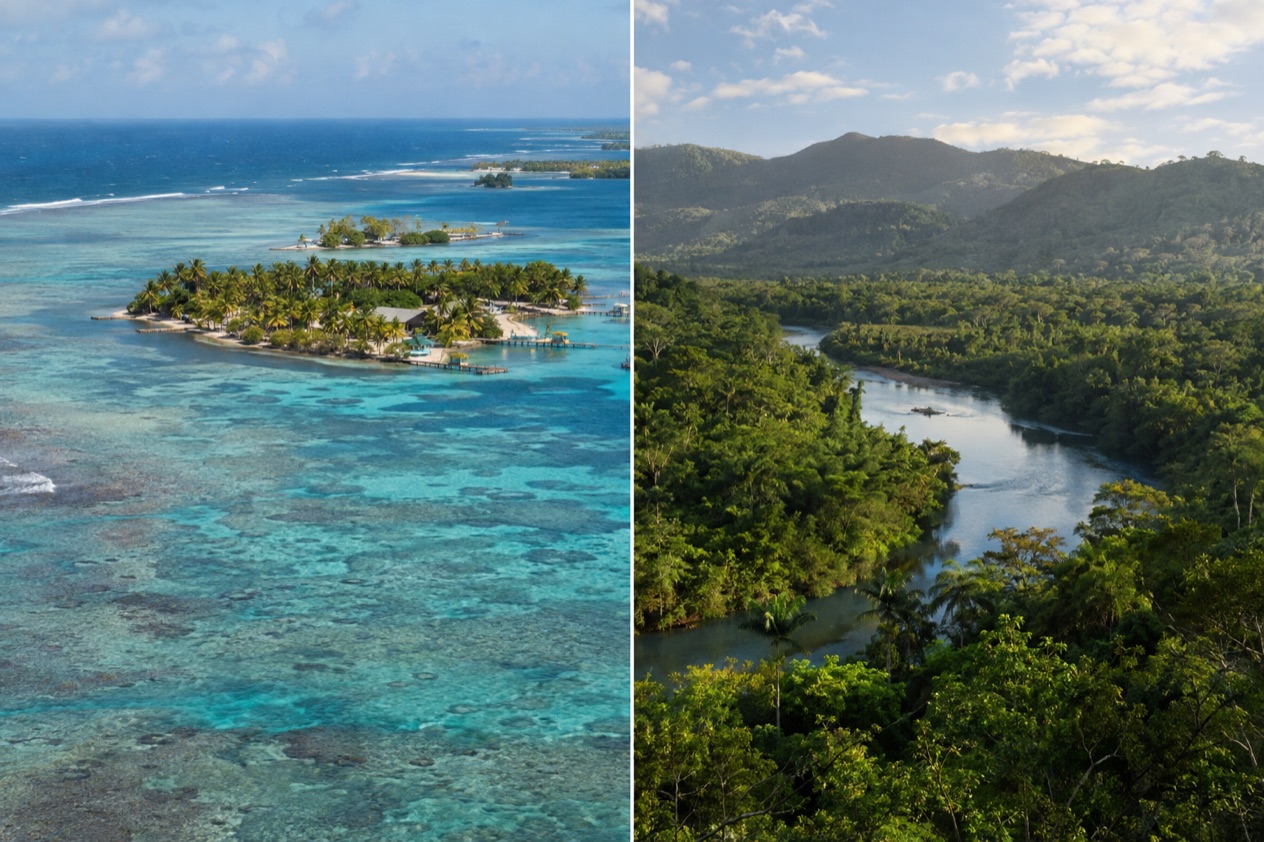
On a Belizean caye, the morning begins with fry jacks on a plate, pelicans on the dock posts and a long turquoise line where the reef breaks the swell. In Jamaica, a bass line drifts from a roadside speaker, jerk smoke curls off an oil-drum grill and the Blue Mountains stand hazy behind the coast.
Both are English-speaking Caribbean getaways, yet they feel very different once you arrive. The choice comes down to whether you want a reef and a jungle or an island with a big musical and culinary personality.
Which is better, Belize or Jamaica?
Belize suits travelers who want to snorkel and dive a barrier reef, walk through rainforest and visit Maya sites, while Jamaica suits those who want an island built around music, food, mountains and a lively resort coast. Neither is better in the abstract. They answer different questions, and the table sets the two side by side before the sections that follow take each topic in turn.
| Category | Belize | Jamaica |
|---|---|---|
| Beaches | Sand on small cayes set inside the barrier reef, with the reef as the main attraction offshore | A long, varied coastline, with Montego Bay on the north coast as a well-known resort base |
| Vibe | Laid-back, English and Creole spoken, Garifuna, Maya, Creole and Mennonite communities side by side | Outgoing and musical, with a strong sense of national identity in food, speech and sound |
| Things to do | Reef and atoll trips, the Great Blue Hole, Maya ruins, caves and jungle lodges | Marine park at Montego Bay, Blue Mountain hiking and coffee country, waterfalls, Kingston’s music heritage |
| Nightlife | Beach bars on the cayes, live drumming, small-town evenings | Reggae and dancehall, sound systems and street parties |
| Weather | Dry season from February to May, rainy season running through November, hurricane season June to November | Tropical, hot and humid, cooler in the higher inland regions, within the Atlantic storm zone |
| Getting there | An international airport near Belize City, then cayes and towns off the coast | An island south of Cuba, with Montego Bay and Kingston as the main hubs |
| Best for | Divers, snorkelers, wildlife and ruin lovers | Music fans, food lovers, hikers and resort-goers |
A traveler who plans to spend most days in or beside the water, with a day or two inland among ruins and birds, will find Belize fits. A traveler who plans around meals, sound systems, mountain mornings and a busier resort scene will find Jamaica fits. A few people want both, and the last sections explain how that works.
Beaches and the sea
In Belize, the sea is defined by the Belize Barrier Reef, the second-largest coral reef system in the world and a UNESCO World Heritage Site. The reef sits close to shore in the north and farther out in the south, so the water inside it looks different from one stretch of coast to another. Many of the beaches are on cayes, small sandy islands where palm trees lean over the shoreline and a dock often counts as the main street.
San Pedro Town on Ambergris Caye lies off the coast of the mainland, and Caye Caulker has its own odd feature, the Split, cut by Hurricane Hattie in 1961. Beyond the cayes lie three atolls, Turneffe Atoll, Glover’s Reef and Lighthouse Reef. Sargassum can reach Caribbean shores, and the Belize Tourism Board describes it as part of the region’s conditions, so the look of a particular beach on a particular day is not something to promise.
Jamaica’s coast offers a different picture. The north coast around Montego Bay is one of the best-known tourism stretches in the Caribbean, with resort beaches, hotels and a busy waterfront. Montego Bay also holds Jamaica’s first marine park, set up in 1992, which protects a stretch of reef and sea close to the city.
Jamaica is a large island rather than a string of small cayes, so its shoreline changes character as you travel around it. You find resort strips, fishing villages with grilled fish on the sand, and quieter bays backed by hills. Mountains rising behind the coast give the beach scenes a green, steep backdrop that Belize’s low coastline does not.
So who comes out ahead? If the sea itself is the reason for the trip, meaning the reef, the atolls and the Great Blue Hole, Belize is built around that.
If you want a beach as one part of a trip that also includes a lively town, food stalls and mountains, Jamaica’s coast fits that rhythm. The conditions of any single beach change with the weather and the season, so treat both coasts as places to look at on arrival, not as guarantees.
Things to do
Belize’s headline activity is the reef. Lighthouse Reef, the most easterly diving area in the country, is home to the Great Blue Hole, a protected natural monument and a prime ecotourism destination in Belize District. Turneffe Atoll lies directly east of Belize City and is the nearest of the atolls to it, while Glover’s Reef is the third of the group. Divers and snorkelers plan whole trips around these names.
The mainland adds a second chapter. Maya sites such as Xunantunich, Caracol, Lamanai and Altun Ha rise out of jungle, and the Cayo District around San Ignacio is known for lodges, rivers and caves, including the Actun Tunichil Muknal cave.
The keel-billed toucan is the national bird, and birders and wildlife watchers come for it and for the country’s many protected species. Cockscomb Basin Wildlife Sanctuary and Crooked Tree are nature stops with their own character.
Food in Belize follows its mix of cultures. Rice and beans with stew chicken is the everyday plate, fry jacks turn up at breakfast, and Garifuna cooking brings hudut, fish in coconut broth served with mashed plantain. In Hopkins and Dangriga, Garifuna drumming is part of the evening air. Nightlife stays small-scale, with beach bars on Ambergris Caye and Caye Caulker, a rum punch and a band, rather than clubs and sound systems.
Jamaica’s list begins with sound. Reggae and dancehall are everywhere, from street corners to evening parties, and Kingston is the city of Bob Marley’s story. Food is just as central, with jerk chicken and pork cooked over pimento wood, patties from a bakery counter, ackee and saltfish at breakfast and curry goat at lunch.
The island also has real elevation. Blue Mountain Peak, at 2,256 meters, is the tallest mountain, and the Blue Mountains are known for coffee. Waterfalls, river rides and cave and cliff-edge spots fill out the day-trip list around Montego Bay and the north coast. In short, Belize gives you wilderness with a reef at the door, and Jamaica gives you a strong cultural scene with the mountains as a bonus.
Weather and the best time to go
In Belize, the dry season usually runs from February to May, and the rainy season lasts through November. The dry months are when many travelers plan reef days, since the days are sunny and the air is warm without being at its fullest humidity. The rainy months bring greener forests, more showers and a quieter feel at some jungle spots.
Belize City’s own figures show the swing between a winter and a summer month. January is the cooler of the two, with evenings comfortable enough for a light layer, while July is clearly hotter and feels heavier at night. Rain comes in both months, so a rain jacket belongs in the bag whenever you go.
| Belize City | Average high (°F) | Average low (°F) | Precipitation (inches) | Rain days |
|---|---|---|---|---|
| January | 83.2 | 68.0 | 4.97 | 10.3 |
| July | 89.3 | 77.0 | 5.73 | 11.8 |
Storms matter on both sides. The Atlantic hurricane season runs from June 1 to November 30, and in Belize, hurricanes that bring coastal flooding are prevalent in those months, especially in the south. The Split at Caye Caulker is a reminder of what a strong storm can do to a coastline. Traveling between December and May keeps you outside that official window.
Jamaica’s climate is tropical, hot and humid, though higher inland regions are more temperate. That makes the Blue Mountains a natural escape from coastal heat, with cooler air for walks and coffee farm visits. The island lies within the Main Development Region for Atlantic tropical cyclone activity and sometimes suffers significant storm damage, so the same hurricane calendar applies.
When to choose each? For Belize, a reef-focused trip fits the dry season, while a jungle trip rewards you at any time of the year if you accept some rain. For Jamaica, plan the beach days for the coast and the cooler air of the hills for another day, and keep the storm months in mind when booking. Both places reward flexibility more than a fixed itinerary.
Getting there and getting around
Belize’s international gateway is the Philip S. W. Goldson International Airport near Belize City, the largest city in the country. From there, travelers head to the cayes, the coast or the Cayo District. San Pedro Town on Ambergris Caye sits off the mainland coast, so reaching it means crossing water.
Belize is a small country with a population of 397,483 in the 2022 census, and Belmopan is the capital. The shape of a trip there is a series of separate bases: a caye for the reef, the Cayo District for ruins and caves, and perhaps the south for Garifuna villages. Each base has its own feel, and you move between them rather than touring in a loop.
English is the official language of Belize, the only Central American country with that status. That shapes how you move around, since signs, menus and conversations with drivers, boat crews and hosts are in English, usually with Creole spoken alongside it. Driving rules, rentals and transport details belong with the place you are visiting, so plan each leg on its own terms.
Jamaica is a single large island, south of Cuba and west of Hispaniola. Kingston is the capital and largest city, and Montego Bay on the north coast is the main tourism hub. A trip there usually centers on one coast, with excursions across the island to the mountains or the other shore.
Local taxis called route taxis are part of everyday island travel, and one example puts a ride of 20 miles at about J$50. The departure tax is regularly included in the airfare, so there is no separate exit tax to pay on the way out. Roads between cities can be demanding, which is worth remembering when planning long transfers.
Money differs on each side. Jamaica’s currency is the Jamaican dollar, with the code JMD, while Belize uses the Belize dollar. Keep that in mind when you compare menus and tour listings, because the same number means different things in each country.
Who should choose which
Choose Belize if the reef is the main draw and you want to spend days around cayes, atolls and the Great Blue Hole. Choose it too if you like the idea of pairing a coast stay with a few nights in a jungle lodge, a Maya site and a cave, all in a country where English is the official language. It suits people who enjoy wildlife, small towns and a slower evening, and it works well for couples, divers and families who like nature more than nightlife.
Choose Jamaica if you want an island with a strong cultural presence: reggae, jerk, Blue Mountain coffee and a lively resort coast around Montego Bay. It suits travelers who like their vacation to have a soundtrack, who want mountain air within reach of the beach, and who enjoy eating their way across a place. It also suits those who prefer a larger, more varied island over a string of small cayes.
Combining the two on one trip is possible in principle, since both sit in the Caribbean and both speak English. In practice they are separate countries with separate hurricane exposure, separate currencies and separate travel logistics, so each deserves its own stretch of time. Most travelers do better to choose one for a single vacation and save the other for a second trip.
Good to know before you go
The U.S. State Department rates Belize Level 2, “Exercise increased caution”, because of crime, and says the south side of Belize City has historically had the highest concentration of violent crime.
The Atlantic hurricane season, June 1 to November 30, covers both destinations, so travel dates in those months deserve a look at the forecast before you commit. In Belize City, the south side has historically had the highest concentration of violent crime, and in Jamaica violent crime is a risk throughout the island, though tourist areas generally see lower rates.
Private hospitals in Jamaica require payment up front before admitting patients, and ambulance services are not always readily available, especially in rural areas. Currency, taxes and insurance are worth sorting out well before you leave.
Sources
- Wikipedia, Belize (https://en.wikipedia.org/wiki/Belize), checked October 11, 2026
- Wikivoyage, Belize (https://en.wikivoyage.org/wiki/Belize), checked October 11, 2026
- Wikipedia, Tourism in Belize (https://en.wikipedia.org/wiki/Tourism_in_Belize), checked October 11, 2026
- Wikipedia, Wildlife of Belize (https://en.wikipedia.org/wiki/Wildlife_of_Belize), checked October 11, 2026
- U.S. Department of State, Belize Travel Information, Travel Advisory (Level 2) (https://travel.state.gov/), checked October 11, 2026
- U.S. Department of State, Belize Travel Information, Entry and exit requirements (https://travel.state.gov/), checked October 11, 2026
- Wikipedia, Jamaica (https://en.wikipedia.org/wiki/Jamaica), checked October 11, 2026
- Wikivoyage, Jamaica (https://en.wikivoyage.org/wiki/Jamaica), checked October 11, 2026
- U.S. Department of State, Jamaica Travel Advisory (https://travel.state.gov/), checked October 11, 2026
- U.S. Department of State, Jamaica Travel Information, Entry and exit requirements (https://travel.state.gov/), checked October 11, 2026
- NOAA NCEI, GHCN-Daily station BHM00078583 (Philip S. W. Goldson International Airport, Belize City), normals 1991-2020 computed from the daily record (https://www.ncei.noaa.gov/access/services/data/v1?dataset=daily-summaries&stations=BHM00078583), checked October 11, 2026
- U.S. Department of State, Belize Travel Advisory, Level 2, March 11, 2026 (https://travel.state.gov/), checked October 11, 2026
- NOAA National Hurricane Center, Climatology (https://www.nhc.noaa.gov/climo/), checked October 11, 2026