
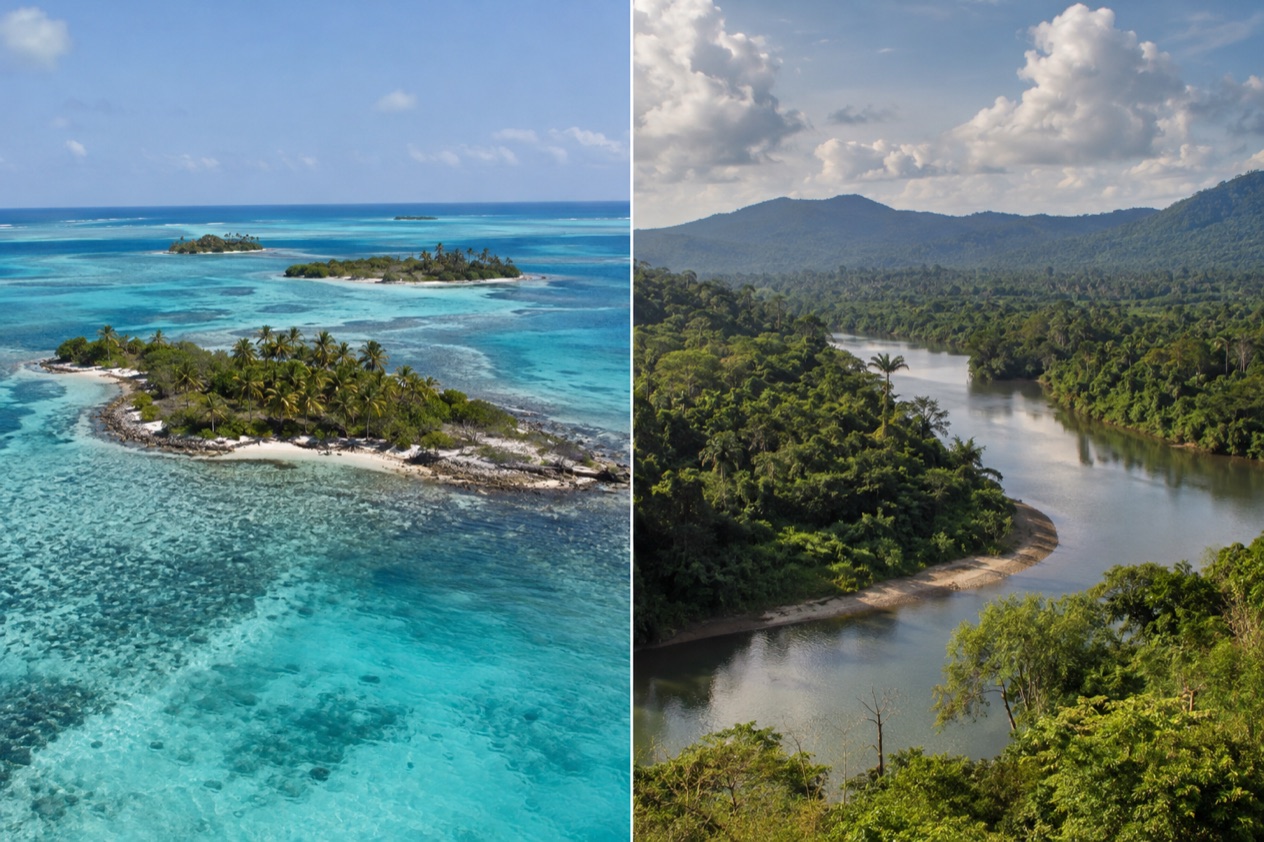
Off Ambergris Caye, a small boat idles over the second-largest barrier reef in the world while you pull on a snorkel mask, and the only language on the dock is English. Both are Central American escapes built around nature, and the choice comes down to whether you want a reef and a laid-back caye, or volcanoes, cloud forest and two coastlines.
Which is better, Belize or Costa Rica?
Belize suits travelers who want to snorkel or dive a barrier reef, speak English everywhere and keep the trip compact, while Costa Rica suits those who want big national parks, wildlife viewing, surf and a wider menu of landscapes. Neither is a wrong choice. They simply point your vacation in different directions.
Belize is small, with a population of about 400,000 in the 2022 census, and the feel is that of a Caribbean country with Creole, Garifuna, Maya and Mennonite communities side by side. Costa Rica is a bigger stage, with a capital, San José, whose metropolitan area holds around two million people, and a tourism industry that has long drawn more visitors from the United States than from any other country.
| Category | Belize | Costa Rica |
|---|---|---|
| Beaches | Caribbean cayes and the barrier reef offshore | Caribbean coast to the east and Pacific coast to the west |
| Vibe | Small, English-speaking, island-and-jungle pace | Larger and more varied, with a developed nature-tourism circuit |
| Things to do | Reef snorkeling and diving, the Great Blue Hole, Maya sites, caves, rainforest | National parks, volcano country, cloud forest, surfing, wildlife viewing |
| Nightlife | Beach bars and small-town evenings on the cayes | Beach towns and the capital |
| Weather | Dry season February to May, rainy season through November | Dry season December to April, rainy season May to November |
| Getting there | Flights into Belize City, then boat or small plane to the cayes | Flights to San José or Liberia, then roads to the parks and beaches |
| Best for | Reef lovers, divers, easy communication in English | Wildlife, surf, hiking and variety |
Beaches and the sea
Belize’s sea is the headline. The Belize Barrier Reef is a UNESCO World Heritage Site and the second-largest reef system in the world, running along the coast and lying much closer to shore in the north than in the south. Out beyond it sit three atolls, Turneffe Atoll, Glover’s Reef and Lighthouse Reef, and Lighthouse Reef is home to the Great Blue Hole, a protected natural monument that Jacques Cousteau made famous in 1970.
The beach experience on the cayes is more about the water than the sand. Piers reach out into turquoise shallows, boats leave for the reef from San Pedro on Ambergris Caye, and Caye Caulker carries a mark of its own, the Split, a channel cut by Hurricane Hattie in 1961. Sargassum can reach Caribbean shores, so the look of a given beach on a given week is never guaranteed.
Costa Rica has two coastlines, the Caribbean to the east and the Pacific to the west, and that is its advantage. You can choose a surf town on one side or a long Pacific beach backed by forest on the other, and many of the places visitors head to, including Tamarindo and Manuel Antonio, are coastal. The sea there has a different character from the reef-sheltered Belizean shallows, with more surf culture and fewer reef excursions.
The winner depends on what you do in the water. For snorkeling, diving and boat days over coral, Belize wins clearly. For variety of coastline, surf and beaches set against mountains and rainforest, Costa Rica takes it.
Things to do
In Belize, the days revolve around the reef and the interior. On the water you snorkel or dive, and the Great Blue Hole and the atolls draw divers.
Inland, the country is known for rainforest, Maya archaeological sites such as Xunantunich, Caracol, Lamanai, Altun Ha and Cahal Pech, caves like the ATM cave (Actun Tunichil Muknal), and wildlife reserves such as Cockscomb Basin Wildlife Sanctuary. The keel-billed toucan, the national bird, is the one to look for.
Food in Belize reflects its mix of cultures: rice and beans with stewed chicken, fry jacks at breakfast, fresh seafood on the cayes and Garifuna dishes along the southern coast. Evenings are easygoing, with beach bars in San Pedro and Caye Caulker rather than big clubs.
Costa Rica leans on its protected land, with national parks and protected areas covering almost 28% of the country. It holds about 5% of the world’s biodiversity on a tiny share of the planet’s landmass, and Corcovado National Park is renowned among ecologists, with big cats and tapirs, and it is the one park where all four Costa Rican monkey species can be found.
Beyond Corcovado, visitors fan out to Arenal, Monteverde, Manuel Antonio, Tamarindo and Liberia, and San José serves as a city stop with its own restaurants and bars. Think volcano views, zip lines over the cloud forest, surf lessons and long hikes, with gallo pinto and casado plates as the everyday meal.
If your ideal day ends with wet fins and a rum punch, pick Belize. If it ends with muddy boots and a wildlife list, pick Costa Rica.
Weather and the best time to go
Both countries follow a dry season and a rainy season, and the calendars overlap. In Belize, the dry season typically lasts from February to May, with the rainy season running through November. Costa Rica’s dry season, which locals call summer, runs from December to April, and the rains arrive from May to November.
That means February to April is the sweet spot for both. December and January are dry in Costa Rica, though they are the coldest months there, while March and April are the hottest. In Belize City, January brings highs in the low 80s and a damp feel with around ten rainy days, and July warms to the upper 80s with a similar number of rain days.
| Belize City | Avg high (°F) | Avg low (°F) | Rain (in) | Rain days |
|---|---|---|---|---|
| January | 83.2 | 68.0 | 4.97 | 10.3 |
| July | 89.3 | 77.0 | 5.73 | 11.8 |
Storms matter in Belize. The Atlantic hurricane season runs from June 1 to November 30, and hurricanes that bring coastal flooding, especially in the south of Belize, are prevalent from June to November. Costa Rica’s rainy season runs from May to November, so its wet months fall in the same part of the year.
For a reef trip, the drier months of Belize bring the easiest planning. For Costa Rica, the dry months are the classic window for beaches and volcano views, while the rainy season turns the forest deeply green.
Getting there and getting around
From there, San Pedro Town on Ambergris Caye lies about 43 miles (roughly 43 miles) off the coast, so the cayes mean a hop over water. Turneffe Atoll lies directly east of Belize City and is the nearest of the atolls to it.
Costa Rica spreads out more. Visitors pass through San José and Liberia, then travel on to Tamarindo, Arenal, Manuel Antonio or Monteverde, which means longer overland legs between the beach, the volcano and the cloud forest. Driving carries real penalties there, including a US$310 fine for going more than 12 miles/h over the limit and a prison sentence plus a US$480 fine for blood alcohol of 0.08 or higher.
For entry, U.S. citizens need a U.S. passport valid for the length of their stay in Belize, an onward or return ticket and sufficient funds to cover the whole stay. Costa Rica admits visitors from most developed countries without a visa for 180 days.
In practice, Belize rewards a base-and-excursion trip, one caye or one inland lodge with outings from there. Costa Rica suits a route with several stops, since its highlights lie in different regions.
Who should choose which
Choose Belize if the reef is the reason you are going, if you want to dive the Great Blue Hole or snorkel off a caye, or if English as the official language, the only one of its kind in mainland Central America, makes the trip feel easier. It also suits travelers who like a small country where jungle lodges, Maya ruins and island time fit into one trip.
Choose Costa Rica if you want wildlife on a grand scale, surf, volcano country, cloud forest and the option of two oceans. It suits travelers building a longer route with different landscapes, and those who want a well-established nature-tourism circuit.
Combining them is possible for a longer trip, pairing reef days in Belize with parks and Pacific beaches in Costa Rica. Each has its own season and its own character, so the contrast is the point.
Good to know before you go
The U.S. State Department rates Belize Level 2, “Exercise increased caution”, because of crime, and says the south side of Belize City has historically had the highest concentration of violent crime.
Belize’s hurricane season runs June to November, so build some flexibility into trips in those months. Costa Rica’s rainy season also begins in May. Keep the usual travel habits in both countries, such as watching your belongings and planning your arrivals and rides sensibly.
| Fee | Amount | Who pays |
|---|---|---|
| Costa Rica exit fee, outbound international flights | US$29, payable in cash or by Visa | Travelers flying out of Costa Rica |
Sources
- Wikipedia, Belize (https://en.wikipedia.org/wiki/Belize), checked October 11, 2026
- Wikivoyage, Belize (https://en.wikivoyage.org/wiki/Belize), checked October 11, 2026
- Wikipedia, Tourism in Belize (https://en.wikipedia.org/wiki/Tourism_in_Belize), checked October 11, 2026
- Wikipedia, Wildlife of Belize (https://en.wikipedia.org/wiki/Wildlife_of_Belize), checked October 11, 2026
- U.S. Department of State, Belize Travel Information, Travel Advisory (Level 2) (https://travel.state.gov/), checked October 11, 2026
- U.S. Department of State, Belize Travel Information, Entry and exit requirements (https://travel.state.gov/), checked October 11, 2026
- Wikipedia, Costa Rica (https://en.wikipedia.org/wiki/Costa_Rica), checked October 11, 2026
- Wikivoyage, Costa Rica (https://en.wikivoyage.org/wiki/Costa_Rica), checked October 11, 2026
- NOAA NCEI, GHCN-Daily station BHM00078583 (Philip S. W. Goldson International Airport, Belize City), normals 1991-2020 computed from the daily record (https://www.ncei.noaa.gov/access/services/data/v1?dataset=daily-summaries&stations=BHM00078583), checked October 11, 2026
- U.S. Department of State, Belize Travel Advisory, Level 2, March 11, 2026 (https://travel.state.gov/), checked October 11, 2026
- NOAA National Hurricane Center, Climatology (https://www.nhc.noaa.gov/climo/), checked October 11, 2026