
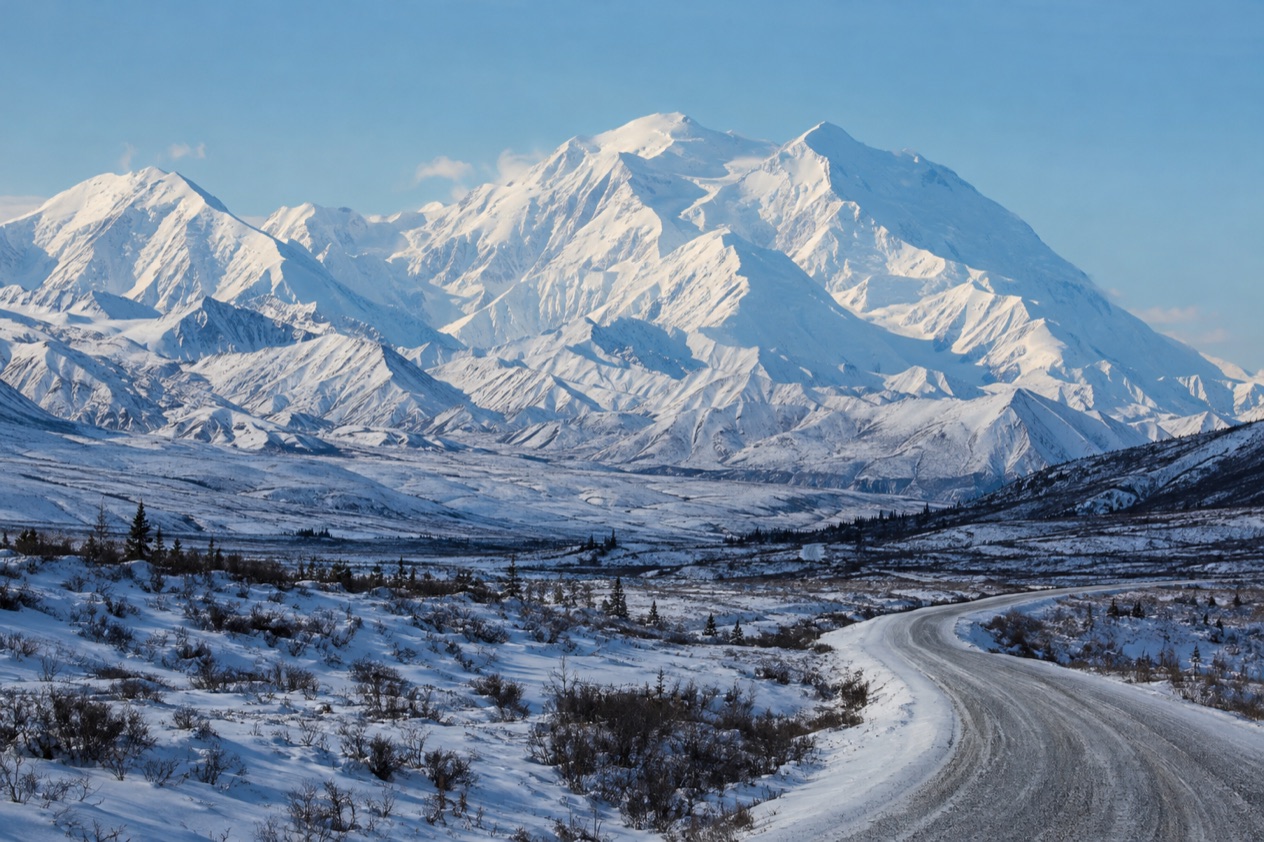
In January, snow squeaks underfoot in Denali, spruce branches hold their load without a sound, and a raven’s call carries a long way across the cold. The light is low and brief, and the stillness is the main event. This is the park in its winter season: quiet trails near the entrance, sled dogs on weekend afternoons, and long dark evenings that give the aurora a chance to show.
What is the weather like in Denali National Park in January?
January in Denali is deeply cold, with afternoon highs far below freezing, nights that fall below zero, and very little precipitation, almost all of it falling as dry snow.
| Month | Average high (°F) | Average low (°F) | Precipitation (in) | Daylight on the 15th |
|---|---|---|---|---|
| December | 14.8 | -5.6 | 1.18 | 4 h 37 min |
| January | 13.8 | -5.3 | 0.79 | 5 h 35 min |
| February | 24.7 | 4.7 | 0.72 | 8 h 38 min |
The precipitation figure counts melted snow, so a month like this brings light, powdery snowfalls rather than heavy storms. Mornings are the coldest part of the day, and the afternoon barely softens it. Nothing here feels like a thaw, and the snow on the ground stays dry and squeaky from one week to the next.
The light shapes the day as much as the temperature. The sun stays low and the daylight window is short, though it has already grown noticeably since the middle of December. Mornings and evenings are dark, so outdoor plans cluster in the middle of the day, and the evening belongs to warm rooms and, with luck, a clear sky.
What this means for packing is simple: layers, insulated boots, and covered hands and face. Cold air that stays this still lets you stay out longer than you might expect, as long as you keep moving and keep your extremities dry. Compared with the weeks on either side, January sits in the cold middle of the winter.
What to do in Denali National Park in January
Winter in Denali is about slowing down. The park’s winter season runs from late September until early May, and January falls in the heart of it. Most organized events belong to summer, and bus service across the park runs only in summer too, so the month offers a different experience: quiet snow, sled dogs, short outings near the entrance and long evenings under a dark sky.
The things to do cluster around the park entrance. A few places are open, a few trails are there to be walked, and the rest of the park is left to the snow. That focus makes planning easy. You choose a handful of outings, leave space between them for warming up, and let the cold set the pace.
The sled dog kennels
The park’s kennels are open in winter on weekend afternoons only, which makes them the one fixed appointment of a January visit. Sled dogs have worked in this country for generations, and in Alaska they traditionally pull side by side in pairs rather than in the fan shape often pictured elsewhere. Meeting them in the snow, with frost on their coats, is a good way to understand why the park keeps them.
You may see the dogs in their yards and learn how the teams and the high-railed freight sleds work. It suits anyone with an interest in animals or in the history of travel across the Alaskan winter. Plan the rest of the trip around the weekend, since on weekdays the kennels are closed.
| Site | Open |
|---|---|
| Denali National Park kennels (late September through winter) | Saturdays and Sundays, 1 pm to 4 pm |
| Ranger by phone | Daily, 9 am to 4 pm, except major holidays |
Murie Science and Learning Center and the entrance trails
In winter the visitor center for the park is the Murie Science and Learning Center, at mile 1.3 on the Denali Park Road. It is the place to start: a warm room, a chance to learn about the park’s winter and science programs, and a way to take the measure of the season before you head out. Stopping in before any outing is a good habit when the weather decides everything.
Most of the marked trails in the park are short and near the entrance, which makes them the natural choice in January. Denali also lets hikers go off-trail in nearly any direction, but in this cold and dark that is a different undertaking from the entrance paths. The Park Road may close at Mountain Vista (mile 13) or Park Headquarters (mile 3) at any time because of winter weather, so the stretch near the start of the road is what you can count on seeing, if conditions allow.
Aurora nights
The Northern Lights oval covers most of Alaska, and in Fairbanks the viewing season runs roughly from late August to late April, so January sits comfortably inside it. The aurora needs a clear sky, and it stays a chance, not a promise. Interior Alaska sees activity somewhat less often near the winter solstice than around the equinoxes, so patience and a flexible evening help.
With long nights and little light around, the sky is dark for many hours, which is the real gift of the month. You may step outside after dinner, bundled up, and look for a pale green band along the horizon. Some evenings stay cloudy, and the stars alone are still worth the cold.
Outside those outings, January is for hot drinks, hearty meals and early nights. Snow tracks around the entrance may tell a story of animals that passed in the dark, and with the park this quiet, small sights loom large.
A two-day itinerary for Denali National Park in January
Day 1 starts late, because the morning is dark and the cold is at its sharpest. Linger over breakfast at your lodging, then head to the Murie Science and Learning Center once the light has come up. Spend a while there getting a feel for the park in winter, and call the ranger line if you want a word about conditions on the road.
Midday is the warmest and brightest part of the day, so it is the time for the trails near the entrance. Choose one marked path, walk it slowly, and turn back when your hands tell you to. If it is a Saturday or Sunday, plan the afternoon for the sled dog kennels. Dinner is a hot, filling meal at a local restaurant or at your lodging.
Day 2 is for the Park Road and the sky. After a slow morning, drive as far as winter conditions allow, remembering that the road may be closed near its start at any time. Use the daylight for photographs of the snowy forest and, on a clear day, a look toward the big mountain, which sometimes shows itself.
As evening comes, trade the road for a warm base and a window with a dark view. Step out as often as you like to check the sky for the aurora, which needs clear weather. If snow or cloud settles in, the day tilts toward a long, cozy time indoors, with a hot drink and a book, and nothing is lost.
Is Denali National Park busy in January?
No, January is a quiet month in Denali, deep inside the winter season that runs from late September to early May.
Most organized events at the park take place in summer, from mid-May through mid-September, and the bus service across the park runs only in summer as well. The three free shuttle lines around the entrance are also a summer feature. In January you will not find that kind of activity, and the pace around the entrance is slow, set by the cold and the short days.
For the traveler, that means few other visitors on the trails and a calm feeling in the area. The things that do run, like the weekend kennels, are small and personal. Campground reservations for the park can open as early as December 1 of the year before, but camping is a summer matter and has little to do with a winter trip.
What to pack for Denali National Park in January
Pack for deep, dry cold and short days, with everything meant to keep you comfortable on short walks and still evenings.
- Insulated, waterproof boots, because the snow is deep and the ground stays frozen.
- Several thin layers plus a warm outer coat, so you can adjust as you move.
- A warm hat, a face covering and insulated mittens, for the coldest mornings.
- Spare gloves and socks, in case a pair gets damp.
- A headlamp, since mornings and evenings are dark.
- A camera and extra batteries kept warm, for snow scenes and the sky.
Good to know before you go
The winter visitor center is the Murie Science and Learning Center, and a ranger answers the phone daily during the day, except on major holidays. The Denali Park Road may close at Park Headquarters or Mountain Vista at any time because of winter weather, so keep your plans near the entrance flexible.
The sled dog kennels open only on weekends in winter, which is the first thing to fit into your calendar. The daylight is short this month, so do your outdoor outings in the middle of the day. Bus service across the park and the free entrance shuttles belong to summer, so January plans rest on walking and on your own vehicle.
Denali National Park in January vs December and February
Moving the trip four weeks earlier brings you to December, the darkest month, with the shortest daylight and a similar cold. It is a month for those who want the deepest winter, and the long nights give the sky more time to put on a show. January keeps most of that atmosphere while the daylight has already begun to stretch.
Four weeks later, February is noticeably milder, with afternoons that feel less harsh and a much longer day. That extra light makes outings easier to fit in, and the nights are still long enough for aurora watching. The winter season continues in both months, and the same weekend kennel schedule applies, so the park keeps the same quiet character.
Choose December if you want the darkest, quietest stretch of the winter. Stay with January for a balance, with deep cold, a little more light and the full mood of the season. Shift to February if you want gentler afternoons and more daylight for walks.
Is January a good time to visit Denali National Park?
Yes, January is a good time for travelers who love quiet, cold and snow, and who are happy with a slow schedule built around a few simple outings.
It will suit people who like to watch the sky, meet sled dogs and walk in silent woods. It will not suit anyone who wants to cross the park by bus, join a ranger program or camp, since those belong to summer. If long, dark days and deep cold sound unpleasant, another month is the better choice.
On arrival, stop first at the Murie Science and Learning Center to take the measure of the season, and check which weekend afternoon fits the kennels. Then keep the days simple. A walk near the entrance, a hot meal, and a look at the sky after dark are enough for a satisfying visit.
What makes January special is the silence. With the summer buses gone and the park nearly empty, the snow, the low light and the dogs in their yards have the place to themselves, and you share it with them.
Sources
- NOAA NCEI, U.S. Climate Normals 1991-2020, monthly (https://www.ncei.noaa.gov/access/services/data/v1?dataset=normals-monthly-1991-2020&stations=USW00096408), station Denali 27 N, elevation 2225 feet, checked October 11, 2026
- Computed from the date and the latitude of the place (sunrise equation, solar elevation -0.833 degrees), October 11, 2026
- University of Alaska Fairbanks Geophysical Institute, Aurora forecast (https://www.gi.alaska.edu/monitors/aurora-forecast), checked October 11, 2026
- Wikivoyage, Northern lights (https://en.wikivoyage.org/wiki/Northern_lights), checked October 11, 2026
- Wikipedia, Aurora (https://en.wikipedia.org/wiki/Aurora), checked October 11, 2026
- Visit Anchorage, northern lights viewing (https://www.anchorage.net/winter/things-to-do/northern-lights-viewing/), checked October 11, 2026
- Visit Anchorage, dog sledding (https://www.anchorage.net/winter/things-to-do/dog-sledding/), checked October 11, 2026
- Wikipedia, Dog sled (https://en.wikipedia.org/wiki/Dog_sled), checked October 11, 2026
- National Park Service, Denali National Park & Preserve, plan your visit: kennels (https://www.nps.gov/dena/planyourvisit/kennels.htm), checked October 11, 2026
- National Park Service, Denali National Park & Preserve, plan your visit: winter activities (https://www.nps.gov/dena/planyourvisit/winter-activities.htm), checked October 11, 2026
- Wikipedia, Polar night (https://en.wikipedia.org/wiki/Polar_night), checked October 11, 2026
- National Park Service, Denali National Park & Preserve, plan your visit: calendar (https://www.nps.gov/dena/planyourvisit/calendar.htm), checked October 11, 2026
- National Park Service, Denali National Park & Preserve, plan your visit: campgrounds (https://www.nps.gov/dena/planyourvisit/campgrounds.htm), checked October 11, 2026
- National Park Service, Denali National Park & Preserve, plan your visit: conditions (https://www.nps.gov/dena/planyourvisit/conditions.htm), checked October 11, 2026
- National Park Service, Denali National Park & Preserve, plan your visit: courtesy shuttle buses (https://www.nps.gov/dena/planyourvisit/courtesy-shuttle-buses.htm), checked October 11, 2026
- National Park Service, Denali National Park & Preserve, plan your visit: dayhiking (https://www.nps.gov/dena/planyourvisit/dayhiking.htm), checked October 11, 2026
- Wikipedia, Climate of Alaska (https://en.wikipedia.org/wiki/Climate_of_Alaska), checked October 11, 2026
To plan your stay
- Things to Do in Denali National Park: Park Road Rides, Sled Dogs, Trails and Where to Eat
- Where to Stay in Denali National Park: Park Entrance, Healy, Backcountry Lodges and Campgrounds
- Denali National Park from Anchorage: the Parks Highway, the Denali Star Train and Park Shuttles
- Know Before You Go to Denali National Park: Fees, Bus Season, Weather and Bears