
Just after dusk, the pink stone of Morelia’s cathedral turns warm gold, and families drift across the Plaza de Armas with paper cones of fruit and cups of hot charanda punch. Under the arcades, waiters carry trays between tables and a band tunes up somewhere nearby.
Morelia is a colonial city built for walking, for travelers who like their history in churches, courtyards and good kitchens. It also makes a handy base for Purépecha lake country, with its ruins, copper villages and island fishing towns.
What are the best things to do in Morelia?
The best things to do in Morelia are mostly on foot in the historic center, then out to the lakes and villages of Michoacán.
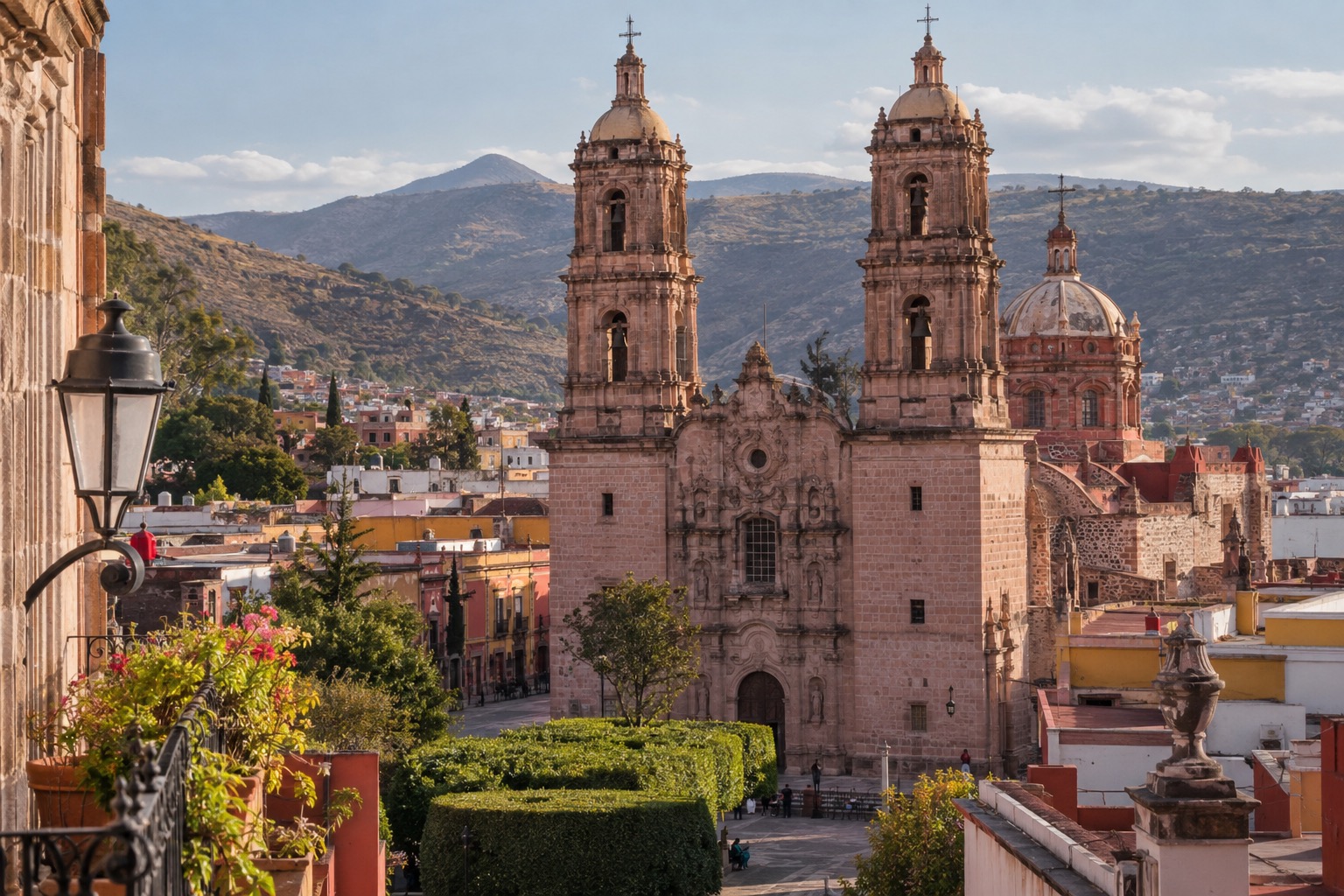
- Stand in front of the pink-stone cathedral and its twin towers on the Plaza de Armas.
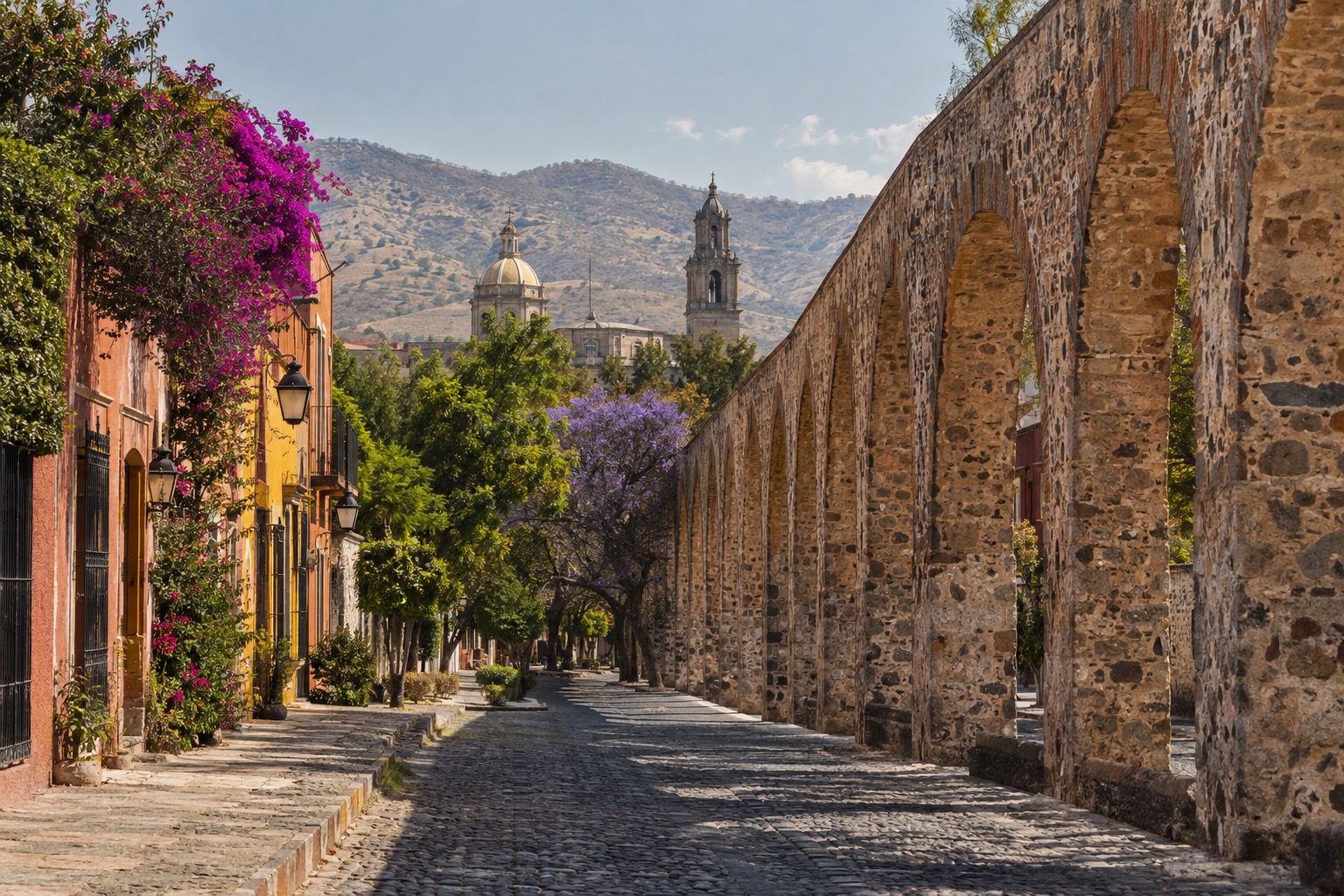
- Walk the arches of the old aqueduct toward the Fuente de las Tarascas.
- Visit the Museo Regional de Michoacán, a Baroque palace full of local history.
- Taste sweets at the candy market and in the old confectioneries.
- Stroll the shady paths of the Bosque Cuauhtémoc and the garden spaces nearby.
- Spend an evening on the plaza and in the cobbled lanes around it.
- Take a day to Tzintzuntzan, the old Purépecha capital above Lake Pátzcuaro.
- Try corundas, uchepos and carnitas at the family places in town.
Sights and landmarks in Morelia
The cathedral and the Plaza de Armas
The pink-stone cathedral anchors the Plaza de Armas at the heart of the historic center, and its twin baroque towers are the first thing you see from almost any street. The stone shifts from salmon to rose to gold as the sun moves, so it is worth passing at different hours.
Inside, the mood is calm and spacious, with a famous organ and a sculpture of the Lord of the Sacristy that locals visit devotedly. Afterward, sit under the portales across the way, where the plaza’s street life plays out: shoe-shiners, balloon sellers, couples on the benches and the occasional brass band.
Museo Regional de Michoacán
This museum fills a Baroque palace built by Isidro Huarte near the cathedral, and it is the oldest museum in its national network. It was restored to international conservation standards, and the building is as much a draw as the collection. Arcaded courtyards, a grand staircase and painted ceilings frame rooms on pre-Hispanic Michoacán, the colonial era and the independence years.
It suits a quiet hour or two, especially when the afternoon sun is strong and you want a cool, shaded interior. History lovers will linger, and anyone who has not yet been to Tzintzuntzan gets a useful sense of the Purépecha world here first.
| Site | Open | Admission |
|---|---|---|
| Museo Regional de Michoacán | Tuesday to Sunday, 9 a.m. to 5 p.m. | 145 pesos; 80 pesos for Mexican nationals and foreign residents |
The aqueduct and the Tarascas fountain
A long line of stone arches runs along Avenida Acueducto toward the Fuente de las Tarascas, a fountain of bronze figures holding up a basket of fruit. The arches look best late in the day when the light is low and the lamps along the avenue come on.
You can follow it on foot from the center, pausing at the benches beneath the arches. It is a simple outing, free of ticket lines, and a natural link between the old center and the more residential streets beyond.
Churches, courtyards and colleges
Around the center, the colonial city reveals itself in small doses: former convents turned into craft houses, the old Colegio de San Nicolás, the Clavijero palace with its quiet patios, and churches whose carved façades glow in the same pink stone as the cathedral. The Casa de las Artesanías is a good stop for lacquerware, copper, guitars from Paracho and embroidered textiles.
Just wander the side streets rather than following a strict route. Almost every block has a courtyard open to the street, a café behind a heavy wooden door or a small plaza with a fountain.
Outdoor things to do in Morelia
Bosque Cuauhtémoc and the garden paths
The Bosque Cuauhtémoc is the city’s green lung, a shady park of tall trees close to the center where office workers take a break and families spread out on weekends. Paths wind between lawns, a small museum building and a fountain, with vendors selling snacks and ice cream.
Go in the morning or late afternoon, when the air is cooler and the park fills with joggers and strollers. Other gardens nearby, including the Jardín de las Rosas near the conservatory, add more places to sit with a coffee.
Walking the Calzada Fray Antonio de San Miguel
This tree-lined calzada leads from the aqueduct toward the Santuario de Guadalupe, with the Convento de San Diego and the Plaza Villalongín close by. It has a neighborhood feel, with old houses, bakeries and cafés, and it is one of the most pleasant stretches for an unhurried walk.
Morelia sits high, so a slower pace helps on your first day. Stop often, drink water and let the evening breeze do the rest.
Markets and open-air corners
The Mercado de Dulces, just off the main plaza, is a sweet-shop lane where ate (fruit paste), candied fruit, morelianas (milk-caramel wafers) and coconut sweets are piled high. The larger Mercado Independencia sells produce, flowers, cheeses and fried snacks, and gives a livelier look at daily life. On weekends, craft stalls and small fairs pop up in squares around the center, so a stroll often turns into a shopping trip for ceramics or woven goods.
Day trips from Morelia
Tzintzuntzan and the Purépecha capital
Tzintzuntzan was the Purépecha capital, on the shore of Lake Pátzcuaro. You walk among the yácatas, the rounded and rectangular stone platforms on a terrace above the water, and look out over the lake and the hills beyond. A former Franciscan convent stands nearby with old olive trees in its atrium.
Buses and cars run from Morelia toward the lake, and the village has a craft market with straw figures, pottery and woven pieces. Late morning gives you good light on the stone, and the lakeside breeze is welcome in the afternoon. It suits anyone interested in pre-Hispanic history who wants an easy, open-air site.
| Site | Open | Admission |
|---|---|---|
| Tzintzuntzan | Daily, 9 a.m. to 6 p.m. (last entry 5 p.m.) | 210 pesos; 105 pesos for Mexican nationals and foreign residents |
Pátzcuaro and its lake
Pátzcuaro is a colonial town of whitewashed walls, red-trimmed doorways and tiled roofs, built around two plazas named for Vasco de Quiroga and Gertrudis Bocanegra. Arcaded portales hold restaurants where you can order lake whitefish (pescado blanco) and a bowl of sopa tarasca.
Boats leave from the docks for the island of Janitzio, known for its fishing traditions and its hilltop statue. The town fills with life around Día de Muertos, when families keep vigils and the lake villages draw visitors from across the country. It is best as a full day, with time for the market, the plazas and a lakeside lunch.
Villages of copper, guitars and more
Several smaller towns repay a visit. Santa Clara del Cobre is known for hand-hammered copper pots and pitchers, and the workshops line the main streets. Paracho is the guitar-making town, with shops full of instruments in every size. Uruapan has its Parque Nacional, where springs and waterfalls run through lush gardens, and it is a base for visiting the Paricutín volcano area.
In the winter months, the monarch butterfly sanctuaries in the mountains east of the city draw nature lovers. Each of these places works best as its own outing rather than stacked into one rushed day.
What to eat in Morelia
Morelia eats carnitas, enchiladas morelianas and corundas, and then finishes with something sweet. Carnitas arrive by the pound from copper pots, with tortillas, salsa, pickled onions and a squeeze of lime. Enchiladas morelianas are tortillas dipped in a red chile sauce and filled with cheese, then topped with potatoes, carrots and chicken.
Corundas are triangular tamales wrapped in a green corn leaf and served with cream and salsa. Uchepos, softer and sweeter tamales made from fresh corn, show up when the corn is in season. A bowl of sopa tarasca, a tomato and bean soup with strips of fried tortilla, is the local comfort food.
For sweets, look for ate with cheese, morelianas, cocadas and churros with hot chocolate. Drinks include charanda, a sugarcane spirit from the region, and atole in the morning. Gazpachos, the Morelia version, are a fruit cocktail with jicama, cheese and chile, and they sell from stands near the plaza and the aqueduct.
Things to do in Morelia at night
Evenings in Morelia center on the plaza, where the cathedral glows and people sit at café tables under the portales until late. The mood is relaxed and family-friendly, with live music drifting from restaurants and street musicians working the arcades.
On special occasions the cathedral is lit with a light and sound show, and the lanes behind it fill with strollers. The Callejón del Romance, a narrow passage near the plaza, is a favorite for couples, and small bars around the center serve mezcal, craft beer and charanda with live guitar.
For a quieter night, grab a table at a courtyard restaurant, order hot chocolate and a sweet and watch the lights come on along the aqueduct. Street stands selling tacos, corn and gazpacho keep going well into the evening.
Things to do in Morelia with kids
Children do well in Morelia because the center is compact, car-free in places and full of squares where they can run. The Bosque Cuauhtémoc has lawns and playgrounds, and a small train or pedal boats may be on offer in the city’s larger parks.
The candy market is a hit, with sweets of every color to pick and taste. The city also has a zoo, a planetarium and a hands-on science museum, and the aqueduct walk is an easy stroll at their pace.
Keep the altitude in mind, since the city sits high and the sun is strong even on mild days. Bring hats, water and shoes made for cobblestones, and plan breaks in shady plazas so little legs stay happy.
Good to know before you go
The U.S. State Department rates the state of Michoacan at Level 4, Do Not Travel — the same level as Acapulco’s Guerrero.
The historic center is best explored on foot, with taxis and ride-hailing for the longer hops to the aqueduct, the Bosque Cuauhtémoc or the bus terminal. Pesos are the currency, and small shops, market stalls and food stands prefer cash, so keep a few bills handy. Regional buses and cars connect Morelia to the lake towns, and the shorter outings fit well into a single day.
Sources
- INAH, Museo Regional de Michoacan (inah.gob.mx/museos/museo-regional-de-michoacan-dr-nicolas-leon-calderon), checked September 29, 2026
- INAH, meme page, checked September 29, 2026
- INAH, Zona Arqueologica de Tzintzuntzan (inah.gob.mx/zonas/zona-arqueologica-de-tzintzuntzan), checked September 29, 2026
- US Department of State, Mexico Travel Advisory (travel.state.gov), advisory of May 29, 2026, checked September 29, 2026