
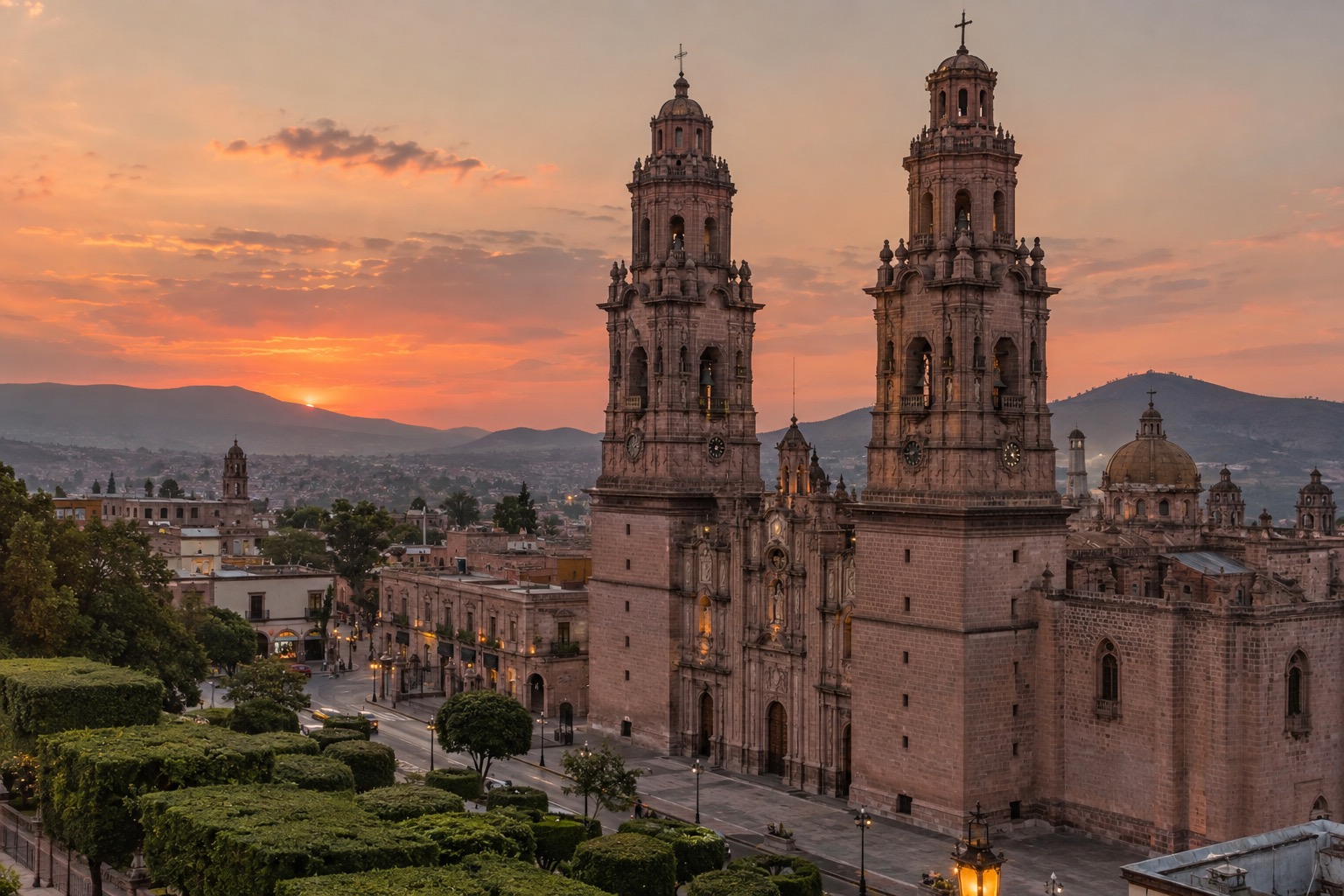
In Morelia, on a dry-season evening, floodlights make the pink-stone cathedral gleam, families stroll around the Plaza de Armas clutching paper cones of sweets, and the air grows cool enough for a shawl. Summer brings the opposite rhythm, with bright mornings and thunderous afternoons that send everyone under the arcades. This is a highland colonial city, far from any beach, and each season gives it a different mood.
When is the best time to visit Morelia?
The best months are November through April for most travelers, when skies are clear, afternoons are warm and rain is rare. Early November adds Día de Muertos, which draws visitors to the lake villages around Pátzcuaro.
For sightseeing, winter and early spring are ideal. You can walk the historic center, the aqueduct and the cathedral square all day without a raincoat, and the evenings are crisp enough for a jacket, especially in December and January. April and May turn hot in the afternoons, so museums and long lunches fill the middle of the day.
Morelia has no sea, so beach plans belong elsewhere. For budget and quiet, the rainy months from June to September are the calmest, with green hills and showers that usually arrive late in the day. Families will find the city easy in most months. Spring break in March is when Mexican coastal resorts get loud, while Morelia stays comparatively relaxed, a good counterweight for parents who want culture without the crowds.
Morelia weather by month
Days are pleasantly warm nearly all year, while nights run from properly cold in winter to mild in summer.
| Month | Average high (°F) | Average low (°F) | Rain (in) | Rain days |
|---|---|---|---|---|
| January | 77.2 | 43.3 | 0.48 | 2.8 |
| February | 81.3 | 45.7 | 0.63 | 2.7 |
| March | 85.3 | 48.6 | 0.61 | 2.5 |
| April | 89.1 | 52.2 | 0.58 | 3.0 |
| May | 89.6 | 55.8 | 1.82 | 8.7 |
| June | 84.7 | 57.2 | 5.80 | 17.2 |
| July | 80.8 | 56.1 | 7.37 | 22.8 |
| August | 80.4 | 56.1 | 6.86 | 21.3 |
| September | 79.7 | 56.1 | 5.20 | 18.7 |
| October | 79.7 | 52.3 | 2.31 | 9.5 |
| November | 79.0 | 47.3 | 0.65 | 3.7 |
| December | 77.7 | 43.9 | 0.24 | 1.8 |
The year splits in two. From November to April, rain is a rarity and the main contrast is between warm sunny afternoons and chilly early mornings, with the coldest nights in December and January. Heat peaks in April and May, just before the rains begin.
From June to September it rains on most days, usually as an afternoon downpour after a clear morning, and the cool, damp evenings call for a light jacket. October is the transition, with showers fading and the air drying out.
When is Morelia cheapest and least crowded?
The quietest stretch is the rainy season, especially June and September, when hotels have rooms to spare and the plazas belong to locals. Crowds in Morelia come in bursts tied to holidays, not to a single high season.
The busiest weeks are Christmas and New Year, Easter week, and the Mexican school vacation from about early July to late August, when families from across the country travel. Early November fills up for Día de Muertos, and long weekends around national holidays bring Mexican visitors from nearby cities.
Outside those windows, January to March and October are calm. Streets are easy to walk, restaurants rarely have waits, and rooms in the historic center are simple to find.
Which months should you avoid in Morelia?
Avoid July and August if you want dry sightseeing, since rain falls on nearly every day and afternoon storms can wash out walking plans. June and September are nearly as wet.
Morelia sits inland and high, so hurricane season matters mostly as extra rain and cloud in late summer and early autumn, not as coastal damage. Sargassum is a coastal issue and does not touch the city. Winter nortes are also a coastal story here, and the highland feel is simply cool, clear nights.
April and May bring the hottest afternoons, and nights are the mildest of the dry season. Those weeks suit travelers who like warmth, though midday sun pushes most walking to the morning and evening.
Before booking any trip to the region, read the current U.S. State Department advisory for Michoacán, which sits at its highest level. It is worth weighing carefully alongside the season.
Festivals and events in Morelia through the year
Día de Muertos and the lake villages
Día de Muertos runs from October 31 to November 2, and Michoacán is one of the places most associated with it. Families decorate graves with marigolds and candles, and the villages around Lake Pátzcuaro hold candlelit vigils in the cemeteries.
In Morelia itself, altars appear in plazas and museums, sugar skulls fill the markets, and the streets smell of pan de muerto and hot atole. Tzintzuntzan, the former Purépecha capital on the lake, is a natural stop for ruins in the same trip.
Nights are chilly and the weather is dry and clear, so bring a jacket. Rooms tighten up around these dates, so plan ahead.
| Site | Open | Admission |
|---|---|---|
| Tzintzuntzan archaeological site | Daily 9 a.m. to 6 p.m., last entry 5 p.m. | 210 pesos (Mexican nationals and foreign residents 105 pesos) |
| Museo Regional de Michoacán | Tuesday to Sunday, 9 a.m. to 5 p.m. | 145 pesos (Mexican nationals and foreign residents 80 pesos) |
Winter holidays, Carnival and Easter week
Christmas in Morelia is lit and festive, with lights on the cathedral, posadas in the neighborhoods and stalls selling ponche and tamales. The cool dry evenings suit strolling around the Plaza de Armas after dinner.
Carnival arrives in February or early spring, depending on the year, with local celebrations that are smaller than those on the coast. Holy Week brings processions through the historic center, including a solemn evening march with hooded participants and silent crowds.
Easter week is also a Mexican vacation period, so the city is busier and rooms fill early. Mornings are warm and dry, and the processions make an evening in the center memorable.
Music, food and the rainy season
The rainy months have their own pleasures. Green hills surround the city, and the cafés under the arcades fill with people waiting out the afternoon storm over coffee and a plate of enchiladas morelianas or a slice of gaznates.
Morelia is also known for its classical music tradition and film culture, and concerts and screenings are common through the year. In late summer, the days around Mexican Independence on September 15 bring fireworks and a crowd to the Plaza de Armas, even when the evening rain arrives.
Sources
- Servicio Meteorologico Nacional (CONAGUA), normales climatologicas 1991-2020, estacion 16080 (Morelia (Obs), Morelia), checked September 29, 2026
- sunrise-sunset.org, sunrise and sunset on the 15th of the month, checked September 8, 2026
- INAH, Museo Regional de Michoacan (inah.gob.mx/museos/museo-regional-de-michoacan-dr-nicolas-leon-calderon), checked September 29, 2026
- INAH, meme page, checked September 29, 2026
- INAH, Zona Arqueologica de Tzintzuntzan (inah.gob.mx/zonas/zona-arqueologica-de-tzintzuntzan), checked September 29, 2026
- US Department of State, Mexico Travel Advisory (travel.state.gov), advisory of May 29, 2026, checked September 29, 2026