
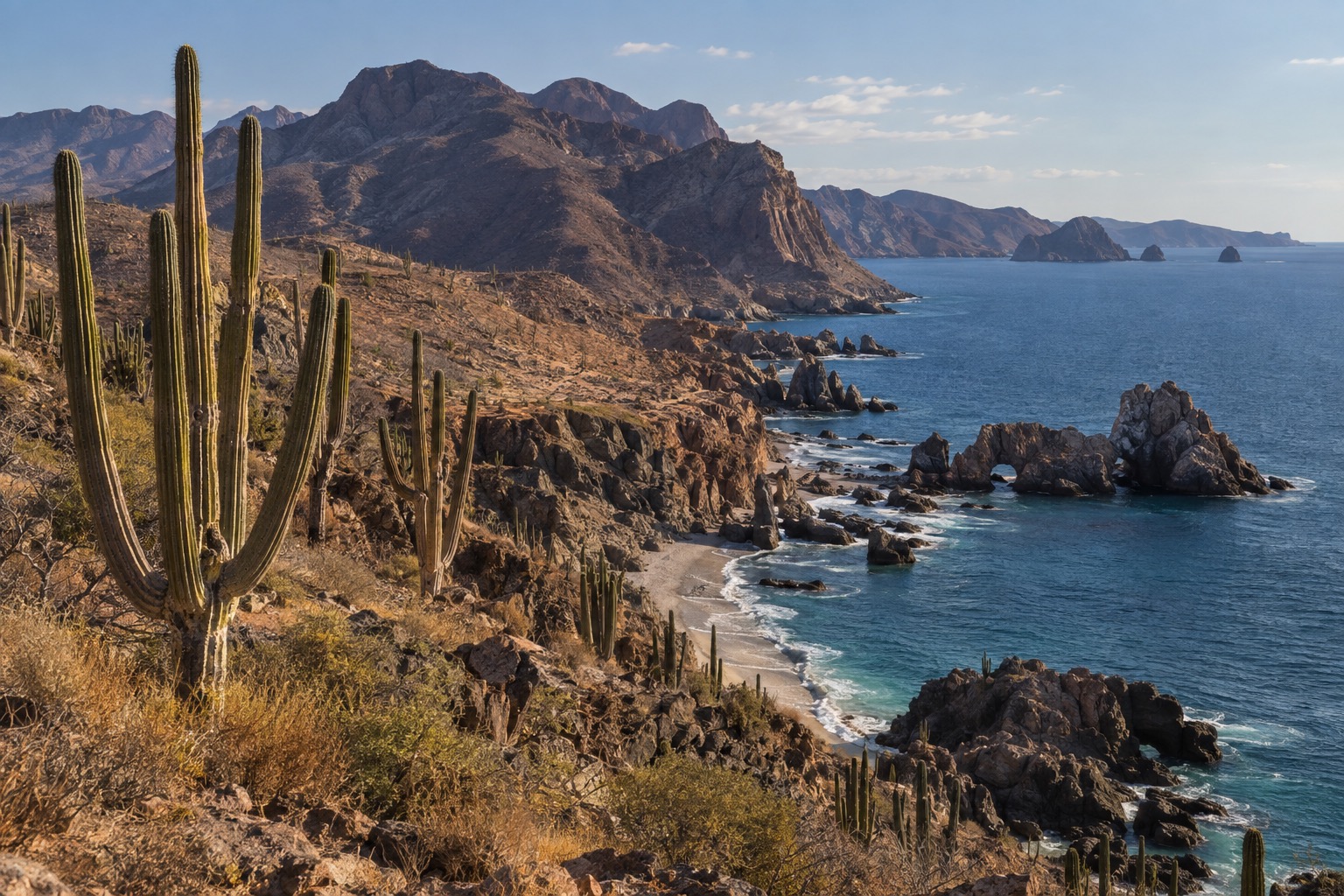
In February, gray whales surface in the Pacific lagoons with their newborn calves, and boats rock gently while people lean over the rails with their cameras. Farther south, Cabo’s afternoons are warm enough for a long lunch of fish tacos on a terrace, while the desert hills turn green after the last rains. Baja California is a long, dry peninsula with two seas, and each season brings a different reason to come.
When is the best time to visit Baja California?
The best time for most travelers is from November to May, with whale lovers aiming for January through March and beach swimmers for late spring and the fall months. The peninsula is a desert, so the sun is rarely in doubt, and the real question is how hot you want it and what you came to see.
For beaches and the sea, the stretch from late May to November has the warmest water, and the Gulf of California side is especially inviting. Winter days are sunny and pleasant on land, but the ocean is cooler and many people prefer to watch it rather than swim. For sightseeing, winter and early spring are comfortable for walking mission towns, wine country in the north and the cactus-studded desert roads, and they coincide with the whale season along the Pacific coast.
For a quieter, easier trip, the shoulder months of late fall and the weeks after Easter work well, when the crowds thin but the weather stays reliable. Summer is very hot and suits those who plan their days around the water and air conditioning.
Families should know that March brings spring break, and beach towns like Cabo and San José del Cabo get loud, with big groups of students and late nights. If you want a calmer atmosphere for children, February or April is gentler.
Baja California weather by month
Southern Baja is sunny nearly all year, and the real differences are in the heat, the sea and a short summer rainy spell.
| Month | Average high (°F) | Average low (°F) | Rain days | Sea (°F) |
|---|---|---|---|---|
| January | 79.9 | 55.0 | 0.9 | 73.6 |
| February | 80.8 | 55.2 | 0.6 | 71.1 |
| March | 83.3 | 57.0 | 0.3 | 71.3 |
| April | 86.2 | 59.7 | 0.0 | 72.7 |
| May | 89.8 | 61.7 | 0.1 | 76.0 |
| June | 90.7 | 65.3 | 0.1 | 80.8 |
| July | 93.9 | 72.3 | 1.0 | 84.5 |
| August | 94.5 | 74.8 | 3.6 | 87.0 |
| September | 92.7 | 73.9 | 4.0 | 86.2 |
| October | 92.1 | 70.2 | 1.4 | 85.9 |
| November | 86.7 | 63.5 | 1.1 | 81.1 |
| December | 81.3 | 57.2 | 0.8 | 77.6 |
The year runs from mild, sunny winters to hot, humid late summers. Rain is scarce almost everywhere on the calendar, and when it comes in winter it is a brief, light spell. August and September are the wettest months, when storms build in the afternoon and can drop heavy rain in a short time. Nights cool off noticeably from December to March, while summer nights stay warm.
When is Baja California cheapest and least crowded?
The quietest stretches are the early fall weeks and late spring, outside the holiday rushes. Beaches are emptier, restaurants have free tables, and rooms are easier to find, often at friendlier rates.
The busiest weeks come with U.S. holidays, spring break in March, Christmas and New Year, and Easter week, when Mexican families also head to the coast. Mexican school vacation, from about early July to late August, fills the beach towns with domestic travelers, especially on weekends. The whale season in winter also draws steady crowds to the Pacific lagoons. If you can travel in the weeks between those peaks, you will find a more relaxed peninsula, with space on the sand and time to talk with locals at the taco stand.
Which months should you avoid in Baja California?
Avoid August and September if you dislike heat, humidity and the risk of storms, since this is the peak of tropical weather on the peninsula.
Officially, the eastern Pacific hurricane season stretches from May 15 to November 30, shaping conditions along the Pacific coast and also the Gulf of California. The late summer and early fall are the time when tropical systems are most likely to disrupt plans, with heavy rain, rough seas and sometimes canceled boat trips. Outside those dates the risk is lower, though no beach is guaranteed to be spared.
The heat is the other factor. Midsummer afternoons are intense, and outdoor sightseeing or desert hiking becomes uncomfortable, so plans shift to early mornings and evenings. In winter, cold fronts can bring a few cooler, windier days, especially in the north, with choppy water and a need for a sweater, but they rarely spoil a whole trip.
When can you swim in Baja California?
You can swim most comfortably from June through November, when the sea is warm and inviting, though winter swimmers who like cooler water can still get in on sunny days.
From late winter into spring the water is at its coolest, refreshing rather than warm, and many visitors paddle or wade instead of staying in. By early summer it warms quickly, and in late summer and early fall it is warm enough that a dip feels like stepping into a bath. December and May sit in between, pleasant on sunny afternoons.
Conditions differ by coast. The Pacific side often has stronger surf and currents, so check the beach flags before going in, while the Gulf of California side has calmer coves that are popular for snorkeling and kayaking, though conditions change with the weather.
Festivals and events in Baja California through the year
Winter holidays and Carnival
Christmas and New Year bring lights, posadas and family dinners to town plazas, and beach resorts fill with visitors. Churches hold midnight Mass on December 25 eve, and restaurants serve tamales and ponche, a warm fruit punch, in the evenings.
Carnival arrives before Lent, usually in February or early March, and La Paz is known for the biggest celebration on the peninsula, with parades along the waterfront, floats, music and costumes. It suits travelers who like crowds and street parties, and the seafront is the place to be at night. Book early, since rooms fill up.
Easter week and Día de Muertos
Holy Week moves every year, usually in March or April, and Mexican families take the week off to go to the beach. Towns hold processions and quiet church services, while coastal areas become lively and busy with picnics and music.
Día de Muertos, from October 31 to November 2, is marked with altars, marigolds, sugar skulls and candlelit visits to cemeteries. In towns like La Paz and Todos Santos you see decorated altars in plazas and shops, and bakeries sell pan de muerto. It is a respectful, family-centered tradition, so watch from a polite distance.
Nature seasons: gray whales and more
Every autumn, gray whales head south to the Pacific lagoons, where their calves are born between early January and mid-February. The peak viewing is usually in the heart of winter, when small boats go out and whales sometimes approach close enough to touch the hull. The towns near the lagoons, such as Guerrero Negro and San Ignacio, host most of the visitors.
The northward migration begins in mid-February and continues through May, so late winter and spring still offer chances to see whales, both in the lagoons and from the coast. Bring layers, since mornings on the water are cool and windy, and a hat and sunscreen for the bright sun.
Sources
- Encyclopaedia Britannica, "Baja California peninsula", britannica.com/place/Baja-California-peninsula-Mexico, checked September 29, 2026
- fait de geographie administrative de notoriete publique
- common geographic knowledge
- UNESCO World Heritage Centre, whc.unesco.org/en/list/1182/, checked September 29, 2026
- US Bureau of Transportation Statistics, "Border Crossing/Entry Data", bts.gov, checked September 29, 2026
- NOAA Fisheries, "Gray Whale" species page, fisheries.noaa.gov/species/gray-whale, checked September 29, 2026
- NOAA National Hurricane Center, official Eastern Pacific season (nhc.noaa.gov), checked October 5, 2026
- Servicio Meteorologico Nacional (CONAGUA), normales climatologicas 1991-2020, estacion 03005 (Cabo San Lucas, Los Cabos), checked September 29, 2026
- Open-Meteo Marine API, average 2015-2024, checked September 8, 2026
- sunrise-sunset.org, sunrise and sunset on the 15th of the month, checked September 8, 2026