
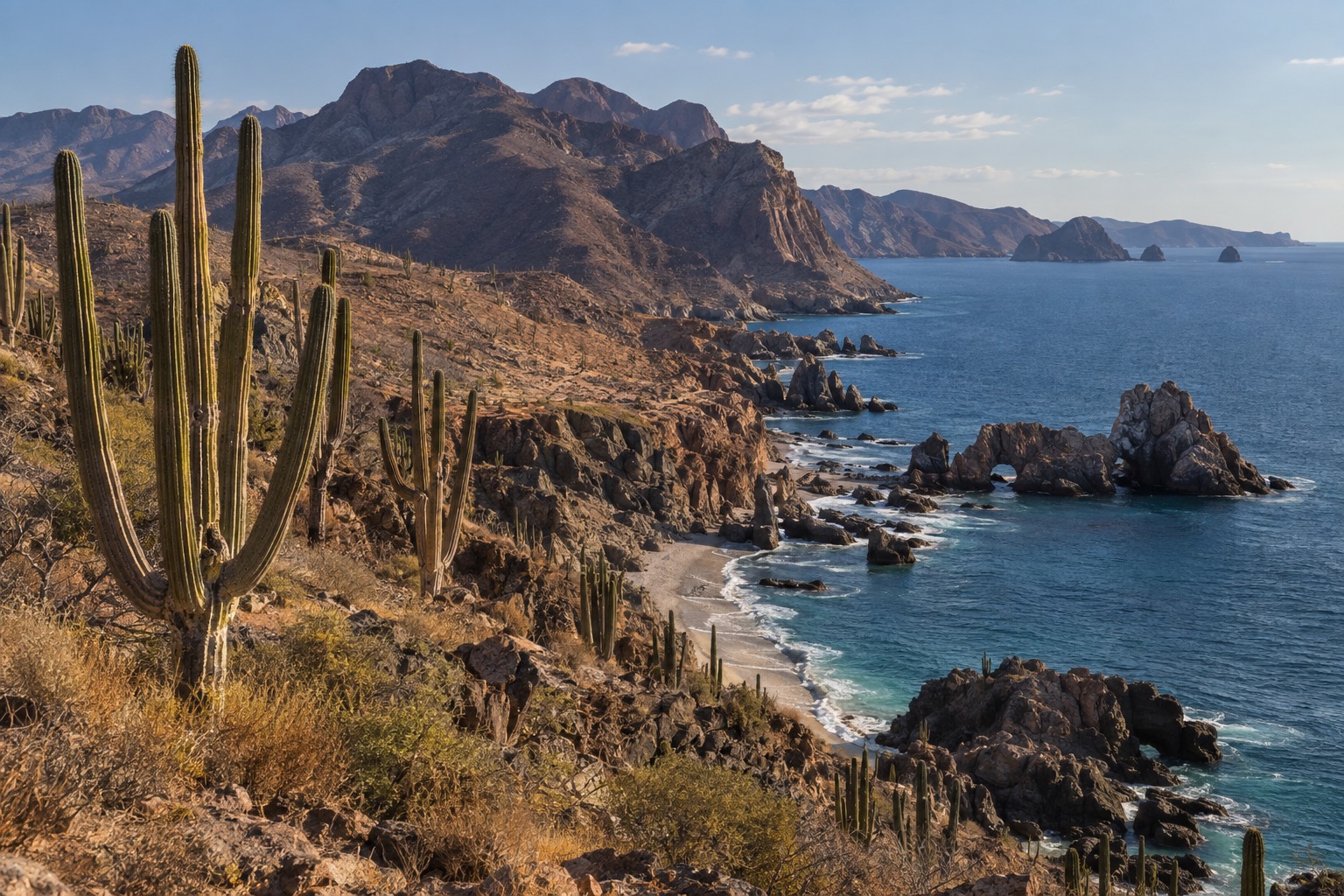
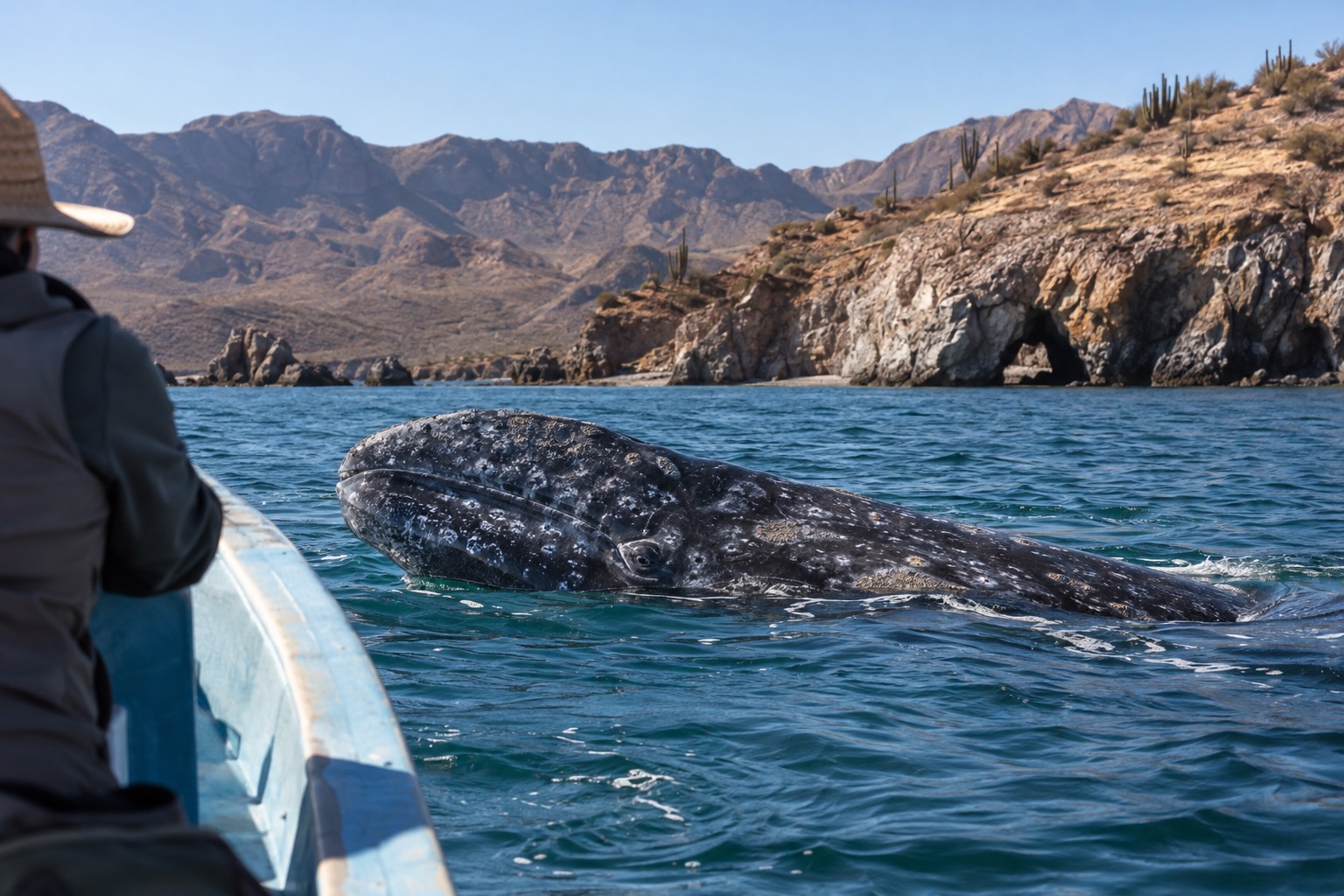
Along the Pacific side of Baja California, a gray whale rises beside a small boat and exhales a cloud of mist that drifts over the water. Behind the coast, cactus forest climbs into rugged mountains, and the Sea of Cortez glows copper at sunset on the other side. This is a long desert peninsula for travelers who like wide open landscapes, fresh seafood and a good deal of time outdoors, from the border towns of the north to the beaches of the cape.
What are the best things to do in Baja California?
The best things to do in Baja California are on the water and in the desert around it: whales, reefs, beaches, wine and tacos.
- Watch gray whales and their calves along the Pacific coast in winter.
- Take a boat to El Arco and Lover’s Beach at Land’s End in Cabo San Lucas.
- Snorkel the living coral reef at Cabo Pulmo.
- Swim with whale sharks off La Paz during their season.
- Taste wine in the Valle de Guadalupe.
- Stroll the streets of Todos Santos, a Pueblo Mágico.
- Watch the sea burst from the blowhole at La Bufadora.
- Eat fish tacos from a street stand in Ensenada.
Sights and landmarks in Baja California
Loreto and its mission
Loreto is where the story of the Californias begins. The Mission of Nuestra Señora de Loreto Conchó was founded on October 25, 1697 by the Jesuit Juan María de Salvatierra, and it was the first permanent mission in the Californias and the head of all the later ones. The stone church sits on a quiet plaza lined with shade trees, a few steps from the waterfront.
The town is small and unhurried, which makes it a good place to wander on foot in the cooler morning hours. Cafés and little shops fill the streets around the mission, and the malecón looks out toward the islands of the bay. History buffs and travelers who prefer a calm base over a resort scene will like it most.
Todos Santos
Todos Santos joined Mexico’s Pueblos Mágicos program in 2006, and its old brick buildings, galleries and courtyard restaurants explain why. It sits at the western foot of the Sierra La Laguna, a biosphere reserve that separates the Pacific side of the peninsula from the Sea of Cortez side, so the light and the breeze feel different from the resort towns of the cape.
A local legend links the town’s Hotel California to the Eagles song of the same name. The story is popular but unconfirmed, and the hotel itself makes no such claim. Most visitors simply enjoy the courtyard, a margarita and an afternoon of browsing art studios. It suits couples and anyone who likes a creative, slower pace.
Ensenada and the mountains behind it
Ensenada is a working port with a lively waterfront, fish market and cruise ships that tie up regularly. It is also the usual overland gateway to Sierra San Pedro Mártir National Park, a protected mountain range that hosts Mexico’s National Astronomical Observatory. Under those dark desert skies, the stars are the main attraction.
The city works well as a base for a few days: wine country sits inland, La Bufadora is down the coast, and the harbor has plenty of seafood stands. Cruise days bring crowds to the main streets, so mornings and evenings feel more local.
Beaches and outdoor things to do in Baja California
Cabo San Lucas: El Médano, Lover’s Beach and El Arco
El Médano is the main swimmable beach in Cabo San Lucas, sheltered from open ocean swell by the Land’s End headland. It is lively, lined with beach clubs and umbrellas, and easy for a first day by the sea. Water taxis and boat tours leave from the marina toward the rocks at the tip of the peninsula.
El Arco is a natural rock formation reachable only by boat, and the surrounding rocks host a resident sea lion colony. At Lover’s Beach, swimming is allowed only on the Sea of Cortez side. Divorce Beach, facing the open Pacific, is considered extremely dangerous for swimming because of rip currents, so you look at it from the sand and leave it at that.
Cabo Pulmo
Cabo Pulmo protects the only living coral reef system in the Gulf of California. It was decreed a protected area in 1995, and commercial and sport fishing are banned inside the park, which is why snorkelers find schools of fish so close to shore. The village is tiny and the setting is wild and quiet.
| Site | Open | Admission |
|---|---|---|
| Cabo Pulmo National Park | Daily, 8:00 a.m. to 6:00 p.m. | 125 Mexican pesos |
Bring reef-safe sunscreen and keep a respectful distance from the coral. It suits snorkelers, divers and anyone who wants a beach day without a resort around it.
La Paz and the whale sharks
La Paz has a relaxed waterfront and a bay that invites boat days. Swimming with whale sharks in the Bahía de La Paz refuge is regulated by a federal management plan, and the 2026-2027 season runs from October 1, 2026 to April 30, 2027. Isla Espíritu Santo, a national park since 2007, sits in the same bay and is part of the UNESCO World Heritage Site of the Gulf of California islands.
Boat trips to the island bring sea lions, rocky coves and clear water for snorkeling. Go with a licensed operator and expect a full day on the water. It suits active travelers and wildlife lovers.
Whale watching on the Pacific side
Gray whales migrate south each fall to winter and calve in the lagoons along the Pacific coast, with calves born from early January to mid-February. The northward journey runs from mid-February to May. Small boats get you close enough to hear the whales breathe, and sometimes curious mothers bring their calves right alongside.
Other nature stops include the Estero de San José del Cabo, a protected wetland that has recorded 217 bird species, 97 of them migratory. It is a calm stop for birders and anyone who wants a break from the beach.
Day trips from Baja California
La Bufadora from Ensenada
La Bufadora, a marine geyser on the Punta Banda peninsula about 20 miles southwest of Ensenada, shoots seawater through a coastal blowhole in a plume that can reach about 100 feet. The road follows the coast through dry hills and small farms, and the approach is lined with craft stalls and snack stands.
The show depends on the swell, so some waves send a thunderous blast and others only a sigh. Come early on a cruise day to avoid the crowds. Families and first-time visitors to Ensenada enjoy it most, and a churro from the stalls makes a good reward.
Valle de Guadalupe wine country
The Valle de Guadalupe lies inland from Ensenada and is promoted by the state as the Ruta del Vino. Vineyards, olive groves and rustic tasting rooms spread across the valley, and many wineries serve food made with local produce, seafood and grilled meats.
A long, lazy lunch is the point, so go with someone who is not driving. Afternoon light over the vines is lovely, and the cooler hours suit a visit best. It is made for couples, friends and anyone who treats food as a reason to travel.
Isla Espíritu Santo from La Paz
A boat from La Paz takes you across the bay to Isla Espíritu Santo, a national park since 2007. Pale sand coves, red rock cliffs and a sea lion colony make this one of the most scenic outings on the Sea of Cortez side of the peninsula.
Plan on a full day with snorkeling, a beach lunch and time to simply float. Mornings are the calmest on the water. It suits travelers who want wildlife and scenery without a long journey.
Other short outings
From Cabo San Lucas, the Estero de San José del Cabo is a short drive away and makes an easy morning of birdwatching along quiet paths, best when the day is still cool. Todos Santos also works as a half-day escape from the cape resorts, with its galleries and courtyard lunches.
From La Paz, the ferry to Topolobampo on the mainland sails Monday through Friday, but it is a crossing rather than a day trip. For a short outing, stick to the bay, the malecón and a seafood lunch. These stops suit travelers with a free afternoon and no desire for a long itinerary.
What to eat in Baja California
Fish tacos are the dish that defines eating in Baja California: battered and fried white fish in a warm tortilla, topped with cabbage, creamy sauce, pico de gallo and a squeeze of lime. Stands in Ensenada made them famous, and the fish market area is the place to try them.
Seafood runs deep here. Look for ceviche, shrimp tacos, grilled lobster, clams, oysters and a cold tostada piled with raw fish and avocado. In Cabo and La Paz, the catch of the day often comes grilled whole with rice and tortillas, and sportfishing boats unload near the marina.
In the Valle de Guadalupe, wineries serve fixed-menu lunches built around local olive oil, cheese, vegetables and meat cooked over fire. Pair it with a regional red or white. Cold Mexican beer and a michelada go well with a beach afternoon, and tacos al pastor and carne asada fill the late-night stands.
Things to do in Baja California at night
Evenings in Baja California depend on where you are. Cabo San Lucas is the nightlife center, with bars and clubs around the marina and along the main strip, and live music spilling onto the street. Sunset cruises leave the harbor as the light turns gold over Land’s End.
Ensenada has a more casual feel, with cantinas, craft beer bars and taco stands that stay busy after dark. In La Paz, locals stroll the malecón at sunset, eat ice cream and watch the bay turn pink. Todos Santos is calmer, with courtyard dinners and the occasional live set in a garden.
In the desert, the night sky is its own show. Away from town lights, the stars are thick and bright, and the mountains of the north hold an observatory for exactly this reason.
Things to do in Baja California with kids
Children usually remember the animals best: sea lions near El Arco, pelicans diving off the pier, and in winter a gray whale surfacing beside the boat. Boat tours around Land’s End and the bay of La Paz suit most ages, with plenty to look at from the deck.
At La Bufadora, kids love waiting for the next blast of spray, and the craft stalls and snacks along the way keep them busy. Snorkeling in calm coves is a good first reef experience for older children, while the Estero de San José del Cabo offers a gentle bird walk.
Keep in mind that this is a desert peninsula, with strong sun and long distances between towns. Hats, water and shade matter. Check the beach flags and local advice before swimming, since some Pacific beaches have strong currents.
Good to know before you go
The peninsula is long, and the towns sit far apart, so most visitors fly into Los Cabos or La Paz in the south or cross the border near Tijuana in the north. A rental car or organized tours make it easier to reach beaches, vineyards and wildlife stops. The eastern Pacific hurricane season, which also governs the Gulf of California, officially runs from May 15 to November 30.
The Islands and Protected Areas of the Gulf of California are a UNESCO World Heritage Site, listed as in danger because of the critical status of the vaquita. That is a reminder to choose responsible operators and respect the rules in marine parks.
Sources
- Encyclopaedia Britannica, "Baja California peninsula", britannica.com/place/Baja-California-peninsula-Mexico, checked September 29, 2026
- fait de geographie administrative de notoriete publique
- common geographic knowledge
- UNESCO World Heritage Centre, whc.unesco.org/en/list/1182/, checked September 29, 2026
- US Bureau of Transportation Statistics, "Border Crossing/Entry Data", bts.gov, checked September 29, 2026
- NOAA Fisheries, "Gray Whale" species page, fisheries.noaa.gov/species/gray-whale, checked September 29, 2026
- NOAA National Hurricane Center, official Eastern Pacific season (nhc.noaa.gov), checked October 5, 2026
- XXV Ayuntamiento de Ensenada, press release of April 4, 2026, ensenada.gob.mx, checked September 29, 2026
- Visit Mexico (official portal of the federal Secretaria de Turismo), La Bufadora, visitmexico.com ; supplemented by CICESE (Centro de Investigacion Cientifica y de Educacion Superior de Ensenada), explanatory note on La Bufadora, cicese.edu.mx, read on September 29, 2026
- Secretaria de Medio Ambiente y Recursos Naturales (SEMARNAT), official notice of September 17, 2026 on the 2026-2027 season of the whale shark refuge zone, gob.mx, checked September 29, 2026
- CONANP (national park status) and UNESCO, inscription "Islands and Protected Areas of the Gulf of California" (2005), corroborated by El Sol de Mexico, August 10, 2024, oem.com.mx, checked September 29, 2026
- Baja Ferries, "Rutas y Horarios", bajaferries.com.mx, checked September 29, 2026
- CONANP, "Aviso" and documents of Parque Nacional Bahia de Loreto, conanp.gob.mx (pdf/aviso_loreto), checked September 29, 2026
- Centro INAH Baja California Sur (official Facebook) and Secretaria de Turismo y Economia de l'Etat de BCS (setuesbcs.gob.mx, "Mision de Nuestra Senora de Loreto Conchó"), checked September 29, 2026
- CONANP, Cabo Pulmo National Park, descubreanp.conanp.gob.mx, read on (indexed excerpt; the site refuses any direct connection from this network) September 29, 2026
- Cabo Adventures (exploitant de tours locaux), "Is Cabo San Lucas Safe for Travelers", cabo-adventures.com, checked September 29, 2026
- H. XV Ayuntamiento de Los Cabos / IMPLAN Los Cabos, "REE Estero de San Jose del Cabo", implanloscabos.mx, checked September 29, 2026
- Secretaria de Turismo (SECTUR), "Todos Santos, Baja California Sur", sectur.gob.mx, checked September 29, 2026