
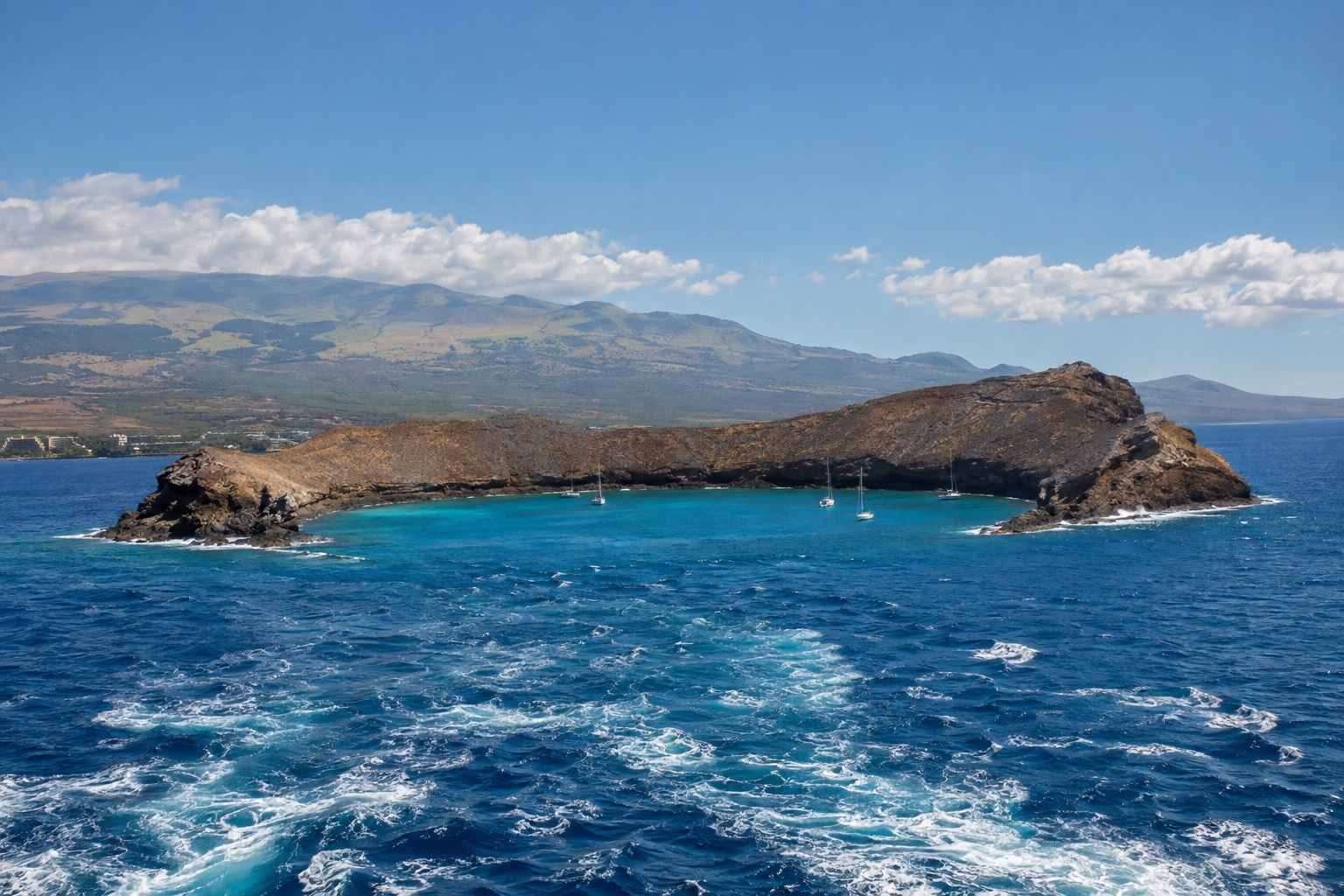
The boat slows, the engine drops to a murmur, and a thin crescent of rock rises out of the open channel with the water inside it turning from deep blue to glass. Fish drift below the hull before anyone has a mask on. Molokini is a half-sunken volcanic crater off Maui’s southwest coast, and a visit here is a morning on the water built around the reef.
Is visiting Molokini Crater worth it?
Yes, if you want to float over a clear reef with a lot of fish and don’t mind that the whole outing happens from a boat. It suits snorkelers and divers best, and anyone who likes being out on open water in the morning.
What sets it apart from a beach snorkel along the Maui shore is the setting. The crescent shelters a cove from the channel, the water is usually clear, and the reef sits inside the curve of the crater wall. Nothing here is reached on foot, so the boat ride is part of the pleasure.
What to see at Molokini Crater
The reef inside the crescent
The heart of the visit is the cove tucked inside the curve. The bottom slopes gently away from the shoreline to about 100 feet before it drops off, so snorkelers float over a shallow, sunlit reef while divers go deeper along the slope.
Look for the reef fish Hawaii is known for: schools drifting over coral heads, parrotfish grazing, and small colorful fish darting in the crevices. The clarity of the water is the main draw, and it lets you see far down the slope from the surface.
The cove is a Marine Life Conservation District, set up in 1977. That is why the reef feels so full of life: it is protected, and you look but never touch or take anything.
The back wall
On the outer side of the crescent, the crater wall plunges to more than 200 feet. This is the side divers talk about, a vertical face where the water turns a deeper blue and the sense of scale changes.
From the surface you still catch the drama of it. The reef gives way to open water, and larger fish pass along the wall. For snorkelers, it is a view into the depths rather than a place to go, and it makes the gentle cove feel even more sheltered by comparison.
The islet and its seabirds
The rim of rock above the waterline is a state seabird sanctuary, and landing on it is prohibited. You see it from the water, a bare crescent of volcanic stone with birds wheeling overhead.
The shape is worth a long look from the boat. It is the visible top of an old crater that has mostly sunk, which explains the half-moon outline. Between Maui and the island of Kahoolawe, it stands alone in the channel, and on a clear day it is a striking sight against the horizon.
Whales on the way
From November through May, the crossing may include humpback whales, with the usual peak from January through March. Spotting a spout or a breaching whale on the way to or from the crater is a bonus that the season sometimes offers.
Boats and swimmers must stay back from them: it is illegal to approach within 100 yards of a humpback. Whales are never guaranteed, but in winter the channel is a place where you keep scanning the surface between snorkel stops.
Hours, tickets and rules
Molokini has no gate, ticket booth or fixed opening hours of its own. You visit on a snorkel or dive tour, and the tour company sets the schedule and the price. Most trips leave in the morning.
| Site | Open | Admission |
|---|---|---|
| Molokini Shoal Marine Life Conservation District | Reached by boat tour, mostly morning departures | Included in the tour price |
The rules protect the reef. It is prohibited to fish for, take or injure any marine life, eggs included, with trolling in Subzone B the one exception. Feeding fish or introducing any food or attractant is also prohibited. Commercial boats may not moor there except under permit, and anchoring is prohibited once a day-use mooring system is established. Landing on the islet is not allowed.
How to get to Molokini Crater
Molokini is reached only by boat. It lies about 3 miles off Maui’s southwestern coast, and snorkel and dive tours leave from Maui’s south and west shores, mostly in the morning.
The morning timing matters because the water inside the crescent is usually calmest then. Pick a departure from the shore that is easiest for where you are staying, and expect the crossing to be part of the outing.
When to visit Molokini Crater
Go in the morning. The water inside the crescent is usually calmest early, which is when most tours run, and the reef is at its clearest and quietest before the day builds.
The reef is there all year, and Maui’s south side is dry and sunny through every month, with only a few days of rain in most. Winter adds the humpback whales, from November through May, peaking from January through March. The warm months bring the hottest air, with highs near 90°F in late summer and early fall.
The Central Pacific hurricane season runs from June 1 to November 30, so a summer or fall trip falls inside the official season. Hawaii is rarely hit, but the weather on the day decides whether boats go out, so keep your plans a little flexible then.
Tips for your visit
- Bring a swimsuit, a towel and a light layer for the boat ride back, when wind and spray can feel cool.
- Look but never touch: the reef is protected, and nothing may be taken or fed.
- Keep your eyes on the water between stops in winter, when whales may surface near the boat.
- Pair the morning outing with a relaxed afternoon on one of Maui’s south shore beaches.
- Families should know the trip is a boat outing with open-water swimming, so it suits confident swimmers and those happy in a mask.
Good to know before you go
Nothing at Molokini requires cash on arrival, since the trip is arranged through your tour. Treat the reef as a living place: no touching, no feeding, no souvenirs, and follow your crew’s lead in the water. Sunscreen that is kind to the reef is part of being a good guest here.
Sources
- Hawaii DLNR Division of Aquatic Resources, « Maui – Molokini Shoal MLCD », dlnr.hawaii.gov/dar/marine-managed-areas, checked September 25, 2026
- Hawaii DLNR Division of Aquatic Resources, Molokini Shoal MLCD, checked September 25, 2026
- NOAA Hawaiian Islands Humpback Whale NMS, checked September 25, 2026
- NOAA NCEI, monthly normals 1991-2020, station USW00022516, checked September 8, 2026
- NWS Honolulu / Central Pacific Hurricane Center, « 2026 Central Pacific Hurricane Season Outlook », weather.gov/hfo/hurricaneOutlook2026, checked September 24, 2026
To plan your stay
- Best Time to Visit Hawaii: Seasons, Weather by Island, Whales and Crowds
- Where to Stay in Hawaii: Choosing an Island, Oahu to Kauai Bases and the Hotel Tax
- Getting Around Hawaii: Interisland Flights, TheBus and Skyline, Rental Cars and Taxi Fares
- Know Before You Go to Hawaii: Agriculture Form, Sunscreen Law, Reservations and Taxes