
PORTUGAL · BEHIND THE WHEEL · ROAD CODE READ SEPTEMBER 2026
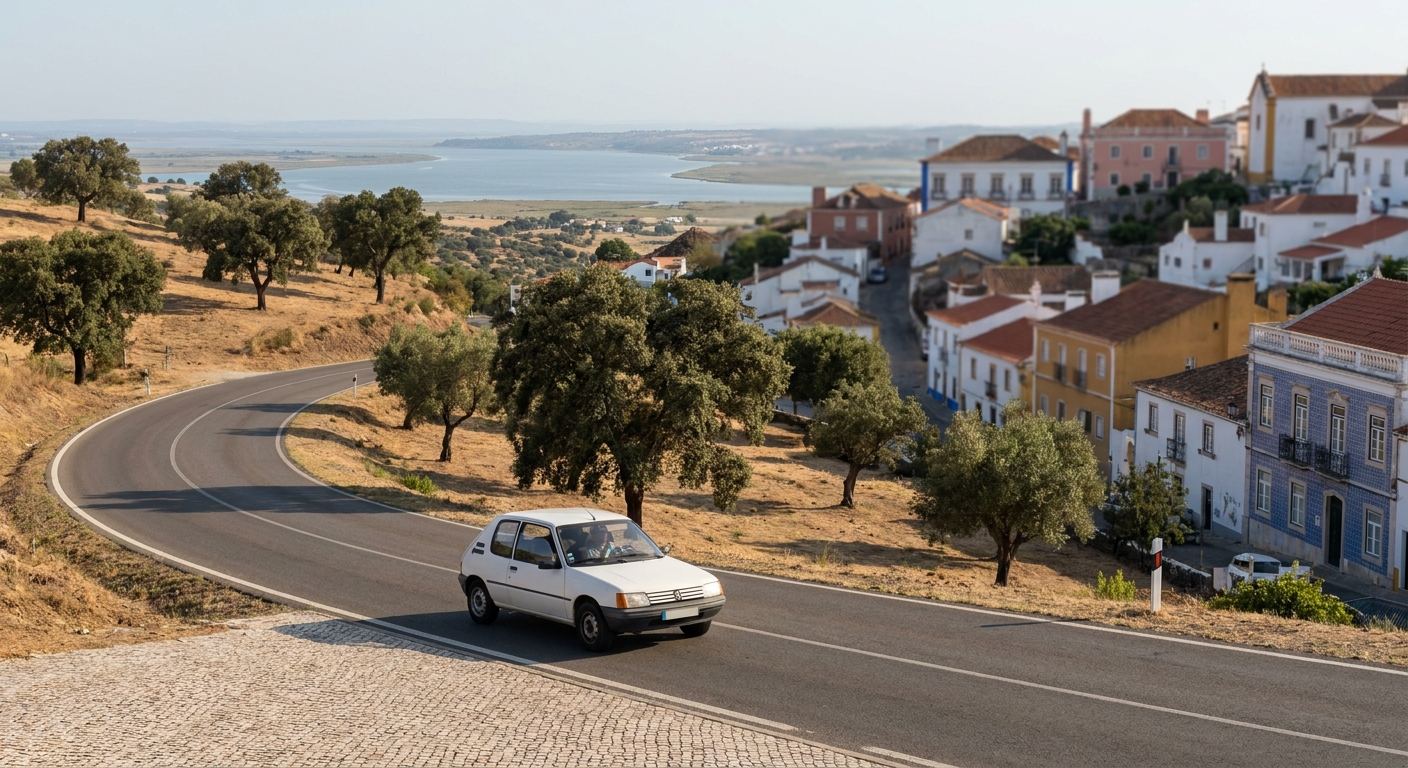
A car opens the parts of Portugal that the train lines skim past: the terraced vineyards of the Douro Valley, the coves strung between Algarve beach towns, the cork-oak plains of the Alentejo with a whitewashed village at the end of the road. Lisbon and Porto are easier on foot and by metro, so most road trips start by collecting the car on the way out of the city.
Your state license is recognized, and the motorway across the Algarve has been toll-free since January 1, 2025. Two things take a day of getting used to: speeds posted in kilometers per hour, and toll roads with overhead gantries and no booth in sight. A rental car handles those gantries on its own if you accept the toll device at the counter.
THE ROAD AT A GLANCE · PORTUGAL
Bring your US license, say yes to the toll device at the rental counter and watch the km/h signs, and Portugal’s coast and wine roads are yours.
US LICENSE RECOGNIZED · 120 KM/H ON MOTORWAYS · A22 TOLL-FREE SINCE JAN 1, 2025
Go for: Douro vineyard roads, Alentejo hill towns, Algarve coves between beach towns, and the freedom to stop wherever a view or a lunch appears.
Think twice before: declining the rental toll device, or planning a tasting day with the driver included. The alcohol line sits at 0.5 g/l.
Rules: Código da Estrada · License: IMT · Tolls: Infraestruturas de Portugal · full sources at the end
On this page
- Speed limits in km/h and mph50, 90, 100 and 120 km/h, plus the fines
- Driving with a US licenseRecognized if renewed within 15 years and you are under 60
- Tolls on a rental carElectronic gantries and the roads toll-free since January 2025
- Drink-driving limit0.5 g/l, or 0.2 g/l for probationary drivers
- Car seats for kidsUnder 12 and under 135 cm: approved seat, back row
- Phone rules behind the wheelHands-free or one earpiece, EUR 250 to 1,250 fine
- Roundabout lanes and right of wayGive way to cars inside, right lane for the first exit
- Warning triangle and vestBoth required, triangle 30 m (100 ft) behind the car
Portugal’s road rules sit in one law, the Código da Estrada, now in its 28th consolidated version after Lei 24/2025. Its fines are written as ranges, with a floor and a ceiling for each offense. For choosing the car and the rental desk itself, our car rental guide covers the booking, and the getting-around guide weighs the car against trains and buses.
What is the speed limit in Portugal?
Limits are posted in kilometers per hour, and for a car without a trailer the general ones step up with the road: 50 km/h (about 31 mph) in towns, 90 km/h (about 56 mph) on ordinary roads outside towns, 100 km/h (about 62 mph) on roads reserved for cars and motorcycles, and 120 km/h (about 75 mph) on motorways. On a long motorway day, that top figure lands close to the pace of an American interstate.
In shared-space zones, the zonas de coexistência where people on foot and cars use the same street surface, the limit drops to 20 km/h (about 12 mph). At the other end of the scale, a driver on a motorway may not travel below 50 km/h (about 31 mph), so pull off at the next exit or service area if you need to slow right down.
Particular roads or stretches can carry lower or higher limits than the general ones, and the signs show them. Follow the posted number over the default.
Speeding in a car costs EUR 60 to 300 for up to 20 km/h over the limit in town, or up to 30 km/h over outside towns. In mph, that first band covers roughly 12 mph over in town and 19 mph over on the open road. The ranges climb by band from there, up to EUR 500 to 2,500 for more than 60 km/h over in town or more than 80 km/h over outside.
Can you drive in Portugal with a US license?
Yes. The IMT, Portugal’s road authority, lists the United States among the OECD countries whose driving licenses it recognizes, on the strength of the 1949 or 1968 road traffic conventions. The American signature dates back decades: the United States ratified the 1949 Geneva Convention on Road Traffic on August 30, 1950. That ratification is why a license from Ohio or Oregon works on a road outside Porto.
The road code attaches conditions. The license must be valid, it must have been issued or last renewed no more than 15 years ago, and its holder must be under 60. Check the issue date printed on your card before you pack, since a license renewed by mail years ago can fall outside the 15-year window.
The same article of the code offers a second route: the international driving permit. It counts when shown together with the national license it supports, and it lets a non-resident drive for the first 185 days after entering Portugal. Keep the permit and the license in the same wallet, since the permit on its own does not count.
Rental desks add their own requirements on top of the law, such as a minimum driver age and a credit card for the deposit, and these differ from one company to the next. Our car rental guide goes through them before you book.
How do tolls work in Portugal?
On motorways signed as electronic-toll-only there are no booths and no stopping. Gantries over the road detect the car as it passes, and a panel near each gantry shows the fee.
Rental companies must fit every car in their fleet with an on-board toll device and subscribe to a toll payment system, and customers can opt in at the counter. Say yes, and the gantries take care of themselves for the rest of the trip. On the road you will also spot Via Verde, the small windshield box that lets a car roll through the green-marked lanes without stopping.
A car with Portuguese plates and no device pays electronic tolls afterward, at a CTT post office, a Payshop agent or a Multibanco ATM. Each trip becomes payable 48 hours after passing and is due within 15 working days, with EUR 0.32 per trip in fees, capped at EUR 2.56 per payment. A rental driver who declines the device lands in this system.
An unpaid toll is fined at least five times the toll, and never less than EUR 25. On motorways with traditional toll barriers, the old routine still applies: stop at the booth and pay in cash or by bank card.
Since January 1, 2025, tolls are no longer charged on the A22 across the Algarve, nor on the A4 Transmontana and the Marão tunnel, the A13 and A13-1, the A23, the A24, the A25 and two stretches of the A28. An Algarve beach week spent hopping between towns on the A22 now costs nothing in tolls. For how the rest of the driving adds up, see what a Portugal trip costs.
What is the legal alcohol limit for driving in Portugal?
A driver counts as under the influence from a blood alcohol level of 0.5 g/l. On the BAC scale American drivers know, that works out to 0.05 percent.
The line drops to 0.2 g/l, or 0.02 percent BAC, for drivers in their probationary period, and that period covers the first three years of a first driving license. If someone in your group got a first license within the past three years, the safe plan is to treat the lower line as theirs and hand them the water.
Driving at 0.5 to under 0.8 g/l costs EUR 250 to 1,250, and 0.8 to under 1.2 g/l costs EUR 500 to 2,500. Port lodges in the Douro and long vinho verde lunches are part of the pleasure here, so pick a designated driver for tasting days, or book a guided tour and leave the car at the hotel.
What are the car seat rules in Portugal?
Everyone buckles up, front and back. The driver and every passenger in a motor vehicle must wear the seat belts the car is fitted with, and the fine is EUR 120 to 600.
Children under 12 who are shorter than 135 cm (about 4 ft 5 in) must ride in an approved child restraint suited to their size and weight, in the back seat. Reserve the seats with the car, or pack your own, and our Portugal with kids guide has the rest of the family logistics.
A child under 3 may ride in front only in a rear-facing seat with the passenger airbag switched off. The fine is EUR 120 to 600 per child, so confirm the airbag switch at pickup if the baby is riding up front.
Taxis and ride-hailing cars are exempt from the child-seat rule, provided the children do not ride in the front seats. For the ride from the airport, put the kids in the back and the bags in the trunk.
Can you use your phone while driving in Portugal?
Only hands-free. While the car is moving, a driver may not keep handling a phone or wear headphones, and a single earpiece or a hands-free system is allowed.
The fine for breaking that rule is EUR 250 to 1,250. Set the navigation before you pull out of the parking space, and let a passenger handle the playlist and the route changes.
Radar detectors are banned outright. Getting caught with one costs EUR 500 to 2,500, and the device is seized, so leave it at home with the car it came from.
How do roundabouts work in Portugal?
Portugal drives on the right, and its traffic circles turn counterclockwise, as they do in the US. Road signs call them rotundas.
Drivers entering a roundabout give way to the vehicles already circulating in it. Wait at the edge for a gap, then merge.
To take the first exit, use the right lane. For a later exit, you stay in an inner lane and move to the rightmost lane only after passing the exit just before yours. Signal right as you make that move, then leave at the next exit.
Do you need a warning triangle and vest in Portugal?
Yes. Every car must carry a reflective warning triangle and a reflective vest. Open the trunk at the rental lot and find both before you drive away.
If the car stops on the road, the triangle goes at least 30 m (about 100 ft) behind it, visible from at least 100 m (about 330 ft). Whoever walks back to place it wears the vest.
Each missing item costs EUR 60 to 300, and failing to use them costs EUR 120 to 600. With the kit checked, the device on the windshield and the license in your wallet, pick a route from our 7-day itinerary or stretch it to ten days, and fill the tank before the Alentejo stretch.
Sources & data for this guide
- Speed limits, shared-space zones, motorway minimum, signed exceptions and speeding fines · Código da Estrada (Decreto-Lei 114/94), 28th consolidated version (Lei 24/2025), arts. 27 and 28 · Procuradoria-Geral Distrital de Lisboa · checked Sep 24, 2026
- US license recognition as an OECD country · IMT, OECD and CPLP licenses page · Código da Estrada art. 125 · checked Sep 24, 2026
- License conditions (15 years, under 60) and international permit (185 days) · Código da Estrada art. 125 · checked Sep 24, 2026
- US ratification of the 1949 Geneva Convention, August 30, 1950 · UN Treaty Collection, chapter XI-B-1 · checked Sep 24, 2026
- Alcohol limits, probationary period and fines · Código da Estrada arts. 81 and 122 · checked Sep 24, 2026
- Seat belts, child restraints and taxi exemption · Código da Estrada arts. 55 and 82 · checked Sep 24, 2026
- Phones, earpieces and radar detectors · Código da Estrada art. 84 · checked Sep 24, 2026
- Roundabout priority and lanes · Código da Estrada art. 14-A · checked Sep 24, 2026
- Warning triangle and vest · Código da Estrada art. 88 · checked Sep 24, 2026
- Toll abolition from January 1, 2025 · Lei n.º 37/2024 of August 7, 2024, Diário da República · checked Sep 24, 2026
- Electronic tolls, rental devices, post-payment, fines and manual booths · PT Tolls, Infraestruturas de Portugal · checked Sep 24, 2026
- Fines are the legal ranges set by the code, and the amount on a ticket falls within them. Rental desk requirements are company policy, not law, and change · check with your rental company when you book.
To plan your stay
- Best Time to Visit Portugal in 2027: Weather, Crowds and the Sea, Month by Month
- Where to Stay in Portugal: Bases by Region, Nights and Car Needs
- Getting Around Portugal: Trains, Buses, Airports and When to Rent a Car
- Things to Know Before Going to Portugal: Couvert Charges, Dinner Hours and Calçada Shoes