
FLORIDA · THE SPACE COAST · SEPTEMBER
September on the Space Coast is a warm-water month with a weather asterisk. The Atlantic off Brevard County averages 85.3°F at the surface, a touch warmer than in August, while the inland thermometer at Orlando International eases to an average high of 89.6°F. Kennedy Space Center and the Cocoa Beach sand make the same vacation they do in spring, with warmer water and a stormier sky.
The Atlantic hurricane season runs June 1 to November 30 and peaks around September 10, according to NOAA’s National Hurricane Center (our Florida orientation covers the full season). Around nine days in an average September bring measurable rain. Book the trip refundable, and read the tropical outlook in the week you fly into MCO.

THE MONTH AT A GLANCE · THE SPACE COAST IN SEPTEMBER
Go in September for an 85.3°F sea and highs a notch under August’s, and book everything refundable: the month sits at the peak of hurricane season.
WARM SEA · HURRICANE-SEASON PEAK · FLY INTO MCO
Go for: a sea warmer than August’s, swims at a 7:09 a.m. sunrise, and Kennedy Space Center’s indoor exhibits for the stormy hours.
Think twice before: locking in a date you cannot move. September sits at the statistical peak of the Atlantic hurricane season.
Air: NOAA NCEI, Orlando Intl, 1991-2020 · Sea: Open-Meteo Marine API, 2015-2024 · Light: sunrise-sunset.org · full sources at the end
On this page
- Space Coast weather in September89.6°F highs, 72.4°F lows, 9.2 rain days
- Can you swim in September?A sea at 85.3°F by daily maxima
- Crowds, prices and hurricane-season bookingRefundable rates and the storm peak
- Things to do on the Space Coast in SeptemberKennedy Space Center, Cocoa Beach, Canaveral National Seashore
- Two days on the Space Coast in SeptemberSunrise swim, space center afternoon, refuge morning
- September vs August and OctoberHighs of 91.6°F, 89.6°F and 84.7°F
- Is September a good time to visit?Yes for swimmers, no for fixed dates
Every figure here for air temperature and rain comes from one thermometer: NOAA’s official 1991-2020 normals for station USW00012815, Orlando International Airport, about 60 km (some 37 miles) inland. The beaches run cooler by day and milder by night, and they get a sea breeze Orlando never feels. Treat the highs below as an inland ceiling that the sand stays under.
The Space Coast weather in September: average highs, lows and rain days
| Measure | September | Source |
|---|---|---|
| Average high | 89.6°F | NOAA NCEI, Orlando Intl, 1991-2020 |
| Average low | 72.4°F | NOAA NCEI, Orlando Intl, 1991-2020 |
| Precipitation | 6.37 in | NOAA NCEI, Orlando Intl, 1991-2020 |
| Days with 0.10 in or more | 9.2 | NOAA NCEI, Orlando Intl, 1991-2020 |
| Days with 1 in or more | 1.8 | NOAA NCEI, Orlando Intl, 1991-2020 |
| Daylight, Sep 15 | 12 h 21 min | sunrise-sunset.org |
| Sunrise and sunset, Sep 15 | 7:09 a.m. and 7:31 p.m. EDT | sunrise-sunset.org, converted from UTC |
NOAA’s National Centers for Environmental Information put the September normal at 89.6°F for the afternoon high and 72.4°F for the overnight low, with 6.37 inches of rain across the month. These are station normals from a real thermometer at Orlando International, averaged over 1991 to 2020, and they are not a gridded reanalysis. Inland, that adds up to hot afternoons and warm, sticky nights a notch below the August peak.
An average September logs 9.2 days with at least 0.10 inch of rain, close to one day in three. Across Florida the wet-season pattern is the afternoon thunderstorm (our best-time guide walks through the season), so a rainy date rarely costs you the morning. Put beach time and outdoor stops before lunch and keep an indoor option ready for mid-afternoon.
Only 17.2°F separates the average high from the average low. A 72.4°F dawn is still shorts weather, so the suitcase stays summer: light breathable clothes, a rain shell that packs small, sandals that shrug off a downpour, and one long layer for air-conditioned interiors.
On September 15 the Space Coast gets about 12 hours 21 minutes of daylight. Sunrise comes around 7:09 a.m. and sunset around 7:31 p.m. Eastern Daylight Time, converted from the UTC times sunrise-sunset.org publishes. The beaches face east, so the sun climbs out of the Atlantic and sets behind the mainland. Plan the last swim for before 7:30 p.m.
Can you swim in the Space Coast in September? Sea temperature and what it feels like
Open-Meteo’s Marine API puts the sea surface off the Space Coast at 85.3°F in September, averaged over 2015 to 2024. That figure is a mean of daily maxima, the warmest reading of each day, so it runs a shade warmer than a 24-hour average of the same water. Tables that average around the clock print a slightly lower number, and both describe the same sea.
At 85.3°F there is no cold-water shock to brace for. The sea sits well above the 72.4°F overnight low measured inland, so an early swim can feel warmer than the air on the beach. Long sessions in the surf leave you overheated sooner than chilled: bring water to the sand and read our Florida safety guide before the first dip.
We could not verify wind or swell data for the Space Coast in September, so we give no wave heights. Check the surf forecast and the posted beach flags each morning. If the National Hurricane Center is tracking a system off Florida’s east coast, stay out of the water until it has passed.
How busy is the Space Coast in September? Crowds and prices
We found no occupancy series and no monthly hotel rates for Brevard County, so we crown no month cheap or expensive. The calendar still speaks: September falls in Florida’s wet season and at the statistical peak of hurricane season. Our Florida orientation names holiday weeks and spring break as the state’s annual price peaks, and warns that September discounts exist for a reason.
We have no lead-time data for Space Coast lodging, so we name no number of weeks. For September, flexibility matters more than timing: a refundable room and a changeable flight into Orlando International, the airport that serves the Space Coast. Routes and fares are in our Florida flights guide. Watch the National Hurricane Center outlook in the week before departure.
We could not verify Brevard County’s tourist development tax rate, so we give no percentage. Look for it as a separate line on the final booking screen, next to any resort fee, before you compare two properties.
Extra money changes a September trip most in the cancellation terms. A refundable rate usually costs more than a prepaid one, and it lets you walk away if a storm lines up on the coast in your week. If the budget allows one upgrade, spend it on the refundable rate before the ocean view. Our where-to-stay guide helps with the base.
Things to do in the Space Coast in September
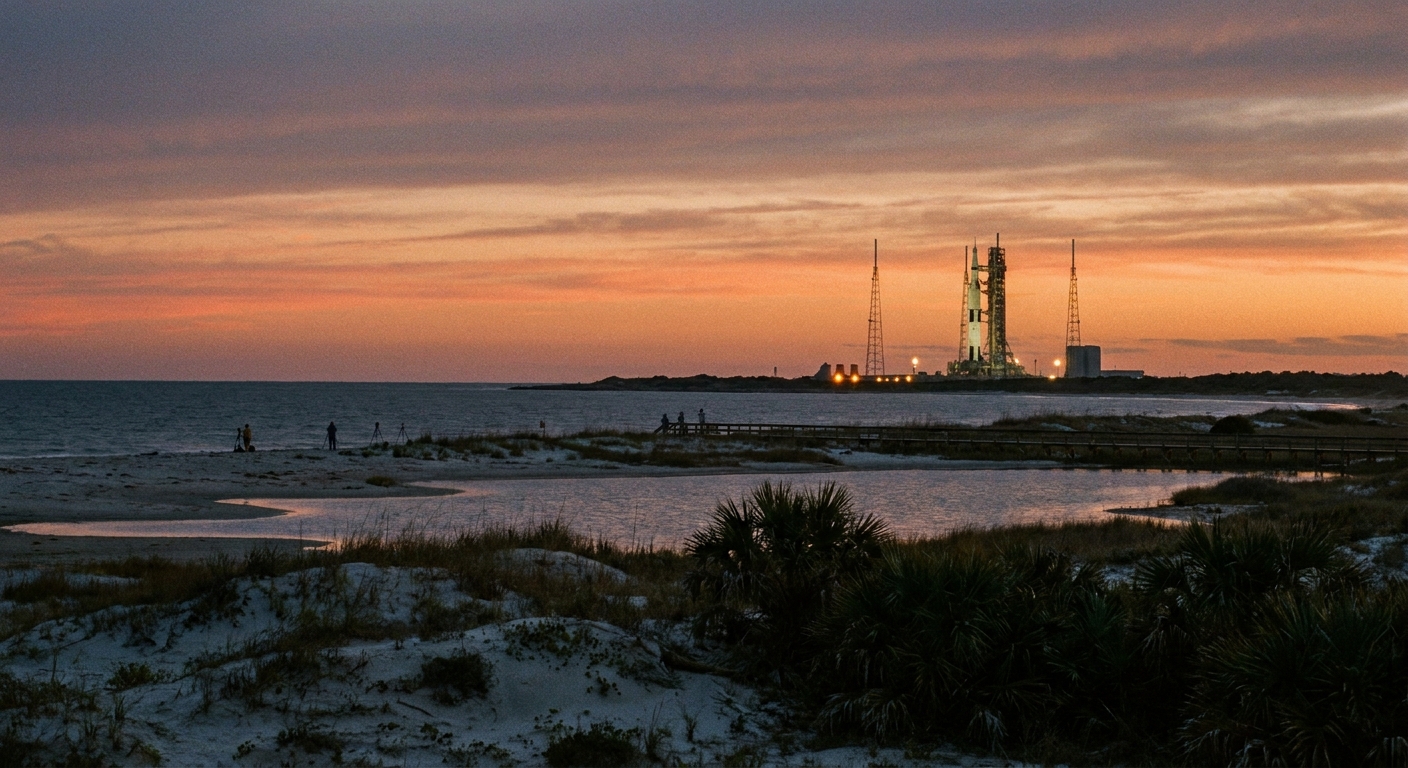
The Atlantic stays warmer in September than in either neighboring month: 85.3°F at the surface, against 84.9°F in August and 79.7°F in October, all from Open-Meteo’s Marine API. A swim at the 7:09 a.m. sunrise, with the sun coming up over the water, is at its warmest here. In October the same dawn swim starts 5.6°F cooler.
Kennedy Space Center is the reason most people drive over, and rocket launches over the surf at Cocoa Beach are what the coast is famous for. North of the launch complexes, Merritt Island National Wildlife Refuge protects lagoon and marsh, and Canaveral National Seashore keeps a long undeveloped beach. We could not verify September hours, admission prices or parking fees for any of the four, and we found no confirmed launch date for the month. Check each operator before you go, and browse our Florida things-to-do guide and national parks guide for more.
In September the gap between sea and air is small. The water at 85.3°F sits just 4.3°F under the inland high of 89.6°F, and the beach itself runs cooler than the airport thanks to the sea breeze. A noon swim cools you off without chilling you. With rain on about 9.2 days, the refuge and the seashore suit the morning, and Kennedy Space Center’s indoor exhibits suit the afternoon storm window.
Watching the sun come up out of the Atlantic from the sand costs nothing, and the beach needs no ticket. We could not verify parking fees at Cocoa Beach or the entrance fee at Canaveral National Seashore, so we quote neither. Our Florida trip-cost guide covers the daily parking layer that catches visitors off guard.
The Space Coast in September: a two-day itinerary
Start day one on the sand at Cocoa Beach for the 7:09 a.m. sunrise and swim before 9, while the 85.3°F sea feels warmer than the morning air. Drive to Kennedy Space Center late in the morning, so its indoor exhibits cover the hottest hours and the mid-afternoon storm window. Head back to the coast around 5 p.m. for a second swim, then book dinner for after the 7:31 p.m. sunset.
Give day two to the wild coast: Merritt Island National Wildlife Refuge at sunrise, then Canaveral National Seashore before noon. If a thunderstorm builds, move to a long lunch indoors and return to the beach once the lightning has passed. If the National Hurricane Center has a system heading for Florida’s east coast, use the refundable booking and move the trip. Our getting-around guide covers the drive from MCO.
The Space Coast in September vs August and October
| Measure | August | September | October |
|---|---|---|---|
| Average high (Orlando Intl) | 91.6°F | 89.6°F | 84.7°F |
| Average low (Orlando Intl) | 73.7°F | 72.4°F | 66.2°F |
| Precipitation | 7.69 in | 6.37 in | 3.46 in |
| Days with 0.10 in or more | 11.5 | 9.2 | 5.3 |
| Sea surface (daily maxima, Open-Meteo 2015-2024) | 84.9°F | 85.3°F | 79.7°F |
At Orlando International, the average high runs 91.6°F in August, 89.6°F in September and 84.7°F in October, and the low 73.7°F, 72.4°F and 66.2°F, all NOAA 1991-2020 normals. Rain drops from 7.69 inches over 11.5 wet days in August to 6.37 inches over 9.2 days in September and 3.46 inches over 5.3 days in October. The sea, per Open-Meteo’s Marine API, reads 84.9°F, 85.3°F and 79.7°F.
Shift four weeks earlier to August and you add 2.0°F to the high and 2.3 wet days, for a sea 0.4°F cooler. Shift four weeks later to October and you gain a high 4.9°F lower and 3.9 fewer wet days, but give up 5.6°F of sea temperature. All three months fall inside the hurricane season, which ends November 30.
Is September a good time to visit the Space Coast?
Yes, for swimmers, beach-first travelers and anyone who can book flexibly: the sea at 85.3°F is the warmest of the three months, and the inland high has eased from August. No, for a trip that cannot move, such as a wedding weekend a storm could wreck, or for a family that needs long outdoor afternoons in 89.6°F inland heat.
If the answer is no, pick October. The inland high drops to 84.7°F, wet days fall to 5.3, and the sea still reads 79.7°F. Hurricane season runs until November 30, so keep the booking refundable, and see our Florida best-time guide for the dry months that follow.
Of the three late-summer months, September is the one when the Space Coast’s sea, at 85.3°F, runs warmer than August’s.
The last word
Book the Space Coast in September with an exit door: a refundable room, a changeable flight into MCO, and a morning-first plan built around an 85.3°F sea. Then enjoy the odds. In an average September at Orlando International, only 1.8 days bring an inch of rain or more, so a day-wrecking deluge comes about twice a month. Pack the rain shell and swim at 7:09 a.m.
Sources & data for this guide
- September, August and October air normals (highs, lows, precipitation, days at 0.10 in and 1 in) · NOAA NCEI monthly normals 1991-2020, station USW00012815, Orlando International Airport · checked Sep 24, 2026
- Station location and coastal caveat (about 60 km inland, coast cooler by day, milder by night, with a sea breeze) · NOAA NCEI station record · checked Sep 24, 2026
- Sea surface temperature, mean of daily maxima, 2015-2024 (August 84.9°F, September 85.3°F, October 79.7°F) · Open-Meteo Marine API · checked Sep 24, 2026
- Daylight, sunrise and sunset on September 15 (11:09 and 23:31 UTC, converted to EDT) · sunrise-sunset.org · checked Sep 24, 2026
- Hurricane season dates and September 10 peak · NOAA National Hurricane Center, via our Florida orientation · checked Sep 24, 2026
- We could not verify September hours, admission prices, parking fees, launch dates, wind and swell data, lodging lead times or the Brevard County tourist tax rate, so we quote none. Place descriptions are editorial · check operators when you book.
To plan your stay
- Best Time to Visit the Space Coast: Weather, Sea Temperature and the Quiet Months
- The Space Coast in August: Weather, Sea Temperature, Rain Days and Crowds
- The Space Coast in October: Weather, Sea Temperature, Crowds and a Two-Day Itinerary
- The Space Coast in July: Weather, Rain Days, Sea Temperature and Crowds