
FLORIDA · THE SPACE COAST · JANUARY
The Space Coast in January is Florida with a sweater in the car. Mornings start cool, afternoons settle in the low 70s, and the Atlantic stays brisk enough that most swimmers keep the dip short. In return the month makes everything on land comfortable: the rocket garden at Kennedy Space Center, the marsh drives of Merritt Island, the long barrier-island sand of Canaveral National Seashore.
You have already picked the coast. What remains are the date questions: how cold the nights get, whether the water is swimmable, and what December or February would change. February runs about 3°F warmer by day for the same sea temperature, December brings the warmest water of the three, and January is the coolest month of the trio on both highs and lows.
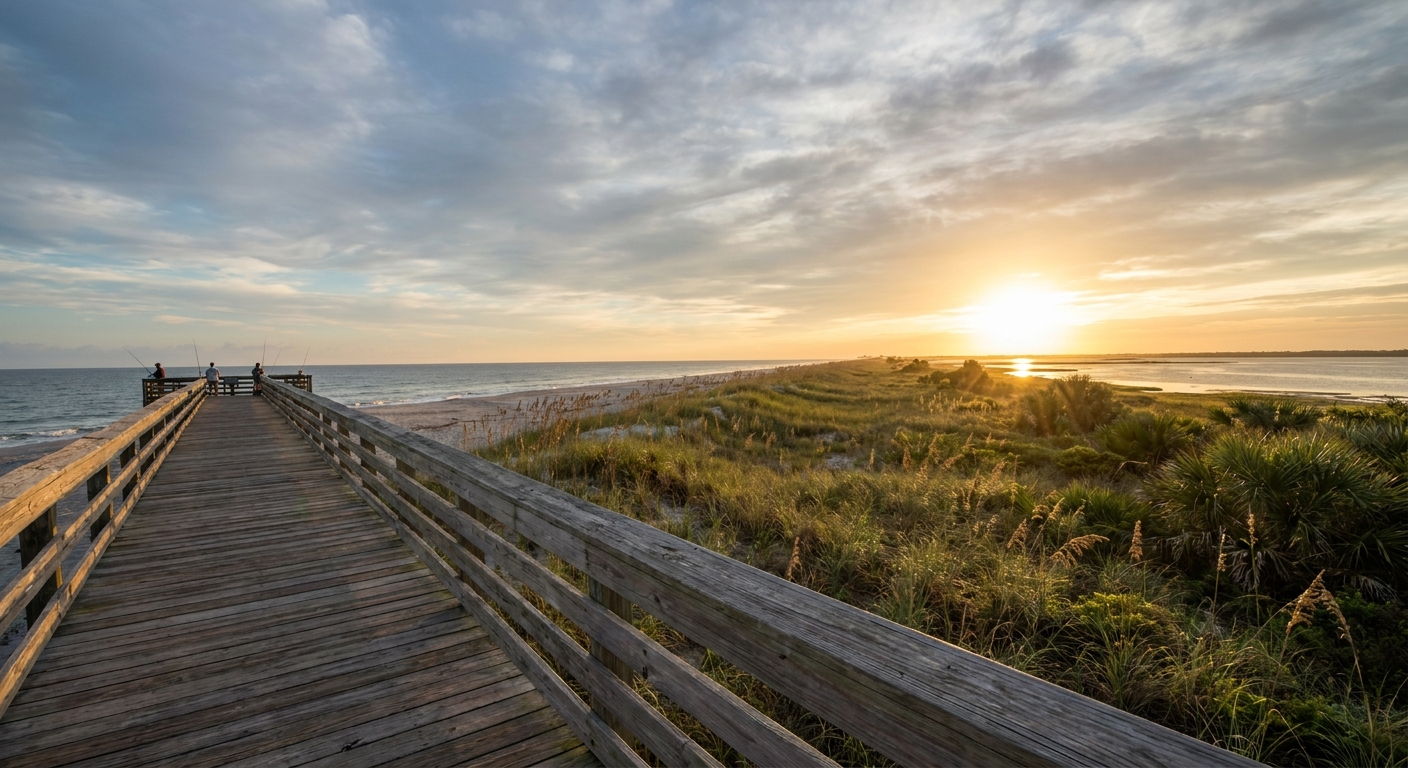
THE MONTH AT A GLANCE · THE SPACE COAST · JANUARY
Come in January for cool, mostly dry days built for Kennedy Space Center and the wildlife refuges, and pack for brisk water rather than a long swim.
HIGHS 71.8°F · LOWS 49.5°F · SEA 67.8°F · FLY INTO MCO
Go for: Kennedy Space Center without summer heat, winter wildlife on Merritt Island, sunrise beach walks, and cool evenings that call for a light layer at dinner.
Think twice before: planning a swim-centered beach week, or counting on warm nights outdoors in shorts.
Air: NOAA NCEI normals, Orlando Intl · Sea: Open-Meteo Marine API · Sun: sunrise-sunset.org · full sources at the end
On this page
- Space Coast weather in January71.8°F highs, 49.5°F lows, 4 wet days
- Can you swim in January?Sea at 67.8°F, measured at the daily peak
- Crowds and hotel prices in JanuaryBooking dates, lodging tax and a heated pool
- Things to do in JanuaryKennedy Space Center, Merritt Island, Canaveral National Seashore
- A two-day January itineraryTwo days from the 7:17 am sunrise to the 5:51 pm sunset
- January vs December and FebruaryHighs of 73.8°F, 71.8°F and 74.9°F
- Is January a good time to visit?Who January suits, and February as the alternative
Air normals below come from the official NOAA station at Orlando International, sea figures from the Open-Meteo Marine API. For the trip itself, our Florida orientation gives the Space Coast one to three nights and routes it through MCO, while our flights guide and getting-around guide handle the airport and the rental car. Still choosing a season before a month? Start with the best time to visit Florida.
The Space Coast weather in January: average highs, lows and rain days
| January normal (Orlando Intl, 1991–2020) | Value |
|---|---|
| Average high | 71.8°F |
| Average low | 49.5°F |
| Precipitation | 2.48 in |
| Days with 0.10 in or more | 4.0 |
| Days with 1 in or more | 0.7 |
| Sea surface, mean of daily maxima (Open-Meteo, 2015–2024) | 67.8°F |
| Daylight on January 15 | 10 h 34 min |
These are official 1991–2020 normals from NOAA’s National Centers for Environmental Information, recorded at station USW00012815 at Orlando International Airport: an average January high of 71.8°F, a low of 49.5°F and 2.48 inches of precipitation. That thermometer stands 60-odd kilometers (roughly 37 miles) inland. On the beaches the days run cooler and the nights milder, and the sea breeze Orlando never feels cools a sunny afternoon further. Read every air figure here as the inland reference: a real station reading, with the coast a little softer at both ends.
Measurable rain, 0.10 inch or more, falls on 4.0 days in an average January, about one day in eight. Only 0.7 day brings an inch or more, so most Januaries get one real soaking and some get none at all. In practice a wet day usually costs a morning or an afternoon. Keep one indoor block in reserve, such as the exhibit halls at Kennedy Space Center, and slide it onto whichever day the forecast darkens.
Between the 71.8°F afternoon and the 49.5°F dawn at Orlando International sits a 22.3°F swing, and the coast narrows it without erasing it. Pack for two seasons in one day: a fleece or light jacket for a sunrise walk, a windproof shell for the pier, and shorts that come out after lunch. Closed shoes help on the refuge trails in the early morning.
On January 15 the sun rises at 7:17 am and sets at 5:51 pm Eastern Standard Time, for 10 hours 34 minutes of daylight. Beach time after 4 pm is short, and the sunset over the Indian River Lagoon, on the west side of the barrier islands, comes early enough to fit before dinner. Plan outdoor sightseeing to wrap up by about 5:30 pm.
Can you swim in the Space Coast in January? Sea temperature and what it feels like
The Open-Meteo Marine API puts the sea surface off the Space Coast at 67.8°F in January, averaged over 2015–2024. That figure is a mean of daily maxima, the warmest reading of each day, so it sits a shade above a 24-hour average. Tables built on daily means will print a lower number, and both can be correct for what they measure.
For most swimmers, water in the upper 60s means a sharp breath on entry and a short dip. Children and anyone who feels the cold tend to come out fast, and with the air cooler on the beach than the inland 71.8°F, the sand does little to warm you back up. Bring a towel and a dry layer to the water’s edge, or a spring wetsuit if you want a longer session in the surf.
We could not verify wind speed, swell height or rip-current frequency for January off the Space Coast, so we give no figures for them. Check the day’s surf forecast and the beach flags when you arrive, and swim near a lifeguard stand where one is staffed. Our Florida safety guide covers beach safety in more depth.
How busy is the Space Coast in January? Crowds and prices
We found no occupancy or room-rate series for the Space Coast, so we crown no month cheap or expensive. The calendar we can place: our Florida orientation puts the state’s annual price peaks at the holiday weeks and spring break. January opens inside the first and closes weeks before the second arrives in March.
The first days of January still belong to the New Year holiday stretch, so a vacation starting on the 2nd books like a holiday trip. Our sources carry no lead-time data for coast hotels, so we give no week count. Book a refundable rate as soon as your dates firm up, and read where to stay in Florida before choosing between Cocoa Beach and a base nearer Titusville and the space center.
We could not verify Brevard County’s tourist development tax rate for 2026, so we give no percentage. When you compare rooms, ask for the total per night with taxes and any resort fee included. Resort fees and parking are the charges that swell a Florida quote, and our Florida trip-cost guide helps you budget around them.
Spend the extra on a heated pool. With the sea averaging 67.8°F at its daily peak and dawn near 49.5°F inland, a heated hotel pool puts swimming back into a January itinerary. Ask the property whether the heating runs in January before paying a premium for pool access.
Things to do in the Space Coast in January
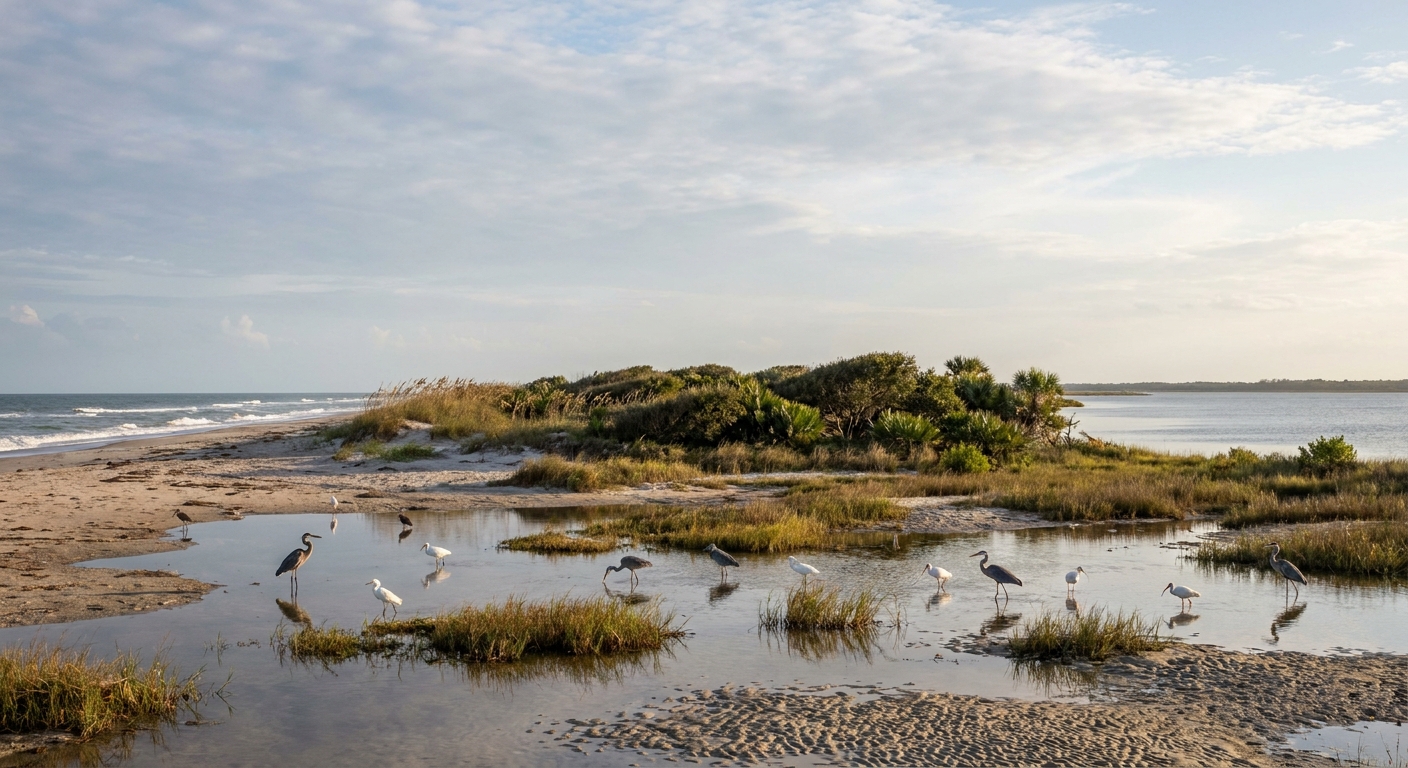
January air suits long walking days. Afternoons at 71.8°F inland, cooler on the coast, make a full day on Kennedy Space Center’s outdoor grounds or a midday wildlife drive comfortable. Winter is also when manatees seek out warm water along Florida’s coast and migrating ducks settle on the refuge marshes. Our manatee guide explains where watching turns into swimming.
Kennedy Space Center Visitor Complex, on Merritt Island, holds the rocket garden and the exhibit halls. Merritt Island National Wildlife Refuge wraps around it, with Black Point Wildlife Drive for birds and the Haulover Canal viewing area for manatees. Canaveral National Seashore runs north to Playalinda Beach, and Cocoa Beach Pier anchors the beach town to the south. We could not verify this season’s admission prices, refuge or seashore fees, or opening hours for any of them, so confirm each with its operator before you plan the day.
The sea off these beaches reads 67.8°F in both January and February, while the air normal climbs from 71.8°F to 74.9°F between the two months. The water holds steady and the land runs cooler, so in January the boardwalk, the wildlife drive and the rocket garden suit the weather better than a swim. At Playalinda and Cocoa Beach, plan on walking the sand more than wading in.
The 7:17 am sunrise from any public beach costs nothing, and neither does the view west over the Indian River Lagoon at 5:51 pm. We could not verify beach parking rates or whether any site waives fees in January, so we list nothing else as free. Rocket launches from Cape Canaveral can be watched from public beaches, but we verified no January launch date, so check the published schedule when you book.
The Space Coast in January: a two-day itinerary
Day one. Be on a public beach in Cocoa Beach for the 7:17 am sunrise, jacket on, since dawn is the coolest hour. Drive to Kennedy Space Center Visitor Complex for opening time and give it the late morning and early afternoon, when the air nears its 71.8°F peak for the outdoor rocket garden. Around 3 pm move to Black Point Wildlife Drive for the low afternoon light over the marsh, then find a spot on the Indian River Lagoon for the 5:51 pm sunset and have dinner after dark.
Day two. Start at the Haulover Canal viewing area, where manatees are often seen in cool weather, then head to Canaveral National Seashore for a long beach walk and, if the sun is out and the sea tempts you, a short dip in 67.8°F water. If the weather turns, with 4.0 wet days in an average January, swap the seashore for Kennedy’s indoor exhibit halls and push the beach walk to the next dry morning. To fold these days into a longer trip, see our seven-day Florida itinerary.
The Space Coast in January vs December and February
| Normal | December | January | February |
|---|---|---|---|
| Average high (NOAA, Orlando Intl) | 73.8°F | 71.8°F | 74.9°F |
| Average low (NOAA, Orlando Intl) | 52.9°F | 49.5°F | 52.4°F |
| Precipitation | 2.48 in | 2.48 in | 2.04 in |
| Days with 0.10 in or more | 3.7 | 4.0 | 3.8 |
| Sea surface, daily maxima (Open-Meteo, 2015–2024) | 69.9°F | 67.8°F | 67.8°F |
January is the coolest of the three months at Orlando International. Its 71.8°F high sits 2.0°F below December’s 73.8°F and 3.1°F below February’s 74.9°F, and its 49.5°F low trails December by 3.4°F and February by 2.9°F. Precipitation matches December at 2.48 inches while February drops to 2.04, and wet days stay close together at 3.7, 4.0 and 3.8. At sea, the Open-Meteo Marine averages give December 69.9°F, then 67.8°F for both January and February.
Moving four weeks earlier gains a sea 2.1°F warmer and milder nights, but puts the trip in the holiday stretch our Florida orientation counts among the year’s price peaks. Moving four weeks later gains 3.1°F on the afternoon high and 0.44 inch less rain for identical water, with spring break waiting in March beyond it. Staying in January keeps you between those two calendar peaks at the cost of a few degrees.
Is January a good time to visit the Space Coast?
Yes, for travelers coming for Kennedy Space Center, the refuges and long beach walks: January keeps those days comfortable, with rain on about one day in eight. No, for a swim-first beach vacation or for anyone who wants warm evenings outdoors without a layer, since the inland low averages 49.5°F and the sea tops out at 67.8°F on an average day.
If the answer is no, pick February. The water is identical at 67.8°F, but afternoons run 3.1°F warmer, nights 2.9°F milder and the month drier at 2.04 inches. For the warmest sea of the three, December’s 69.9°F leads. Our Florida best-time guide follows the curve on into spring.
Of the three winter months, January gives the Space Coast its coolest walking weather, with 10 hours 34 minutes of daylight to spend on rockets and marshes.
The last word
Decide what the trip is for before you settle the date. If the plan is rockets, refuges and sunrise walks, January is a sound pick, and a light jacket is the only special gear it asks of your suitcase. Pack a warm one: at Orlando International, 1.1 nights in an average January fall to 32°F or below, and the coast, milder at night, still feels those cold snaps on the dawn beach.
Sources & data for this guide
- January, December and February air normals (high, low, precipitation, days at 0.10 in and 1 in or more, nights at 32°F or below) · NOAA NCEI 1991–2020 monthly normals, station USW00012815, Orlando International Airport · checked Sep 24, 2026
- Station location and coastal difference · NOAA NCEI record for USW00012815 · the station sits 60-odd km inland, so beach days run cooler and nights milder · checked Sep 24, 2026
- Sea surface temperatures for December, January and February (mean of daily maxima, 2015–2024) · Open-Meteo Marine API · checked Sep 24, 2026
- Sunrise, sunset and daylight on January 15 · sunrise-sunset.org, converted from UTC to Eastern Standard Time · checked Sep 24, 2026
- Nights, airport and seasonal price peaks · The Travel Chronicle Florida orientation · editorial
- What we could not verify: hotel rates or occupancy, Brevard County’s lodging-tax rate, admission prices and hours at Kennedy Space Center, the refuge and the seashore, wind and swell data, and January launch dates. Confirm each with the operator when you book.
To plan your stay
- Best Time to Visit the Space Coast: Weather, Sea Temperature and the Quiet Months
- The Space Coast in February: Weather, Sea Temperature, Rain Days and Crowds
- The Space Coast in December: Weather, Sea Temperature, Crowds and Booking
- The Space Coast in March: Weather, Sea Temperature, Crowds and Things to Do