
FLORIDA · JULY · GILCHRIST BLUE SPRINGS
July puts the afternoon at 91.1°F at the nearest official thermometer. That heat is why people drive into North Florida in summer to lower themselves into a clear spring. The water under the trees is the reward for the drive, and in July you feel it the moment your feet leave the steps.
July is also a wet, bright month. NOAA’s normals put 6.68 inches of rain into an average July. On the 15th, the sun rises at 6:39 a.m. and sets at 8:34 p.m., so a storm rarely costs you the whole day. Plan a swim, a picnic on the bank and a slow river afternoon, and keep the evening flexible.
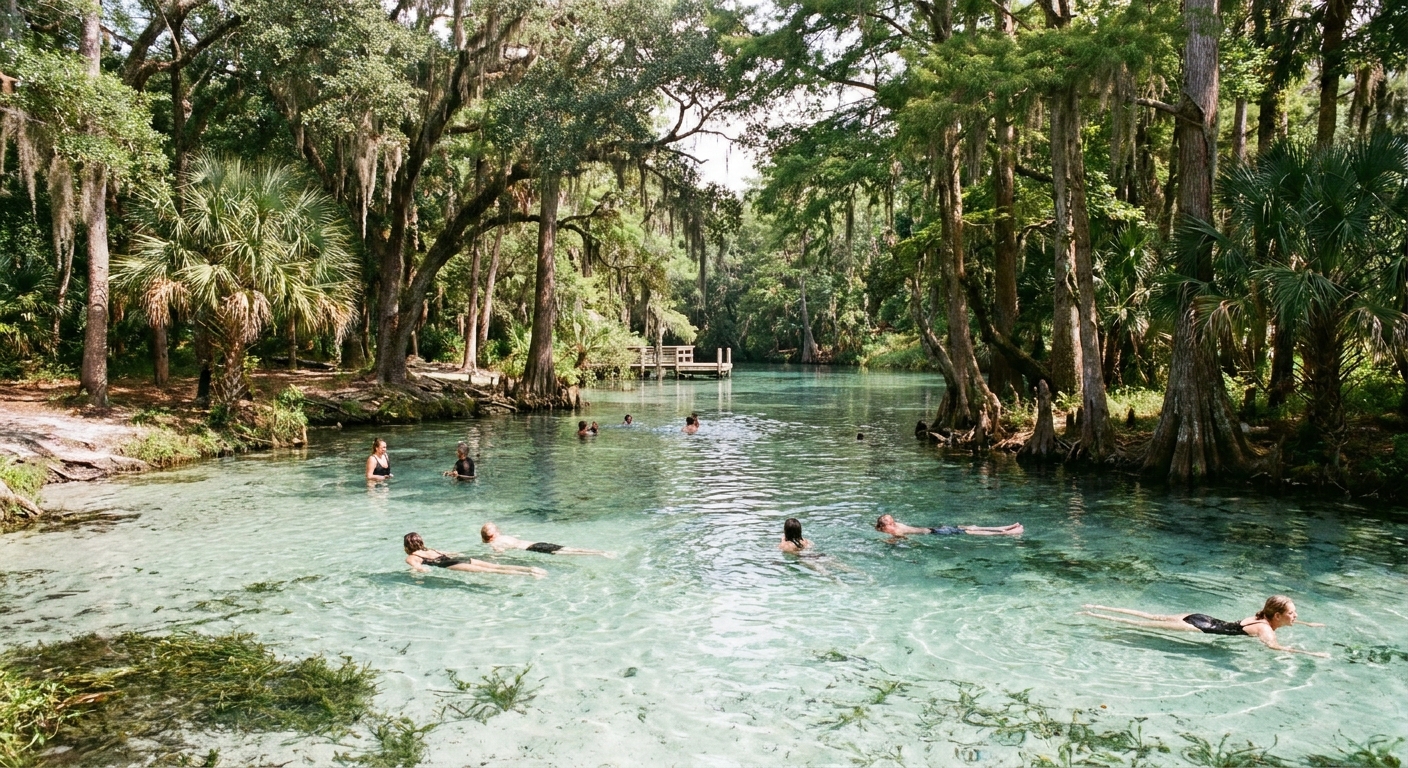
JULY AT A GLANCE · GILCHRIST BLUE SPRINGS
July is a swimming month here: go early, get in the water before the heat peaks, and keep the afternoon loose for the storms that come with 10.5 rain days.
HIGH 91.1°F · LOW 71.6°F · 10.5 RAIN DAYS · SUNSET 8:34 P.M.
Go for: a cold spring swim on a 91°F day, long evenings of light, and a summer-holiday trip the whole family can share.
Think twice before: booking a nonrefundable room in hurricane season, or planning a long afternoon hike with rain on one day in three.
Climate: NOAA NCEI 1991–2020, Gainesville Regional · Light: sunrise-sunset.org · full sources at the end
On this page
- Gilchrist Blue Springs weather in JulyHighs of 91.1°F, lows of 71.6°F, 6.68 inches of rain
- How warm is it in July?A 19.5°F gap between afternoon and dawn
- July crowds and pricesSchool-holiday season and refundable rates
- Things to do in JulyThe spring, the Santa Fe River and Ginnie Springs
- A July day trip to the springFrom sunrise at 6:39 a.m. to sunset at 8:34 p.m.
- July vs June and AugustHow the three months compare on heat and rain
- Is July a good time to visit?Yes for swimmers, less so for hikers
First, where the thermometer sits. Every figure here comes from NOAA’s Gainesville Regional station (USW00012816), the same station that serves Ginnie Springs a few miles up the same stretch of the Santa Fe River. It is an airport weather station, so the shade over the spring and the river valley can feel different from the official reading.
Gilchrist Blue Springs weather in July: average highs, lows and rain days
| July normal, 1991–2020 | Gainesville Regional |
|---|---|
| Average high | 91.1°F (32.8°C) |
| Average low | 71.6°F (22.0°C) |
| Precipitation | 6.68 in |
| Days with 0.10 in or more | 10.5 |
| Days with 1 in or more | 1.9 |
| Daylight on July 15 | 13 h 55 min |
| Sunrise · sunset, July 15 | 6:39 a.m. · 8:34 p.m. EDT |
NOAA’s National Centers for Environmental Information publish the 1991–2020 normals for Gainesville Regional: an average July high of 91.1°F (32.8°C), an average low of 71.6°F (22.0°C) and 6.68 inches of precipitation. These come from a real station thermometer rather than a reanalysis grid cell. Read them as the conditions in Gainesville, the closest official record to the spring.
An average July brings 10.5 days with at least 0.10 inch of rain, roughly one day in three. Florida’s wet season tends to deliver that rain as afternoon thunderstorms (our Florida best-time guide covers the pattern). Plan for a dry morning and a possibly gray afternoon: swim early and keep the second half of the day flexible.
The average high and low sit 19.5°F apart, and a 71.6°F dawn is still shorts weather. So the bag is about rain and sun rather than layers: a light poncho, water shoes for the steps and the sandy bottom, sunscreen, a wide hat, a towel you can sit on and a dry bag for the phone and car keys.
On July 15 the sun rises at 6:39 a.m. and sets at 8:34 p.m. Eastern Daylight Time, for 13 hours 55 minutes of daylight. We could not verify the park’s closing hour. Check it before you plan an evening swim around that late sunset.
How warm is Gilchrist Blue Springs in July?
The average July afternoon peaks at 91.1°F at Gainesville Regional, and the average night bottoms out at 71.6°F. Neither summer neighbor gets that hot by day: June averages 90.3°F and August 90.5°F.
In practice, arrive in a swimsuit under shorts and a T-shirt. The morning air near 71.6°F makes the first step into the spring bracing. By afternoon, when the air is closer to 91.1°F, shade and a refilled water bottle matter more than any extra layer.
You won’t need to worry about freezing nights in July: the average low of 71.6°F sits nearly 40°F above freezing. A sweater only earns a place in the bag for air-conditioned restaurants and the drive home.
How busy is Gilchrist Blue Springs in July? Crowds and prices
July falls in the middle of the American summer school holiday, a calendar fact that shapes a family spring more than any rain normal does. We found no occupancy series or monthly room-rate data for the area, so we rank no month cheaper or pricier than another.
Without lead-time data, we give no number of weeks. July also sits inside the Atlantic hurricane season, which runs June 1 to November 30 (see our Florida best-time guide). Book the room once your dates are fixed, keep the rate refundable, and compare bases in where to stay in Florida.
We could not verify the lodging-tax rate where you’ll sleep, so we give no percentage. Ask for the all-in nightly total, taxes and fees included, before you confirm.
Spending more changes a July trip on one line: the refundable rate. A nonrefundable room only pays off if the tropics stay quiet that week, and if a storm cancels the trip, the loss is yours. Our Florida trip-cost guide helps set the rest of the budget.
Things to do in Gilchrist Blue Springs in July
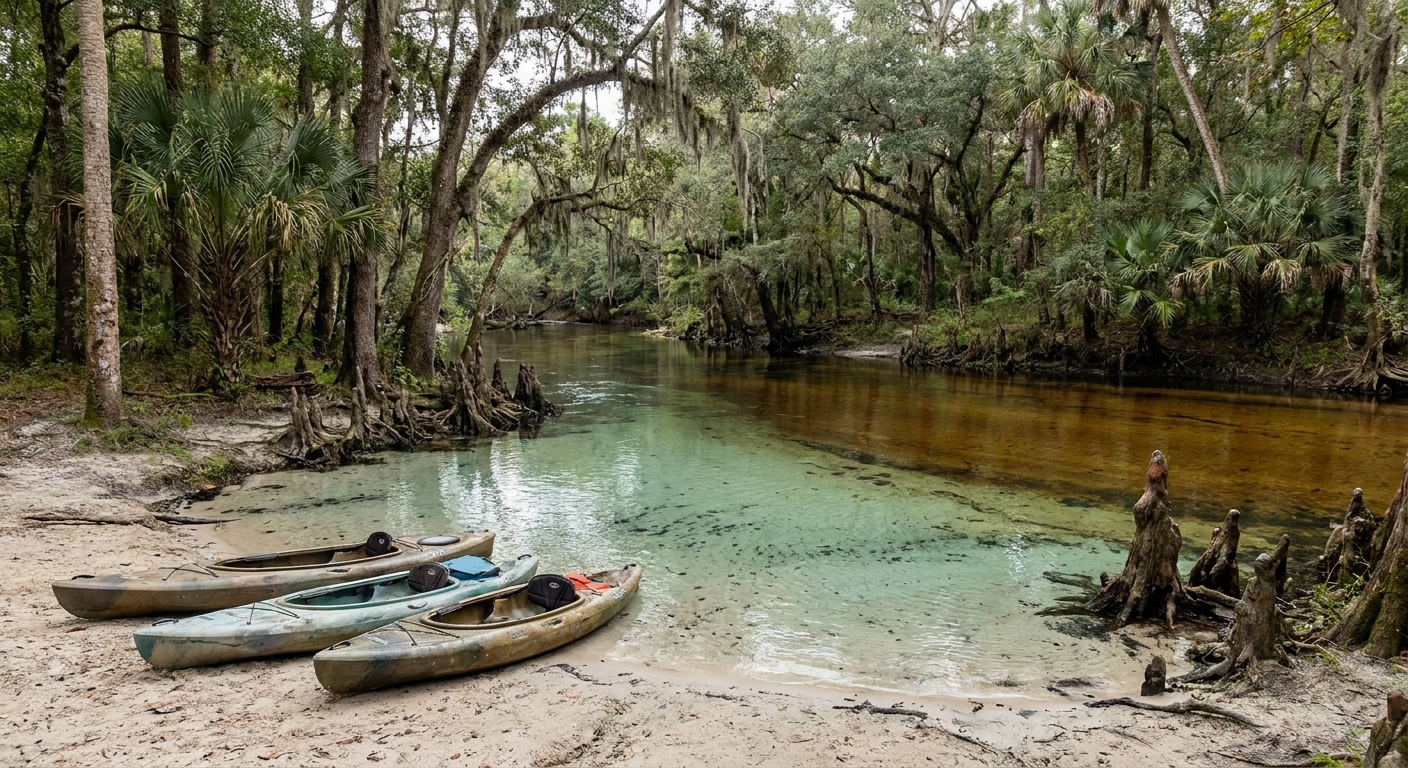
July pairs a 91.1°F afternoon with 13 hours 55 minutes of light on the 15th. You get a cold swim at the hottest part of the day and enough daylight left for a paddle after the storm passes. Cooler months offer the same water with much less reason to crave it.
The main event is Gilchrist Blue Springs State Park: the spring pool, its run down to the Santa Fe River, and the river itself for tubing and paddling. Ginnie Springs sits a few miles up the same stretch of the Santa Fe. Check the operators’ listings for current admission, hours, parking capacity, and water temperature before you drive. More ideas are in things to do in Florida.
A spring’s water holds steady through the year, and the air around it does not. In July the air climbs higher than in June or August, so the contrast on entering the water is the strongest of the three months. On a 71.6°F morning the pool feels bracing, and on a 91.1°F afternoon it feels like relief.
We found no verified free-admission day in July, so we name none. Families building a longer summer loop can pair the spring with ideas from Florida with kids.
Gilchrist Blue Springs day trip in July
Aim to arrive at opening. Check the park’s listing the evening before for the opening time. The sun is up at 6:39 a.m. and the air is near its 71.6°F low, the coolest hours of the day. On a school-holiday morning, early is the safer bet for parking. Swim first, eat on the bank, and move into the shade before the afternoon peak of 91.1°F. For the drive in, see getting around Florida, and for flights, see flying to Florida.
With 10.5 rain days in an average July, expect to lose roughly one afternoon in three to a storm. At the first thunder, leave the water and wait under a roof. A cold turn is not a July risk, since nights average 71.6°F. The light holds until 8:34 p.m., so a cleared-up evening can still carry a short paddle if the park is open.
Gilchrist Blue Springs in July vs June and August
| NOAA normal, Gainesville Regional | June | July | August |
|---|---|---|---|
| Average high | 90.3°F | 91.1°F | 90.5°F |
| Average low | 69.5°F | 71.6°F | 72.0°F |
| Precipitation | 7.56 in | 6.68 in | 6.40 in |
| Days with 0.10 in or more | 11.0 | 10.5 | 10.4 |
All three months come from the same NOAA station and the same 1991–2020 period. June runs 90.3°F by day and 69.5°F by night, with 7.56 inches of rain over 11.0 days. July reaches 91.1°F and 71.6°F, with 6.68 inches over 10.5 days. August settles at 90.5°F and 72.0°F, with 6.40 inches over 10.4 days.
Moving four weeks earlier to June buys a high 0.8°F lower and nights 2.1°F cooler, at the cost of 0.88 inch more rain. Moving four weeks later to August trims the high by 0.6°F and the rain by 0.28 inch, but the nights run 0.4°F warmer. Either way, the difference in rain days is under one day a month.
Is July a good time to visit Gilchrist Blue Springs?
Yes, if the trip revolves around the water: swimmers, tubers, paddlers and families on summer break get the spring when the contrast with the air is sharpest. It is a harder sell for anyone planning long afternoon hikes or wanting a dry forecast, with rain on 10.5 days in an average month.
If the answer is no, shifting within summer changes little: August is the slightly drier choice at 6.40 inches. For cooler air, look outside the wet season with our Florida best-time guide, and fold the spring into a wider Florida road trip.
Of the three summer months, July brings the hottest average afternoon, 91.1°F, so the first step into the spring’s steady water feels the most welcome.
The last word
The decision that shapes a July visit is the booking, not the forecast: take the refundable room, then plan to reach the water early. An average July brings 1.9 days with an inch of rain or more, enough to swell a river afternoon. With a flexible rate and a morning swim already done, a soaking day costs you almost nothing. Pack the dry bag, set the alarm for 6:39 a.m., and let the spring handle the heat.
Sources & data for this guide
- July, June and August normals (highs, lows, precipitation, rain days) · NOAA NCEI monthly normals 1991–2020, station USW00012816, Gainesville Regional · checked Sep 24, 2026
- Station scope · Gainesville Regional also serves Ginnie Springs, a few miles up the same stretch of the Santa Fe River, and is not a sensor at the spring · checked Sep 24, 2026
- Daylight, sunrise and sunset on July 15 · sunrise-sunset.org, converted from UTC to Eastern Daylight Time · checked Sep 24, 2026
- Hurricane season dates · as cited in our Florida best-time guide · checked Sep 24, 2026
- We could not verify park admission, opening hours, parking capacity, spring water temperature or the local lodging-tax rate. Check the operators when you book.
To plan your stay
- Best Time to Visit Gilchrist Blue Springs: Month-by-Month Highs, Rain and the Quietest Weeks
- Gilchrist Blue Springs in June: Weather, Rain Days and How It Compares to May and July
- Gilchrist Blue Springs in August: Weather, Rain Days, Crowds and a Two-Day Plan
- Gilchrist Blue Springs in May: Weather, Crowds and How It Compares to April and June