
GILCHRIST BLUE SPRINGS · FEBRUARY · THE MONTH GUIDE
North Florida’s spring country spends February in the best mood it has all winter. The Santa Fe River runs low and clear, the air over Gilchrist County averages a high of 70.9°F, and the month carries 2.67 inches of rain, less than the months on either side of it. A weekend here costs you one tank of gas from Gainesville and one warm change of clothes.
What February takes back happens at dawn. The average low sits at 45.9°F, and 2.8 nights in a normal February drop to freezing, so the trip works as an afternoon swim and a morning walk rather than the other way around. For the park itself, its trails and its access, our Gilchrist Blue Springs guide is the place to start.
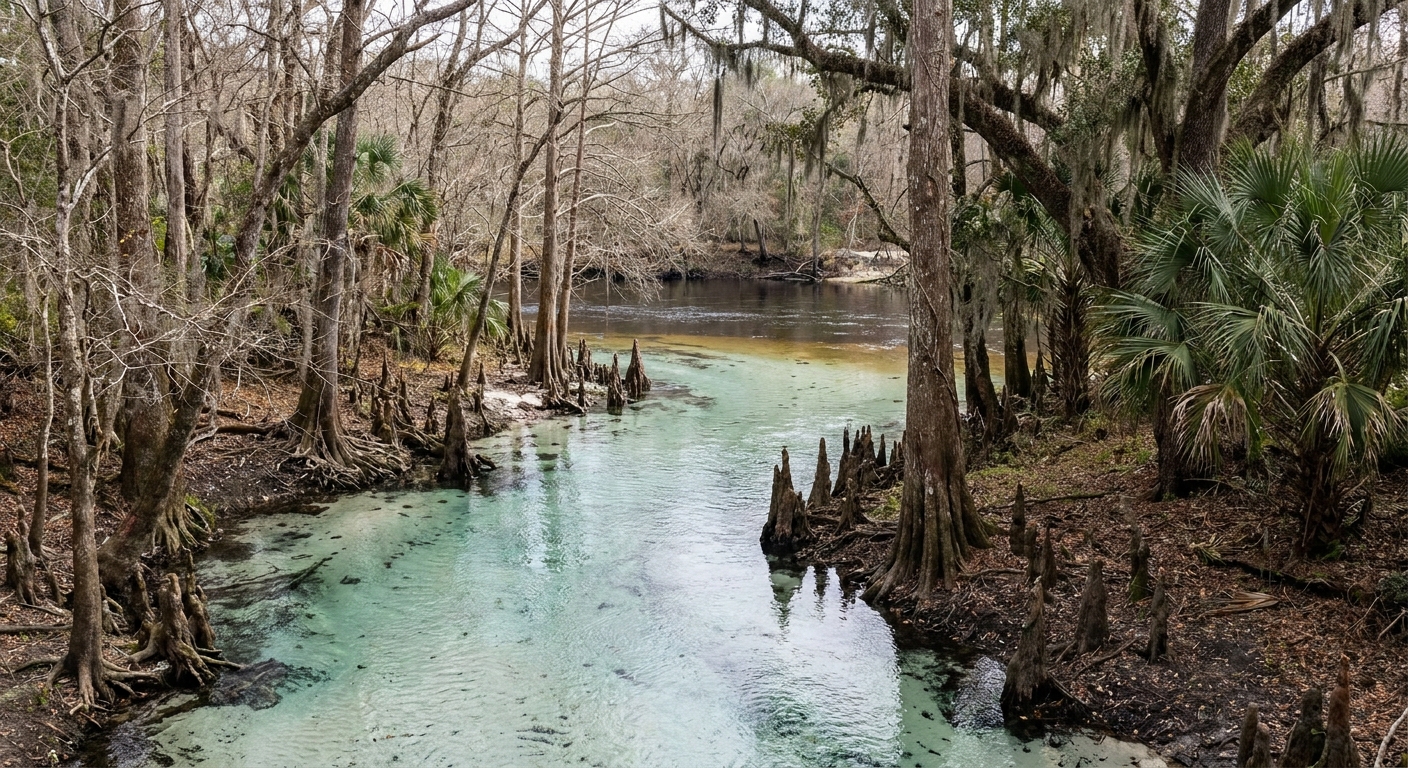
THE MONTH AT A GLANCE · FEBRUARY
February buys you the driest air of the winter and 70.9°F afternoons, and charges you dawns near 45.9°F with a few nights at freezing.
NOAA 1991–2020 NORMALS · GAINESVILLE REGIONAL STATION · FLORIDA DRY SEASON
Go for: dry-season air, an afternoon swim without August’s thunderstorms, and a two-day trip that fits a single weekend and one car.
Think twice before: booking a tent site for a February weekend, with 2.8 nights a month at or below 32°F and a 25-degree swing between dawn and mid-afternoon.
Air normals: NOAA NCEI 1991–2020, station USW00012816 · Daylight: sunrise-sunset.org · full sources at the end
On this page
- February highs, lows and rain daysThe NOAA normals, and the station they come from
- How cold the mornings getThe 25-degree gap between dawn and 3 pm
- Crowds and what a February trip costsWhat we can price and what we cannot
- Things to do at the spring in FebruaryThe spring run, the Santa Fe River, Ginnie Springs
- A two-day plan built on 11 hours of lightThe February weekend, hour by hour
- February against January and MarchHow the three months compare
- Is February a good month to go?Our February verdict
One date decides most of this trip: whether you swim in the afternoon or shiver at nine in the morning. Everything else, the drive up from Gainesville, the bed you book, the budget, belongs to our Florida trip-cost guide and the park page. The numbers that follow are the ones February changes.
Gilchrist Blue Springs weather in February: average highs, lows and rain days
| February normal | Value |
|---|---|
| Average high | 70.9°F (21.6°C) |
| Average low | 45.9°F (7.7°C) |
| Total precipitation | 2.67 in |
| Days with 0.10 in or more | 4.1 |
| Days with 1 in or more | 0.7 |
| Nights at 32°F or below | 2.8 |
| Daylight, February 15 | 11h 11m |
Every figure here comes from NOAA NCEI’s 1991–2020 monthly normals for station USW00012816 at Gainesville Regional, a real thermometer at an airport rather than a modeled grid cell. It is the same station that serves Ginnie Springs a few miles up the same stretch of the Santa Fe River, and it sits inland from the water. February averages 70.9°F by day, 45.9°F at night and 2.67 inches of rain across the month. Read it as the air over the county, not as a reading taken at the vent.
Rain arrives on 4.1 days in an average February, which works out to roughly one wet day in seven. Most of those days are a gray hour, not a lost weekend: you sit out a shower under the pavilion or in the car and the swim resumes. The heavier kind exists too, and it is the exception rather than the pattern.
The gap between the average high and the average low is exactly 25.0°F, wider than anything Florida throws at you in summer. Pack for two climates in one day: a fleece and long pants for the 7 am walk, shorts for two in the afternoon, and a towel plus a dry set of clothes left in the car. A thermos of something hot is the cheapest upgrade a February swim gets.
On February 15 the sun rises at 7:09 am and sets at 6:20 pm local time, giving 11 hours 11 minutes of daylight (sunrise-sunset.org). That sunset is early enough to matter: the water goes dark under the trees well before the clock does, and a 5 pm swim means changing in the cold. Aim to be out and dry by four.
How warm is Gilchrist Blue Springs in February?
February’s ceiling is 70.9°F and its floor is 45.9°F, a spread of 25 degrees inside a single day. The warm end lands in mid-afternoon, roughly between one and four, and it is a dry warmth: 2.67 inches of monthly rain is the lightest total of the three winter months we have on file.
In practice that means a jacket at breakfast and a T-shirt at lunch. Hikers and paddlers get the easiest conditions of the year, with no summer heat index to fight. Swimmers get a decision instead: you enter the water warmer than you leave it, so bring a towel you can wrap around yourself, and consider a neoprene top if you plan to stay in longer than twenty minutes.
An average February counts 2.8 nights at or below 32°F, so a frost on the windshield is normal here, not a fluke. As for the spring itself, a Florida spring run holds close to the same temperature all year while the air swings with the season.
How busy is Gilchrist Blue Springs in February? Crowds, prices and the demand peak
February falls inside Florida’s dry season, November through April, the stretch the whole state sells hardest (our month-by-month verdict lays out the wider calendar). That is a fact of climate, not of tariffs. We found no occupancy series and no monthly room-rate series for Gilchrist County, so we crown no month cheap and no month expensive.
What we can say about booking is structural. A north Florida spring weekend draws from Gainesville, Jacksonville and Orlando, all within a morning’s drive, so Saturday is the contested night and a Tuesday is not. We could not verify the park’s reservation window or its campsite count, so check the reservation system before you plan nights on site rather than a day trip from town.
We could not verify the Gilchrist County tourist development tax rate, so no percentage appears anywhere here. Assume the quoted nightly rate is not the final one, as everywhere in the state, and read the total before you confirm. Our where-to-stay guide covers the lodging tiers across Florida.
The one place extra money changes February is warmth after the swim. A heated room or a cabin instead of a tent is worth more in this month than any other upgrade, given those 2.8 freezing nights and a dawn average of 45.9°F. Spend there and the rest of the weekend costs what a weekend costs.
Things to do in Gilchrist Blue Springs in February
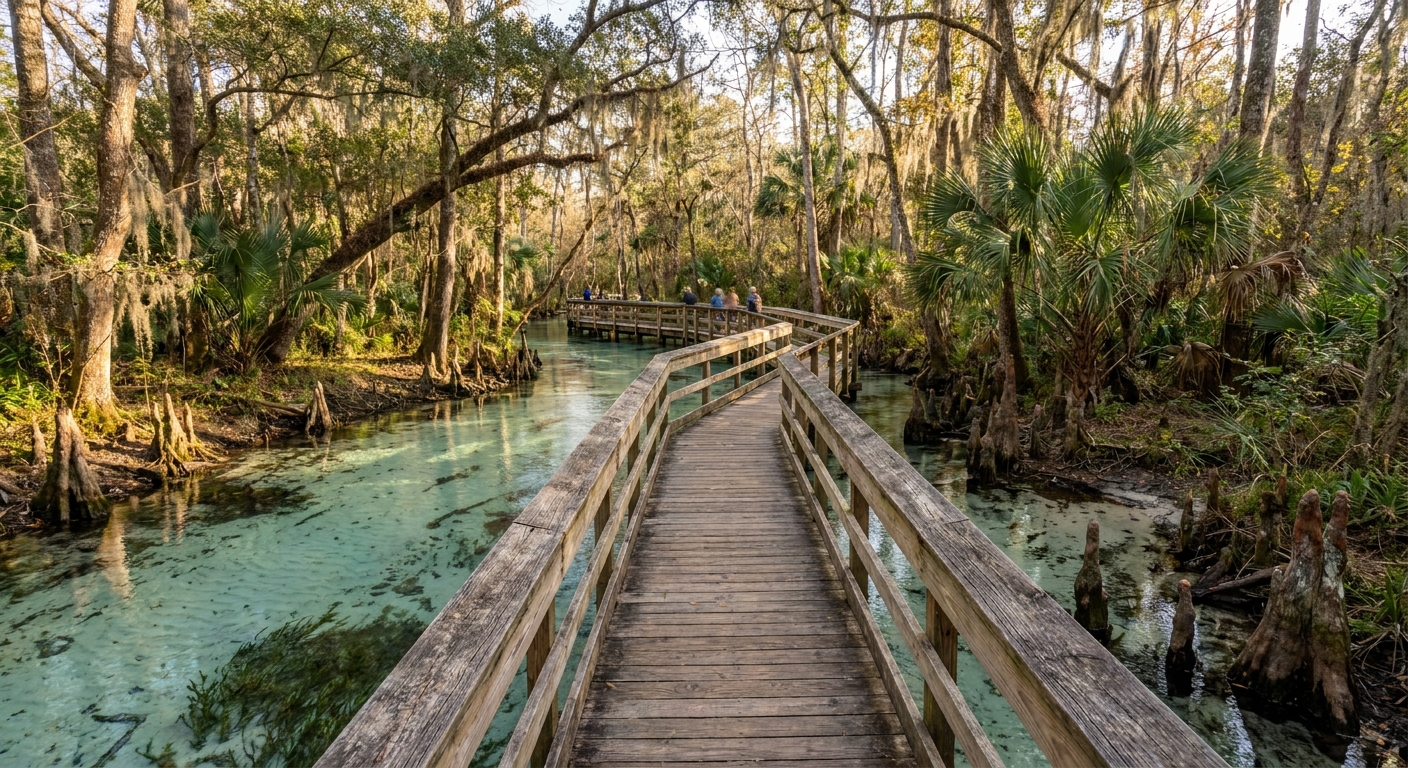
February hands you the two things July cannot: dry air and empty light. There is no afternoon thunderstorm to plan around, no heat index, and the swim area is not working at summer capacity. The trade is time, since the usable outdoor day runs about 11 hours and the best of it is squeezed into the afternoon.
The spring run and its swim area are the reason to come, and they sit a short walk from the Santa Fe River, which the park fronts. A few miles up the same stretch of river lies Ginnie Springs, a separate private property with its own gate and its own rules. Call or check the operator the week you drive up for current entry fees and opening hours.
The seasonal difference is in the air, not the water. A spring run barely moves across the year while February air swings from 45.9°F at dawn to 70.9°F at three, so the same swim feels bracing at nine and easy at two. Manatees are the other winter story in Florida’s springs, and our manatee guide explains where that reliably happens.
Free in February: the walking, the river bank and the light. We could not verify any fee-free day at the park for this month, so we name none, and we would rather you spent the saved hour on the boardwalk than hunting a discount.
Gilchrist Blue Springs in February: a two-day itinerary
Day one, built on the light. Leave Gainesville after breakfast and arrive around nine, when the air is still close to its 45.9°F low and the walk is the pleasure. Trail and river bank until eleven, lunch out of a cooler, then swim between one and three when the 70.9°F ceiling arrives. Dry off by four, because the sun goes at 6:20 pm and the shade goes sooner.
Day two goes to the river: a paddle or a slow float on the Santa Fe, starting late morning so the air has climbed. If the day lands among the 4.1 wet ones, flip the plan. Drive the county roads in the morning, take the shower hour indoors, and swim in the clearing afternoon, since rain barely touches what a spring run looks like. Our getting-around guide covers the car question statewide.
Gilchrist Blue Springs in February vs January and March
| Normal 1991–2020 | January | February | March |
|---|---|---|---|
| Average high | 67.1°F | 70.9°F | 75.8°F |
| Average low | 42.6°F | 45.9°F | 49.7°F |
| Precipitation | 3.29 in | 2.67 in | 3.49 in |
| Days with 0.10 in or more | 5.2 | 4.1 | 5.3 |
February runs 3.8°F warmer by day than January and 4.9°F cooler than March, and it is the driest of the three by a clear margin: 2.67 inches against 3.29 in January and 3.49 in March. It also counts about one wet day fewer, 4.1 against 5.2 and 5.3. Nights follow the same ladder, from 42.6°F in January to 49.7°F in March. All four rows come from the same NOAA station and the same 30-year period.
Shift four weeks forward and you buy afternoons near 75.8°F and mornings almost 4 degrees milder, at the price of 0.82 inch more rain and Florida’s spring-break traffic. Shift four weeks back to January and you lose 3.8 degrees of afternoon and gain a quieter park. February sits between the two, drier than either.
Is February a good time to visit Gilchrist Blue Springs?
Yes for walkers, paddlers, photographers and anyone driving up from a Florida base for a day or two. Less so for a family whose whole plan is hours in the water with small children, or for anyone hoping to sleep in a tent without a real sleeping bag. The month rewards people who treat the swim as one act of the day rather than the entire day.
If that is not your trip, take March: 75.8°F afternoons, lows of 49.7°F, and a morning that no longer requires a fleece. You pay 3.49 inches of rain and 5.3 wet days for it, and you share the springs with spring-break weekends, so book the room earlier than you would now.
No other month combines 70.9°F afternoons with only 2.67 inches of rain and an empty boardwalk at nine in the morning.
The last word
Book the Saturday bed, drive up Friday evening, and put the swim at two in the afternoon: that single decision is what February asks of you. Bring the fleece for the 7:09 am start and the towel for the walk back to the car. And since a normal February logs only 0.7 day with an inch or more of rain, a gray forecast is rarely a reason to cancel. Pack a dry bag and go.
Sources & data for this guide
- February normals: high 70.9°F, low 45.9°F, 2.67 in · NOAA NCEI 1991–2020 monthly normals, station USW00012816 (Gainesville Regional) · checked Sep 24, 2026
- Wet days (4.1 at 0.10 in or more, 0.7 at 1 in or more) and 2.8 nights at or below 32°F · NOAA NCEI 1991–2020, same station · checked Sep 24, 2026
- January and March normals used in the comparison · NOAA NCEI 1991–2020, same station and same period, not estimates · checked Sep 24, 2026
- Daylight 11h 11m on February 15, sunrise 7:09 am and sunset 6:20 pm local · sunrise-sunset.org · checked Sep 24, 2026
- Editorial reserve: the station sits at Gainesville Regional, inland from the park, and also serves as the reference for Ginnie Springs up the same stretch of the Santa Fe River. Treat the figures as county air, not a reading at the vent.
- Editorial reserve: we could not verify a published water temperature for the spring, the park’s fees and hours, the county lodging-tax rate, or any monthly occupancy or room-rate series. No number is given for those. Check the park and your operator before you book.
To plan your stay
- Best Time to Visit Gilchrist Blue Springs: Month-by-Month Highs, Rain and the Quietest Weeks
- Gilchrist Blue Springs in January: Weather, Freeze Nights and a Two-Day Plan
- Gilchrist Blue Springs in March: Weather, Crowds and How It Compares to February and April
- Gilchrist Blue Springs in April: Weather, Rain Days and a Two-Day Plan