
FLORIDA · GINNIE SPRINGS · JANUARY
The USGS gauge in the spring run at Ginnie Springs read 72.7°F (22.6°C) on September 11, 2026, and it reads close to that every day of the year. A spring has no season. The air above it does, and January is the month when the difference between those two sentences decides what you pack.
NOAA’s 1991–2020 normals put January air at a 67.1°F average high and a 42.6°F average low. So the water runs warmer than the average afternoon and a great deal warmer than dawn. That inversion is the whole January trip: a swim that feels like a reward rather than a dare, wrapped in a drive, a thermos and a dry change of clothes.
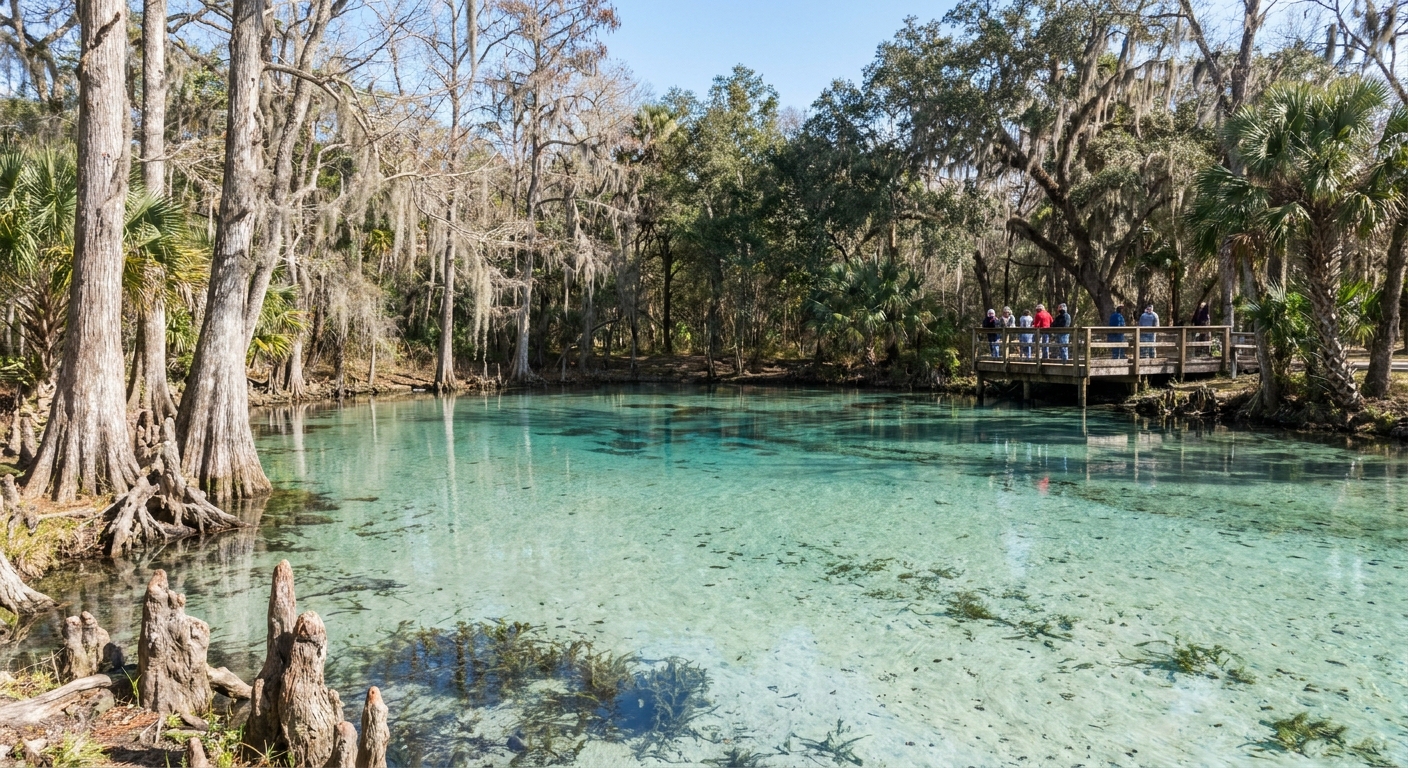
THE MONTH AT A GLANCE · GINNIE SPRINGS · JANUARY
January hands you 72.7°F spring water under the coolest and wettest air of the winter three, so the month works if you dress for a 42.6°F dawn and get in the water between eleven and three.
AIR 67.1°F / 42.6°F · WATER 72.7°F · 5.2 RAIN DAYS · 10H29 OF DAYLIGHT
Go for: diving and swimming in water that sits 5.6°F above the month’s average air high, plus short bright days that push you into the spring at midday instead of at five.
Think twice before: booking a tent in a month with 6.2 nights at or below freezing, or planning a sunbathing weekend around a 67.1°F afternoon.
Air: NOAA NCEI 1991–2020, Gainesville Rgnl AP · Water: USGS gauge 02322400 · Light: sunrise-sunset.org · full sources at the end
On this page
- Ginnie Springs weather in JanuaryHighs of 67.1°F, lows of 42.6°F, 5.2 rain days
- Can you swim at Ginnie Springs in January?Yes, at 72.7°F, with a 42.6°F dawn to dress for
- Gate prices and how busy the month getsWhat we verified, and what we could not
- Things to do at Ginnie Springs in JanuaryThe spring run, the dive sites, Peacock Springs
- A two-day plan around 10h29 of daylightBoth days, hour by hour
- January, December or February?How the three months line up on air and rain
- Is January a good time to visit Ginnie Springs?Who should go, who should shift four weeks
What does not change with the date lives elsewhere. Drive times and rental logic sit in getting around Florida, beds in where to stay, and the budget shape of a full week in what a Florida trip costs. Everything below is dated: the air, the light, the rain and the two neighboring months you might prefer.
Ginnie Springs weather in January: average highs, lows and rain days
| January measure | Value |
|---|---|
| Average high | 67.1°F |
| Average low | 42.6°F |
| Precipitation | 3.29 in |
| Days with 0.10 in or more | 5.2 |
| Days with 1 in or more | 1.1 |
| Nights at 32°F or below | 6.2 |
| Daylight on January 15 | 10h 29m |
| Spring water (USGS gauge) | 72.7°F |
Every air figure here comes from one place: NOAA’s National Centers for Environmental Information, 1991–2020 monthly normals, station USW00012816 at Gainesville Regional Airport. That is a real thermometer, not a grid cell, and it stands about 48 miles from the spring. It also measures air. January there normals out at a 67.1°F average high, a 42.6°F average low and 3.29 inches of precipitation across the month.
Rain arrives on 5.2 days in an average January, roughly one day in six, counting anything from 0.10 inch up. Only 1.1 of those days deliver an inch or more, so a typical month holds one real soaking and four grey drizzles. Underwater, none of it matters. On the walk back to the car it matters a lot, so a sealed bag with dry clothes and dry socks earns its space in the trunk.
Between the normal low and the normal high sits 24.5°F of daily swing, which is a wider spread than most visitors dress for. Two separate outfits go in the bag: a fleece, long pants and a beanie for the first two hours after sunrise, then shorts and a sun shirt for the middle of the day. A towel is not a coat, and in January the walk from the water to the changing room is the coldest twenty yards of the trip.
On January 15 the sun rises at 7:25 a.m. and sets at 5:54 p.m. Eastern Standard Time, giving 10 hours 29 minutes of daylight (sunrise-sunset.org). Useful light on the water runs shorter than that at the bottom of a wooded spring run. Plan your last swim to end by 4:30 p.m. and your drive to start in daylight.
How warm is Ginnie Springs in January?
January air moves 24.5°F between its normal low of 42.6°F and its normal high of 67.1°F. The water does not move at all. The 72.7°F on the USGS gauge is one instantaneous reading taken on September 11, 2026, not a monthly average, and it deserves that caveat out loud. The gauge sits near that number all year because the spring discharges at a constant temperature. Net result for a January afternoon: the water is 5.6°F warmer than the air around it.
Practically, mornings belong to layers and afternoons to neoprene. Divers already own the answer, a full or shorty wetsuit. Swimmers who would happily jump in barefoot in June should know that 72.7°F for twenty minutes is pleasant and 72.7°F for ninety minutes is not, unless you are wearing rubber. Bring a robe or an oversized hoodie for the exit, plus a hot drink in a thermos, because the wind on wet skin at 60°F does the damage, not the spring.
Frost is genuinely part of this month: 6.2 nights in an average January fall to 32°F or below at the Gainesville station. That number decides the sleeping arrangement more than anything else here. It also has zero effect on the water you will be swimming in the next morning, which is the strangest and best thing about a north Florida spring in winter.
How busy is Ginnie Springs in January? Crowds, prices and the demand peak
January falls inside Florida’s dry season, November through April, and our state-wide calendar lays out both halves of the year. Up here the label needs a footnote: with 3.29 inches, January is the wettest of the three winter months at this station. As for demand, we found no occupancy series and no room-rate series for this corner of north Florida, so we crown no month cheap, expensive or peak.
We could not verify an entrance fee or an opening hour for the spring either, and a price quoted for some other Florida park does not transfer. That makes one phone call the cheapest item in your planning. Ask two things before you drive: the hour the gate opens on your date, and whether tent sites and cabins are taking reservations for the weekend you want. We have no booking data, so we quote no lead time in weeks.
We could not verify a county tourist development tax rate for lodging in this area, so we give no percentage. If you book a room or a cabin, read the final line of the quote rather than the nightly headline, and ask whether the tax and any per-vehicle charge are already inside it.
One budget line genuinely changes in January, and it is thermal. Paying for a proper wetsuit rental instead of a swimsuit turns a ten-minute dip into a two-hour dive, and paying for four walls instead of nylon answers those 6.2 freezing nights. Spend there. Everything else on the invoice buys you the same spring at the same 72.7°F it delivers in July.
Things to do in Ginnie Springs in January
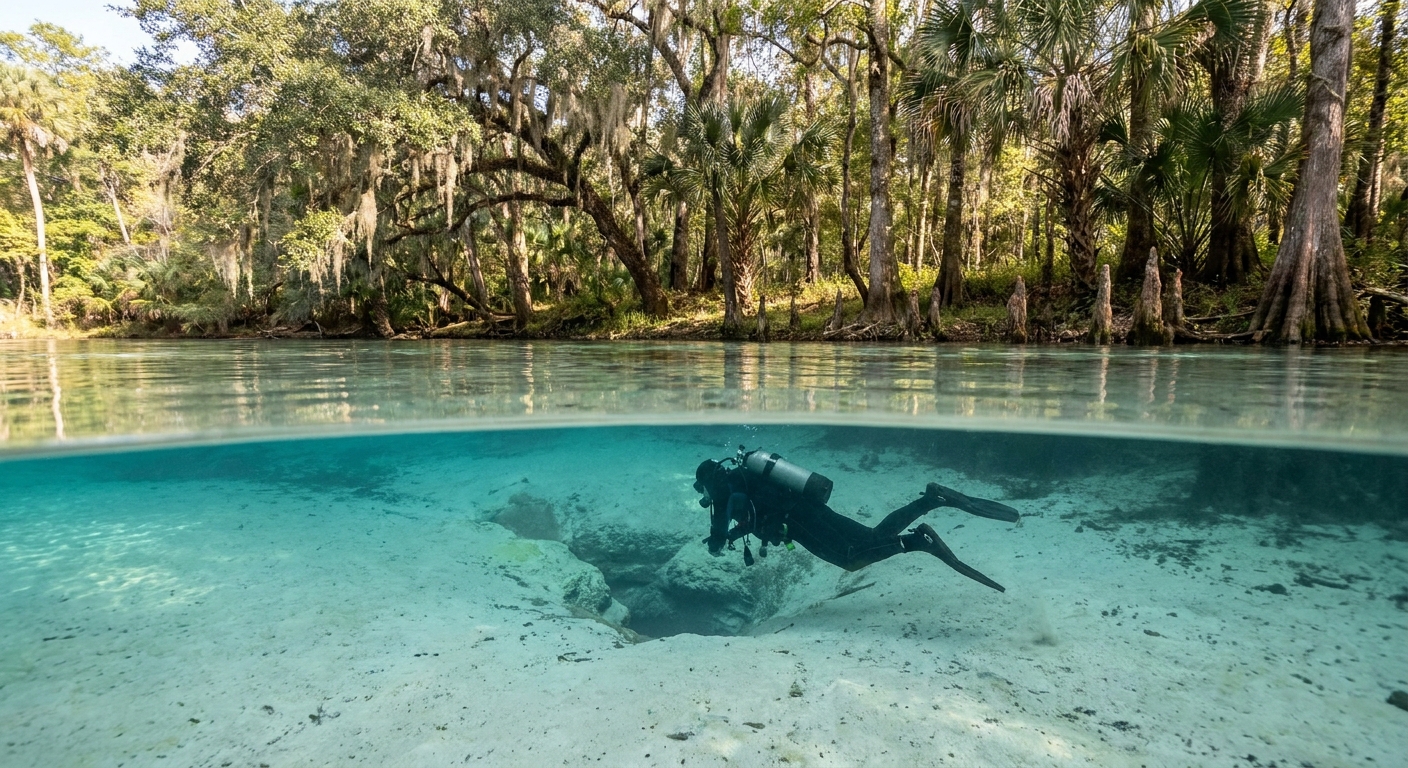
Here is the arithmetic that makes January distinctive among the winter three. The water reads 5.6°F above the month’s average air high. In December that gap is 3.4°F, in February 1.8°F. January is therefore the month when stepping into the spring is the warmest thing you do all day, and when a wetsuit swim is more comfortable than standing on the bank watching one.
The spring itself is the destination: USGS station 02322400 sits in the run and logs the 72.7°F that brings people this far inland. The Florida Department of Environmental Protection names Ginnie Springs, alongside Peacock Springs, among the most popular and interesting springs diving destinations in the state, which puts a second dive site within a day’s reach if your certification covers it. Manatees are a different spring and a different trip entirely, and Crystal River is where that one starts.
January changes the schedule at these places rather than the places themselves. The vent discharges the same water it discharged in August, so the gear list is what shifts: hood and gloves for divers, a second towel for everyone, and a swim window pushed into the warmest three hours instead of spread across the day. Tubing and float trips are the casualty, since sitting still on the surface at 67.1°F is a short-lived idea.
We could not verify any fee-free day or free-entry program at the spring, so we promise none. What January hands out at no charge is limited and worth naming anyway: 10 hours 29 minutes of low winter light on January 15, clear enough at midday to see the limestone lip of the vent from the surface.
Ginnie Springs in January: a two-day itinerary
Day one runs late and short on purpose. Sunrise is 7:25 a.m., but with 6.2 freezing nights in the month there is no reason to be at the gate for it. Drive in around 9:30, set up, walk the run, and let the air climb. Get wet between 11 a.m. and 3 p.m., when the normals put the air nearest 67.1°F and the 72.7°F water feels like a bath. Be dry and changed by 4:30. Sunset is 5:54 p.m., and the last hour of daylight belongs to the drive.
Day two repeats the middle of day one with better technique: longer in the water, shorter on the bank, lunch eaten in the car with the heater running. If rain moves in, remember it falls on 5.2 days of an average January and that divers are wet regardless. Move the picnic, keep the swim. The one day worth rescheduling is the inch-plus soaking, which arrives 1.1 times in a typical month and turns the parking area and the walk into a mud problem rather than a water problem.
Ginnie Springs in January vs December and February
| Measure | December | January | February |
|---|---|---|---|
| Average high | 69.3°F | 67.1°F | 70.9°F |
| Average low | 45.2°F | 42.6°F | 45.9°F |
| Precipitation | 2.88 in | 3.29 in | 2.67 in |
| Days with 0.10 in or more | 4.5 | 5.2 | 4.1 |
| Spring water | No seasonal cycle | 72.7°F on the USGS gauge | No seasonal cycle |
All three columns come from the same NOAA station and the same 1991–2020 period, so the comparison is clean. January is the coldest of the three on both ends, 2.2°F below December on the high and 3.8°F below February. It is also the wettest, 3.29 inches against 2.88 and 2.67, and the one with the most rain days, 5.2 against 4.5 and 4.1. The water column stays flat, because the spring ignores all of it.
Shift four weeks forward and February buys you 3.8°F on the afternoon, 3.3°F on the night, 0.62 inch less rain and one fewer rain day. Shift four weeks back and December gives you a milder morning than January without February’s warmth. What you lose by moving is that 5.6°F gap between water and air, the widest of the three, along with the emptier bank that a 67.1°F afternoon tends to produce.
Is January a good time to visit Ginnie Springs?
For divers, yes without hesitation: the water you came for reads 72.7°F and the air above it is doing nothing that a wetsuit and a hot drink cannot handle. For swimmers who accept neoprene, yes. For a family whose picture of Florida springs involves floating, sunbathing and a long lazy afternoon in a swimsuit, no. A 67.1°F average high is a fleece afternoon, and 42.6°F dawns make an early start unpleasant for children.
If that second description is yours, take February: 70.9°F and 45.9°F, 2.67 inches across 4.1 rain days, the warmest and driest of the winter three by the same station. Later still is warmer again, and our twelve-month verdict for Florida sets the whole year out, including which months turn the springs into the busiest water in the state.
January’s one exclusive: it is the only month of the three when the spring is more than five degrees warmer than the air you are standing in, so the swim is the warm part of the day rather than the brave part.
The last word
Make one call before you load the car, get the gate hour, and aim to be in the water by eleven with dry clothes sealed in a bag for the ride home. One thing worth carrying with you: Florida law protects a category called Outstanding Florida Springs, which under Statute 373.802(5) covers every historic first-magnitude spring as determined by the Florida Geological Survey plus six more named by hand in the text. The 72.7°F you are floating in is a legal category as well as a temperature, and in January you will have more of it to yourself.
Sources & data for this guide
- January air normals (67.1°F high, 42.6°F low, 3.29 in, 5.2 days at 0.10 in, 1.1 day at 1 in, 6.2 nights at 32°F or below) · NOAA NCEI monthly normals 1991–2020, station USW00012816, Gainesville Rgnl AP, FL US · checked Sep 24, 2026
- December (69.3°F / 45.2°F, 2.88 in, 4.5 days) and February (70.9°F / 45.9°F, 2.67 in, 4.1 days) normals · same NOAA station and period · checked Sep 24, 2026
- Daylight of 10h 29m on January 15, sunrise 7:25 a.m. and sunset 5:54 p.m. EST · sunrise-sunset.org · checked Sep 24, 2026
- Spring water at 72.7°F (22.6°C), one instantaneous reading, not a monthly mean · USGS National Water Information System, station 02322400 Ginnie Springs · checked Sep 24, 2026
- Outstanding Florida Springs definition · Florida Statutes 373.802(5) · checked Sep 24, 2026
- Ginnie Springs and Peacock Springs named among the state’s springs diving destinations · Florida DEP, Visit a Spring · checked Sep 24, 2026
- Our gaps, stated plainly: we could not verify an entrance fee, an opening hour, a county lodging-tax rate or any manatee count. Florida State Parks returned 403 to our automated reads on Sep 11, 2026, and the FWC manatee pages render client-side. Call the operator before you drive, since fees and hours change.