
ICHETUCKNEE SPRINGS · FEBRUARY · THE MONTH IN FIGURES
February gives Ichetucknee Springs an average afternoon high of 69.6°F and a dawn low of 45.2°F, and it gives the river itself nothing at all: the spring water has no season. That gap between cold air and unchanging water is the whole story of a February visit, and it decides what goes in the car.
In an average February, 4.8 days record at least a tenth of an inch of rain and 4.1 nights fall to 32°F or below, so you want a fleece at 7 a.m. and short sleeves by mid-afternoon. You also get the park nearly to yourself. Florida’s environmental department describes as many as 3,000 visitors a day during peak summer months, and February sits a long way from that.
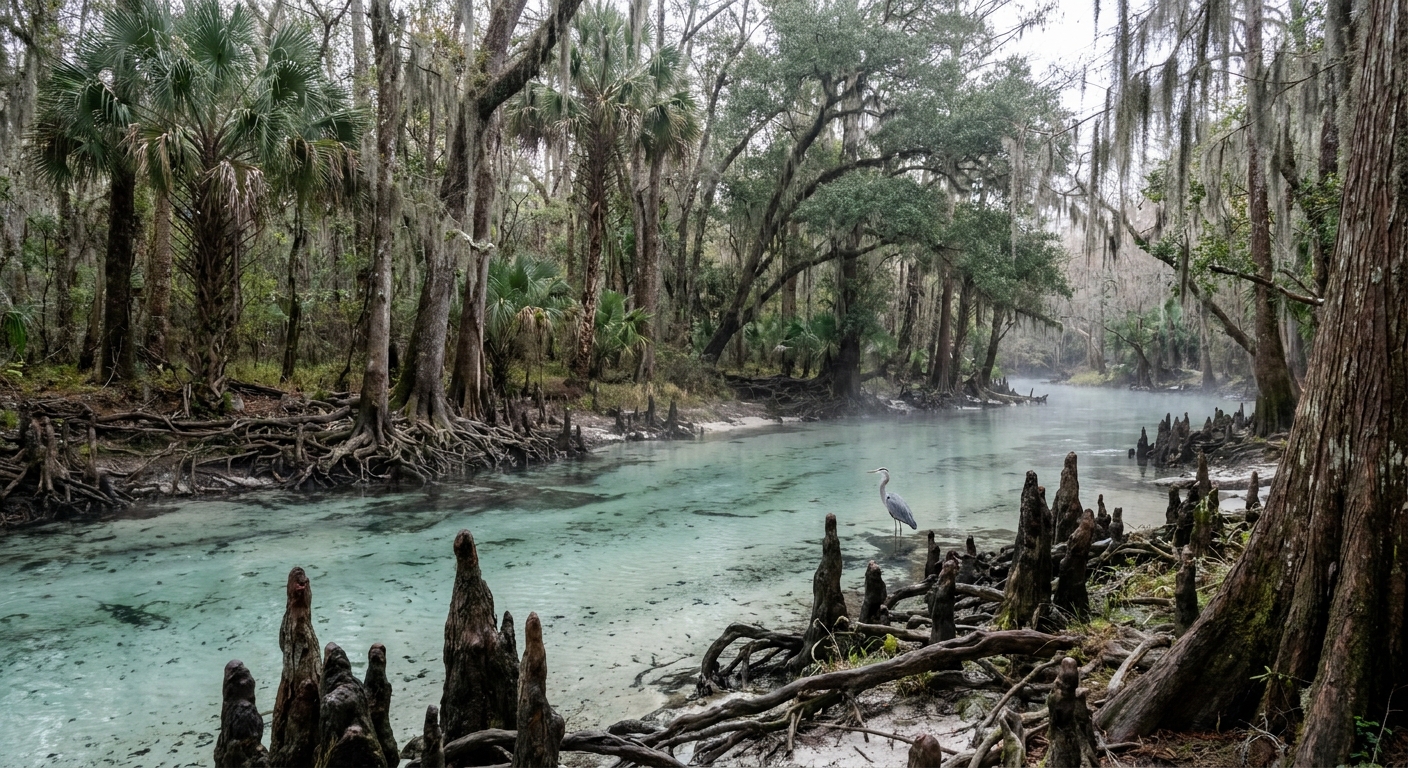
FEBRUARY AT A GLANCE · ICHETUCKNEE SPRINGS
Come in February for a river without a crowd and a 909-space lot that has no reason to fill, and accept 45.2°F mornings as the price of it.
AVG HIGH 69.6°F · AVG LOW 45.2°F · 4.8 RAIN DAYS · 4.1 FROST NIGHTS · 11H 11M OF LIGHT
Go for: 2.8 miles of marked paddling water, 4.2 miles of hiking trail and four launches with no line, under afternoons that reach 69.6°F.
Think twice before: planning a whole day floating: mornings average 45.2°F and roughly four nights a month drop to freezing.
Air normals: NOAA NCEI 1991-2020, Cross City AP · Park counts: Florida DEP inventory, 2024 · full sources at the end
On this page
- Ichetucknee Springs weather in February69.6°F highs, 2.96 inches, 4.8 rain days
- How cold do the mornings get?45.2°F lows and 4.1 freezing nights
- Crowds and parking in February909 spaces against a summer peak of 3,000 a day
- Things to do at the park in FebruaryFour launches, 4.2 miles of trail, 1,472 feet of boardwalk
- A two-day plan built on the daylightSunrise 7:09 a.m., last light 6:20 p.m.
- February, January or March?How the three months compare, degree by degree
- Is February worth the drive?Who should go now and who should wait for March
Every air figure here comes from one real thermometer at Cross City AP, about 27 miles from the spring, and every park figure comes from the state’s own facilities count.
Ichetucknee Springs weather in February: average highs, lows and rain days
| February normal | Figure |
|---|---|
| Average high | 69.6°F |
| Average low | 45.2°F |
| Precipitation | 2.96 in |
| Days with 0.10 in or more | 4.8 |
| Days with 1 in or more | 0.8 |
| Nights at 32°F or below | 4.1 |
| Daylight on February 15 | 11 h 11 m |
Those numbers are NOAA NCEI monthly normals for 1991-2020, measured at station USW00012833, Cross City AP, about 44 km (27 miles) from the spring. They come from a station, not from a reanalysis grid cell, so they are a real record rather than a model average, and they describe the air. The water in the run keeps its own temperature all twelve months.
Measurable rain falls on 4.8 days, roughly one day in six. Only 0.8 day reaches a full inch, so a genuine soaking arrives in about four Februaries out of five and usually lasts part of an afternoon rather than a weekend. At 2.96 inches, the month is drier than either neighbor: January runs 3.38 inches and March 3.53.
The day-to-night spread is 24.4°F, and that single figure packs the bag. A fleece and a knit hat for the first two hours, a short-sleeve layer for the afternoon, and two towels instead of one, because the wind on wet skin at 50°F does more damage than the water does. Shoes you can soak, plus a full change of dry clothes left in the car.
On February 15 the sun clears the trees at 7:09 a.m. and sets at 6:20 p.m., for 11 hours 11 minutes of daylight (converted from the 12:09 and 23:20 UTC times). Under cypress, useful light arrives later and leaves earlier than that, so treat 5:30 p.m. as the moment to be walking back toward the lot.
How warm is Ichetucknee Springs in February?
The average high is 69.6°F and the average low 45.2°F, a spread of 24.4 degrees inside a single day. That is more range than most visitors expect from north Florida in winter, and it means the same Saturday can feel like early spring at 3 p.m. and like a November morning in Georgia at breakfast.
In practice: long sleeves, a warm layer and a hat for anything before 10 a.m., then down to a shirt by early afternoon. For the water, we found no verified temperature reading at this spring, so we give no figure. The only water measurement we could read is discharge, and the state’s own description of the river as swiftly flowing says more about how it feels in February than any single number would.
Freezing is part of the month here: 4.1 nights in an average February drop to 32°F or below. That is a frosted windshield roughly one morning in seven, and it is the reason a 7 a.m. arrival needs gloves on the paddle and a thermos, even when the afternoon is going to hit 70.
How busy is Ichetucknee Springs in February? Crowds, prices and the demand peak
Demand at this park is a summer story. Florida’s environmental department counts as many as 3,000 visitors a day during peak summer months, and the state also counts 909 parking spaces. When that lot fills on a July Saturday, the gate closes. February has neither the heat nor the tubing season that produces those days. We found no occupancy or rate series for the area, so we crown no month cheapest and no month dearest.
Parking is first come, so the booking question is smaller than it looks: there is no reservation to win. What we could not verify is which tube launches, rentals and shuttle runs operate in February, and that changes a day far more than a bed does. Call the park in the week before you drive rather than planning months out, and have a walking alternative ready if the shuttle is on its winter schedule.
On lodging costs, we could not verify a county lodging-tax rate near the spring, so we give no percentage. The one fixed cost we also could not read is admission: the state parks site returns an error to automated reads, and fees vary by park and by season, so a price quoted for another spring does not transfer. Our Florida trip cost guide handles the wider budget.
The place where spending a little changes February is neoprene. A shorty wetsuit or a neoprene top turns a 45°F morning from a five-minute dip into an hour in the water, and it costs less than a night’s lodging. After that, money buys proximity: a bed close enough to be at the gate by 7:09 a.m. beats a cheaper one two hours away.
Things to do in Ichetucknee Springs in February
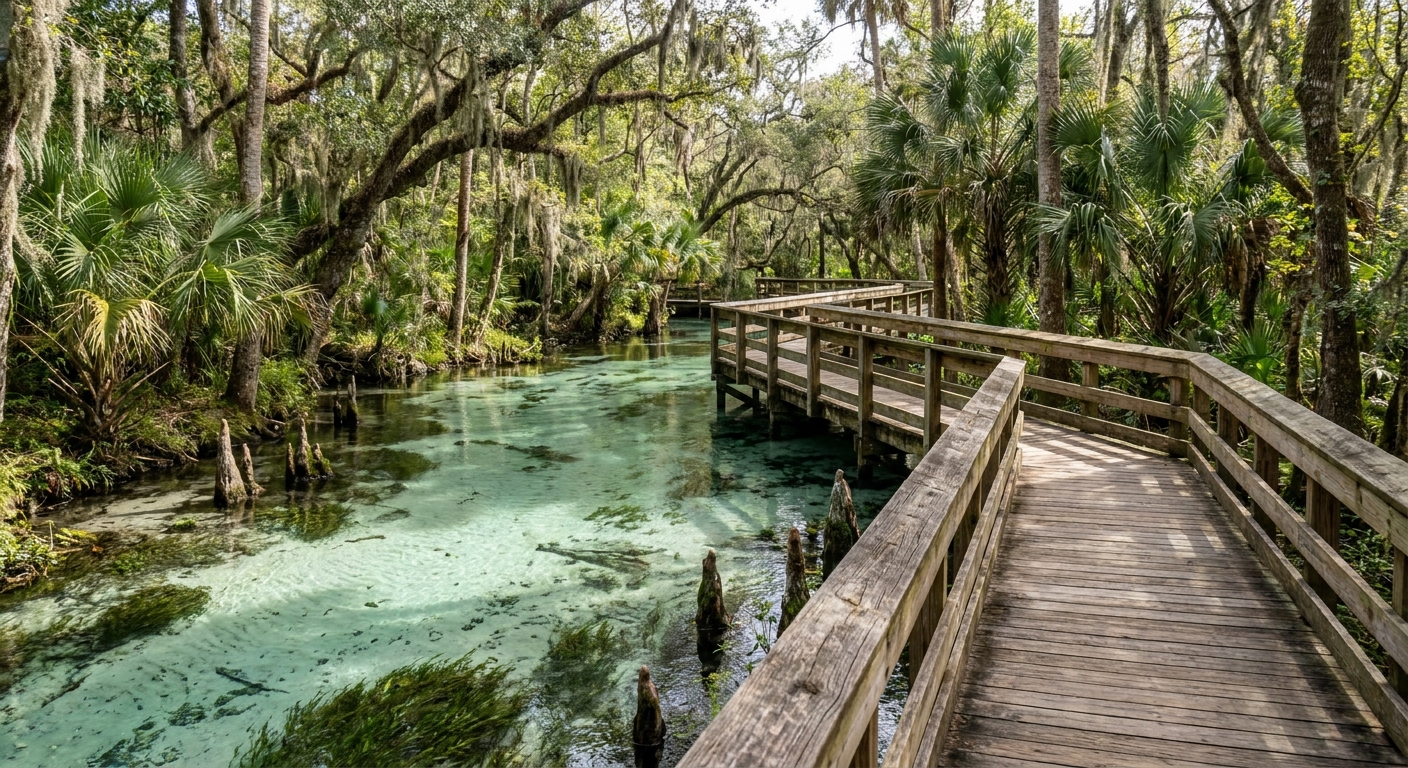
February hands you two things July cannot: trails you can walk at midday without heat, and a lot that has no reason to close. The 4.2 miles of hiking trail are pleasant at 69.6°F and punishing in August, and the four launches that form a queue in summer have no line at all in winter. The trade is obvious the moment you get in, and it is worth knowing before you drive.
The state’s facilities inventory counts what is actually there at Ichetucknee Springs State Park: 4 canoe, kayak and tube launches, 2.8 miles of marked paddling trail, 4.2 miles of hiking trail, 1,472 feet of boardwalk and 2 designated swimming areas. The department’s own park description adds more than seven miles of swiftly flowing river and three separate canoe and tube launches. For the rest of the region’s water, our Florida things-to-do guide has the wider list.
A USGS gauge at the spring, station 02322685, measured 23 cubic feet per second leaving the vent, a single instantaneous reading rather than a monthly mean. That volume is why the water stays clear: it is replaced faster than it can cloud. What actually moves between January and March is the air above it, from a 65.9°F average high to 74.9°F, with February’s 69.6°F between them. The clarity in February is the August clarity. The parking lot is not the August parking lot.
On what costs nothing this month, we have to be straight: we could not verify an entrance fee, an opening hour or a free day, and we could not read a winter manatee count either, since the state wildlife page renders in the browser rather than in the file. Manatees are a Crystal River story in any case, and our manatee guide carries what we could confirm.
Ichetucknee Springs in February: a two-day itinerary
Day one starts cold and dry. Be parked near 7:09 a.m. with coffee, walk the boardwalk’s 1,472 feet while the mist is still on the water, then take the hiking trail for the first two hours while the air climbs out of the 40s. Eat at noon. Get in the water between 1 and 3 p.m., when the air is nearest 69.6°F and the change of clothes matters least. Be walking back by 5:30, because usable light is gone soon after 6:20.
Day two is the paddle: one of the four launches, the 2.8-mile marked route, a mid-morning start so the sun is already on the run. If the day is one of the 4.8 wet ones, flip the order and do the trail in the rain, which drains fast on sand, saving the water for the clear hour that usually follows a north Florida winter shower. Getting between launches needs a car, as our getting-around guide explains.
Ichetucknee Springs in February vs January and March
| Normal at Cross City AP | January | February | March |
|---|---|---|---|
| Average high | 65.9°F | 69.6°F | 74.9°F |
| Average low | 41.8°F | 45.2°F | 49.6°F |
| Precipitation | 3.38 in | 2.96 in | 3.53 in |
| Days with 0.10 in or more | 5.7 | 4.8 | 4.6 |
| Nights at 32°F or below | not verified | 4.1 | not verified |
Across the three months the highs climb 9 degrees, from 65.9°F in January to 74.9°F in March, and the lows climb nearly 8, from 41.8°F to 49.6°F. Rain does not move in step: February is the dry one at 2.96 inches with 4.8 wet days, while January brings the most wet days at 5.7 and March the most total water at 3.53 inches. The spring water sits outside all of it, unchanged in every column.
Shift four weeks later and you gain 5.3°F on the afternoon and 4.4°F on the morning, which is the difference between swimming as a dare and swimming as a plan. You lose the drier air and you move toward spring break traffic. Shift four weeks earlier and January gives you the emptiest river of the three, at 65.9°F and almost a full extra rainy day.
Is February a good time to visit Ichetucknee Springs?
Yes, if your day is mostly above the water: paddlers, walkers, photographers and anyone who wants the 2.8-mile run without company. No, if the point is floating for hours. A 45.2°F start and four freezing nights a month are not the conditions for a lazy tube day, and no amount of 69.6°F afternoon fixes a 9 a.m. entry into the water.
If a full day in the water is the trip, wait for March: the average high reaches 74.9°F, the low 49.6°F, and rainy days drop to 4.6. You pay for it with more total rain, 3.53 inches, and with the spring-break company that arrives on the state’s roads in March. Our month-by-month Florida verdict sets that against the rest of the year.
What February alone offers is the driest of the three months at 2.96 inches, five months of distance from the summer days the state counts at 3,000 visitors, and a 909-space lot with no closing hour to beat.
The last word
Pick a February Saturday you can start at 7:09 a.m. and the rest sorts itself. One more thing worth knowing as you stand on the boardwalk: Florida law files this spring under Outstanding Florida Springs, a category set out in Statutes 373.802(5) that takes in every historic first-magnitude spring the Florida Geological Survey recognizes, plus six named by hand in the text. In winter that protection is easy to see, at 23 cubic feet per second of clear water, with nobody waiting at any of the four launches. Bring the fleece: that thermometer 27 miles away is not exaggerating the 45.2°F start.
Sources & data for this guide
- February highs, lows, precipitation, rain days and freezing nights · NOAA NCEI monthly normals 1991-2020, station USW00012833, Cross City AP, FL, about 44 km (27 miles) from the spring · checked Sep 24, 2026
- January and March normals, same station and same 1991-2020 period · NOAA NCEI · checked Sep 24, 2026
- Daylight, sunrise 12:09 UTC and sunset 23:20 UTC on February 15 · sunrise-sunset.org · checked Sep 24, 2026
- Four launches, 2.8 miles of paddling trail, 4.2 miles of hiking trail, 1,472 feet of boardwalk, 2 swimming areas, 909 parking spaces · Florida Department of Environmental Protection, Recreational Facilities Inventory, 2024 annual report · checked Sep 24, 2026
- More than seven miles of swiftly flowing river, three canoe and tube launches, up to 3,000 visitors a day in peak summer · Florida DEP, Visit a Spring · checked Sep 24, 2026
- 23 cubic feet per second at the vent, one instantaneous reading rather than a monthly mean · USGS National Water Information System, station 02322685 · checked Sep 24, 2026
- Outstanding Florida Springs definition · Florida Statutes 373.802(5), leg.state.fl.us · checked Sep 24, 2026
- Our limits, stated plain: we could not read an entrance fee, an opening hour or a winter manatee count. floridastateparks.org returns a 403 to automated reads and the state manatee page renders client-side. Fees, hours and shuttle seasons change · check with the park before you drive.