
BLUE SPRING · JANUARY · ORANGE CITY, FLORIDA
The water at Blue Spring in January is the same water you would swim in there in July. A U.S. Geological Survey gauge in the spring read 74.3°F (23.5°C) on September 11, 2026, and it reads close to that every day of the year. What changes between July and January is the air above it, and in January the air finally runs cooler than the spring.
That single gap is what a January visit buys. Of the three winter months, January brings the coolest air, at a normal high of 71.2°F and a normal low of 51.8°F, and it gives you ten and a half hours of daylight to spend it in. Sunrise on January 15 comes at 7:18 a.m. and the light is gone by 5:50 p.m., so the swim belongs to the middle of the day and the boardwalk to either end of it.
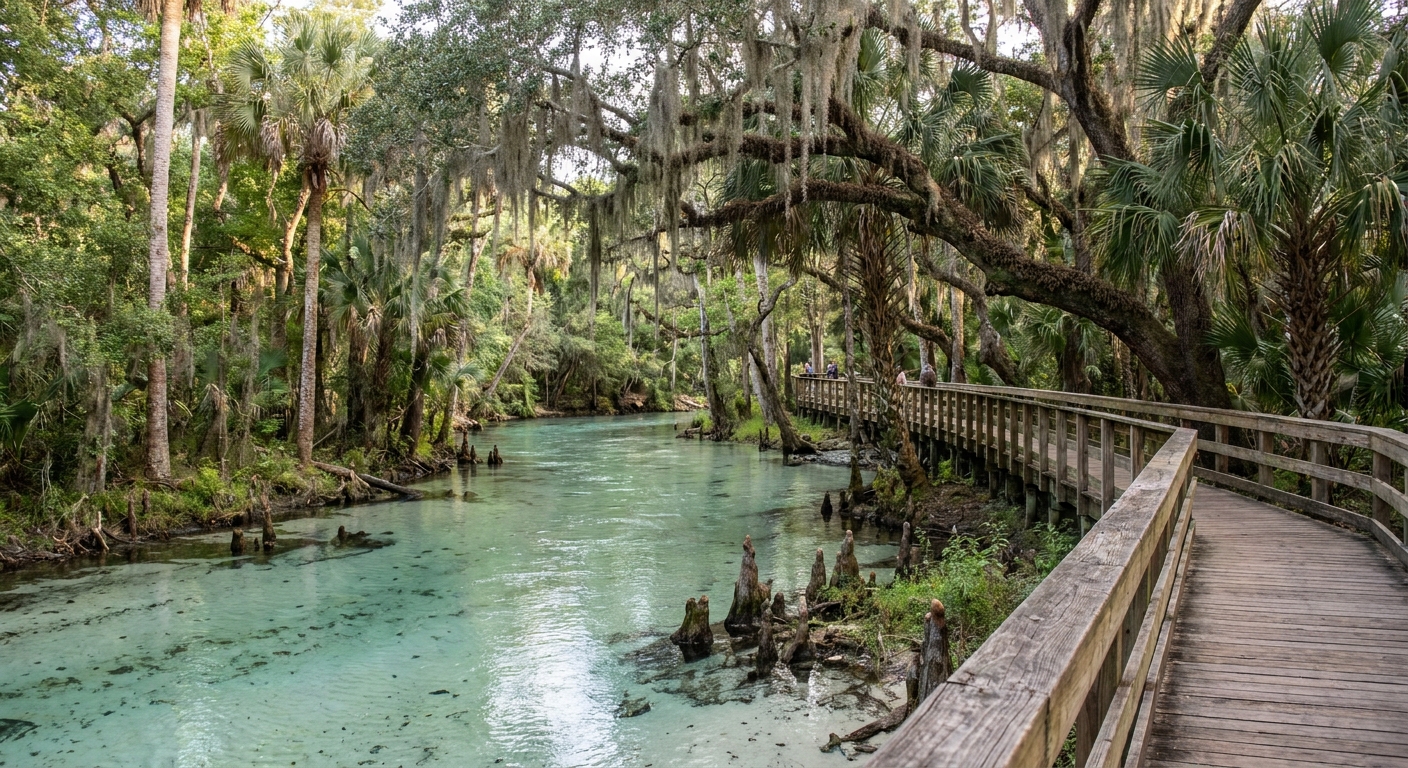
BLUE SPRING AT A GLANCE · JANUARY
January is the month when the spring is warmer than the air above it, so come for mild walking weather and a short bright swim, and bring a real jacket for the first hour of the day.
AVERAGE HIGH 71.2°F · 3.8 RAIN DAYS · 10 H 32 MIN OF DAYLIGHT ON JAN 15
Go for: 71.2°F afternoons on 3,050 feet of boardwalk, water measured at 74.3°F while the air stays under it, and a paddle launch you can use in a long-sleeve shirt.
Think twice before: planning a long swim at the start of a 51.8°F morning, or driving up without checking the park’s own page: we could not read the entrance fee or the opening hour from the state’s site.
Air: NOAA NCEI 1991-2020, Orlando Executive AP · Water: USGS gauge 02235500 · Facilities: Florida DEP 2024 inventory
On this page
- January highs, lows and rain daysThe NOAA normals, and where the thermometer sits
- How cold the nights getNight lows and freezing dawns
- Crowds, parking and entrance feesThe 187-space lot and what we could not price
- Things to do at Blue Spring in JanuaryBoardwalk, swimming area, paddle launch
- A two-day plan for Blue SpringTwo days built around the light
- January, December or February?How the three months compare
- Is January a good time to visit?Our verdict, and who should shift dates
Every figure here for the air comes from NOAA’s 1991-2020 monthly normals at Orlando Executive Airport, station USW00012841, about 44 km (27 miles) from the spring. The water figure comes from a gauge in the spring itself. For the park in the other eleven months, see our Blue Spring guide, and for the statewide calendar, when to visit Florida takes all twelve in one go.
Blue Spring weather in January: average highs, lows and rain days
| January at Blue Spring | 1991-2020 normal |
|---|---|
| Average high | 71.2°F |
| Average low | 51.8°F |
| Precipitation | 2.61 in |
| Days with 0.10 in or more | 3.8 |
| Days with 1 in or more | 0.7 |
| Nights at 32°F or below | 0.8 |
| Daylight on January 15 | 10 h 32 min |
NOAA’s National Centers for Environmental Information put January’s normal high at 71.2°F and its normal low at 51.8°F, averaged over 1991 to 2020. Those readings come from a real thermometer on an airport apron, station USW00012841 at Orlando Executive, and not from a reanalysis grid cell. A wooded river bottom and a runway are not the same microclimate, and we found no long-run air gauge at the spring itself.
Measurable rain lands on 3.8 days in an average January, counting days with at least 0.10 inch. That works out to roughly one day in eight with something worth a rain jacket. A full inch or more falls on 0.7 day, so most Januaries get one genuine soaking and a fair number get none at all. The month’s total, 2.61 inches, is the wettest of the three winter months.
Between 71.2°F and 51.8°F sit 19.4 degrees, and you feel all of them in a single day. Pack a fleece for the first two hours and the last one, a T-shirt for the middle, and a towel that dries fast. You come out of 74.3°F water into air that can still be in the fifties before nine in the morning, and water shoes beat sandals on a wet boardwalk.
Daylight on January 15 runs 10 hours 32 minutes: sunrise at 7:18 a.m., sunset at 5:50 p.m. local time. A day trip driven up from Orlando that reaches the gate by nine still has the whole usable stretch of light, and there is nothing outdoors to plan after six.
How cold does Blue Spring get in January? Highs, lows and freeze nights
71.2°F by day, 51.8°F at night, 19.4 degrees between them. January’s low is the coldest of the winter trio by a clear margin: 2.7 degrees under December’s 54.5°F and 2.5 under February’s 54.3°F. The three daytime highs, by contrast, sit within 3.1 degrees of one another. January’s cold is a night-time cold.
Mornings ask for long pants and a jacket you can tie around your waist by eleven. By two in the afternoon, a 71-degree normal is short sleeves in the sun and a jacket again in the shade under the oaks. Swimmers have the easiest time of it, since the water they enter is 74.3°F whatever the sky does; the ten minutes after the swim are what need the dry clothes.
Freezing nights are rare without being absent: 0.8 nights in an average January drop to 32°F or below at the airport station. Frost at dawn does nothing to the spring run and a great deal to the first hour of a boardwalk walk. If your trip includes a night in one of the park’s cabins, the forecast for your dates matters more than the 30-year normal.
How busy is Blue Spring in January? Crowds, parking and entrance fees
January sits inside Florida’s dry season, November through April, which is the half of the year the whole state advertises (our statewide calendar sets out both halves). We found no occupancy series and no monthly room rates for the towns around the spring, so we crown no month expensive and no month cheap. The first days of the month still belong to the holiday period running out of December.
Six cabins stand inside the park, counted in the state’s 2024 facilities inventory. We could not verify a booking window for them, so we give you no number of weeks in advance, and the state’s reservation system is the place to test your own dates. For a room outside the gate, our Florida lodging guide covers the regional options.
We could not verify a lodging-tax rate for the county, so we give no percentage. The park’s entrance fee is missing from our sources for the same kind of reason: floridastateparks.org returns a 403 error to automated reads, and fees vary by park and by season, so a price you saw for another spring does not transfer. Call the park or read its own page before you drive.
The one place where spending more changes a January day is a night inside the gate. Florida counts 187 parking spaces at Blue Spring, and when the lot fills the gate closes, which is why the state’s own framing points at summer Saturdays as the pressure test. Anyone sleeping in one of the six cabins is already past that gate at opening. We found no month-by-month visitor counts, so we will not promise you an empty January.
Things to do in Blue Spring in January
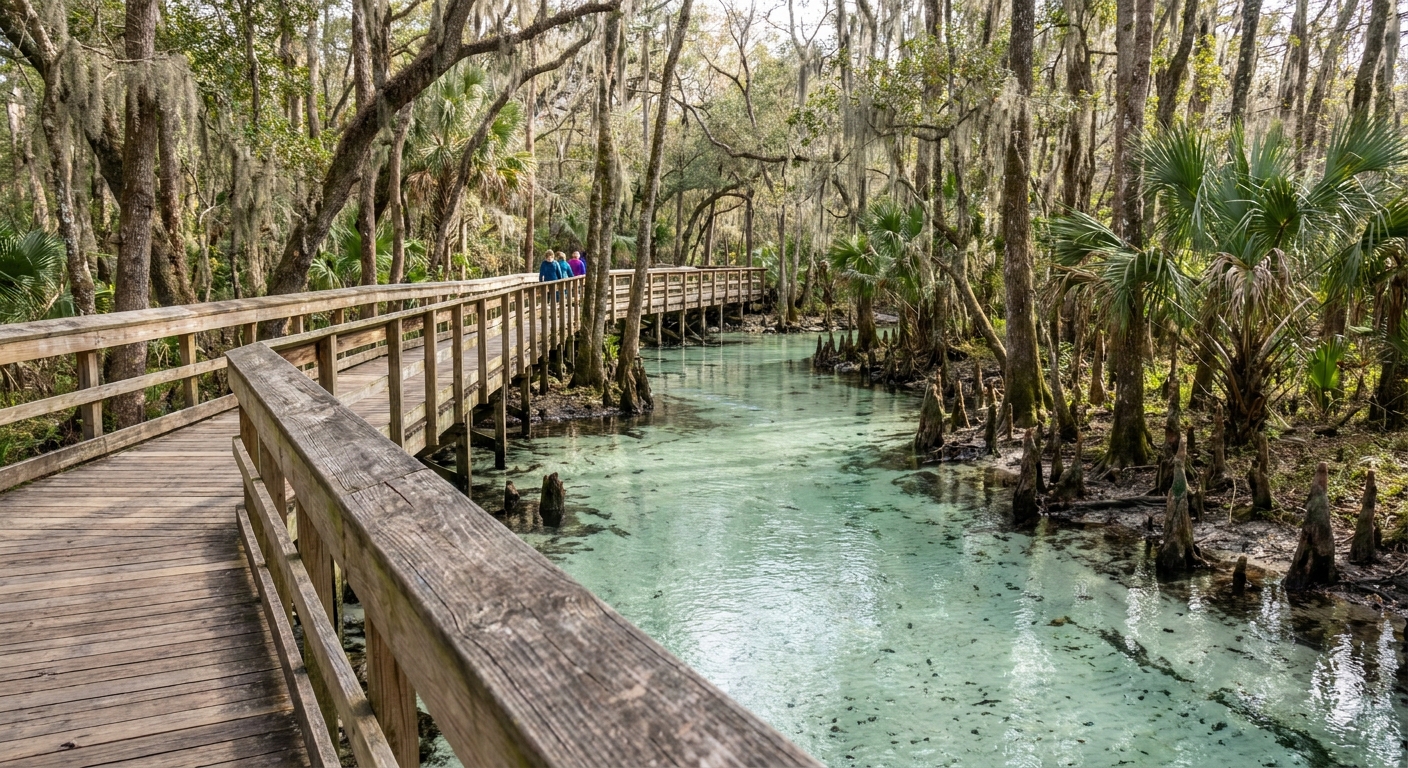
A 71.2°F afternoon turns the whole boardwalk into the main event rather than the route to the water. The same month makes the swim a decision instead of a reflex: getting into 74.3°F water when the air is 71 is a different act from getting into it when the air is far warmer than the spring. Cool air is also what makes the flat, railed walking pleasant for a couple of miles.
The Florida Department of Environmental Protection counted the park in 2024: one designated swimming area, one launch for canoes, kayaks and tubes, 3,050 feet of boardwalk, three observation platforms and six cabins. The boardwalk runs just over half a mile one way, so out and back is close to 1.2 miles. At the vent, the USGS gauge measured 168 cubic feet per second leaving the spring, and that volume is why the water stays clear: it is replaced faster than it can cloud.
None of those counts move with the calendar, and neither does the water. The contrast moves. In July you step from hot air into cool water. In January you step from 71-degree air into water measured at 74.3°F, and the spring is the warm half of the exchange. After a morning that started near 51.8°F, that inversion is why people stay in longer than they planned.
We could not verify what a day at Blue Spring costs, since the state park site would not release its fee schedule to us, so we will not tell you that anything here is free. The three observation platforms and the full length of the boardwalk come with whatever the gate charges. On the manatee question, our manatee guide handles where you may and may not get into the water; we found no count and no seasonal closure date for Blue Spring, so we give neither.
Blue Spring in January: a two-day itinerary
Day one runs on the light. Reach the gate at opening, whatever hour the park publishes for your dates, and take the boardwalk while the air is still in the fifties, using the three observation platforms before the swimming area gets your attention. Get in the water between noon and two, when the 71.2°F normal is at its best. Dry off, eat, then take a kayak or a tube out from the launch for the middle of the afternoon. Be back at the car before 5:50 p.m.
Day two depends on the sky. With measurable rain on 3.8 days in an average January, most two-day trips get two dry ones, and the spare day suits a second spring or the St. Johns River. If the forecast turns, only 0.7 day in an average January reaches a full inch, so a wet morning usually still leaves a dry afternoon. The swim survives any of it: you are already wet, and the water is 74.3°F with or without sun. Our Florida things-to-do guide holds the indoor fallbacks for a day that goes fully gray.
Blue Spring in January vs December and February
| 1991-2020 normal | December | January | February |
|---|---|---|---|
| Average high | 73.1°F | 71.2°F | 74.3°F |
| Average low | 54.5°F | 51.8°F | 54.3°F |
| Precipitation | 2.28 in | 2.61 in | 2.06 in |
| Days with 0.10 in or more | 3.4 | 3.8 | 3.4 |
| Spring water | 74.3°F, no seasonal swing | 74.3°F, no seasonal swing | 74.3°F, no seasonal swing |
Put the three side by side and January is the cool one. Its 71.2°F day normal sits 1.9 degrees under December’s 73.1°F and 3.1 under February’s 74.3°F, and its nights run about two and a half degrees colder than either neighbor. January is also the wettest of the trio, 2.61 inches against December’s 2.28 and February’s 2.06, with rain on 3.8 days against 3.4 on each side. The spring ignores every line of that and stays near 74.3°F.
Shift four weeks forward and February hands you a 74.3°F average high, the exact figure the USGS gauge read in the water, plus half an inch less rain and nights 2.5 degrees warmer. Shift four weeks back and December gives you 2.7 warmer degrees at dawn and 0.4 fewer days of measurable rain, at the cost of sharing the park with the holiday period. Leaving January costs you the widest water-over-air gap of the three, 3.1 degrees.
Is January a good time to visit Blue Spring?
Yes, for anyone who came to walk and will take the swim as a short bright shock. At 71.2°F and 3.8 rain days, January gives you cool, mostly dry conditions for 1.2 miles of boardwalk out and back, and the water measures the same 74.3°F it does in August. No, if your picture of the day involves lying in the sun afterward: a 51.8°F night means the first and last hours belong to a jacket.
If the answer is no, take February instead. It carries the warmest of the three winter normals at 74.3°F by day, the lowest rainfall at 2.06 inches, and nights 2.5 degrees above January’s. You lose the January contrast and you keep the identical spring, because the water does not change.
Of the three months, January alone puts the spring 3.1 degrees above the average afternoon above it. That makes the swim the warmest part of the day.
The last word
Decide on the light and the rest arranges itself: gate at opening, boardwalk while the air is still cold, water around noon, car before the 5:50 p.m. sunset. One thing to carry home with the wet towel: Florida keeps a legal category for springs of this kind. Statute 373.802(5) defines Outstanding Florida Springs as every historic first-magnitude spring the Florida Geological Survey recognizes, plus six named outright in the text. We could not confirm from our reading which list applies to Blue Spring, and it changes nothing about a 74.3°F January afternoon.
Sources & data for this guide
- January air normals: high 71.2°F, low 51.8°F, 2.61 in, 3.8 days at 0.10 in or more, 0.7 day at 1 in or more, 0.8 nights at 32°F or below · NOAA NCEI monthly normals 1991-2020, station USW00012841, Orlando Executive AP, about 44 km from the spring · checked Sep 24, 2026
- December (73.1°F / 54.5°F, 2.28 in, 3.4 days) and February (74.3°F / 54.3°F, 2.06 in, 3.4 days) · same NOAA NCEI normals, same station and period · checked Sep 24, 2026
- Daylight of 10 h 32 min on January 15, sunrise 7:18 a.m. and sunset 5:50 p.m. local, converted from 12:18 and 22:50 UTC · sunrise-sunset.org · checked Sep 24, 2026
- Water temperature 74.3°F (23.5°C) and discharge 168 cubic feet per second · USGS National Water Information System, station 02235500 Blue Spring · instantaneous reading of September 11, 2026, not a monthly mean and not an average of daily maxima
- 187 parking spaces, 1 designated swimming area, 1 canoe, kayak and tube launch, 3,050 feet of boardwalk, 6 cabins, 3 observation platforms · Florida Department of Environmental Protection, Recreational Facilities Inventory, 2024 annual report (PDF, 374 pages) · checked Sep 24, 2026
- Outstanding Florida Springs definition · Florida Statutes 373.802(5), leg.state.fl.us · checked Sep 24, 2026
- We could not verify an entrance fee, an opening hour or a manatee count: floridastateparks.org returns 403 to automated reads and the FWC manatee page renders client-side · checked Sep 24, 2026
- Packing advice, itinerary hours and comparisons between months are editorial, built on the figures above · fees and hours change, so check the park before you drive.