
WARM MINERAL SPRINGS · FLORIDA · JANUARY
The USGS gauge inside Warm Mineral Springs read 84.6°F on September 11, 2026. It will read something very close to that on the coldest morning of January, and on the hottest afternoon of July. A spring has no season. The air above it does, and in January that air averages a 72.5°F afternoon and a 52.3°F dawn, so for a few winter weeks the water is the warm thing in the landscape.
That inversion is what the date buys you. January takes something back: it is the wettest of the three winter months at the nearest official thermometer, 2.79 inches against February’s 1.92, and it hands you the shortest afternoon, with the sun gone at 5:58 p.m. on the 15th. Four weeks either way moves about 2.5°F and most of an inch of rain.
THE MONTH AT A GLANCE · JANUARY
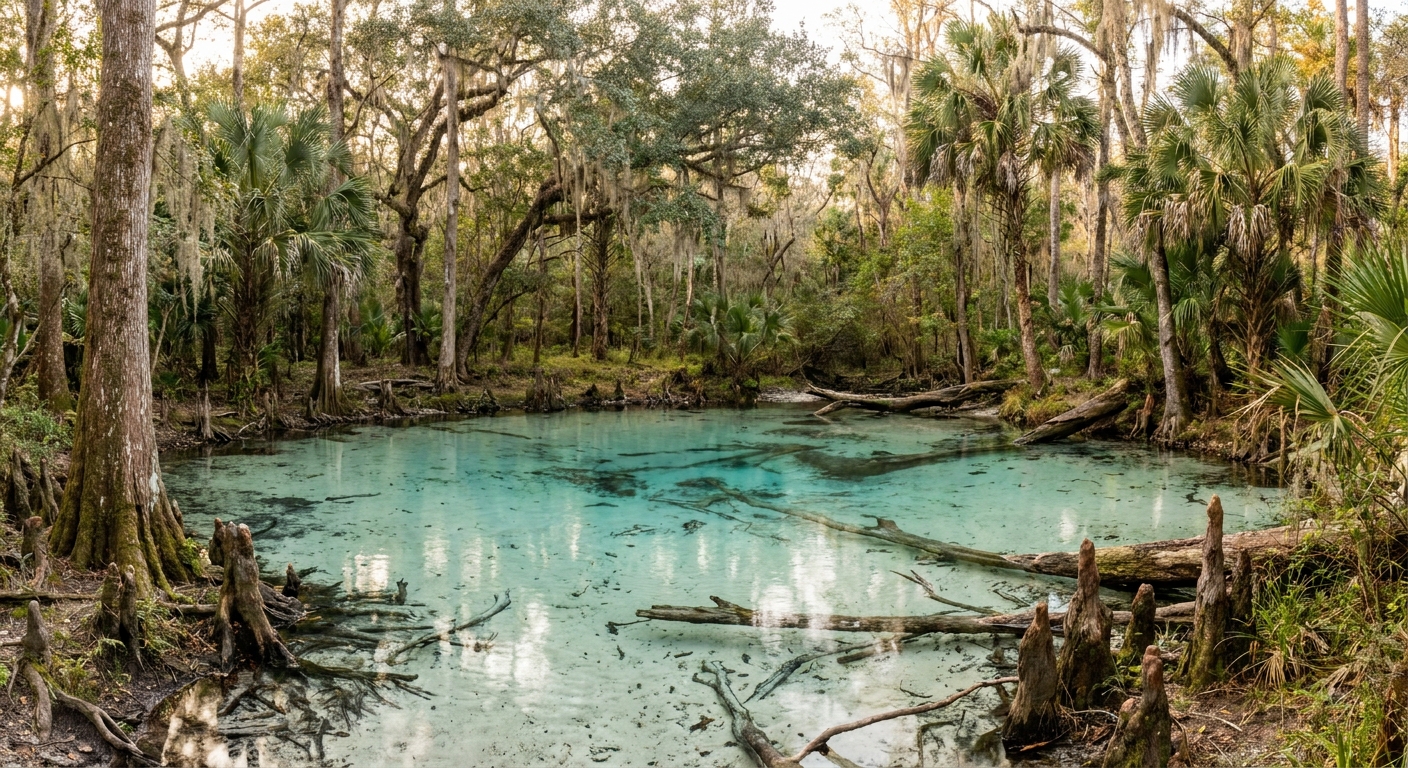
January is the month the water beats the air by the widest margin of the winter: 84.6°F in the spring against a 72.5°F afternoon and a 52.3°F dawn, paid for with the wettest and shortest days of the three.
DRY SEASON · 72.5°F DAYS · 84.6°F WATER · 10H 40M OF DAYLIGHT
Go for: an 84.6°F soak under air that tops out at 72.5°F, a 12.1°F water-to-air gap that neither December nor February matches, and measurable rain on about one day in nine.
Think twice before: driving down for a fixed date without calling first.
Air: NOAA NCEI 1991-2020, Sarasota Bradenton AP · Water: USGS gauge 02299260 · full sources at the end
On this page
- January highs, lows and rain daysThe NOAA 1991-2020 normals
- How cold the mornings get52.3°F at dawn, 72.5°F by mid-afternoon
- Crowds and prices in JanuaryDry-season demand, and the fees we could not verify
- Things to do in JanuaryThe spring at 84.6°F and 8 cubic feet per second
- A two-day plan around the daylightTwo days between 7:18 a.m. and 5:58 p.m.
- December, January or February?How the three months compare, in figures
- Is January a good time to go?Our verdict, and who should shift dates
January sits in the middle of Florida’s dry season, November through April, and Warm Mineral Springs sits inland in Sarasota County. Every air figure below comes from one thermometer: NOAA’s station at Sarasota Bradenton AP, about 27 miles north. The water figures come from a separate gauge in the spring itself. For the state-wide question of which month suits which trip, our Florida timing guide runs all twelve.
Warm Mineral Springs weather in January: average highs, lows and rain days
| Measure | January (1991-2020) | In plain terms |
|---|---|---|
| Average high | 72.5°F (22.5°C) | The fleece comes off by mid-morning |
| Average low | 52.3°F (11.3°C) | Dawn wants a real jacket |
| Precipitation | 2.79 in | The wettest of the three winter months |
| Days at 0.10 in or more | 3.6 | About one day in nine |
| Days at 1.00 in or more | 0.4 | A soaking day in roughly two Januarys out of five |
| Nights at 32°F or below | 0.8 | A freeze is possible, not scheduled |
| Daylight, Jan 15 | 10h 40m | 7:18 a.m. to 5:58 p.m. |
| Spring water | 84.6°F at the gauge | No seasonal swing |
NOAA NCEI’s 1991-2020 monthly normals put January at 72.5°F by day, 52.3°F at night and 2.79 inches of precipitation. Those are station normals, taken by a real thermometer at Sarasota Bradenton AP roughly 27 miles from the spring, not a modeled grid cell averaged over the county. The distance is worth knowing, and so is the limit of the series: it describes the air and nothing else. The water is metered separately, and it answers differently.
Measurable rain falls on 3.6 January days at that station, counting days of 0.10 inch or more, so roughly one day in nine. Heavier weather is rarer still: 0.4 days reach a full inch, which works out to one真 soaking day in about two Januarys out of five. The remaining 27 days record a trace or nothing at all. Plan the outdoor half of the day normally and keep one indoor fallback on the list.
Between the 52.3°F low and the 72.5°F high sits 20.2°F of daily swing, and that swing decides the bag more than either average does. Long pants and a fleece for the first two hours after 7:18 a.m., short sleeves by early afternoon, the fleece again at dusk. Pack a thick towel and a full dry change too. Stepping out of 84.6°F water into 60-degree air is the moment visitors underestimate, and a damp shirt in a moving car undoes a soak fast.
January 15 gives 10 hours 40 minutes of daylight, sunrise at 7:18 a.m. and sunset at 5:58 p.m. local time. The light goes flat around five and the parking lot is dark shortly after six. That short tail is the real constraint on a January day here: a late soak ends in the cold and the dark, and any dinner plan should assume you are driving after sunset.
How warm is Warm Mineral Springs in January?
The month averages 72.5°F at its warmest hour and 52.3°F at its coldest. Set that spread beside the neighboring months and it barely budges: 20.0°F in December, 20.2°F in January, 20.3°F in February. What moves across the three is the whole scale, down 2.7°F from December’s afternoons to January’s. Nothing about January is dramatic on paper. It is simply the bottom of a shallow curve.
So the morning wants a jacket and the afternoon does not. The number that matters more is the gap with the water: 84.6°F at the USGS gauge is 32.3°F above the average dawn and 12.1°F above the average afternoon. One caveat on that reading, since it decides the trip. It is a single instantaneous measurement taken on September 11, 2026, not a monthly mean of daily values, and daily-maximum tables tend to run a shade warmer than a 24-hour average anyway. The gauge reads close to 84.6°F year-round, but we hold no January-specific average.
Frost is on the table without being on the schedule. The station counts 0.8 nights at or below 32°F in an average January, so many Januarys see one such night and plenty see none. A freezing dawn does nothing whatsoever to the spring. It does mean scraping a windshield before you drive, and it argues for arriving at mid-morning rather than at first light.
How busy is Warm Mineral Springs in January? Crowds and prices
January falls inside Florida’s dry season, November through April, which is the state’s busy half of the year by calendar rather than by accident. Past that, we will not rank it. We found no occupancy series and no monthly room-rate data for this corner of Sarasota County, so we crown no month cheap and no month expensive.
Lead time is what the dry season genuinely changes. Rooms in the Venice and Sarasota belt are competing with every northern winter escape in the same weeks, so six to eight weeks ahead (est.) is a sane target for a January weekend, and more around the holiday tail of the first week. Midweek dates stay easier to book in any month, and a Tuesday soak is a different experience from a Saturday one.
On the money side we owe you two blanks. We could not verify the county lodging-tax rate, so we give no percentage, and we could not read an entrance fee or an opening hour for the spring itself, because floridastateparks.org returns a 403 to automated reads. Call before you drive rather than trusting a price found on a forum. State-level budget lines live in our Florida trip-cost guide.
One upgrade earns its money in January, and it is not the larger room: it is the rate you can move. With 3.6 wet days in the month, a front can land squarely on your Saturday, and a refundable booking turns that into a Sunday soak instead of a washed-out drive. The car is the other line to budget, since Florida is a driving state outside a few city exceptions, as our getting-around guide sets out.
Things to do in Warm Mineral Springs in January
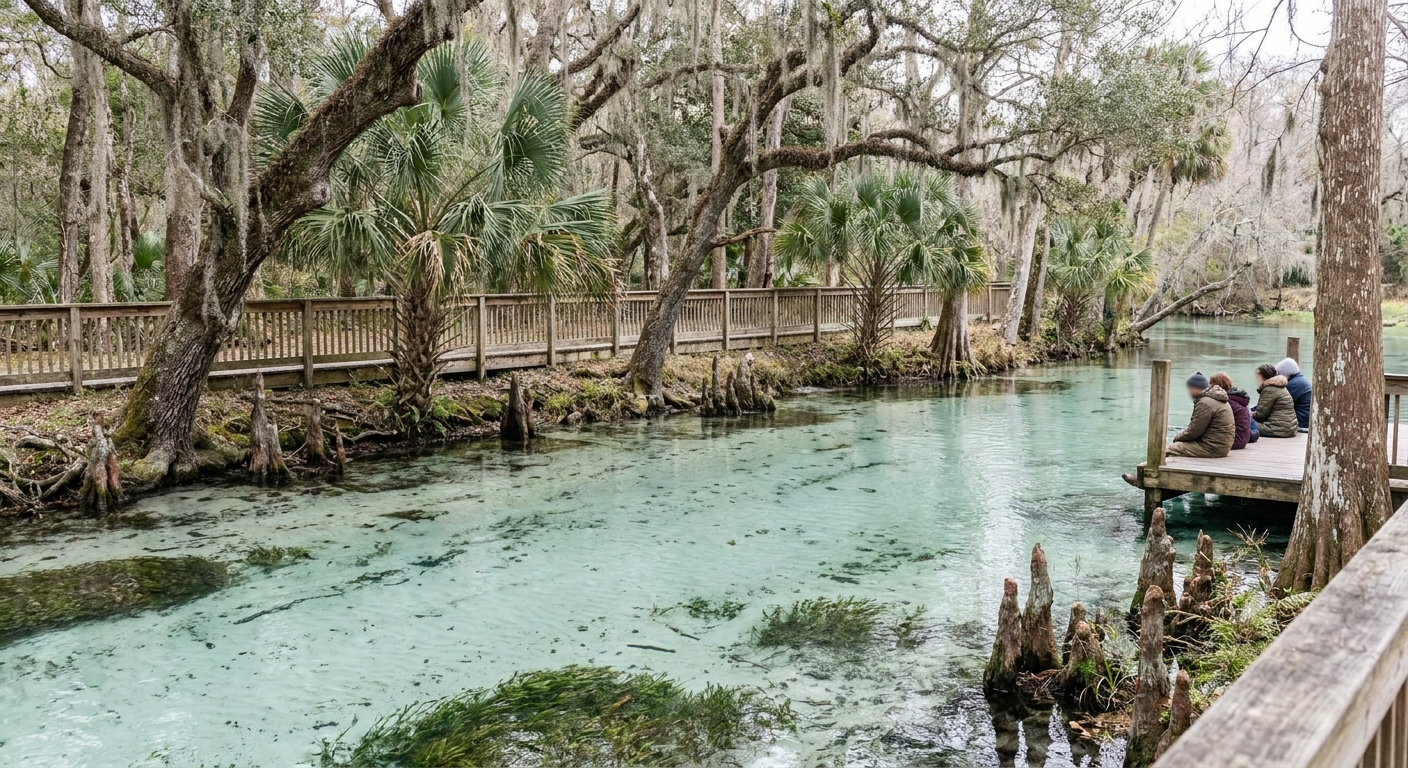
The pleasure here is a contrast, and January supplies the widest one of the winter. Gauge water sits 12.1°F above a normal January afternoon, against 9.4°F in December and 9.7°F in February. On a 52.3°F morning the gap opens to 32.3°F. Cool air over warm water is a combination the cold half of the Florida year produces and the wet half cannot.
The named figures are few, and worth having straight. The spring is metered by USGS station 02299260. On September 11, 2026 that gauge read 84.6°F (29.2°C), with 8 cubic feet per second leaving the vent. The flow is the reason the water looks the way it does: the pool is replaced faster than it can cloud. No admission price and no operating hour could be read from the official site, so we publish neither.
January changes none of that and changes everything around it. Mid-morning sits somewhere between the 52.3°F dawn and the 72.5°F peak, which makes the first minutes in the pool feel like a rescue and the first minutes out of it feel like a mistake. Come at noon instead and both ends are easy. That two-hour shift is the entire seasonal adjustment, and it is the reason a January visit runs later than a July one.
On what is free, we can only half deliver. We could not verify a free-entry day, a fee or a manatee count for this spring: the park site blocks automated reads and the FWC manatee page renders in the browser. If a winter manatee is the goal, our manatee guide handles the springs that publish numbers. For a free afternoon at 72.5°F, the Gulf sand to the west is covered in our Siesta Key guide.
Warm Mineral Springs in January: a two-day itinerary
Day one runs on the light. Sunrise is 7:18 a.m., so give the first hours to the drive and breakfast rather than the water, and aim to be changing around 10 a.m. with the air climbing off its 52.3°F low. Soak, then eat somewhere dry in the early afternoon while the thermometer is at its 72.5°F best. Back in around three for a second session, out by five, because the light goes flat well before 5:58 p.m. and the lot empties into the dark.
Day two is the flexible one. Give the morning to the Gulf beaches or to our wider Florida list, keep the early afternoon for a shorter second soak, and drive home in daylight. If one of the month’s 3.6 wet days lands on you, invert the order: the water reads 84.6°F in the rain exactly as it does in the sun, so the soak becomes the wet-weather plan and the beach waits for the next trip.
Warm Mineral Springs in January vs December and February
| Measure | December | January | February |
|---|---|---|---|
| Average high | 75.2°F | 72.5°F | 74.9°F |
| Average low | 55.2°F | 52.3°F | 54.6°F |
| Precipitation | 2.33 in | 2.79 in | 1.92 in |
| Days at 0.10 in or more | 3.0 | 3.6 | 3.1 |
| Spring water | Unchanged | Unchanged | Unchanged |
Across the three months the air moves inside a narrow band. December runs 75.2°F by day and 55.2°F at night, January 72.5°F and 52.3°F, February 74.9°F and 54.6°F, leaving January the coldest of the three by 2.4 to 2.7°F. Rain sorts them differently: 2.33 inches in December, 2.79 in January, 1.92 in February, with 3.6 wet days in January against 3.0 and 3.1. The spring stays out of the argument at a steady 84.6°F.
Shift four weeks forward and you gain 2.4°F of afternoon, 0.87 inch less rain and a longer evening, and you give up the widest water-to-air contrast of the winter. Shift four weeks back and December offers warmer nights and half an inch less rain, with the holiday fortnight sitting in the middle of it, one of the two crowd peaks our Florida guide names. February suits a beach-and-spring trip better. January suits the soak itself better.
Is January a good time to visit Warm Mineral Springs?
For a trip built around the water, January is a yes with no qualification attached. The spring ignores the season, the cool air turns 84.6°F into a luxury rather than a lukewarm bath, and 3.6 wet days out of 31 are decent odds on any weekend. For a trip built around Gulf beaches, long outdoor evenings and swimming in the sea, January is the weakest of the three winter months: coldest afternoons, most rain, 10 hours 40 minutes of daylight.
If that second description fits, take February. It runs 2.4°F warmer by day, drops 1.92 inches of rain against January’s 2.79, and pushes sunset later. December is the other option when warm nights matter more than a quiet calendar, at 55.2°F overnight against January’s 52.3°F, with 2.33 inches of rain and the holiday weeks folded in.
What January alone hands you is the size of the gap: 32.3°F between the dawn air and the water you are about to step into, a difference neither December nor February matches.
The last word
Book the rate you can move, pack a towel you can wrap all the way around, and be in the water by mid-morning so the walk back to the car happens in the warm part of the day. One more piece of context for what you are floating in: Florida law protects a class it calls Outstanding Florida Springs, defined in Statute 373.802(5) as every historic first-magnitude spring the Florida Geological Survey recognizes, plus six named by hand in the text. We did not verify which list this spring sits on, so treat the water as the protected resource it is and leave the site as you found it.
Sources & data for this guide
- January normals, rain days and freezing nights · NOAA NCEI monthly normals 1991-2020, station USW00012871, Sarasota Bradenton AP, about 27 miles from the spring · checked Sep 24, 2026
- December and February normals (75.2/55.2°F and 74.9/54.6°F) · same NOAA NCEI 1991-2020 series · checked Sep 24, 2026
- Daylight, sunrise and sunset for January 15 · sunrise-sunset.org, converted to local time · checked Sep 24, 2026
- Spring water at 84.6°F (29.2°C) and flow of 8 cubic feet per second · USGS National Water Information System, station 02299260 · instantaneous reading, Sep 11, 2026
- Outstanding Florida Springs definition · Florida Statutes 373.802(5), leg.state.fl.us · checked Sep 24, 2026
- We could not read an entrance fee, an opening hour or a manatee count: floridastateparks.org returns 403 to automated reads and the FWC manatee page renders client-side · Sep 11, 2026
- We found no occupancy series and no monthly room-rate data for this area, so we rank no month cheapest or dearest. Hours, fees and access change · call before you drive.
To plan your stay
- Best Time to Visit Warm Mineral Springs: Month-by-Month Highs, Rain Days and the Quiet Weeks
- Warm Mineral Springs in February: Weather, Crowds and 84.6°F Water
- Warm Mineral Springs in December: 75.2°F Days, 84.6°F Water and 3 Rain Days
- Warm Mineral Springs in March: Weather, Water Temperature and Crowds