
BLUE SPRING · FEBRUARY · 28.9° N
February is the month the air finally agrees with the water. The spring run held 74.3°F when the USGS gauge at the vent was read on September 11, 2026, and it reads close to that every day of the year. The air above it does move: NOAA’s 1991-2020 normals put February’s average afternoon at 74.3°F and its pre-dawn low at 54.3°F. The two figures landing on the same decimal is a coincidence, and it is also the shortest description of the month you will get.
February also runs drier than the months on either side of it, 2.06 inches of rain against January’s 2.61 and March’s 2.74, with 3.4 days carrying at least a tenth of an inch. Daylight on the 15th comes to about 11 hours 13 minutes, sunrise at 7:02 a.m. and sunset at 6:16 p.m. local time. For the wider Florida calendar rather than one month at one spring, our state timing guide takes the other eleven.
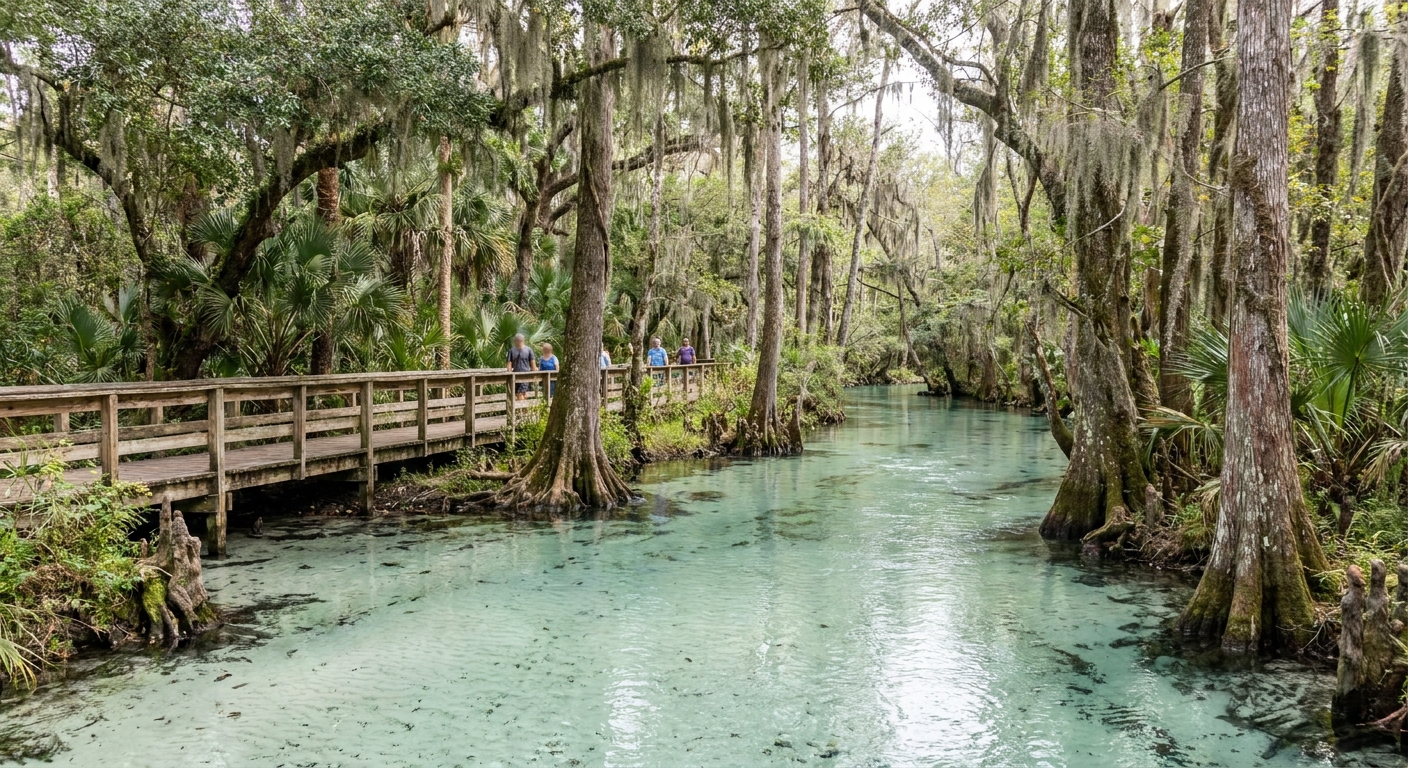
BLUE SPRING AT A GLANCE · FEBRUARY
February gives Blue Spring the driest air of the winter and 74.3°F afternoons over water that holds the same figure all year, with a 187-space lot as the only real constraint.
AVG HIGH 74.3°F · AVG LOW 54.3°F · 2.06 IN OF RAIN · 11 H 13 MIN OF DAYLIGHT ON FEB 15
Go for: 74.3°F water under the coolest, driest air of the three winter months, 3,050 feet of boardwalk that is comfortable at noon, and a swim area that does not care what the sky is doing.
Think twice before: counting on a late arrival. The state counts 187 parking spaces, and when the lot fills the gate closes.
Air: NOAA NCEI 1991-2020, Orlando Executive AP · Water: USGS gauge 02235500 · Facilities: Florida DEP · full sources at the end
On this page
- Blue Spring weather in FebruaryHighs of 74.3°F, 2.06 inches, 3.4 wet days
- How warm it gets by day and by night74.3°F afternoons, 54.3°F before dawn
- Crowds, parking and what a February day costs187 spaces, six cabins, no fee we could verify
- Things to do at the spring in FebruaryThe boardwalk, the swim area, the launch
- A two-day plan built around the lightSunrise 7:02 a.m. to sunset 6:16 p.m.
- February vs January and MarchHow the three months compare on air and rain
- Is February a good month to go?Who should go now and who should wait for March
Every figure here that describes the air comes from NOAA NCEI’s 1991-2020 monthly normals for station USW00012841, Orlando Executive Airport, about 44 km (27 miles) from the spring. That is a real thermometer with a real record rather than a reanalysis grid cell, and it is still an inland airport a county away, so read the normals below as regional air, not a measurement taken on the boardwalk. Water figures come from somewhere else entirely, the USGS gauge at the vent, and they are instantaneous readings rather than monthly averages.
Blue Spring weather in February: average highs, lows and rain days
| February at Blue Spring | Figure | Source |
|---|---|---|
| Average high | 74.3°F | NOAA NCEI 1991-2020 |
| Average low | 54.3°F | NOAA NCEI 1991-2020 |
| Precipitation | 2.06 inches | NOAA NCEI 1991-2020 |
| Days with 0.10 in or more | 3.4 | NOAA NCEI 1991-2020 |
| Days with 1 in or more | 0.3 | NOAA NCEI 1991-2020 |
| Daylight, Feb 15 | About 11 h 13 min · 7:02 a.m. to 6:16 p.m. | sunrise-sunset.org |
| Spring water | 74.3°F · single reading, Sept 11, 2026 | USGS gauge 02235500 |
NOAA NCEI’s normals give February an average high of 74.3°F, an average low of 54.3°F and 2.06 inches of precipitation across the 1991-2020 period. That high sits 3.1°F above January’s and 4.1°F below March’s, which puts February on the middle rung of the winter ladder with the least water falling on it.
Measurable rain lands on 3.4 days in an average February, roughly one day in nine. Only 0.3 of a day reaches an inch or more, so a genuine soaking turns up about one February in three. In a single day that usually means a shower that passes rather than a washout, and a plan that keeps moving between the boardwalk and the water loses very little to it.
The gap between that 74.3°F afternoon and that 54.3°F dawn is a clean 20 degrees, and it decides the bag more than the rain does. A fleece and long pants for the first hour of light, a shirt and shorts by early afternoon, and a second towel for the drop that comes back after sunset. Damp cotton and 54-degree air make a poor combination in a parking lot.
On February 15 the sun clears the horizon at 7:02 a.m. and drops at 6:16 p.m., about 11 hours 13 minutes of daylight. Light falls early by Florida standards. A start at 9 a.m. leaves just over nine hours; a start at noon leaves six and change. The last usable hour on the run, from roughly 5:15 to 6:16 p.m., is the one most day visitors have already spent on the drive home.
How warm is Blue Spring in February?
The month’s two anchor numbers are 74.3°F by mid-afternoon and 54.3°F before dawn, a spread of 20.0 degrees. January runs a narrower 19.4 and March a near-identical 20.1, so the swing is a winter constant rather than a February quirk. What moves between the three months is the whole ladder, not the distance between its rungs.
Dress for two days in one. At 8 a.m. the air is nearer 54 than 74 and the 74.3°F run is the warmest thing in sight, which makes the walk back to the car the cold part of a morning swim. By early afternoon the air has caught the water at the same figure, and that is the stretch when getting out of the spring costs you nothing at all.
We found no count of freezing nights in the normals we read, so we give none. What the record does hold is an average low of 54.3°F, 2.5 degrees up on January’s 51.8, in a stretch of inland Florida that can run colder than its own average on any given night. Pack one warm layer you expect not to need.
How busy is Blue Spring in February? Crowds, parking and costs
February falls inside Florida’s dry season, the November to April half when the state is at its most reliable and its most visited, and our state calendar sets out both halves. We found no occupancy series and no monthly room rates for the area around the spring, so we crown no month cheap and no month expensive.
What is worth planning weeks out is a morning rather than a room. The state counts 187 parking spaces at Blue Spring State Park, and the gate closes on capacity rather than holding a queue. The park’s own lodging is six cabins, the entire on-site inventory, so treat those as something you try for early or not at all. Everything else means driving in, and our getting-around guide covers the rental layer.
We could not verify a lodging-tax rate for the area, so we give no percentage. Admission is the same story: floridastateparks.org answers automated reads with a 403, so we quote no entrance fee and no opening hour, and we would not trust a price copied from another park’s page either. Bring a card for the gate, and see our Florida cost guide for the parts of the budget we could price.
Money changes exactly one thing at this spring: how close you sleep to the gate. A room in a nearby town buys a shot at the lot before mid-morning. A room in Orlando, about 27 miles off by the same measure that sites the weather station, buys a commute instead, and February mornings are short enough that the difference is the visit. Our lodging guide sorts the regions.
Things to do in Blue Spring in February
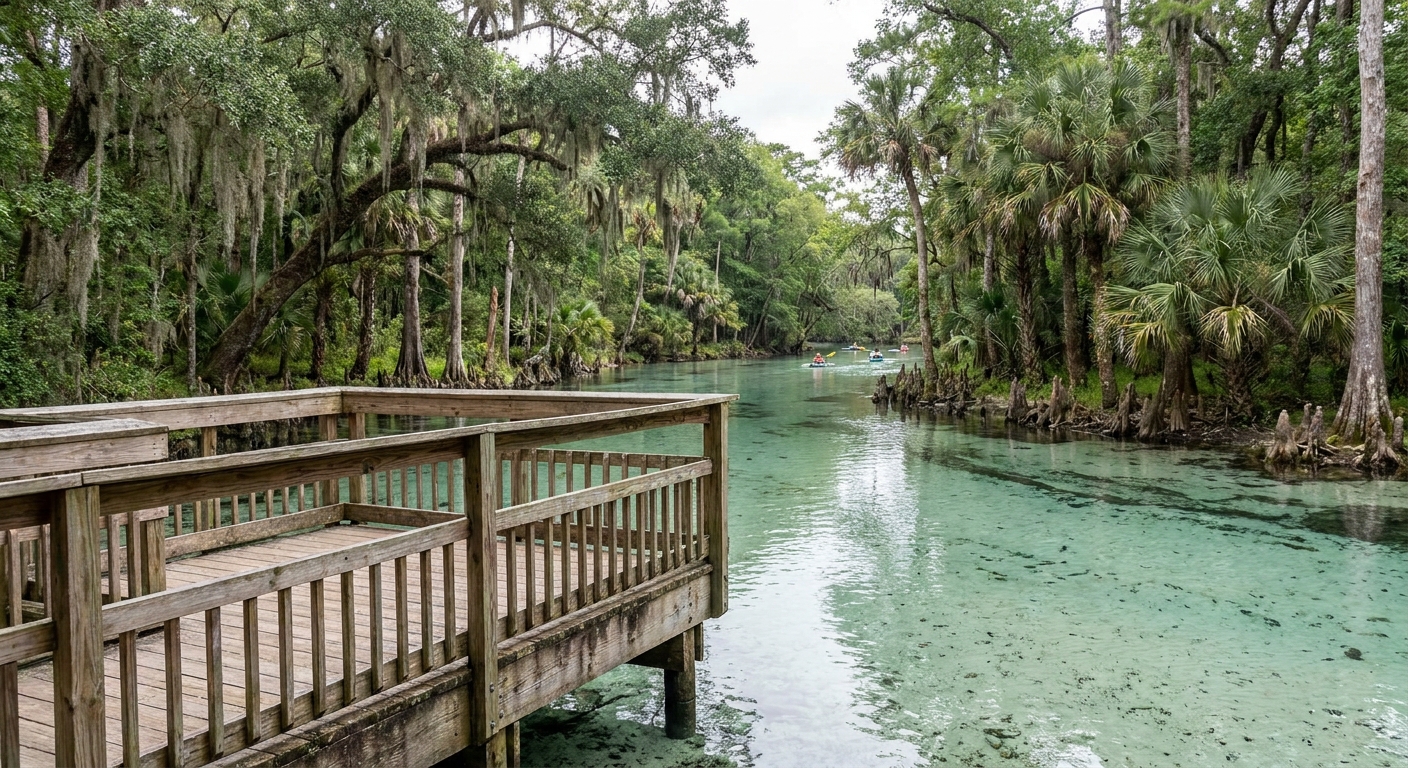
Winter is when manatees move up Florida’s spring runs, and a February visit here is built around that rather than around a swim schedule. We could not read FWC’s manatee pages, which render client-side, so we give no count and no season dates: our manatee guide handles the species and the park’s own signage handles the day. February supplies the rest, the driest air of the winter at 2.06 inches over water doing what it does in August.
The state has counted the place item by item: 3,050 feet of boardwalk along the run, one designated swimming area, one launch for canoes, kayaks and tubes, three observation platforms, six cabins and those 187 parking spaces. The USGS gauge measured 168 cubic feet per second leaving the vent. That volume is why the water stays clear, since it is replaced faster than it can cloud.
The run has no season. The air does: 71.2°F in January, 74.3 in February, 78.4 in March, above the same 74.3°F water and along the same boardwalk. In February the gap between air and water closes to nothing at the afternoon peak, so the walk back from the swim area is comfortable in a way the January version, three degrees cooler, is not.
We could not read the fee schedule, so nothing here gets labeled free. What costs nothing extra once you are through the gate is all of it: the full 3,050 feet of boardwalk, the three platforms and the single swim area sit inside one admission, and we found no separate reservation system for any of the three.
Blue Spring in February: a two-day itinerary
Day one runs on the light. Sunrise lands at 7:02 a.m., and the first hour on the boardwalk happens in air nearer 54°F than 74, cold on the hands and the best light of the day on the water. Be parked well before mid-morning, because 187 spaces is the whole allowance. Swim in the early afternoon, when the average high of 74.3°F finally matches the run. Save the stretch from about 5:15 to 6:16 p.m. for the observation platforms.
Day two belongs to the launch, where canoes, kayaks and tubes go in at the single ramp, and the water will be the same temperature it was the day before. If one of February’s 3.4 wet days lands on you, none of that changes: 74.3°F water does not notice rain. Only the 0.3 of a day per February that brings an inch or more argues for a driving day instead, and our state-wide list holds the indoor options.
Blue Spring in February vs January and March
| January | February | March | |
|---|---|---|---|
| Average high | 71.2°F | 74.3°F | 78.4°F |
| Average low | 51.8°F | 54.3°F | 58.3°F |
| Precipitation | 2.61 in | 2.06 in | 2.74 in |
| Days with 0.10 in or more | 3.8 | 3.4 | 4.0 |
| Spring water | No seasonal swing | No seasonal swing | No seasonal swing |
February’s afternoon average runs 3.1 degrees above January and 4.1 below March, and its nights land between the two at 54.3°F. On rain it wins outright: 2.06 inches against 2.61 in January and 2.74 in March, with 3.4 wet days against 3.8 and 4.0. The water column stays flat across all three, because a first-magnitude spring delivers the same temperature in every one of them.
Shift four weeks forward and you gain 4.1 degrees of afternoon warmth and lose 0.68 inches of dry sky, along with whatever spring break does to Florida in March. Shift four weeks back and January hands you cooler mornings at 51.8°F and 0.55 inches more rain, for a lot that is under the same pressure. February is the cheapest trade of the three in weather terms.
Is February a good time to visit Blue Spring?
Yes, for anyone who came for the run itself, for winter wildlife and for a boardwalk walked in a shirt at noon. It is a poorer month for a pure swimming holiday, since a 54.3°F dawn and 11 hours 13 minutes of daylight limit the number of hours in which the water is the obvious idea. Families chasing pool weather rather than spring weather are in the wrong month.
If that is you, March is the move: 78.4°F afternoons and 58.3°F nights, at the price of 2.74 inches of rain, 4.0 wet days and the busiest school-holiday stretch of the Florida spring. January is the other direction, quieter in the water and colder on the walk back at 51.8°F.
No other month puts the least rain of the winter, 2.06 inches, above water that stays at 74.3°F regardless.
The last word
One decision carries this trip and it is not a booking: what time you leave your bed. The lot holds 187 cars, the gate shuts when they are in it, and every other number on a February day here is fixed for you already. While you drive, a piece of trivia worth the mileage: Florida Statutes 373.802(5) files this run among the Outstanding Florida Springs, a class reserved for the historic first-magnitude springs plus six more named by hand in the law.
Sources & data for this guide
- February normals, rain days, and the January and March figures · NOAA NCEI monthly normals 1991-2020, station USW00012841, Orlando Executive Airport, about 44 km from the spring · checked Sep 24, 2026
- Daylight, sunrise and sunset for February 15 · sunrise-sunset.org, converted to local time · checked Sep 24, 2026
- Water temperature 74.3°F and discharge of 168 cubic feet per second · U.S. Geological Survey, National Water Information System, station 02235500 Blue Spring · instantaneous reading, Sept 11, 2026
- Parking spaces, swimming area, boardwalk length, cabins, platforms and launch · Florida Department of Environmental Protection, Recreational Facilities Inventory, 2024 annual report · checked Sep 24, 2026
- Outstanding Florida Spring definition · Florida Statutes 373.802(5) · checked Sep 24, 2026
- We could not read the park’s fee schedule or hours (floridastateparks.org returns 403 to automated reads) and we could not read FWC’s manatee pages (rendered client-side), so we quote no entrance price, no opening hour and no manatee count · checked Sep 24, 2026