
ST. AUGUSTINE · FLORIDA · JUNE
June opens with the ocean already at 82.2°F and the afternoon air at 89.9°F, and those two numbers explain most of what the month does to a visit. You get 14 hours and 6 minutes of daylight on the 15th, a beach that asks for no wetsuit and no courage, and two Spanish forts you can walk into before the heat lands. The trade is humidity, a 7.60-inch rain total, and the opening weeks of the Atlantic hurricane season.
That season runs June 1 to November 30 and peaks on September 10, with most activity between mid-August and mid-October, per NOAA’s National Hurricane Center. June sits inside the window at its quietest end. If you are still choosing a Florida month rather than a St. Augustine one, the statewide calendar makes that call. The question here is narrower: what June gives, what it charges, and whether May would have served you better.
THE MONTH AT A GLANCE · ST. AUGUSTINE IN JUNE
June hands St. Augustine an 82.2°F ocean and light until 8:29 p.m., and charges for it with 89.9°F afternoons and measurable rain on roughly one day in three.
AVG HIGH 89.9°F · SEA 82.2°F · 9.7 WET DAYS · 14H06 OF DAYLIGHT · HURRICANE SEASON OPEN
Go for: ocean swimming with no chill in it, light until 8:29 p.m., and the Castillo’s 9:00 a.m. first admission before the stone warms up.
Think twice before: planning midday on foot in the old town: 89.9°F afternoons, plus 2.4 days in the month that deliver an inch of rain or more.
Climate: NOAA NCEI 1991-2020 · Sea: Open-Meteo Marine · Forts: National Park Service · full sources at the end
On this page
- St. Augustine weather in June89.9°F days, 7.60 inches, 9.7 wet days
- Sea temperature in June82.2°F, and how that figure is measured
- Crowds, booking and the lodging tax11% on the room, and what to lock first
- Things to do in JuneCastillo de San Marcos, Fort Matanzas, the lighthouse
- A two-day plan built around the heatHour by hour, with a wet-day version
- June, May or July?How the three months compare, degree by degree
- Is June a good month to go?Who should book it, who should shift
Every figure here for air temperature and rain comes from NOAA NCEI’s 1991-2020 monthly normals at station USW00013889, the thermometer at Jacksonville International Airport. We found no separate long-run station on the St. Augustine seafront, so read these as regional normals rather than a reading taken on the Matanzas riverfront.
St. Augustine weather in June: average highs, lows and rain days
| June normal | Value |
|---|---|
| Average high | 89.9°F |
| Average low | 70.7°F |
| Precipitation | 7.60 inches |
| Days with 0.10 in or more | 9.7 |
| Days with 1 in or more | 2.4 |
| Daylight on June 15 | 14 h 06 min |
| Sea surface, mean of daily maxima | 82.2°F |
The June normal runs 89.9°F by day and 70.7°F at night in the NOAA NCEI 1991-2020 series. That is a station normal from a real instrument, not a modeled grid cell, and the distinction shows up when you compare tables online: reanalysis products routinely sit a degree or two off a station on the overnight minimum. The same series puts 7.60 inches of precipitation on the month, and that total is the figure most visitors misread.
Measurable rain falls on 9.7 days in an average June, about one day in three, and 2.4 of those days bring an inch or more. Florida’s wet season rain is convective and weighted to the afternoon, as our state calendar sets out, so the working assumption is a bright morning, a dark half hour somewhere between two and six, and a street that has dried by dinner. Two or three days will ignore that pattern and stay gray all day. Put the outdoor hours before noon and the month behaves.
Nineteen degrees separate day from night, and humidity narrows that gap in practice. At 11 p.m. the riverfront is still shirt-sleeve warm. The packing consequence is short: no layers, but a dry second shirt for the walk back, a brimmed hat, and shoes you can rinse after a shower.
On June 15 the sun rises at 6:22 a.m. and sets at 8:29 p.m. Eastern time, for 14 hours and 6 minutes of daylight. St. Augustine lies east of the Apalachicola River and keeps Eastern time with Orlando, Tampa and Miami, a detail that only bites if you are driving in from the western Panhandle. That late sunset is the month’s quiet gift: the Castillo takes its last admission at 5:00 p.m., and you still have more than three hours of light afterward.
Can you swim in St. Augustine in June? Sea temperature and the beach warning flags
The sea off St. Augustine averages 82.2°F in June on the Open-Meteo Marine series for 2015-2024. Read the method with the number: it is the mean of daily maxima, the warmest point of each day, so it sits a shade above what a 24-hour average would give and a little above what meets you at 7 a.m. We did not check it against a second buoy series, so treat 82.2°F as one method’s answer rather than the only one on offer.
At that temperature nobody stands at the edge negotiating. You walk in. Children stay under until someone calls them out, and an hour in the water costs nothing in body heat, which is the real gap between June and May’s 77.6°F. The flip side is that water this warm stops cooling you after two in the afternoon. Shade does more for an overheated hour than the surf does.
We found no verified June wind or swell series for this stretch of coast, so we give no wave heights. What is published is the flag system: double red means the water is closed, red high hazard, yellow medium, green low hazard, and purple dangerous marine life, flown beside another flag. No Florida law compels a beach to fly any of them, so read the lifeguard stand before you read the sky, and where there is no stand, the judgment is yours. Rip currents and marine life get the full treatment in our Florida safety guide.
How busy is St. Augustine in June? Crowds, booking and the 11% lodging tax
June is a school-vacation month across the eastern United States, and Florida’s dry season ended in April, so the town runs on its summer rhythm. We will not rank it beyond that: we found no occupancy series and no monthly room-rate series for St. Johns County, so June gets crowned neither the bargain nor the peak. Anyone building a budget will get further with our Florida cost guide than with a guess about one month’s rates.
No hotel, rate or restaurant in St. Augustine is verified in our notes, so we name none and quote none. The Castillo asks for no advance planning at all: first admission 9:00 a.m., last admission 5:00 p.m., seven days a week, and the $15 adult ticket stays valid for seven consecutive days. Lock the room early for a June weekend and leave the forts to be decided over breakfast.
St. Johns County levies a 5.0% transient rental tax on short-term stays, filed and paid alongside Florida’s 6% state sales tax, per the Department of Revenue’s form DR-15TDT. That is 11% on the room before any property adds charges of its own, and it applies in June exactly as in January. Resort fees and nightly parking are a separate layer, and we have no verified figure for either here, so budget them as unknown rather than as zero.
An 89.9°F afternoon rewrites the day around going back to shower or swim at two o’clock, which makes the distance between your bed and the water the one line item where paying more changes June. Walkable to the old town, or walkable to the sand: that is the criterion, and it is worth more than a view. Our statewide lodging guide covers how Florida resort fees and parking stack on top of the room rate.
Things to do in St. Augustine in June: the Castillo, Fort Matanzas and the lighthouse
Swimming is the June difference. At 82.2°F the Atlantic keeps a family in the water for an hour without anyone turning blue, and sunset at 8:29 p.m. leaves room for a second outdoor session once the heat breaks. May gives you one of those reliably. It does not give you both.
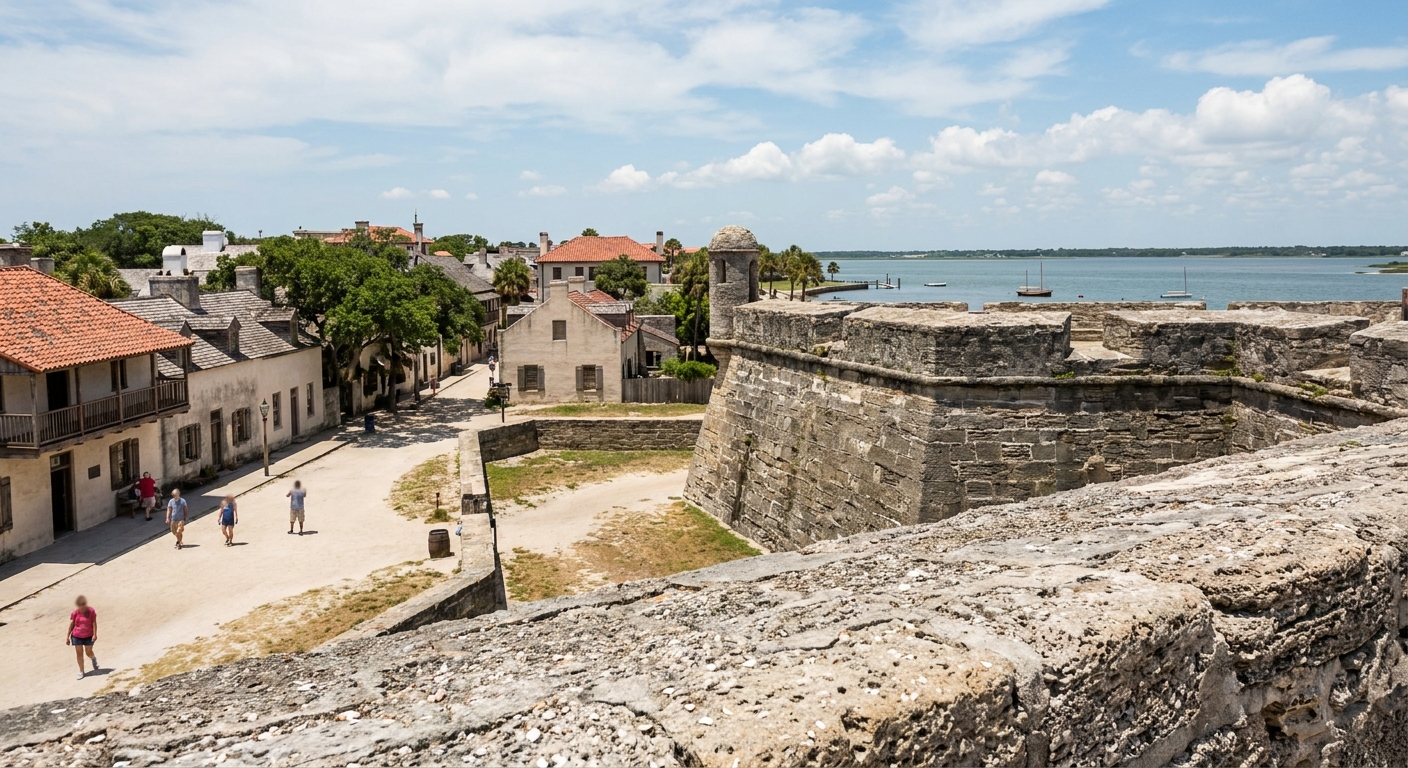
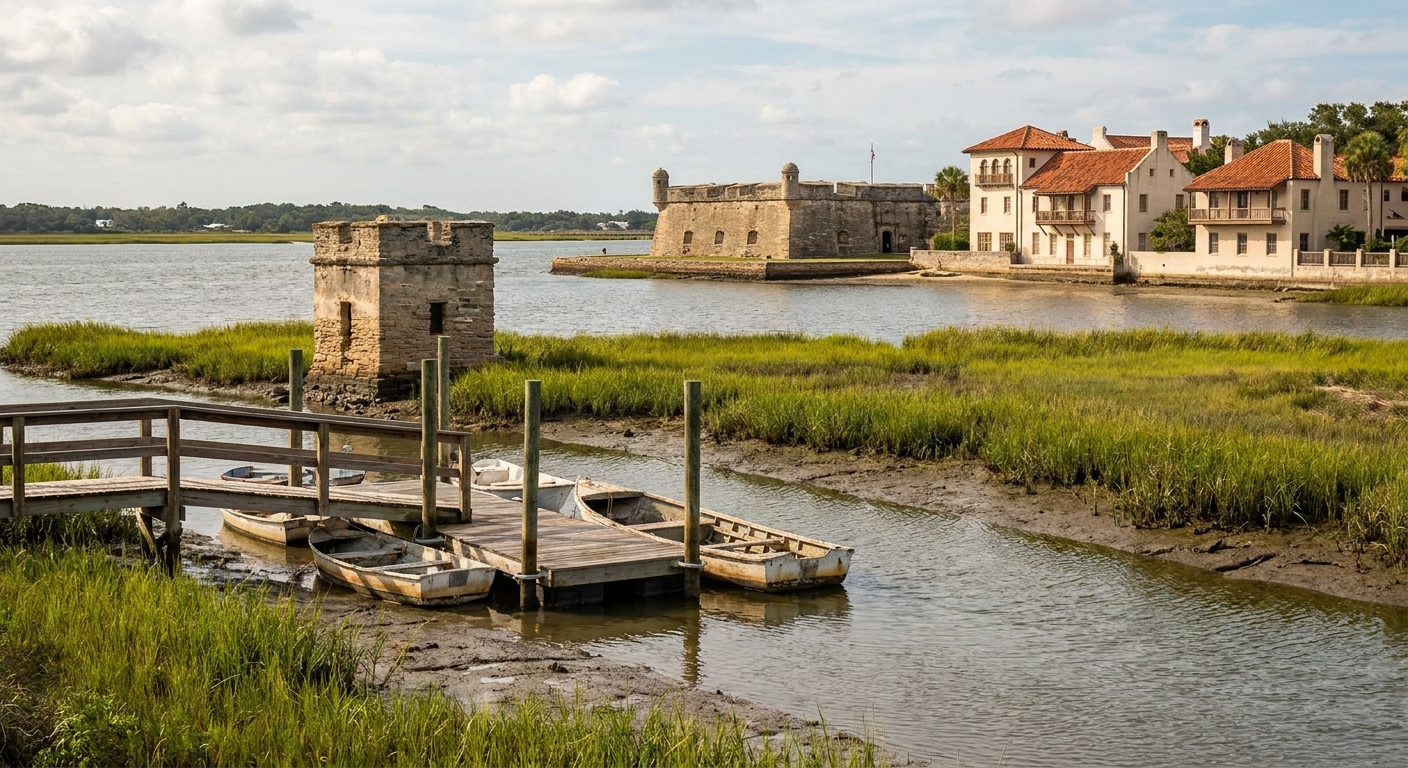
Castillo de San Marcos is, in the National Park Service’s own wording, the oldest masonry fortification in the continental United States, built by the Spanish from coquina because it was the only local stone. Adults 16 and up pay $15, valid seven consecutive days, and children 15 and under are free with an adult. Down the coast, Fort Matanzas preserves a coquina watchtower completed in 1742 that guarded the southern approach to the settlement. They are two of Florida’s eleven National Park Service units, and neither carries the National Park title.
The forts do not change with the month. The air around them does, and the seven-day Castillo ticket is the answer to that: arrive for the 9:00 a.m. opening, leave when the walls start radiating, come back another morning at no extra cost. Everyone is out by 5:15 p.m. The lighthouse works the other way around. From March 1 to September 30 it stays open to 6:30 p.m. with the last ticket sold at 6:00, so the 1874 tower can wait for the cooler end of the day. Children under 44 inches are kept off the climb, and anyone taller has to make it up under their own power.
Free all month, and all year: every part of Fort Matanzas, the ferry crossing included. The catch is the boarding pass, which costs nothing but must be collected at the Fort Matanzas Visitor Center rather than the city visitor center downtown, and every family member of every age needs one. The ferry runs on an October 1 to September 30 service year. We could not read its daily departure times at the source, so call before you drive down. We also could not verify the lighthouse’s general admission price, so we give no figure for it.
St. Augustine in June: a two-day itinerary
Day one starts early. Be at the Castillo for the 9:00 a.m. first admission, when the coquina is still cool, and give it ninety minutes. Walk the old town while shade still reaches across the streets, eat indoors around one, and hand the two-to-four block to the ocean or the air conditioning rather than to sightseeing. Back out at five, and the light holds until 8:29 p.m. That is room for the beach, the seawall and dinner at an unhurried pace.
Day two goes south to Fort Matanzas: collect the boarding passes at its own visitor center, ride the free ferry, then come back north for the lighthouse late in the afternoon, with the last ticket sold at 6:00 p.m. through September 30. If the sky turns, and on 9.7 days in an average June it will, invert the order and push the tower and the ferry to the next morning. Only 2.4 days in the month bring an inch or more, and those are the ones worth giving up entirely.
St. Augustine in June vs May and July
| Normal | May | June | July |
|---|---|---|---|
| Average high | 85.9°F | 89.9°F | 91.9°F |
| Average low | 63.9°F | 70.7°F | 73.2°F |
| Precipitation | 3.42 in | 7.60 in | 6.77 in |
| Days with 0.10 in or more | 4.6 | 9.7 | 9.9 |
| Sea, mean of daily maxima | 77.6°F | 82.2°F | 84.5°F |
From May to July the air climbs 6.0°F and the water 6.9°F, but rain moves furthest: 3.42 inches and 4.6 wet days in May become 7.60 inches and 9.7 wet days in June, with July holding that pattern at 6.77 inches and 9.9 days. June is the step-change month. The jump out of May is bigger than anything that follows into July, and it lands on the sky rather than on the thermometer.
Shift four weeks earlier and May halves the rain and gives back a night that genuinely cools, 63.9°F against 70.7°F, while taking 4.6°F off the water. Shift four weeks later and July adds 2.3°F of sea and 2.0°F of air, and moves you closer to the mid-August to mid-October stretch NOAA calls the active part of the season. For a family whose whole trip is the ocean, June is the earliest month that works without hesitation. For a trip spent walking, May is kinder.
Is June a good time to visit St. Augustine?
Yes if the trip is built on water and evening light: 82.2°F ocean, 14 hours and 6 minutes of daylight, two federal forts open every day of the month. No if the plan is six hours a day on foot in the old town, because 89.9°F with Florida humidity turns one long walking itinerary into two short ones with a swim in between.
If that second description is yours, take May instead: 85.9°F days, 63.9°F nights, 3.42 inches of rain and fewer than half June’s wet days, with water at 77.6°F that swims fine even if it never feels like a bath. The other answer for walking weather in Florida is autumn, though October sits inside the hurricane season’s most active stretch, and the statewide calendar weighs that trade properly.
Only June puts an 82.2°F ocean under an 8:29 p.m. sunset. July matches the water and gives up the 70.7°F nights, May keeps the cooler nights and gives up 4.6°F of sea, and nothing else in the year splits the difference the way these four weeks do.
The last word
Book the bed within walking distance of water, take the Castillo at 9:00 a.m. on your first morning, and let the two-to-four block belong to the ocean. One rule worth knowing before you spread a towel: under Florida Statutes s. 163.035, wet sand below the mean high-water line is public, while dry sand above it can be private unless a court has said otherwise, so the access point you walk through matters as much as the stretch you can see. And if you can pick your arrival, Jacksonville is the nearest large airport, with 3,749,791 boardings in 2024 against Orlando’s 27,859,783 (our flights guide compares the two).
Sources & data for this guide
- June normals, rain-day counts, and the May and July figures · NOAA NCEI monthly normals 1991-2020, station USW00013889 (Jacksonville International Airport) · checked Sep 23, 2026
- Sea surface 82.2°F, mean of daily maxima 2015-2024 · Open-Meteo Marine API · checked Sep 23, 2026
- Daylight, sunrise and sunset for June 15, converted to Eastern time · sunrise-sunset.org · checked Sep 23, 2026
- Hurricane season dates, September 10 peak and the mid-August to mid-October stretch · NOAA National Hurricane Center · checked Sep 23, 2026
- Castillo de San Marcos fees, hours and coquina construction · National Park Service · checked Sep 7 and Sep 8, 2026
- Fort Matanzas free admission, boarding passes, ferry service year and the 1742 watchtower · National Park Service · checked Sep 23, 2026
- 5.0% St. Johns County transient rental tax with the 6% state sales tax · Florida Department of Revenue, form DR-15TDT · checked Sep 23, 2026
- Lighthouse hours, the 1874 tower and the 44-inch rule · St. Augustine Lighthouse & Maritime Museum · checked Sep 23, 2026. We could not read the general admission price at the source, so none is quoted.
- Beach warning flags and beach access · Florida Statutes s. 380.276 and s. 163.035, Volusia County Beach Safety · checked Sep 23, 2026
- JAX and MCO 2024 boardings · Federal Aviation Administration, CY2024 · checked Sep 23, 2026
- We found no occupancy or room-rate series for St. Johns County, and no hotel, room rate or restaurant is verified in our notes, so we name and price none. Hours and fees change · check the operators when you book.
To plan your stay
- Things to Do in St. Augustine: Castillo Tickets, Fort Matanzas Ferry and Lighthouse Hours
- Where to Stay in St. Augustine: Historic District, the Beach and the 5% Lodging Tax
- Airport to St. Augustine: JAX, MCO, Rental Cars and Eastern Time
- St. Augustine Know Before You Go: Castillo Fees, the Fort Matanzas Ferry Pass and Beach Rules