
ST. AUGUSTINE · FLORIDA · MARCH
Afternoons in March average 74.3°F and nights fall to 50.6°F, a 23.7°F spread that puts you in shorts at noon and a jacket by dinner. That is walking weather on open stone, and St. Augustine’s two federal sites are open stone: the Castillo de San Marcos takes its first visitors at 9:00 a.m. for $15, and Fort Matanzas takes them for nothing.
The ocean runs behind the air. Sea surface off the coast averages 67.6°F in March, cool enough that most swims end fast. Rain lands on 5.6 days in an average month, the Atlantic hurricane season (June 1 to November 30) is nowhere near, and the whole trip sits inside Florida’s dry season.
THE MONTH AT A GLANCE · ST. AUGUSTINE · MARCH
March pairs 74.3°F afternoons with a 67.6°F ocean: excellent for the forts, the tower and the old town on foot, thin for swimming, and safely outside hurricane season.
AVG HIGH 74.3°F · AVG LOW 50.6°F · SEA 67.6°F · 5.6 WET DAYS · 12H 02M OF DAYLIGHT
Go for: 74.3°F walking afternoons, a $15 Castillo ticket good for seven consecutive days, and Fort Matanzas free from the parking lot to the far side of the ferry.
Think twice before: building the week around swimming. A 67.6°F sea is a short plunge for most visitors, and one night in an average March still drops to 32°F or below.
Air: NOAA NCEI 1991-2020, Jacksonville Intl · Sea: Open-Meteo Marine 2015-2024 · Fees and hours: NPS · full sources at the end
On this page
- March highs, lows and rain days74.3°F days, 50.6°F nights, 5.6 wet days
- Can you swim in St. Augustine in March?A 67.6°F ocean, and what that buys you
- Crowds, booking and the lodging tax5% county tax on top of 6% state
- Things to do in MarchCastillo at $15, Fort Matanzas free, the 1874 tower
- A two-day itinerary for MarchTwo days timed to a 7:35 p.m. sunset
- March vs February and AprilHow the three months compare, degree by degree
- Is March a good time to visit?Yes for walkers, no for swimmers
Two different kinds of measurement carry this month, and they should not be read the same way. The air temperatures are station normals, taken by an instrument at Jacksonville International Airport. The sea temperature is a model average taken off the coast. Every figure here is attributed where it is used, with reading dates at the end.
St. Augustine weather in March: average highs, lows and rain days
| March in figures | Value |
|---|---|
| Average high | 74.3°F |
| Average low | 50.6°F |
| Precipitation | 3.29 in |
| Days with 0.10 in or more | 5.6 |
| Days with 1 in or more | 0.8 |
| Nights at 32°F or below | 1.0 |
| Sea surface (mean of daily maxima) | 67.6°F |
| Daylight on March 15 | 12 h 02 m |
The 74.3°F high and 50.6°F low come from NOAA NCEI’s 1991-2020 monthly normals for station USW00013889, a real thermometer at Jacksonville International Airport rather than a reanalysis grid cell averaged over a box of ocean and land. The station sits north of town and back from the dunes, so read every figure here as the region’s climate, not as a reading taken on the seawall. Total precipitation for the month: 3.29 inches.
Measurable rain (0.10 inch or more) shows up on 5.6 days, roughly one day in five or six, and a full inch falls on 0.8 day. Translated into a week on the ground: expect one or two days with a band of rain in them, and something close to a one-in-five chance that a single day of your trip gets a genuine soaking. The other five or six days are dry.
That 23.7°F gap between afternoon and dawn writes the packing list. Shorts and a shirt handle midday, a fleece or a light jacket handles everything after the sun goes, and one night in an average March still touches 32°F or below. Add a rain shell for the wet days and shoes you can walk five miles in, because the old town and both forts are walked, not driven.
On March 15 the sun rises at 7:32 a.m. and sets at 7:35 p.m. Eastern time: 12 hours and 2 minutes of daylight. St. Augustine keeps Eastern time along with Orlando, Tampa and Miami, and only the western Panhandle runs Central. The Castillo empties at 5:15 p.m., which leaves more than two hours of light for the waterfront, the marina and dinner.
Can you swim in St. Augustine in March? Sea temperature and what it feels like
Sea surface off St. Augustine averages 67.6°F in March, from the Open-Meteo Marine model averaged over 2015 to 2024. One nuance travels with that number: it is the mean of daily maxima, the warmest reading of each day, so a true 24-hour average would land a shade below it. Treat 67.6°F as the friendly end of what the water does in March, not the middle.
In practice, 67.6°F is a plunge rather than a session. Adults go in, count to sixty and come out pink and pleased with themselves. Children last longer than their parents and shiver afterward all the same. Anyone planning more than ten minutes in the water, surfers included, wants a wetsuit. April adds 4.2°F to that figure, and the difference is the difference between a dip and an afternoon.
We could not verify wind or swell statistics for March off St. Johns County, so we give none. What is posted on the sand is the state’s flag system: double red means the water is closed, red high hazard, yellow medium, green low hazard with caution, and purple, flown alongside another flag, dangerous marine life. No Florida law compels a beach to fly any of them, so look for a lifeguard stand before you look for a flag (our safety guide covers the rest).
How busy is St. Augustine in March? Crowds, prices and the demand peak
March falls in the closing stretch of Florida’s dry season, November through April, and well outside the hurricane season that runs June 1 to November 30 and peaks on September 10. That much is calendar, and it is the reason the whole state is busy in late winter. We found no occupancy series and no month-by-month room-rate series for St. Johns County, so we crown no month cheap and no month expensive.
Spring break has no single national date, and we could not verify a week-by-week calendar for the county, so we will not tell you which March week is the loud one. Lock your nights first and leave the sights loose: the Castillo charges $15 for visitors 16 and over and the ticket stays valid seven consecutive days, which takes the pressure off choosing one morning. On flights, Jacksonville JAX is the nearest large airport, a medium hub that boarded 3,749,791 passengers in 2024 against 27,859,783 at Orlando MCO, so price the drive from both (flights guide).
St. Johns County levies a 5.0% transient rental tax on short stays, filed and paid together with Florida’s 6% state sales tax. Add 11% to any nightly rate you are quoted, hotel room or vacation rental, and build the budget from that total rather than the headline (our cost guide does the same arithmetic statewide). We verified no hotel and no room rate, so we name none.
Spend the extra on location rather than on square footage. With nights at 50.6°F and daylight holding to 7:35 p.m. in mid-March, the hours after the fort closes are the pleasant ones, and a bed you can walk home to turns them into the best part of the day. A room out on the highway spends them in the car. One more small saving: that seven-day Castillo ticket means two visits for a single $15.
Things to do in St. Augustine in March
March 1 is the date the lighthouse changes its clock. From then until September 30 it opens 9:00 a.m. to 6:30 p.m. with the last ticket at 6:00 p.m., half an hour later than the October 1 to February 28 schedule. Pair that longer evening with a 74.3°F afternoon on shadeless coquina and a fort morning plus a tower climb fit comfortably into one day, which is a harder ask in the heat of the summer months.
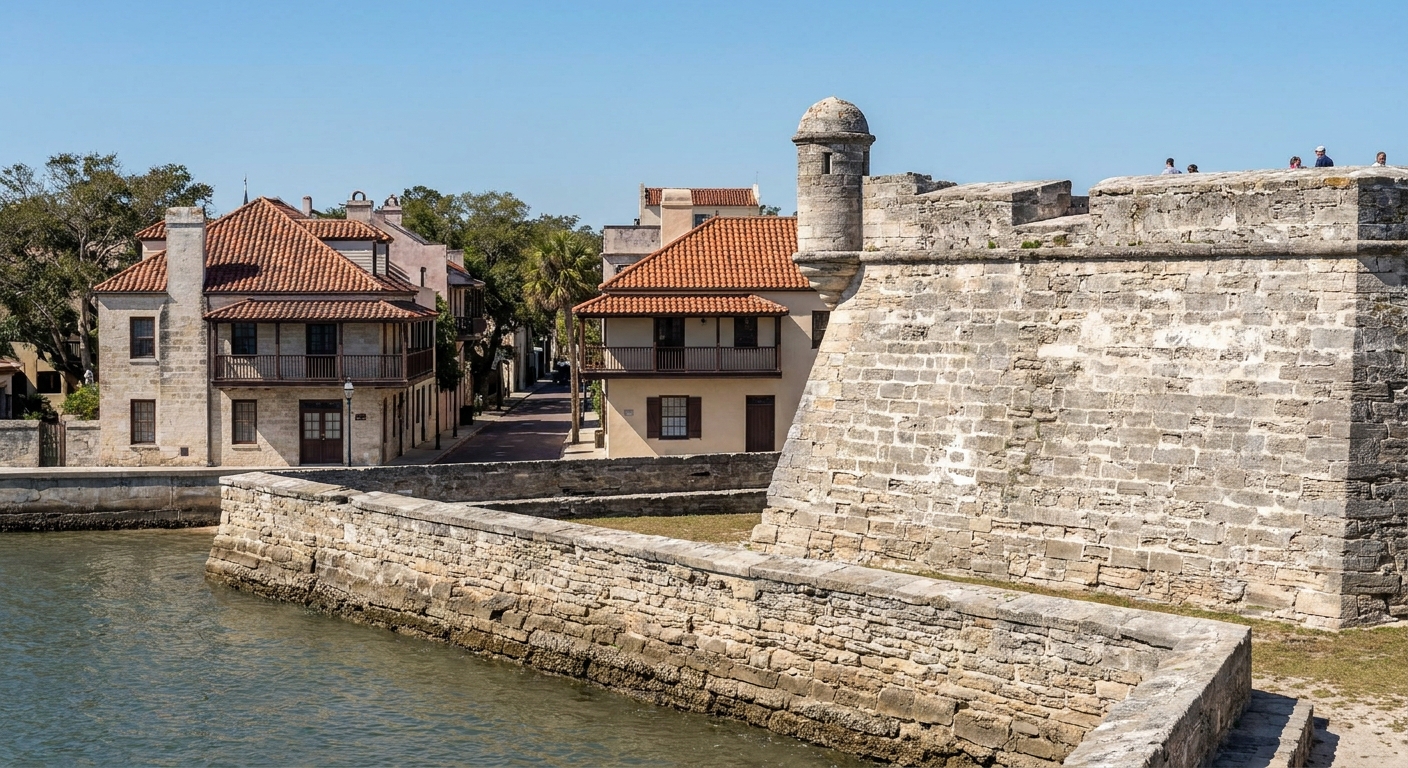
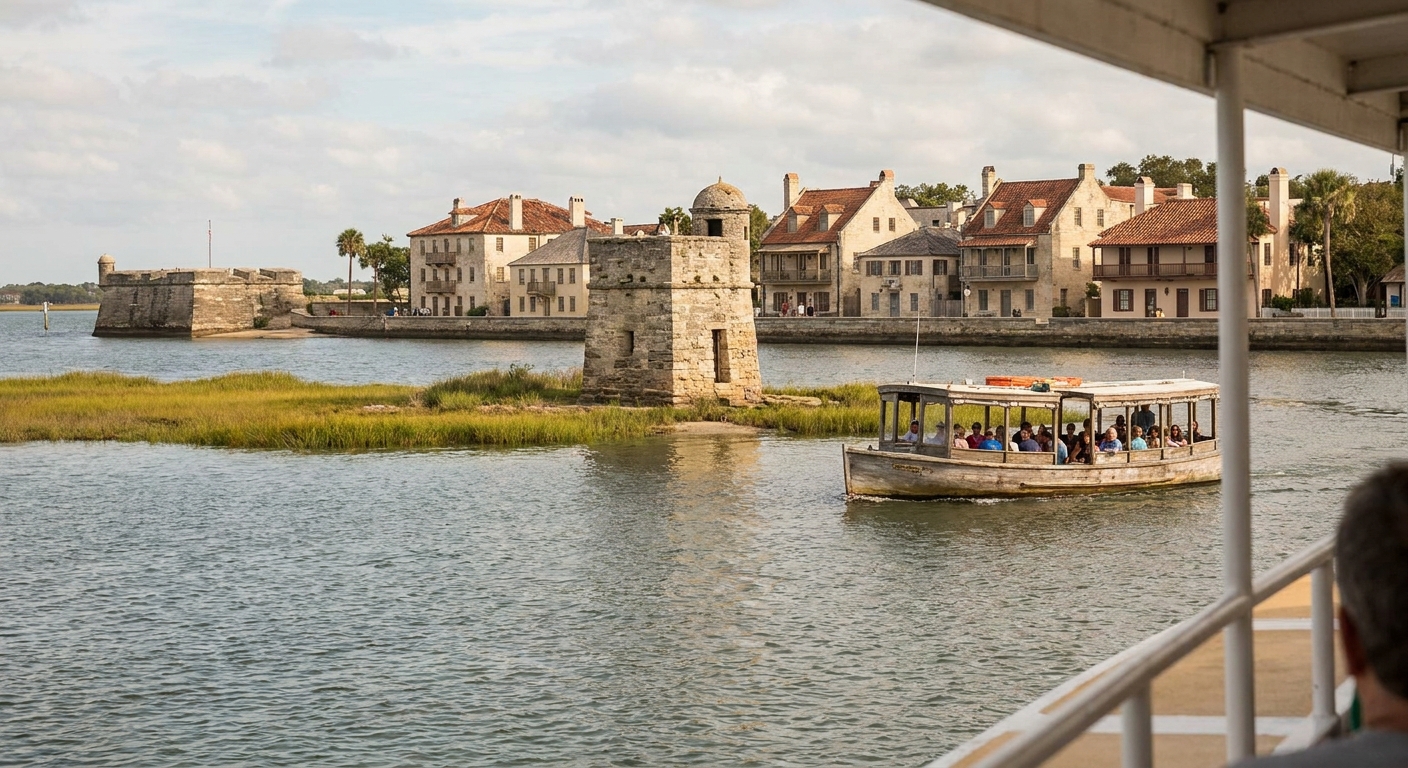
Castillo de San Marcos is the oldest masonry fortification in the continental United States, in the Park Service’s own careful wording, and it was built from coquina because that shell stone was the only local rock available. Adults 16 and over pay $15, valid seven consecutive days, and visitors 15 and under enter free with an adult. First admission 9:00 a.m., last admission 5:00 p.m., everyone out at 5:15, seven days a week except Thanksgiving and Christmas. Fort Matanzas, whose coquina watchtower was completed in 1742, charges nothing at all.
Those two are Florida’s only National Park Service units north of the peninsula’s parks, and both are open to the sky, so the month does its work on the air rather than on the buildings. At 74.3°F the gun deck is a comfortable hour. The tower, standing since 1874, sells its last ticket at 6:00 p.m., more than an hour and a half before the 7:35 p.m. sunset: plan it for late light, not for the sun dropping. Children under 44 inches cannot go up, and taller children must climb under their own power. We could not read a general admission price at the source, so we quote none.
Free in March, and free all year: every part of Fort Matanzas, ferry included. The boarding pass comes from the Fort Matanzas Visitor Center, not the city visitor center downtown, and each family member needs one whatever their age. The ferry service runs October 1 to September 30, though we could not read the daily departure times, so arrive with margin. Children 15 and under are free at the Castillo, and the wet sand below the mean high-water line is public under Florida law while dry sand above it can be private.
St. Augustine in March: a two-day itinerary
Day one opens at the Castillo’s 9:00 a.m. first admission: $15 for adults, and the ticket keeps working for the next six days. Give the old town the late morning on foot, eat indoors while the thermometer tops out near 74°F, then drive south at about 2:00 p.m. for Fort Matanzas, collecting the free boarding pass at its own visitor center before anything else. Back in town by 5:30, and with sunset at 7:35 p.m. the waterfront gets two hours of daylight it does not get in December.
Day two goes to the water and the tower: beach in the morning, when 67.6°F makes ten minutes a long swim, and the lighthouse in the afternoon, remembering the 6:00 p.m. last ticket and the 44-inch rule at the stairs. If the sky turns, the seven-day Castillo ticket is the flexible piece: trade the beach for a second, slower visit inside the walls and hold the climb for the clear afternoon. Only 0.8 day in an average March delivers an inch of rain or more, so a two-day trip rarely loses both.
St. Augustine in March vs February and April
| Measure | February | March | April |
|---|---|---|---|
| Average high | 68.9°F | 74.3°F | 79.8°F |
| Average low | 46.1°F | 50.6°F | 56.4°F |
| Precipitation | 2.86 in | 3.29 in | 2.93 in |
| Days with 0.10 in or more | 4.8 | 5.6 | 4.4 |
| Sea surface | 63.8°F | 67.6°F | 71.8°F |
The daytime ladder runs 68.9°F, 74.3°F, 79.8°F: March stands 5.4°F above February and 5.5°F below April, almost exactly halfway. Nights climb in step, 46.1 to 50.6 to 56.4. Rain is where March loses: 3.29 inches over 5.6 wet days, against 2.86 inches over 4.8 days in February and 2.93 inches over 4.4 days in April. The ocean climbs 63.8, 67.6, 71.8, which is 3.8°F gained since February and 4.2°F still to come.
Move the vacation four weeks later and you buy that 4.2°F of ocean, 5.5°F of afternoon and one fewer wet day, at the cost of hotter stone at midday. Move it four weeks earlier and February gives back a drier calendar and quieter streets while taking 5.4°F off the air and 3.8°F off the water, with our February page running the same figures in full.
Is March a good time to visit St. Augustine?
Yes, if the trip is built on walking. A 74.3°F afternoon, two National Park Service sites within half an hour of each other, an 1874 tower you climb yourself, and a beach you sit on rather than swim off: that is a strong long weekend and it costs $15 in admissions. No, if the trip is built on swimming. A 67.6°F ocean is a plunge, and no amount of sunshine warms it up by Thursday.
Swimmers should take April instead. The water reaches 71.8°F, afternoons reach 79.8°F, and rain days drop to 4.4, the lowest of the three months in the table above. The trade is hotter open coquina at midday and the end of the dry season closing in at the end of the month, which our statewide calendar lays out season by season.
What March holds that April does not: the lighthouse’s longer hours begin on March 1, while the air is still averaging 74.3°F, so a tower climb and both forts fit into a single day without anyone hunting for shade.
The last word
Book the nights first, then let $15 and a free boarding pass carry the rest of the trip. One thing worth knowing before you stand on that inlet: Matanzas is the Spanish word for slaughters, and the river was named for the massacre of French Huguenots there, at a time when whoever held Florida held the shipping lanes out of the Spanish Caribbean. The Park Service dates the town’s founding to 1565. The familiar “oldest continuously occupied city” line appears on none of the NPS pages we read, so we leave it unverified and stick to the date. Collect the Matanzas pass early, keep the Castillo ticket all week, and eat late: on March 15 the light holds to 7:35 p.m.
Sources & data for this guide
- March normals, wet days and the 32°F night · NOAA NCEI monthly normals 1991-2020, station USW00013889 (Jacksonville International Airport) · checked Sep 23, 2026
- February and April normals, same station and same 1991-2020 period · NOAA NCEI · checked Sep 23, 2026
- Sea surface 67.6°F, mean of daily maxima 2015-2024 · Open-Meteo Marine API · checked Sep 23, 2026
- Daylight, sunrise 7:32 a.m. and sunset 7:35 p.m. on March 15 · sunrise-sunset.org, converted to Eastern time · checked Sep 23, 2026
- Castillo de San Marcos: $15 for ages 16 and up valid seven consecutive days, 9:00 a.m. first admission, 5:15 p.m. exit, coquina · National Park Service · checked Sep 7 and 8, 2026
- Fort Matanzas: free entry and free ferry, boarding pass at the Fort Matanzas Visitor Center, 1742 watchtower, the Matanzas name, the 1565 founding · National Park Service · checked Sep 23, 2026. Daily ferry departure times were not readable at the source, so we give none.
- Lodging tax: 5.0% St. Johns County transient rental tax filed with the 6% state sales tax · Florida Department of Revenue, form DR-15TDT · checked Sep 23, 2026
- Lighthouse hours (Mar 1 to Sep 30, last ticket 6:00 p.m.), the 1874 tower and the 44-inch rule · St. Augustine Lighthouse & Maritime Museum · checked Sep 23, 2026. We could not read a general admission price, so none appears.
- Hurricane season dates and the September 10 peak · NOAA National Hurricane Center · checked Sep 23, 2026
- Beach warning flags and access above the mean high-water line · Florida Statutes s. 380.276 and s. 163.035 · checked Sep 23, 2026
- JAX and MCO 2024 enplanements · Federal Aviation Administration, CY2024 · checked Sep 23, 2026
- We found no occupancy or room-rate series for St. Johns County, and we verified no hotel, rental or restaurant, so we name none and rank no month by price.
To plan your stay
- Things to Do in St. Augustine: Castillo Tickets, Fort Matanzas Ferry and Lighthouse Hours
- Where to Stay in St. Augustine: Historic District, the Beach and the 5% Lodging Tax
- Airport to St. Augustine: JAX, MCO, Rental Cars and Eastern Time
- St. Augustine Know Before You Go: Castillo Fees, the Fort Matanzas Ferry Pass and Beach Rules