
PORTUGAL · NAZARÉ · JULY
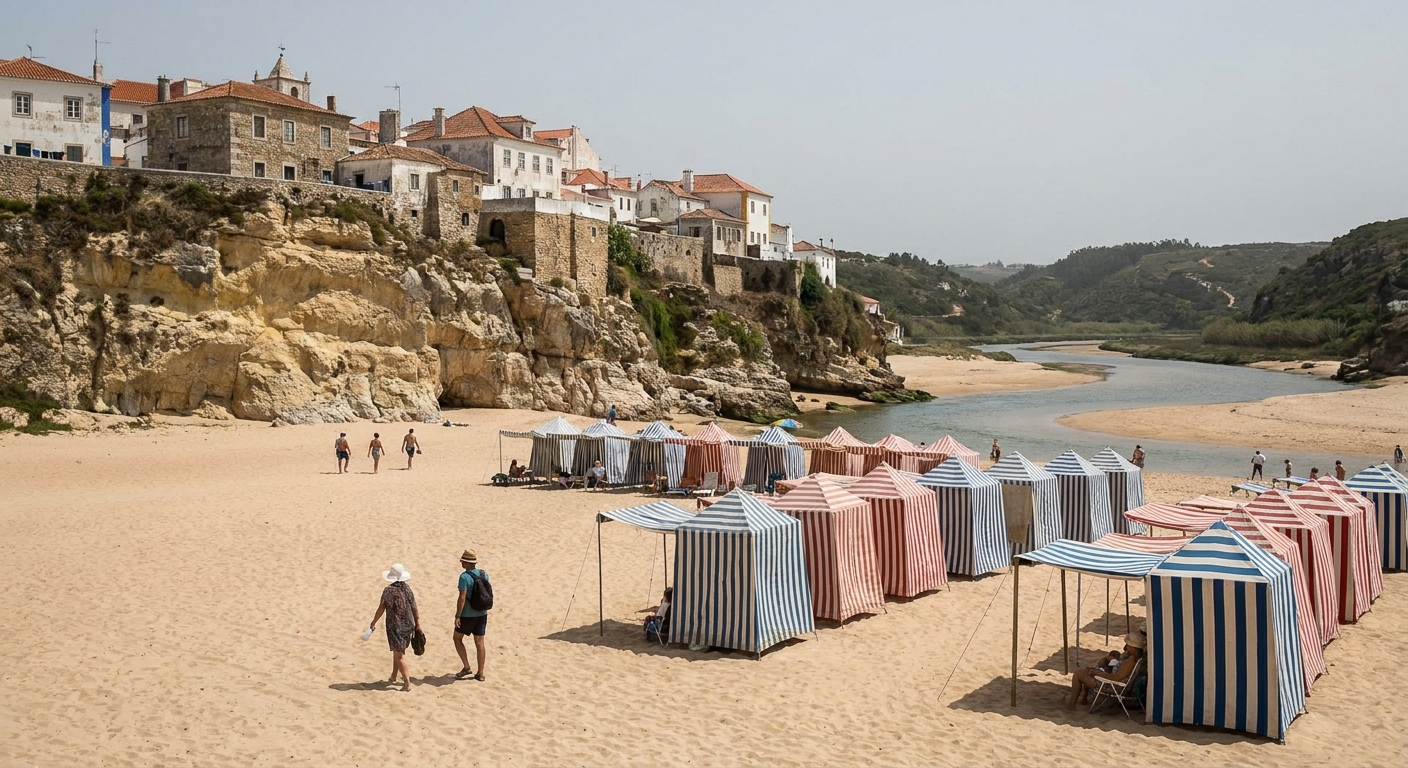
July fills both halves of Nazaré at once: the long beach under the cliff, and Sítio on top of it. The month arrives mild, 68.9°F by day and 62.4°F at night on the official coastal normals, with 0.20 inch of rain across the whole four weeks. It is also the middle of the Portuguese holidays, so the seafront terraces, the funicular and the ranks of striped awnings on the sand all run at capacity. You get the driest weeks of the summer and the fullest town in the same package.
What July does not hand you is warm water. The Atlantic off Nazaré averages 63.7°F this month, and it gets colder in August rather than warmer. In exchange the light is enormous: 14 hours 43 minutes on July 15, with the sun still up at 21:05. Plan the trip around that light and around a wetsuit, and the month delivers.
THE MONTH AT A GLANCE · NAZARÉ · JULY
July is the driest and longest-lit month of the Nazaré summer, and the fullest: come for the light and the cliff, and plan around a 63.7°F Atlantic.
HIGH SEASON · 68.9°F DAYS · 63.7°F SEA · 0.9 RAIN DAYS · SUNSET AT 21:05
Go for: 0.20 inch of rain in a whole month, evenings that run to 21:05, and a clifftop at Sítio you can reach by funicular after a beach afternoon.
Think twice before: banking on warm water or a quiet seafront: the sea averages 63.7°F and the town sits inside the Portuguese school holidays.
Air and rain: IPMA station 531, Cabo Carvoeiro, 1991-2020 · Sea: Open-Meteo Marine, 2015-2024 · full sources at the end
On this page
- Nazaré weather in July68.9°F days, 0.9 rain days
- Sea temperature for swimming63.7°F, and what it takes to enjoy it
- How crowded July getsThe Portuguese holiday peak
- Things to do in JulyPraia da Nazaré, Sítio, Praia do Norte
- A two-day plan built on July lightHour by hour, to a 21:05 sunset
- July or June or August?How the three months compare
- Is July a good time to visit?The verdict for swimmers and walkers
Nazaré in mid-July is a question of dates, and the answers sit in four numbers: 68.9°F, 0.20 inch, 63.7°F, 14h43. For what does not move with the calendar, the drive up from Lisbon airport, the beds, the rest of the country, start with getting around Portugal, where to stay and the 12-month verdict.
Nazaré weather in July: average highs, lows and rain days
| July at Cabo Carvoeiro, 1991-2020 | Value |
|---|---|
| Average high | 68.9°F (20.5°C) |
| Average low | 62.4°F (16.9°C) |
| Precipitation, whole month | 0.20 in |
| Days with 0.04 in or more | 0.9 |
| Days with 0.39 in or more | 0.1 |
| Sea surface, mean of daily maxima | 63.7°F (17.6°C) |
| Daylight on July 15 | 14 h 43 min |
The numbers here come from IPMA, Portugal’s national weather service, and from one instrument in particular: station 531 at Cabo Carvoeiro, a real thermometer standing 32.0 m above the sea at Peniche, on the same exposed run of coast as Nazaré. Its 1991-2020 July normals read 68.9°F for the average high, 62.4°F for the average low, and 0.20 inch of rain for the month. A model grid cell would give you something smoother and less local. One limit travels with the reading: it describes this windward shoreline, while the country behind it runs colder and far wetter on high ground.
Rain barely registers. In an average July, 0.9 days record at least 0.04 inch and 0.1 day records 0.39 inch or more, so a genuine soaking turns up about one July in ten. Those are IPMA’s own thresholds, set lower than the 0.10-inch bar most American tables use, so the counts do not line up against a US almanac. Morning cloud is the more common event on this coast: a gray lid over the water that lifts by late morning and leaves the afternoon clear.
Between the average high and the average low sits 6.5°F. That is the whole day, top to bottom, and it decides what goes in the bag. A 68.9°F afternoon with wind coming off the water stops being shorts weather once the sun drops behind the cliff, and 62.4°F after dark makes the seafront a jacket walk. Bring a windbreaker, a fleece for the clifftop, and long pants for dinner. Our Portugal packing guide covers the rest of the list.
On July 15 the sun rises at 06:22 and sets at 21:05 local time, which makes 14 hours 43 minutes of daylight. That changes the shape of a day. You can take a full beach afternoon, be back at the room by seven, shower, and still climb to Sítio in broad light for the last of it. Dinner at nine happens under a lit sky, and the beach empties long before the light does.
Can you swim in Nazaré in July? Sea temperature and what it feels like
63.7°F is the July figure for the surface off Nazaré, and it carries a footnote worth reading. It is an average of daily maxima over 2015 to 2024, drawn from the Open-Meteo marine model, so it runs a shade warmer than a plain 24-hour mean would. Read it as the warmest the top of the water gets on a July afternoon, with mornings a little under it. Other sea-temperature tables use other methods and land on other numbers, which is worth remembering before you argue with a thermometer on the sand.
In practice that is a cold entry and a fine swim. Adults going in at four in the afternoon gasp once and then get on with it. Children generally want a rash vest or a shorty, and anyone hoping to stay in past twenty minutes wants a full suit. Surf schools on the beach rent them, though we could not verify their July rates. The Atlantic here also has real shorebreak, and the flagged, lifeguarded stretch in front of town is the place to swim rather than the open sand north of it.
On wind and swell we came up short. We found no July wind speeds or wave heights for Nazaré that we could stand behind, so we give no figure for either. What can be said without numbers: summer afternoons on this coast bring an onshore northerly that stiffens after lunch, and the giant-wave season that made Praia do Norte famous belongs to the winter months. In July that break is an ordinary, if powerful, summer beach.
How busy is Nazaré in July? Crowds, booking ahead and the tourist tax
Put July where the calendar puts it: inside the Portuguese school holidays and inside the European summer window at the same time. A beach town of this size draws from both, and Nazaré is a domestic favorite before it is an international one. We found no monthly occupancy figures or room-rate series for the town, so we crown no month the expensive one and quote no average nightly rate. High season here is something the calendar tells us. The price of a July room is something we could not measure.
Book earlier than you would for a city trip. Lisbon absorbs late bookings, while a small seafront town in its peak four weeks does not, and the apartments with a sea view and a parking space go first. Six to eight weeks out is our working target for July (est.), and that is editorial judgment rather than a measurement. The wider budget, flights included, is broken down in what a Portugal trip costs and flights from the US.
On the tourist tax we have to leave a gap. We could not verify whether Nazaré’s municipality levies a per-night charge, or at what rate, so we give no percentage and no euro amount. Ask the property directly when you reserve, and ask whether any such charge is inside the quoted rate or collected at check-in.
If you spend extra anywhere in July, spend it on where the bed sits. A place within walking distance of the sand means the car stays where you left it on Friday, and it puts the 21:05 sunset five minutes from the door instead of a drive and a parking hunt up the cliff road. The rest of the trip, meals and moving around, can be decided on the day.
Things to do in Nazaré in July: Praia da Nazaré, Sítio and Praia do Norte
July’s edge over its neighbors is dryness and length of day: 0.20 inch of rain for the month against June’s 0.48, and 14 hours 43 minutes of light on the fifteenth. That combination makes the two-part day possible, a morning on the sand and a second outing after five with hours to spare. June hands you more than twice as many days with measurable rain. August hands you a colder sea.
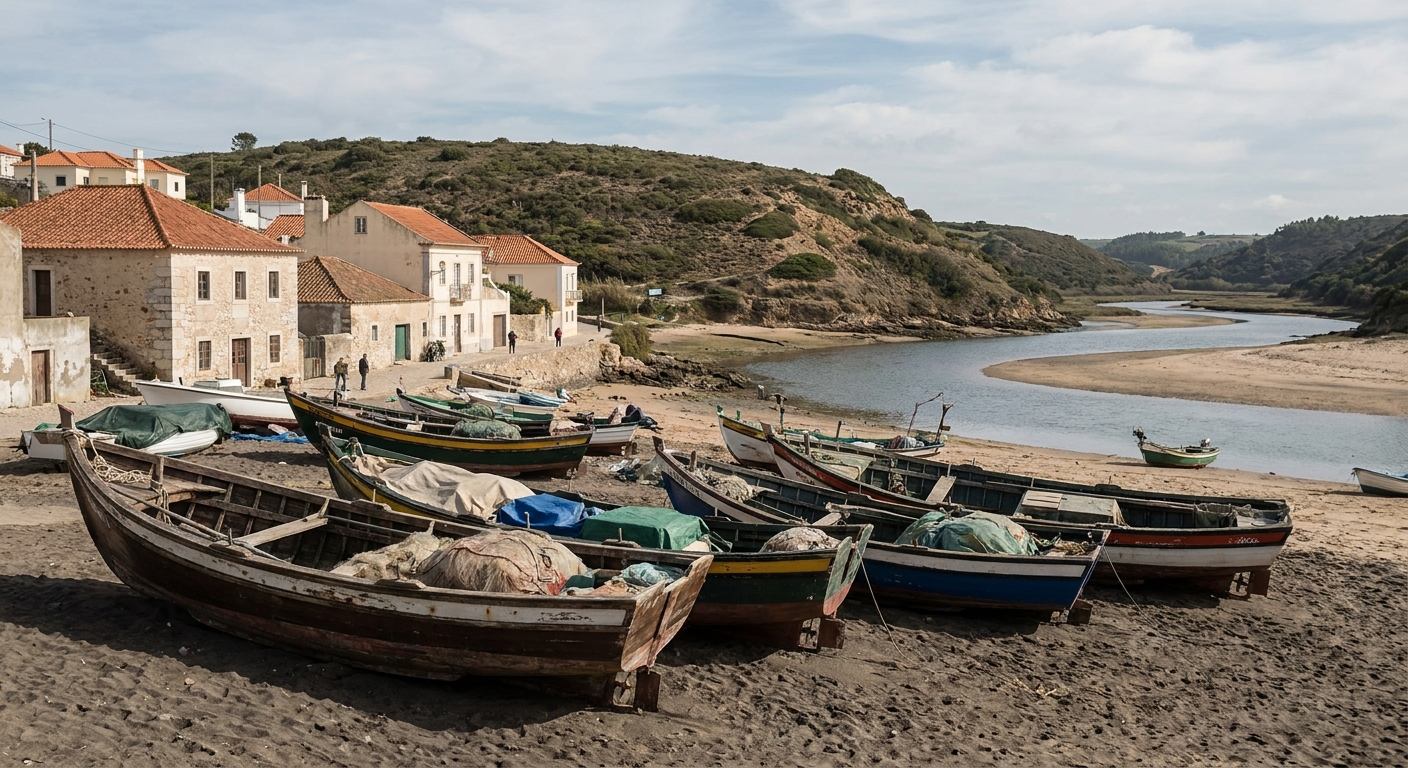
The short list is walkable. Praia da Nazaré is the wide town beach under the cliff, with the fishing boats at its northern end. Sítio sits on the headland above, reached by the funicular that climbs the cliff face, and holds the sanctuary of Nossa Senhora da Nazaré and the miradouro responsible for every photograph you have seen of this town. Beyond it, Praia do Norte runs north from the Forte de São Miguel Arcanjo at the point. We could not verify the funicular’s July timetable or fare, or the fort’s admission, so we quote none: check both on the morning you go.
None of those places move with the season; the air around them does. The miradouro at Sítio catches the same northerly that holds the beach to 68.9°F, and it always feels cooler at the rail than on the sand, which is why the clifftop in July is a sunset spot you dress for. Praia do Norte is the quiet version of itself this month: the winter swell that made its name is still months away, and the fort’s terrace looks out on a plain summer Atlantic.
The free half of a July day is the better half: the beach, the miradouro, the headland walk out to the fort’s exterior, and a 21:05 sunset that draws a crowd to the clifftop rail. We could not verify whether any museum in town runs a free day or a free hour in July, so we promise none.
Nazaré in July: a two-day itinerary
Two nights covers the town in July, with the long light doing the extra work. Day one: out by 9 for the beach while the air is still calm, since the wind stiffens through the afternoon. Lunch late, around 1.30, the way the town eats. Take the flat part of the day indoors, then the funicular up to Sítio around 5 with a jacket in the bag, because 62.4°F plus wind is what the clifftop feels like by eight. Sanctuary first, miradouro second, the walk out toward the fort third. Dinner at 8.30, and the sun is still above the water.
Day two goes north. Walk or drive to Praia do Norte in the morning, take the point for the long view back down the beach, then give the afternoon to the water: a swim off the guarded stretch in town, or a lesson in a rented suit at 63.7°F. If the sky closes in, which the record puts at about one day in the month, point the car inland instead. Óbidos is the obvious substitute, a walled town that reads better under cloud than under glare, and our car guide has the driving detail.
Nazaré in July vs June and August
| June | July | August | |
|---|---|---|---|
| Average high | 67.6°F | 68.9°F | 70.2°F |
| Average low | 61.2°F | 62.4°F | 63.0°F |
| Precipitation | 0.48 in | 0.20 in | 0.42 in |
| Days with 0.04 in or more | 2.2 | 0.9 | 1.8 |
| Sea surface, daily maxima | 64.4°F | 63.7°F | 61.4°F |
Across the three months the air climbs slowly and the water goes the other way. June averages 67.6°F by day, July 68.9°F, August 70.2°F, a spread of 2.6°F from end to end. Rain is where July separates itself: 0.20 inch and 0.9 wet days, against 0.48 inch and 2.2 days in June, 0.42 inch and 1.8 days in August. The sea, from the marine model rather than the IPMA station, runs 64.4°F in June, 63.7°F in July and 61.4°F in August, the coldest of the three.
Shift four weeks back and you gain the warmest water of the summer plus a town that has not yet filled, at the cost of more than twice as many days with measurable rain. Shift four weeks forward and you gain 1.3°F of daytime air and lose 2.3°F of sea, in the four weeks when Portugal itself is on holiday. Both neighbors have their own reckoning: Nazaré in June and Nazaré in August.
Is July a good time to visit Nazaré?
Yes for walkers, photographers, surfers and anyone who treats the ocean as scenery with an occasional swim in it. Yes for families willing to accept a cold entry and a rash vest, since 0.9 rain days means almost nothing gets canceled. No if your idea of a beach holiday involves floating for an hour, because 63.7°F does not allow it and neither does any other month of this town’s summer. And no if a packed seafront spoils the point for you.
If that is you, take June. The sea reaches its summer best at 64.4°F, the holiday crowd has not arrived, and the price of admission is 2.2 rainy days instead of 0.9. If it is warm air you are after, August runs 1.3°F higher by day, though the water falls to 61.4°F and the town is at its busiest.
What July alone gives: 14 hours 43 minutes of daylight on the fifteenth with 0.20 inch of rain in the entire month, the driest and best-lit of the three summer months on this coast.
The last word
Book the bed near the sand, pack the windbreaker, and decide before you fly that the Atlantic is going to be cold. One comparison sums the place up: the average July night here is 62.4°F while the sea runs 63.7°F, so the water is warmer than the air you walk home in. Take the funicular to Sítio on your first evening rather than your last, so you already know where the 21:05 sunset happens when you need it.
Sources & data for this guide
- July normals (68.9°F high, 62.4°F low, 0.20 in) and rain-day counts (0.9 at 0.04 in, 0.1 at 0.39 in) · IPMA climate normals 1991-2020, station 531 Cabo Carvoeiro, 32.0 m · checked Sep 23, 2026
- June and August normals used in the comparison · same IPMA 1991-2020 series, same station · checked Sep 23, 2026
- Sea surface 63.7°F in July, 64.4°F in June, 61.4°F in August, as means of daily maxima 2015-2024 · Open-Meteo Marine API · checked Sep 23, 2026
- Daylight 14 h 43 min, sunrise 06:22 and sunset 21:05 local on July 15 · sunrise-sunset.org · checked Sep 23, 2026
- Our gaps, stated plainly: we could not verify a Nazaré tourist-tax rate, the funicular’s July fare or timetable, the fort’s admission, or any wind and swell series for the month, so none of those carry a number. The six-to-eight-week booking target is our editorial estimate, not a measurement.
To plan your stay
- Best Time to Visit Nazaré: Weather, Sea Temperature and the Quiet Months
- Nazaré in June: Weather, Sea Temperature, Crowds and How It Compares to May and July
- Nazaré in August: Weather, Sea Temperature and the Peak-Season Crowds
- Nazaré in May: Weather, Sea Temperature, Crowds and How It Compares to April and June