
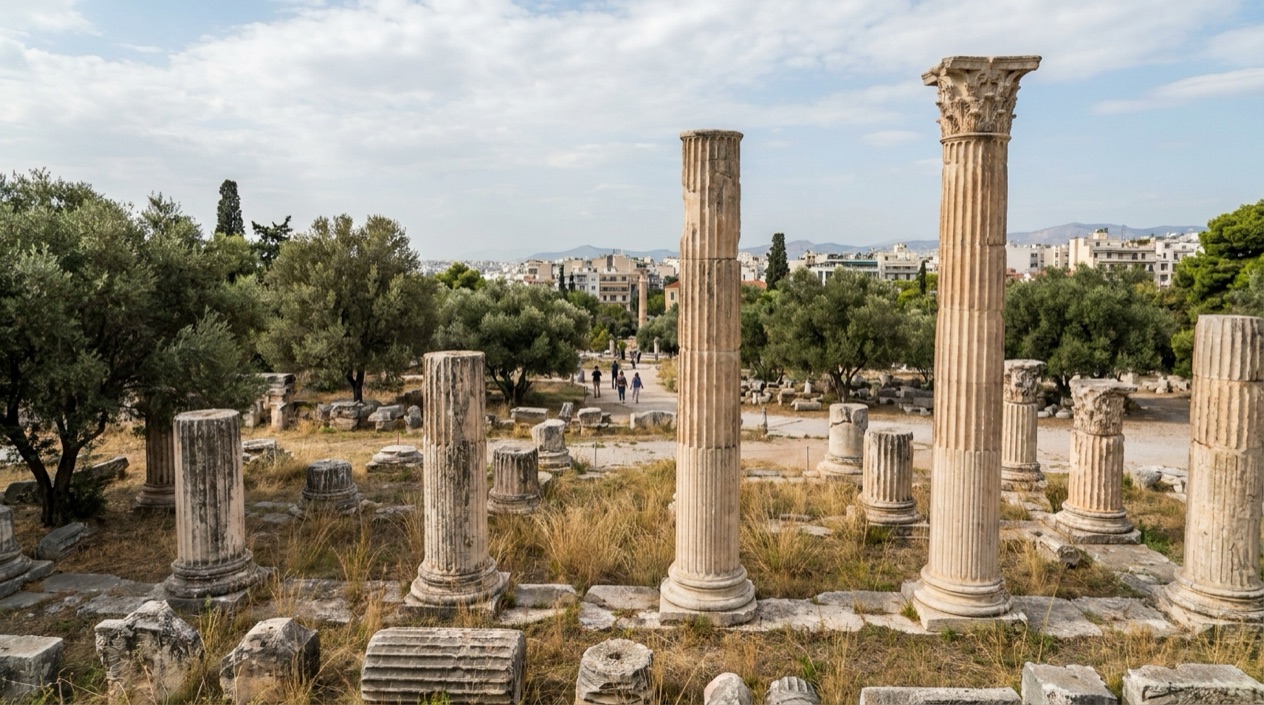
On a wide grassy terrace just southeast of the Acropolis, a cluster of pale marble columns rises so high it barely looks real. These are the remains of the Temple of Olympian Zeus, still counted among the finest ancient monuments in Athens and an easy stop on any day spent around the Acropolis.
What is the Temple of Olympian Zeus?
Also called the Olympieion, this was a colossal temple to Zeus, king of the Olympian gods. It stood about 1,640 feet (500 m) southeast of the Acropolis, on the bank of the River Ilissos. It was the largest temple in Athens and one of the largest anywhere in the ancient world.
The Corinthian columns rise about 57 feet (17.25 m). There were originally 104 of them, set in double rows along the long sides and triple rows across the ends. Fifteen still stand: a group of 13 at the southeast corner and two at the southwest. A sixteenth lies on the ground where a storm toppled it in 1852, its drums spread out in a neat line. Scaffolding currently stands at the southeast corner for stabilization and conservation work, so expect it in some of your photos.
Why did it take so long to build?
The tyrant Peisistratos laid out the first plan in the sixth century BC: an enormous Doric temple in limestone. Work stopped in 510 BC, when his son Hippias was expelled from Athens, and the site sat unfinished for centuries.
In 174 BC the Syrian king Antiochus IV Epiphanes revived the project. His Roman architect, Cossutius, kept the same ground plan, switched the design to the Corinthian order, and replaced the planned limestone with high-quality Pentelic marble. When the king died, work stalled once more. The Roman emperor Hadrian finally completed the temple around 131 AD, more than six centuries after construction began. Inside stood gigantic gold and ivory statues of Zeus and of Hadrian himself.
Its glory was short-lived. The Heruli sacked Athens in 267 AD and damaged the temple. In 425 AD the Byzantine emperor Theodosius II banned worship there and allowed its marble to be taken for churches, houses and other buildings. By the middle of the 15th century, just 21 of the original 104 columns were still standing, and in 1759 a local governor had one of them pulled down and turned into lime for a new mosque.
How much does it cost, and when is it open?
2026 prices: full admission is €20 and reduced admission is €10. Entry is free on March 6, April 18, May 18, the last weekend of September, and October 28.
In winter the site is open from 8 a.m. to 3 p.m., with last entrance at 2:40 p.m. In summer, hours run until 8 p.m., and the last entrance is at 7:30 p.m. The winter schedule covers the colder months and the summer schedule runs from spring through fall, so check which applies to your dates.
The site is closed on January 1, March 25, May 1, Easter Sunday, December 25, and December 26. Over Greek Orthodox Easter, it opens from 12 to 5 p.m. on Good Friday and from 8:30 a.m. to 3:30 p.m. on Holy Saturday.
When is the best time to go?
Go early in the morning. High summer brings large crowds, longer lines, and intense midday heat. In summer, the late closing time opens a second good window in the evening, with fewer people and cooler air.
Spring and early fall tend to be pleasant months to visit, with fewer people around, though weekends can still bring a sizeable crowd. Winter is the quietest season, with short waits, but daylight is brief and the early closing leaves little room in the afternoon. In any season, weekdays are calmer than weekends, so you can photograph the columns without a crowd in the background.
How long should you allow?
A quick stroll among the columns takes 15 to 30 minutes. To read the plaques and linger over the views toward the Acropolis and other Athens landmarks, allow 30 to 60 minutes. There's no time limit once you're inside, but on a winter afternoon arrive well before the last entrance to give yourself that hour.
How do you get to the Temple of Olympian Zeus?
The entrance is on Vassilisis Olgas Avenue. The closest metro stop is Akropoli on Line 2, the Red Line, about a 5-minute walk away. The nearest tram stop is Leoforos Vouliagmenis, and many city bus stops are close by.
If you're staying in the center, walking is the simplest choice. Syntagma Square is about 2,300 feet (700 m) away, roughly 10 minutes on foot.
Most of the site is wheelchair accessible through the main entrance, and a companion to help is recommended. Tactile site plans and Braille brochures in Greek and English are available at the ticket office.
What else is nearby?
The Arch of Hadrian stands at the temple's northeast corner. This marble gateway, about 59 feet (18 m) tall, once marked the line between the old city of Theseus and Hadrian's new city. The area around it is closed to the public during construction work on the redevelopment of Vasilissis Olgas Avenue, so check access before planning a close look.
The Panathenaic Stadium and the Zappeion are also close. The neighborhoods around the Acropolis have an island-like charm, and several highlights are close by: Plaka about 1,160 feet (353 m) away, the Museum of Greek Folk Art about 1,160 feet (355 m), the Acropolis Museum about 1,410 feet (430 m), the Theatre of Dionysus about 1,570 feet (479 m), and Anafiotika about 1,790 feet (546 m).
Sources
- introducingathens.com (https://www.introducingathens.com/temple-of-olympian-zeus), checked October 18, 2026
- temple-of-zeus.com (https://www.temple-of-zeus.com/temple-of-olympian-zeus-opening-hours/), checked October 18, 2026
- penelope.uchicago.edu (https://penelope.uchicago.edu/encyclopaedia_romana/greece/olympieion/olympianzeus.html), checked October 18, 2026
- greeka.com (https://www.greeka.com/attica/athens/sightseeing/athens-olympian-zeus/), checked October 18, 2026
- worldhistory.org (https://www.worldhistory.org/article/815/temple-of-olympian-zeus-athens/), checked October 18, 2026
- Hellenic Ministry of Culture, Odysseus (http://odysseus.culture.gr/h/3/eh355.jsp?obj_id=2384), checked October 15, 2026
- Hellenic Ministry of Culture, Odysseus (http://odysseus.culture.gr/h/3/eh355.jsp?obj_id=2488), checked October 15, 2026
- Hellenic Ministry of Culture, Odysseus (http://odysseus.culture.gr/h/3/eh355.jsp?obj_id=2485), checked October 15, 2026
- Hellenic Ministry of Culture, Odysseus (http://odysseus.culture.gr/h/3/eh355.jsp?obj_id=2402), checked October 15, 2026
- ktelmessinias.gr (https://www.ktelmessinias.gr/en/routes/athens/), checked October 15, 2026
- Hellenic Ministry of Culture, Odysseus (http://odysseus.culture.gr/h/1/eh155.jsp?obj_id=2409), checked October 15, 2026
- Visit Greece (GNTO) (https://www.visitgreece.gr/en/mainland/attica/athens), checked October 15, 2026
To plan your stay
- Best Time to Visit Greece: September and Late May to Early June
- Arachova: Parnassus Mountain Town, Formaela Cheese, Ski Season and Saint George's Day
- American Airlines Flights to Greece: U.S. Cities, Athens Arrivals and Onward Island Flights
- Greece on a Budget: Cash Machines, Cards, Beaches and Ferries