
The Panathenaic Stadium is a horseshoe of white marble in the middle of Athens, and a ticket lets you climb its tiers and run on the track where the first modern Olympic Games opened in 1896. It is a memorable sight in Athens, and one that many visitors pass by. Before you go, check whether the track is open, because resurfacing and events kept visitors off it for long stretches this year.
What is the Panathenaic Stadium?
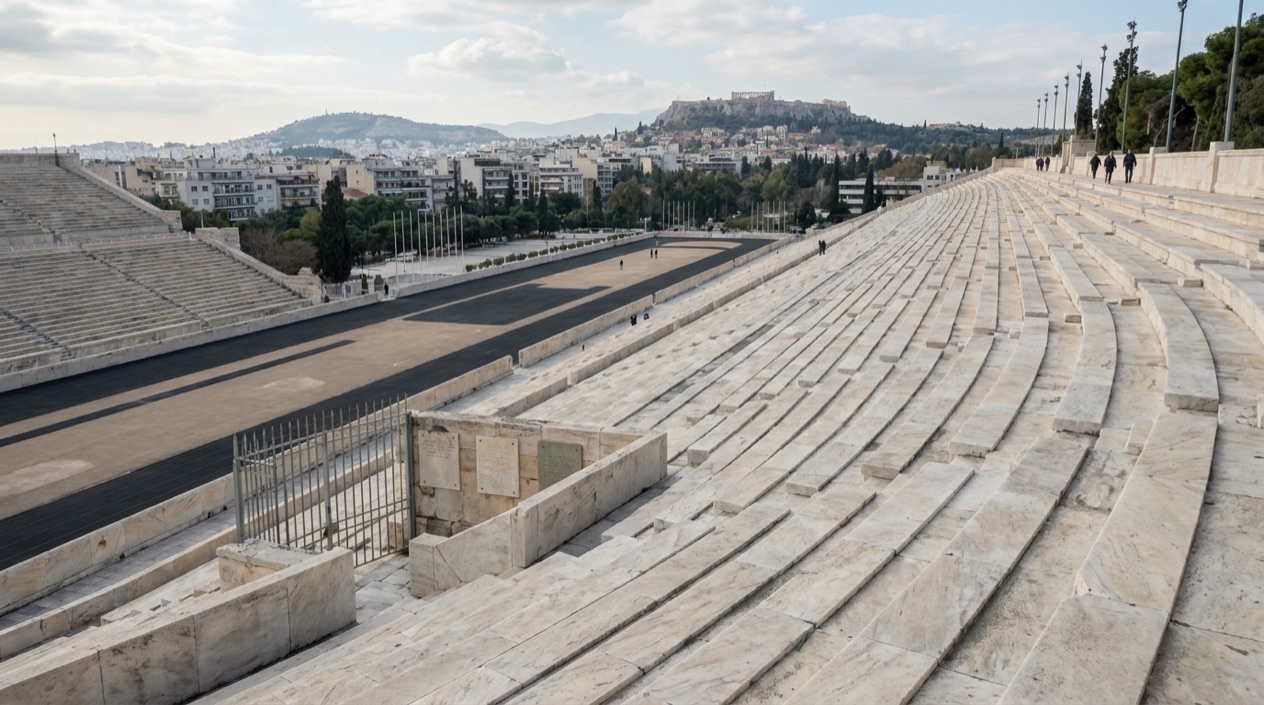
Athenians call it Kallimarmaro, "the beautiful marble one," and the name fits. Rows of pale Pentelic marble, the same stone used for the Parthenon, rise on three sides around a long track and curve at the southern end into the rounded sphendone. In the evening the light shifts the marble from white to gold.
Athletic contests were part of the Panathenaic festival on this ground long before the orator Lycurgus built the first permanent stadium here in the 4th century BC. Spectators then sat on the earthen slopes of two hills. Between 139 and 144 AD, Herodes Atticus rebuilt the stadium in marble and gave it the horseshoe shape you see now. Once the pagan games ended, the stadium fell into neglect, and much of its stone was carted off for other buildings. For the 1896 revival, the Egyptian-Greek merchant Georgios Averoff paid for the reconstruction, and the stands filled again for the first modern Games.
The stadium has kept its Olympic role ever since. The Olympic flame is handed over here, wherever the Games are held, and in 2004 the stadium hosted the archery events and the finish of the men's and women's marathons.
What do you actually see and do inside?
A ticket lets you walk around the stadium, climb the marble seating, pass through the vaulted passage beneath the stands and run onto the field. The audio guide is included with full and reduced tickets.
On the way down, stop for a photo on the podium with the whole stadium behind you.
The marble itself is getting its first systematic cleaning in 120 years, a gentle method using clean water at controlled pressure. The work began at the sphendone and is expected to continue across the stadium through the year.
The track and the stoa are both accessible to visitors with physical disabilities. A canteen to the right of the entrance serves coffee, refreshments and quick snacks. Of the two gift shops, the one in the courtyard needs no ticket. The other sits in the museum area, and its selection runs from books on the stadium's history to keepsakes and children's titles.
Can you run on the track?
Yes, whenever the track is open. Do your running there and not on the stands, because the old marble is slippery and easy to fall on.
The track has been closed to visitors at times for resurfacing and special events. It shut from 26 June through August for resurfacing. The new surface is meant to bring major international meets, Diamond League included, back to the stadium, and events have closed the track before. Check the notices on the stadium's website before you book and again a few days ahead.
How much does it cost, and when is it open?
2026 prices: general admission is €12 and reduced admission is €6. Students get the reduced rate with a student ID. If you qualify for free or reduced entry, bring your documentation with you to the ticket office.
From March through October, the stadium is open from 8 a.m. to 7 p.m. From November through February, hours are 8 a.m. to 5 p.m. In both seasons, last entry is at closing time. Ceremonies and concerts sometimes bring closing time forward, so check the notices before you plan a late visit.
When is the best time to go, and how long should you stay?
Go early. Before the tour groups arrive, the track is empty, the marble catches the low light and the bowl feels almost meditative. Late afternoon is the other good window, when the marble turns gold. In summer, both are also the coolest hours of the day.
Allow 60 to 90 minutes: time on the track and in the seats, the exhibition and the audio guide. Rushing through in half an hour means skipping the museum. On warm days, bring water and sunscreen. In winter, watch your step on the stairs, which can be slippery.
How do you get to the Panathenaic Stadium?
The stadium is right in the middle of the city, about a kilometer on foot from the Syntagma (lines M2 and M3), Akropoli (line M2) and Evangelismos metro stations. Buses 90, 209 and 550 and trolleys 2, 4, 10 and 11 stop at "Stadium" on Vasileos Konstantinou Avenue, right in front of the stadium. Tram stops are close to the stadium, so you can also arrive by tram. Taxis and bicycles work well too, and there is parking at the entrance. The entrance sits on Vasileos Konstantinou Avenue, facing the statue of the Discobolus of Myron.
What should you pair it with nearby?
The National Garden and the Zappeion lie just west of the stadium, and a stroll through the garden toward Syntagma Square takes 30 to 45 minutes. Kolonaki, to the north, has museums, an aristocratic ambience and good coffee. The Museum of Cycladic Art and the Benaki Museum are both there, and the area makes a natural follow-up to a morning visit and a good place for lunch.
The stadium also makes a fine last stop on a day of monuments. Start at the Acropolis, wander the neighborhoods below it, with their island-like charm, and reach the stadium in time for the late light. Budget for that day accordingly: Acropolis admission is separate, at €30 full and €15 reduced, with tickets sold online and at the ticket offices on site.
Sources
- panathenaicstadium.gr (https://www.panathenaicstadium.gr/en/home/), checked October 18, 2026
- panathenaicstadium.gr (https://www.panathenaicstadium.gr/en/visit/), checked October 18, 2026
- greeking.me (https://greeking.me/blog/greek-culture/panathenaic-stadium), checked October 18, 2026
- panathenaicstadium.gr (https://www.panathenaicstadium.gr/en/?id=15), checked October 18, 2026
- athensglance.com (https://athensglance.com/2026/04/16/panathenaic-stadium-athens-the-complete-visitor-guide-to-the-marble-olympic-stadium/), checked October 18, 2026
- Hellenic Ministry of Culture, Odysseus (http://odysseus.culture.gr/h/3/eh355.jsp?obj_id=2384), checked October 15, 2026
- Hellenic Ministry of Culture, Odysseus (http://odysseus.culture.gr/h/3/eh355.jsp?obj_id=2488), checked October 15, 2026
- Hellenic Ministry of Culture, Odysseus (http://odysseus.culture.gr/h/3/eh355.jsp?obj_id=2485), checked October 15, 2026
- Hellenic Ministry of Culture, Odysseus (http://odysseus.culture.gr/h/3/eh355.jsp?obj_id=2402), checked October 15, 2026
- ktelmessinias.gr (https://www.ktelmessinias.gr/en/routes/athens/), checked October 15, 2026
- Hellenic Ministry of Culture, Odysseus (http://odysseus.culture.gr/h/1/eh155.jsp?obj_id=2409), checked October 15, 2026
- Visit Greece (GNTO) (https://www.visitgreece.gr/en/mainland/attica/athens), checked October 15, 2026
To plan your stay
- Best Time to Visit Greece: September and Late May to Early June
- Arachova: Parnassus Mountain Town, Formaela Cheese, Ski Season and Saint George's Day
- American Airlines Flights to Greece: U.S. Cities, Athens Arrivals and Onward Island Flights
- Greece on a Budget: Cash Machines, Cards, Beaches and Ferries