
MANATEE SPRINGS · FLORIDA · THE 12-MONTH VERDICT
Between January and July, the air over this corner of Florida climbs 24.2 degrees, from an average high of 65.9°F to 90.1°F. The spring water does none of that. It has no season, which turns the usual when-to-go question inside out: you are not picking a temperature to swim in, you are picking the air you stand in when you climb back out.
So the calendar decides the rest: how often rain lands on the boardwalk (3.4 days in November against 11.6 in July), how long the light holds, and how cold the walk back to the car is in January, a month averaging 8.5 nights at or below 32°F in the 1991-2020 record.
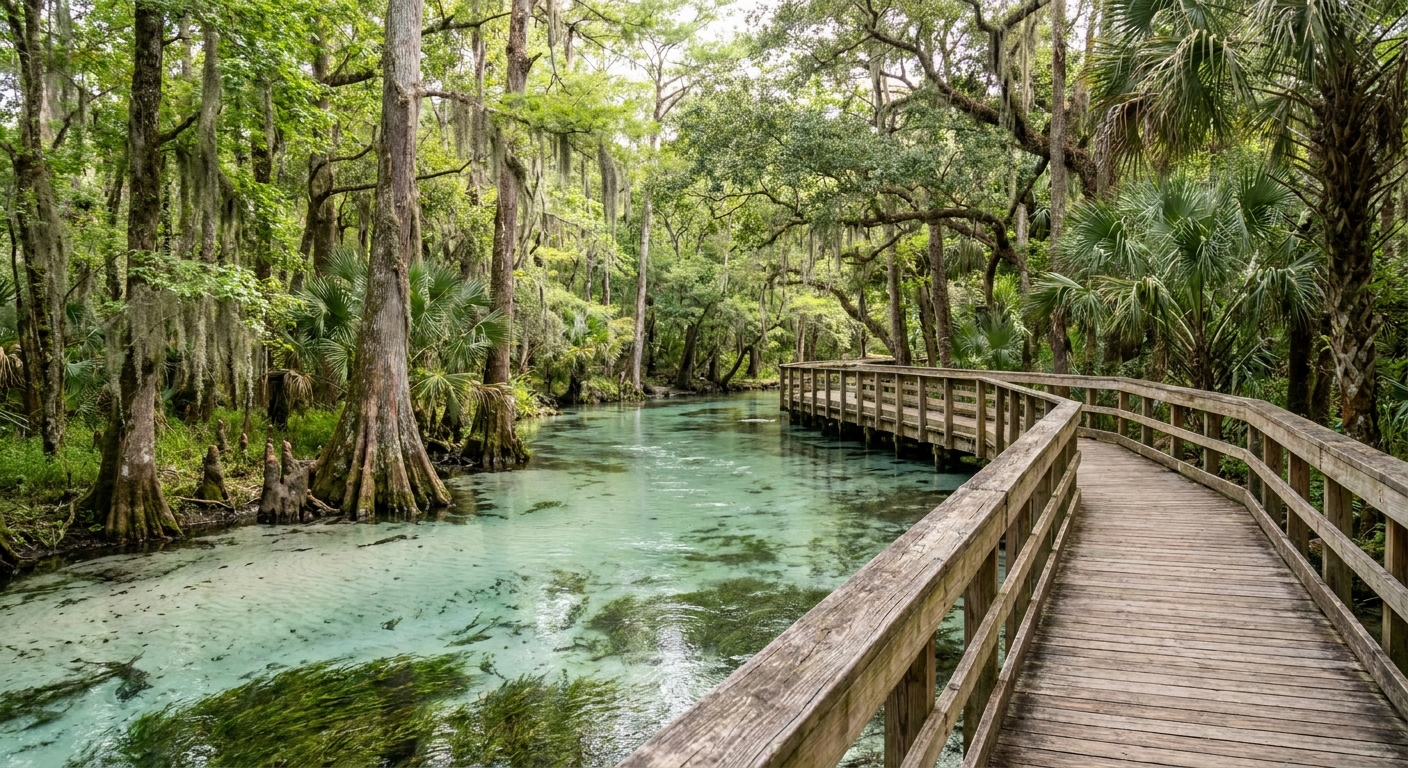
THE YEAR AT A GLANCE · MANATEE SPRINGS
October is the answer: 82.2°F afternoons, 59.9°F nights, 2.23 inches of rain over 3.7 wet days, with water that feels the same as it did in July.
BEST MONTH: OCTOBER · WETTEST: AUGUST · DRIEST: NOVEMBER · AIR NORMALS FROM CROSS CITY AP, ABOUT 44 KM AWAY
Go for: swimming that ignores the calendar, October afternoons at 82.2°F, and the driest stretch of the year in October and November (2.23 and 2.10 inches).
Think twice before: pitching a tent in August (8.10 inches of rain, 11.5 days at 0.10 inch or more, nights at 72.9°F) or planning a dawn swim in January, which averages 8.5 nights at or below 32°F.
Air normals: NOAA NCEI 1991-2020, Cross City AP · Daylight: sunrise-sunset.org · full sources at the end
On this page
- Weather month by monthAll twelve months, highs, lows and rainfall
- The best month to goOctober, at 82.2°F and 2.23 inches
- How hot summer getsJuly and August highs near 90°F
- The quietest weeks of the yearNovember through February
- The month to avoidAugust, and who it hurts
- April, May or OctoberThe shoulder gap in degrees and inches
Daylight swings 3 hours 45 minutes across the year: 14 hours 4 minutes on June 15, 10 hours 19 minutes on December 15. For a day trip, that is the real winter constraint, because February’s 69.6°F afternoons are pleasant and short, with 11 hours 12 minutes of light on the 15th.
Manatee Springs weather month by month: highs, lows and rainfall
| Month | Avg high | Avg low | Rain | Days ≥ 0.10 in |
|---|---|---|---|---|
| January | 65.9°F | 41.8°F | 3.38 in | 5.7 |
| February | 69.6°F | 45.2°F | 2.96 in | 4.8 |
| March | 74.9°F | 49.6°F | 3.53 in | 4.6 |
| April | 80.1°F | 55.0°F | 2.90 in | 4.1 |
| May | 86.7°F | 62.7°F | 2.74 in | 4.7 |
| June | 89.5°F | 70.6°F | 7.00 in | 9.1 |
| July | 90.1°F | 72.5°F | 7.77 in | 11.6 |
| August | 89.9°F | 72.9°F | 8.10 in | 11.5 |
| September | 88.0°F | 69.8°F | 5.82 in | 7.6 |
| October | 82.2°F | 59.9°F | 2.23 in | 3.7 |
| November | 74.4°F | 49.2°F | 2.10 in | 3.4 |
| December | 68.2°F | 44.4°F | 2.95 in | 4.6 |
October through May stays between 2.10 and 3.53 inches of rain a month, on 3.4 to 5.7 days recording at least 0.10 inch. June through September doubles or triples it: 7.00, 7.77, 8.10 and 5.82 inches, spread over 7.6 to 11.6 wet days. That is the whole shape of the year, one dry three-quarters and one soaked quarter.
June lands the rain: 7.00 inches against May’s 2.74, 9.1 wet days against 4.7, and nights rising from 62.7°F to 70.6°F. October takes it all back: 2.23 inches against September’s 5.82, 3.7 wet days against 7.6, and a low that falls 9.9 degrees in a single month. Those two hinges matter more than any individual month’s average.
August punishes everything done out of the water: 8.10 inches of rain, 11.5 days at 0.10 inch or more, 2.4 days at an inch or more, and an average low of 72.9°F, the warmest night of the year. Campers get the wettest ground of the twelve months, 8.10 inches of it. Walkers on the trails get the heat with no evening relief. Swimmers get none of the penalty.
Every figure here comes from NOAA’s 1991-2020 normals for Cross City AP, about 44 km from the spring, and each of them measures the AIR. The spring water itself has no season, and no reading for it was available. The wet-day counts use the American thresholds, 0.10 inch and one inch, not millimeters.
When is the best time to visit Manatee Springs?
October carries the cleanest set of numbers in the year: an average high of 82.2°F, a low of 59.9°F, 2.23 inches of rain across 3.7 wet days, and 11 hours 30 minutes of daylight on the 15th, sunrise at 7:32 a.m. and sunset at 7:02 p.m. local time. Warm enough to swim without persuasion, dry enough to plan a trail in the afternoon.
September runs 5.82 inches over 7.6 wet days with nights at 69.8°F, so October arrives 3.59 inches drier, with 3.9 fewer wet days and a low nearly ten degrees cooler. November is drier still at 2.10 inches, but it gives back 7.8 degrees of afternoon warmth (74.4°F) and 48 minutes of daylight.
The October booking line carries its own conditions. The Atlantic hurricane season runs to November 30, and the statewide calendar sets out that risk window. And the springs are winter refuges for manatees across Florida, which is a different trip on a different date: our manatee guide covers where and when that works.
How hot does Manatee Springs get in summer?
July tops the year at an average high of 90.1°F, with August at 89.9°F and June at 89.5°F. The nights are the underestimated part: 70.6°F in June, 72.5°F in July, 72.9°F in August, so the air never resets between one afternoon and the next. June 15 brings 14 hours 4 minutes of daylight, the longest of the year, and most of it falls in the hot half of the day.
No humidity or dew point series was read for this station, so this guide carries no heat index figure, and a summer afternoon here will feel heavier than 90.1°F alone suggests. Frequency is on the record: 11.6 wet days in July, of which 2.5 deliver an inch or more, matching the statewide wet-season pattern of afternoon storms described in our Florida orientation.
When is Manatee Springs quietest?
November through February is the quiet stretch on the calendar, sitting outside school breaks apart from the week around Christmas and New Year. Daylight is at its shortest through those months: 10 hours 42 minutes on November 15, 10 hours 19 minutes on December 15, 10 hours 30 minutes on January 15. Short days shape a winter visit more than the thermometer does.
The driest months of the year fall inside that window. November’s 2.10 inches over 3.4 wet days is the lowest total of the twelve, and December adds 2.95 inches over 4.6 days. February climbs back to an average high of 69.6°F on 4.8 wet days, which is boardwalk and trail weather rather than swimming weather, and a reasonable trade for families (Florida with kids sets out the rest).
What you give up shows at dawn. January averages 8.5 nights at or below 32°F, December 6.2, February 4.1, and November still records 2.0. With a January average low of 41.8°F, climbing out of the water becomes a decision rather than a reflex, and a towel stops being enough.
Which month should you avoid at Manatee Springs?
August is the hardest month for anyone not in the water: 8.10 inches of rain, 11.5 days at 0.10 inch or more, 2.4 of them at an inch or more, and an average low of 72.9°F. Campers pay the most, on 8.10 inches of rain and nights averaging 72.9°F. Day visitors who came for the trails pay next.
August still holds 13 hours 14 minutes of daylight on the 15th, which is nearly two hours more than October’s 11 hours 30 minutes. Of its 11.5 wet days, 9.1 stay under an inch. And the one variable the month cannot touch is the water, unchanged from January.
Is the shoulder season worth it at Manatee Springs?
April, May, October and November are the shoulder months here, and the gap to midsummer is wide. April’s average high of 80.1°F runs 10.0 degrees below July’s 90.1°F, its 2.90 inches of rain are 4.87 inches below July’s 7.77, and its 4.1 wet days are 7.5 fewer than July’s 11.6.
Cool nights come back with them. April averages 55.0°F after dark and just 0.1 freeze nights, October 59.9°F, against 72.5°F in July. May holds 2.74 inches, third-driest after November and October, while already reaching 86.7°F by day, which is summer swimming without summer rainfall.
Light is what gets billed. April 15 carries 12 hours 57 minutes of daylight, 67 minutes less than June 15. November 15 carries 10 hours 42 minutes, 3 hours 22 minutes less than the June peak. That shortens a day trip from two swims and a trail to one of each, and it ends a November afternoon in the water well before dinner.
October first, April second. October pairs near-summer afternoons (82.2°F) with the year’s second-driest total (2.23 inches), at a cost of 2 hours 34 minutes of daylight against June 15. April keeps 12 hours 57 minutes of light, 55.0°F nights and 2.90 inches of rain. Take November (2.10 inches, 3.4 wet days) only if 74.4°F afternoons suit the way you plan to use the water.
The last word
One month has stayed off the podium here: March, which still averages 2.0 nights at or below 32°F and 3.53 inches of rain, the wettest total of the cool half of the year. Book the October week instead, and pack for both ends of the day, 59.9°F at sunrise and 82.2°F by mid-afternoon, knowing the swim itself will feel exactly like a July one.
Sources & data for this guide
- Monthly air normals 1991-2020, all twelve months · NOAA NCEI, station USW00012833, Cross City AP, FL US, about 44 km from the spring · checked Sep 13, 2026
- Wet-day counts at the 0.10 inch and 1 inch thresholds · NOAA NCEI, same station and period · checked Sep 13, 2026
- Nights at or below 32°F, November through April · NOAA NCEI, same station and period · checked Sep 13, 2026
- Daylight length, sunrise and sunset on the 15th of each month · sunrise-sunset.org, converted to local time · checked Sep 13, 2026
- Atlantic hurricane season dates · NOAA National Hurricane Center, via our Florida calendar · checked Sep 13, 2026
- Editorial admissions: no humidity, dew point or heat index series was read for this station. No water temperature reading for the spring itself was available for this guide. The quiet months are stated from the school and holiday calendar, since no crowd or price series was used.