
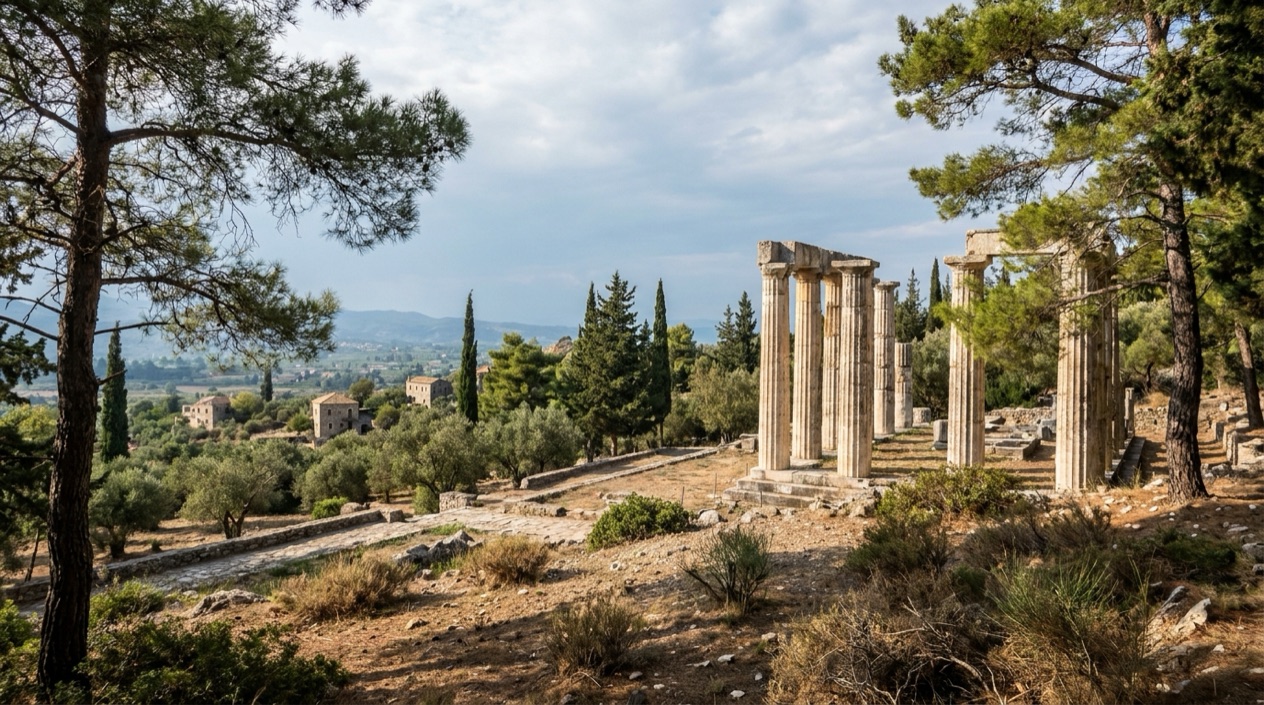
Mystras is a medieval hill city above Sparta, and it's one of the best places in the Peloponnese to walk through real Byzantine history. Stone paths zigzag up a steep slope past painted churches, a palace and a castle, with the whole Laconian plain spread out below. The climb is steep, and the views and churches along the way make the effort feel worthwhile.
What is Mystras, exactly?
Picture a whole town draped down a hillside, with a castle on the summit and the slopes of Mount Taygetus behind it. That's Mystras. Churches, monasteries, mansions and a big palace step down the terraces, linked by narrow stone paths. The churches and some mansions survive well, while many other buildings are ruins.
A Frankish prince, William II of Villehardouin, built the fortress in 1249. The Byzantines took it over in 1262, and from the middle of the 14th century it was the seat of the Despotate of the Morea, a semi-autonomous province ruled by despots. In its last two centuries as a Byzantine city, Mystras became a center of art, philosophy and learning. Scholars came here to write, teach and rescue ancient texts, among them the philosopher Georgios Gemistos Plethon, who helped bring Plato's ideas back to Western Europe. The town earned the nickname "Wonder of the Morea." Its best-known despot, Constantine XI, left Mystras to become the last Byzantine emperor.
The Ottomans took the city in 1460, and the Venetians held it from 1687 to 1715. After Mystras joined the 1770 uprising against Ottoman rule, it was badly destroyed. From 1834 people gradually moved down to the new town of Sparta, and the last residents left in 1953, when the Greek state expropriated the area. Today the nuns of the Pantanassa Monastery are the ones who still live on the site. Mystras is a UNESCO World Heritage Site, and it feels like a complete medieval city left where it stood.
What should you see at Mystras?
The churches come first. Many follow a "mixed" plan that was born here and is now called the Mystras type: a basilica on the ground floor with a domed cross-in-square church above it. Inside, frescoes survive in various states of wear.
Pantanassa
Built in 1428, this is considered the finest surviving church on the site. Its five-domed church has well-preserved frescoes and a richly decorated exterior apse. The convent is still home to a community of nuns, so keep your voice down and give them space. With luck, they may offer you homemade sweets.
Agios Dimitrios (the Metropolis)
Near the lower entrance, this was the city's cathedral. Tradition holds that Constantine XI was crowned emperor here in 1449. The frescoes are colorful, though worn in places, and a carved double-headed eagle is set into the floor. Next door, the small archaeological museum shows sculptures, icons and fragments from other churches on the site.
Hodegetria and Agioi Theodoroi
The Hodegetria, built in the early 14th century, holds frescoes from that period, and Despot Theodoros I Palaiologos is buried in the north-west chapel of its narthex. Look for the "Descent into Hell" fresco. Agioi Theodoroi dates to the 1290s, with a large dome and fragmentary frescoes of warrior saints.
Agia Sophia and Perivleptos
Agia Sophia dates from the mid-14th century, and the Ottomans later used it as a mosque. The Perivleptos clings to a rock face near the southeastern walls, and its vivid frescoes include scenes from the Life of the Virgin.
The Palace of the Despots and the castle
This is the most important secular building to survive from late Byzantine Greece. It has two large wings and a grand hall thought to have been the throne room. Nearby, mansions such as the Laskaris house show how the Byzantine elite lived. Above it all, the castle sits on the summit, and its panorama over the plain and the Taygetus mountains is among the finest in the Peloponnese.
How much does Mystras cost, and when is it open?
2026 prices: full admission is €20 and the reduced ticket is €10. Entry is free on 6 March, 18 April, 18 May, the last weekend of September and 28 October.
From April through October the gates open at 8 a.m. They close at 8 p.m. from April through August, then progressively earlier: 7:30 p.m. in the first half of September, 7 p.m. in the second half, 6:30 p.m. in the first half of October and 6 p.m. from 16 to 31 October. In winter, from 1 November through 31 March, the site is open 8:30 a.m. to 3:30 p.m. It's closed on New Year's Day, March 25, May 1, Easter Sunday and both days of Christmas.
During the summer schedule, the palace doesn't open until 11 a.m. on Tuesdays. There are two ticket offices, one near the main entrance and one at the palace, with the same hours. Visitors with disabilities can be driven to the palace in a specially adapted passenger vehicle, Monday to Friday from 8 a.m. to 3 p.m., by prior arrangement with the Ephorate of Antiquities of Lakonia.
When is the best time to visit, and how long should you allow?
Summer can bring crowds, and the heat makes the climb harder, so arriving when the gate opens is a good idea. In winter the 3:30 p.m. closing leaves little room for a late start.
Allow about three hours to see the main churches, the palace and the castle. Many visitors follow a circular route through the site. Tickets are valid at both the lower main gate and the upper gate by the castle, so you can start at either end. Tour groups usually begin at the top and walk down to meet their bus below.
What should you wear and bring?
Good shoes matter most, ideally with solid tread and ankle support. The paths are rocky and steep, many stone stairs are in poor repair, and some cobbled lanes simply vanish. Expect to climb about 820 feet (250 m) if you want to take in the whole site.
Bring water, especially in summer, and a site map. Google Maps also has a detailed presentation of the site, with the monuments identified and information on each. Visitors mention that the toilets are at the lower entrance gate, so it can be handy to stop there before you start exploring.
If the full climb isn't for you, the lower levels still hold some lovely churches. Visitors with limited mobility often skip the citadel. Another option is to see the lower town from the lower gate, then drive up and enter again at the upper gate.
How do you get to Mystras?
Mystras sits about 4 miles (6 to 4.3 miles (7 km)) west of Sparta along the EO84 road, and Sparta is your base. Sparta lies 153 miles (248 km) southwest of Athens and 36 miles (58 km) south of Tripolis, roughly 2.5 to 3 hours by car from Athens on modern highways. Intercity KTEL buses link Sparta with Athens, Patra, Kalamata and nearby towns. From Athens, where buses leave from the Kifissos terminal, the ride takes about 3.5 to 4 hours, and from Patra about 4 to 4.5 hours.
Local buses to Mystras leave from in front of Sparta's Archaeological Museum. They're infrequent, so ask at the tourist information office about timetables, especially the last return. The final stop is in a restaurant parking lot, a 10-minute walk downhill from the ticket office. A taxi is the easy fallback. If you drive, there's a small car park at the lower gate, next to the Xenia Taverna, and another at the top. Arrive early or late to find a spot in the lower lot.
What can you pair with Mystras, and where should you stay?
Sparta, just down the road, works for lunch or a museum stop. Its archaeological museum costs €10, or €5 reduced. The Archaeological Museum of Sparta is open 8:30 a.m. to 3:30 p.m. and closed on Tuesdays. For questions, call +30 27310 28575 or email [email protected]. For a meal closer to the ruins, the modern village of Mystras has tavernas, and Chromata is a local favorite with good views.
Monemvasia, about an hour and a half away, makes a natural next stop. Several tours combine Mystras with Sparta, including private day trips from Athens, and others run half-day trips from Monemvasia.
To sleep near the ruins, you can choose from Paleologio Camping, the Mazaraki Guesthouse in Pikoulianika village, or the 3-star Byzantion Hotel. Staying this close lets you reach the gate at opening time, ahead of the heat and the tour buses.
Sources
- UNESCO World Heritage Centre (https://whc.unesco.org/en/list/511/), checked October 18, 2026
- visitpeloponnese.com (https://visitpeloponnese.com/en/prdct/city-state-mystras), checked October 18, 2026
- travellingtrekker.com (https://www.travellingtrekker.com/post/mystras-greece-travel-guide), checked October 18, 2026
- Wikivoyage (https://en.wikivoyage.org/wiki/Mystras), checked October 18, 2026
- wanderingwagars.com (https://wanderingwagars.com/guide-to-mystras-greece/), checked October 18, 2026
- Hellenic Ministry of Culture, Odysseus (http://odysseus.culture.gr/h/3/eh355.jsp?obj_id=2397), checked October 15, 2026
- Hellenic Ministry of Culture, Odysseus (http://odysseus.culture.gr/h/1/eh155.jsp?obj_id=3305), checked October 18, 2026
- Visit Greece (GNTO) (https://www.visitgreece.gr/mainland/peloponnese/sparta), checked October 18, 2026
To plan your stay
- Best Time to Visit Greece: September and Late May to Early June
- Arachova: Parnassus Mountain Town, Formaela Cheese, Ski Season and Saint George's Day
- American Airlines Flights to Greece: U.S. Cities, Athens Arrivals and Onward Island Flights
- Greece on a Budget: Cash Machines, Cards, Beaches and Ferries