
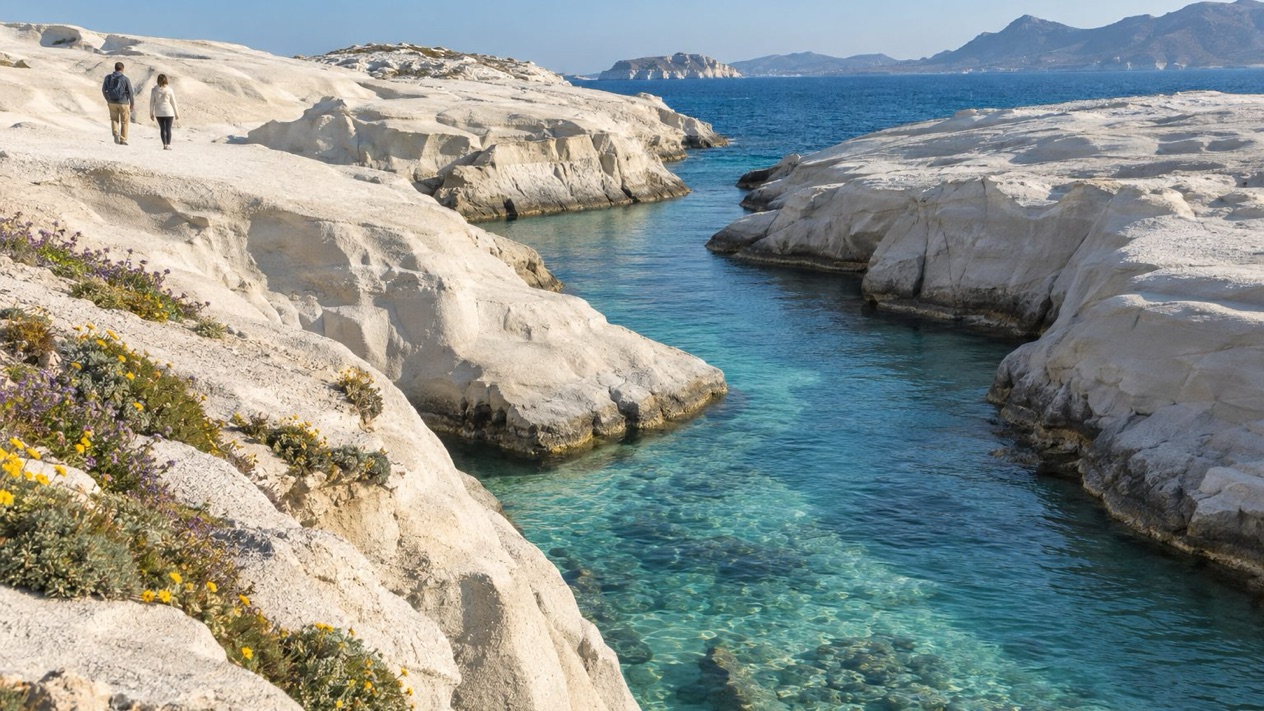
Milos is a volcanic island in the Cyclades, the island group in the Aegean Sea. Coming from the States, you land in Athens first. From there you either take a ferry from Piraeus, Athens' main port, or catch a domestic flight of about 40 minutes. Fly if you are short on time or stepping off a long-haul flight. Take the ferry if you are traveling on a budget, carrying a lot of luggage or hopping between islands.
How do you get to Milos from Athens?
There are two main routes. Ferries leave from Piraeus and dock at Adamas, the island's main port. Flights leave from Athens International Airport (Eleftherios Venizelos) and land at Milos Island National Airport, a small single-terminal airport that usually handles domestic flights, mostly from Athens.
For a splurge, a helicopter transfer from Athens is also available.
Is it better to take the ferry or fly to Milos?
The flight lasts about 40 minutes, but that figure covers just the time in the air, so allow extra time for getting to and through the airport. If you start in central Athens, the ride out to the airport, check-in and the wait shrink the gap with the ferry considerably.
The math flips if you are landing in Athens on a long flight from the U.S. You stay in the airport and connect to the small plane. There is no taxi to the port, no waiting on the dock and no boat ride after a night of travel. Milos Airport is tiny and quick to get through, with a single baggage carousel. Booking the whole trip on one ticket can make the connection easier. If your tickets are separate, allow at least 2.5 hours in Athens, because you will need to collect your bags and check them in again.
Flying has its downsides. Olympic Air (owned by Aegean Airlines) and Sky Express operate the route on small turboprops, so seats are limited. There are more flights in summer, but seats still sell out. Fares get pricey if you book late, and baggage limits are stricter than on a ferry.
The ferry is generally cheaper, and it is more scenic and more relaxed about luggage. It is also the option that lets you bring your own vehicle along. The trade-offs are time and reliability. Summer sailings sell out, and wind can delay the smaller fast boats. Transportation strikes in Greece can also disrupt seaports, airports, taxis and public transit, whichever way you travel.
Prices for both vary with the season and the seat you choose, and they climb in summer, so compare the two before you book.
- Long-haul from the U.S.: connect at Athens Airport and fly to Milos. It is the least stressful route.
- Family with luggage: take the ferry for the more generous baggage allowance and the outdoor deck seating. If you would rather skip the transfer to the port, the flight still works, but check the baggage rules first.
- Tight budget: take the ferry, and choose a slower boat if you can live with the extra hours.
- Island hopping: the ferry, no contest.
How long is the ferry to Milos?
The crossing from Piraeus takes anywhere from about 2.5 to 7 hours, depending on the boat and the weather. The distance is roughly 84 nautical miles (about 96 miles, or 155 km).
High-speed ferry
Seajets runs the fastest crossing, and its Olympic Champion Jet reaches Milos in just over 2.5 hours. Fast boats have airplane-style seats, and you usually can't go out on deck. They cost more than the slow boats, though usually still less than a summer flight.
Conventional ferry
Slower boats take around 4 to 7 hours. In return you get open-air seating on deck, a steadier ride when the sea turns rough and a lower fare. They are the better pick if you get seasick easily. Some sail in the evening, which is handy if you land in Athens late in the day.
The operators on the Piraeus route include Seajets, Aegean Sea Lines, Minoan Lines, ANEK Lines, Blue Star Ferries and Fast Ferries. A weekly conventional ferry also leaves from Lavrio, near Athens Airport. It takes about 15 hours, so it tends to suit travelers who are staying close to the airport.
Frequency follows the season. In July and August there are several sailings a day. By October service thins out fast, and in winter there are far fewer sailings.
How do you get to Piraeus from Athens?
From central Athens, you have three good options:
- Metro Line 1 (the green line) runs straight to Piraeus Station and is the best way to dodge traffic.
- A taxi costs more but takes you right to the port, which helps if you have lots of luggage. Expect roughly 30 minutes, longer in traffic.
- Buses 040 (from Syntagma) and 049 (from Omonia) also go to Piraeus, but traffic can slow them down.
From the airport, the Blue Line 3 metro runs directly to Piraeus. It has no dedicated luggage space, though, which matters if you are carrying big bags. The X96 bus runs around the clock between the airport and Piraeus and takes an hour or more. A taxi takes about an hour in daytime traffic. If you land the night before a morning sailing, spend that night in Piraeus. A hotel within a short walk of the port makes for a calm start to the day.
The port is huge, so give yourself time to find your gate, usually E6, E7 or E9. Aim to arrive 30 to 45 minutes before departure, or up to an hour if you are on foot. The terminals have Wi-Fi, ATMs, food, taxis, a ticket office and accessibility facilities.
How do you get to Milos from other islands?
If you are already island hopping, take the ferry. There are no flights between Milos and the other Cycladic airports, so flying would mean going back through Athens.
Ferries link Milos with Santorini, Mykonos, Paros, Naxos, Serifos, Sifnos and Crete. Seajets runs fast boats on several of these routes, and slower, cheaper boats run on some of them. Some routes run just a few days a week, and from Crete there are sailings two days a week. Check your dates before you build an itinerary around a connection.
How far ahead should you book the ferry or flight to Milos?
Book early for July and August, when boats and planes fill up quickly. For flights, a month or more ahead is a sensible minimum. For summer ferries, two to three months ahead is safer. Fares also tend to be higher when you buy on the day.
Online booking platforms sell tickets for several operators at once, and many companies send e-tickets you can show on your phone. Minoan Lines also sells Piraeus to Milos tickets directly, and you can call the company at 2810-399-899 for help.
If you plan to bring a car, check that your operator carries vehicles. Minoan Lines asks that a vehicle be delivered to the port at least 2 hours before departure, with its key.
What do U.S. travelers need to enter Greece?
U.S. citizens can visit Greece without a visa for up to 90 days for tourism. Your passport should have at least three months of validity beyond your planned departure date. If asked, you must be able to show proof of sufficient funds and a return ticket or other evidence that you will leave.
How do you get from the port or airport to your hotel?
Cafes, restaurants, hotels and shops are a short walk from the port at Adamas. Pollonia, a fishing village in the northeast, is the island's second port, but it mainly serves fishing boats and water taxis to Kimolos and Glaronisia.
Car rental desks mostly close around 10pm and taxis can be hard to find late at night, so consider booking a room in Adamas for the first night or arranging a pickup in advance.
The airport sits about 3 miles (5 km) southeast of Adamas, roughly a 10-minute drive. Plaka, Pollonia and Trypiti are 15 to 25 minutes away by road. Uber and Bolt don't operate on the island, and just a small number of taxis meet each flight, so they are taken within minutes. Book a transfer, hotel pickup or rental car before you land.
Most visitors rent a car, ATV or motorcycle, either at the port or airport or through their hotel, and a car is close to essential. Buses start from the main square in Adamas, about 500 feet (150 m) from the port. If you plan to rely on them, Adamas is the best place to stay. The two core lines run year-round, linking Adamas with Plaka and Trypiti and with Pollonia. The beach routes run in summer. The bus also skips anything on a dirt road, and many of the best spots on Milos are reached by dirt road.
ATVs handle bumpy roads well, but you ride in full sun and dust, and they can't carry big suitcases. Plaka's lanes are extremely narrow, so park just outside the village. Automatics are scarce because manual cars are the norm, so reserve one early if you need it. Greek law requires you to carry a valid U.S. license, and insurance companies may require an international driver’s permit. Motorcyclists must wear a helmet. Thieves target rental cars, so it's wise to take passports and valuables with you instead of leaving them inside.
Check your sailing or flight again the day before you travel, since weather and strikes can change the schedule.
Sources
- dailytoursmilos.gr (https://dailytoursmilos.gr/how-to-get-from-athens-to-milos/), checked October 18, 2026
- omio.com (https://www.omio.com/ferries/athens/milos-h1gf6), checked October 18, 2026
- postcardsbyhannah.com (https://postcardsbyhannah.com/how-to-get-to-milos/), checked October 18, 2026
- tavernatravels.com (https://tavernatravels.com/athens-to-milos-greece/), checked October 18, 2026
- greeka.com (https://www.greeka.com/cyclades/milos/travel/), checked October 18, 2026
- U.S. Department of State (https://travel.state.gov/content/travel/en/international-travel/International-Travel-Country-Information-Pages/Greece.html), checked October 15, 2026
- U.S. Department of State (https://travel.state.gov/content/tsg_aem/us/en/home/international-travel/travel-advisories/destination.grc.html), checked October 15, 2026
- minoan.gr (https://www.minoan.gr/en), checked October 15, 2026
- Visit Greece (GNTO) (https://www.visitgreece.gr/en/islands/cyclades/milos), checked October 15, 2026