
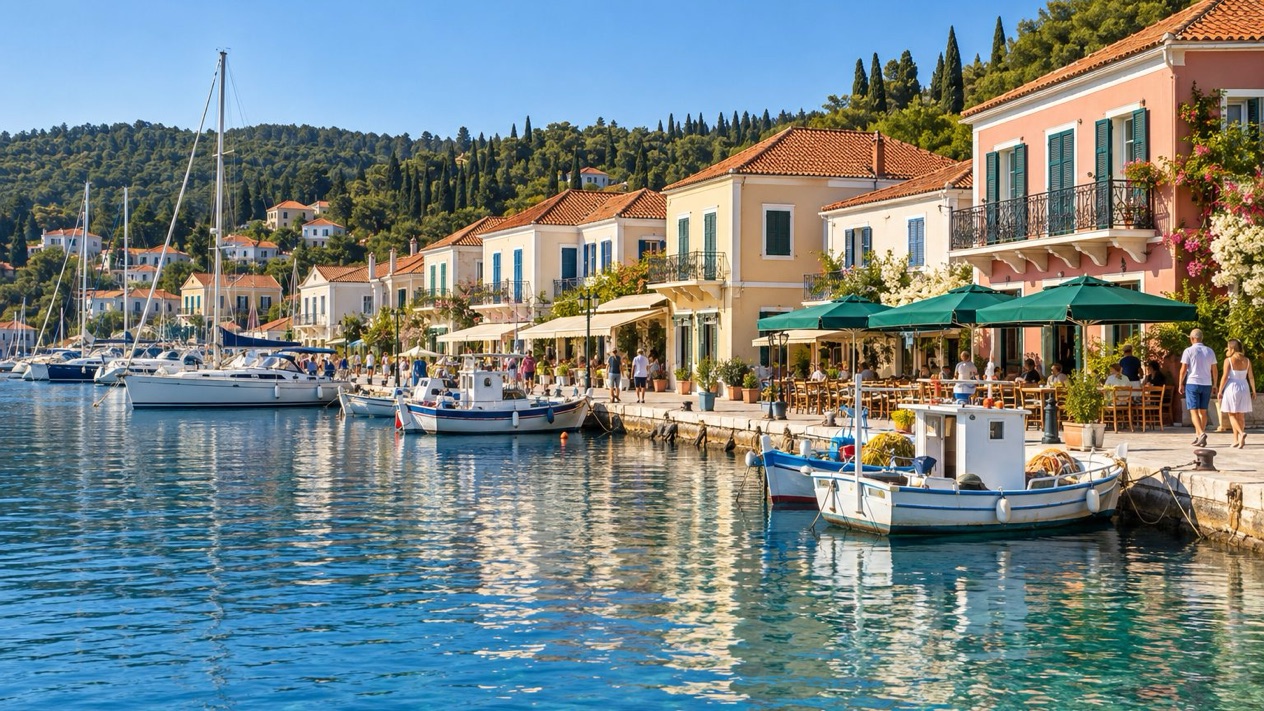
Expect sea caves, a fir-covered mountain, Venetian castles, fishing villages and more than 60 beaches, many of them reached by roads full of hairpin turns.
Where should you stay in Kefalonia?
The island covers about 300 square miles (781 square kilometers) and distances are long, so your base shapes your trip. Choose between the capital, a beach resort or a quiet village, depending on how much you plan to drive.
Argostoli
The capital is cosmopolitan and active, set on a harbor lined with restaurants and shops. The 1953 earthquake ended the whitewashed look, so expect a pastel, mid-century rebuild that still has plenty of charm. Pick Argostoli if you want the widest choice of restaurants and bars, the best bus connections and an easy stay without a car. The trade-off is that it is busier, and the beaches are a walk, short drive or bus ride away.
Lassi
Lassi sits just south of Argostoli, so close that the two blur together, and a taxi between them takes five minutes. It is one of the island's older resorts, with golden beaches, calm clear water and west-coast sunsets. It is also the closest resort to the airport, a transfer of 10 minutes or less. Lassi suits a beach holiday with a town next door, but it gets crowded in summer and feels more like a generic Mediterranean resort than a Greek village.
Fiskardo
Fiskardo is the romantic pick and one of the prettiest villages on the island. It escaped the 1953 earthquake, so its Venetian-style buildings still line a harbor full of yachts and fishing boats. Mornings are quiet, with locals buying bread and walking dogs. By midday the boat crowd arrives for long lunches and boutique shopping, and at night the bars warm up while calm water laps near the dinner tables. It suits couples and island hoppers, since ferries leave from here for Lefkada. The catch: the airport is more than an hour away, you will want a car, and the roads are winding and steep.
Assos
Assos is a quieter alternative to Fiskardo, a tiny fishing village said to have only about 100 residents. The road in is usually narrow, with hairpin turns lined by cypress trees and views worth pulling over for. Small coves with calm water and waterside tavernas wait at the bottom, with a Venetian fortress looking over the bay from across the way.
Katelios and the south
Katelios is a former fishing village that still feels Greek, with a gentle sandy beach, beach bars and tavernas. It suits families who want calm, and it sits about 45 minutes from the airport. Most of the key sights are a long drive away and buses are limited, so rent a car if you plan to explore. Skala has sandy beaches, lively evenings and plenty of amenities, and it is a good choice for first-timers. Poros was a busy resort in the 1980s and '90s and is now a quieter base for couples and families.
The Paliki Peninsula
The peninsula in the west is quieter and less developed, with fewer hotels and restaurants and a more traditional feel. It suits peace-seekers with a car. Lixouri, its main town, is a peaceful place with traditional architecture, tavernas and bars playing live music.
What are the best things to do in Kefalonia?
The island's highlights are a cave lake, a mountain summit, two castles and a walkable capital.
Start at Melissani, near the village of Karavomylos, where a boat glides across a cave lake under a circular opening in the ceiling. Go around midday, when the sun is high and the water glows blue and green. Bring a long-sleeved layer for the second, darker part of the cave, which is cold. The boats move fast and crowds are common, so have your camera ready. Drogarati Cave, with its stalactites and stalagmites, makes a good second cave. Both have set opening hours that change with the season, so check before you go.
Mount Ainos is a national park, and the endemic Cephalonian fir grows on its peaks. A paved but winding road with some blind hairpins takes you most of the way up. Park below the towers, follow the gravel track to the left past an information plaque, then take the path on the right up through the woods. The summit is 20 to 30 minutes on foot and ends in a rock scramble, so wear sneakers or closed-toe shoes. If fog hangs at the top, wait a bit: on a clear day you see the whole island, plus Zakynthos and Ithaca.
Castles reward the effort. The Venetians built Assos Fortress in the 16th century, and the walk up takes about 30 to 40 minutes along a trail shaded by cypress and pine, with views the whole way. St. George Castle is more ruin than castle, but it sits on a hilltop with sweeping views over the island, and lunch at its base is a pleasure.
In Argostoli, head to the docks early in the morning, when fishermen feed scraps to the turtles. Walk the De Bosset Bridge, a stone bridge across the bay that takes about 20 minutes to cross. Climb the bell tower on Campana Square for views, and stroll out to the Saint Theodore Lighthouse on a sunny afternoon to see the nearby sinkholes. The Corgialenios Museum of Folklore and Cultural History is on the ground floor of the Corgialenios Library at 12 Zervou Street. On May 18, museums and archaeological sites across the island open free of charge.
Divers and snorkelers can look for ancient amphorae resting on the seabed near Agia Efimia and Skala.
Wine lovers should stop at Gentilini Winery, a few minutes from the airport and Argostoli, so it fits almost any day or your drive to a departing flight. Tastings are cheap by American standards, priced by flights of three, five or seven wines, and an add-on tour comes with a board of cheese, bread, olive oil and tomato. Look for Robola, the island's white wine, made from vines grown on the slopes of Mount Ainos.
What are the best beaches in Kefalonia?
Kefalonia has more than 60 beaches, from big sandy strands with every amenity to secluded coves, and many are reached by a winding drive down.
Myrtos
Myrtos is the island's famous beach, seen in the movie Captain Corelli's Mandolin. White pebbles meet water that swirls in shades of blue and aqua, changing pattern and color through the day, under towering cliffs. Stop at the viewpoint above first, because the view from there is the real show. The road down is a narrow zigzag with blind spots, so drive slowly and honk at corners. There is no natural shade, so bring an umbrella, and arrive early for easy parking and a sun lounger.
Antisamos
About 3 miles (5 km) east of Sami, at the bottom of another hairpin road, Antisamos has shallow aqua water that drops sharply to deep blue. This pebble beach has sun loungers, umbrellas and beach bars, and it easily fills a whole afternoon.
Fteri
Fteri is the adventurer's beach, and the effort pays off. Look for a sign on the left about three minutes along the gravel road, which marks the start of the hike and a tiny parking spot with room for just a few cars; if you keep following your map app, you can easily drive past it. The hike down takes about an hour through forest and over rocks, and the path gets confusing about 10 minutes in, so follow the green spray paint on the rocks. Wear proper shoes and long pants, since the bushes scratch. At the bottom, the water falls away in shades of turquoise and deep blue, startlingly clear.
Petani
Petani sits on the Paliki Peninsula under big limestone cliffs, with white sand and gravel, sun beds and tavernas. The winding road down to the beach has lovely views. Waves can get rough in bad weather, so take care.
Makris Gialos
Makris Gialos, near Lassi, is a large sandy beach with shallow, clear water and one of the busiest scenes on the island. It has sun loungers, umbrellas, lifeguards, a beach bar and water sports. Parking is on an unpaved incline, easier on an ATV than in a car.
Kalamia and Gradakia
For a quieter swim near Argostoli, try Kalamia, a small rocky beach about a 30-minute walk from the center, with a little bar, a sandy patch and rock arches to swim under. Gradakia is a 15-minute walk farther, a sandy beach with a bar, sun beds, showers and changing rooms.
Xi
Xi, on the Paliki Peninsula, has red sand and clay cliffs. Its shallow, wind-protected water is good for kids, and it has loungers, restaurants and cafes. Smear on the grey clay from the beach for a homemade spa treatment.
Foki
Foki is a small, wind-protected cove five minutes by car from Fiskardo, with shallow emerald water and tavernas nearby. There are no sun loungers, but olive and cypress trees provide shade.
What should you eat in Kefalonia?
Kefalonian cooking blends Greek and Italian traditions, built on fresh fish, organic vegetables and wild herbs. Try mpakaliaropita, a cod pie, and kouneli stifado, a rabbit and onion stew. Skordalia is a garlic purée, tsigaridia is wild greens with rice, and mantoles are caramelized almonds with cinnamon. At bakeries, look for the island's meat pie, a local favorite.
In Argostoli, have a frappe by the water at Kalafatis, the island's oldest restaurant, and cocktails at De Bosset's. Fiskardo's harbor is lined with fish tavernas; locals and visitors rave about the lamb kleftiko at Elli's, and Theodora's Cafe has a top floor with great views for drinks. Below St. George Castle, order the octopus in vinegar at Il Borgo. In Katelios, any beachfront taverna serves very fresh food, and The Morning Star does a good watermelon and feta salad. On the Paliki Peninsula, Taverna Gialos on Atheras Beach is the place for the catch of the day.
How many days do you need in Kefalonia?
Five days covers the highlights without rushing. Base yourself in Argostoli or Lassi, which makes a handy starting point for the island, and rent a car, because distances are long; Myrtos, for example, is about 19 miles (30 km) from Argostoli.
Day 1: Argostoli and its beaches
See the turtles at the docks early, then cross the De Bosset Bridge and wander the harbor. Spend the afternoon at Kalamia and Gradakia, and finish with dinner in town and a frappe or cocktail by the water.
Day 2: Myrtos, Assos and Fiskardo
Reach the Myrtos viewpoint early, then drop down to the beach before the crowds. Continue about 6 miles (10 km) north to Assos for a swim and a taverna lunch, then walk up to the fortress; check its opening times before you climb, because it can be closed when you arrive. End in Fiskardo for a drink on the harbor and dinner as the bars come alive.
Day 3: Melissani and Antisamos
Visit Melissani at midday for the best color, then drive to Antisamos for an afternoon of swimming. Add Drogarati Cave if you have the energy, and eat in Sami, where cocktail bars and restaurants line the waterfront.
Day 4: Fteri and Petani
Hike to Fteri in the morning, while you are fresh. Then head to Petani for a late taverna lunch and a swim. Coming back, the local ferry from Lixouri to Argostoli saves the long drive around the bay.
Day 5: Mount Ainos, St. George Castle and wine
Drive up Mount Ainos in the morning and walk to the summit. Come down for lunch at Il Borgo and explore St. George Castle, then finish with a relaxed tasting at Gentilini Winery.
How do you get to Kefalonia and around?
Most visitors fly in, though ferries from the mainland work well if you are driving.
By air, Kefalonia Airport (EFL) has direct flights from major European cities in summer, with connections via Athens all year. The main airlines are Jet2.com, easyJet and Sky Express.
By sea, the best routes from mainland Greece leave from Patras or Kyllini, both about three hours from Athens by car or bus. The Kyllini to Poros ferry runs year-round and takes about 1.5 hours. Ferries from Patras to Sami take about 3 hours and run mainly in peak season. In 2026, the one-way fare from Kyllini to Poros is 14.50 euros per adult, 8.00 euros for children 5 to 10, and 45.00 euros per car. From Patras to Sami, the fares are 15.40 euros, 7.70 euros and 52.90 euros. Children under 5 ride free on both routes, and prices can change without notice. For island hopping, boats leave Fiskardo for Lefkada (in summer) and Ithaca, Pessada for Zakynthos, and Sami for Ithaca, where the 2026 one-way fare to Pisaetos is 4.50 euros per adult.
On the island, a rental car gives you real freedom, since places are far apart; Sami alone is 15 miles (24 km) from Argostoli. A bus network links the main ports, the airport and major villages, though service thins out of season. In season, a bus links Argostoli, Lassi and the airport four times a day in each direction, until late October. At the airport, the stop is on the left side of the departures building's main entrance. Taxis and sea buses also operate, and a short local ferry links Argostoli with Lixouri on the Paliki Peninsula. An ATV is fun for a day on the beaches near Argostoli, but the island is too big for one, and many cliff roads have no rails.
What should Americans know before visiting Kefalonia?
U.S. citizens can enter Greece without a visa for up to 90 days, according to the State Department, and your passport should have at least three months of validity beyond your planned departure date. Be ready to show proof of sufficient funds and a return ticket if asked, and carry your passport or another photo ID at all times.
To drive, Greek law requires a valid U.S. driver's license and an international driving permit, even if the rental company does not ask for it; AAA offices issue the permit the same day. Greece has one of the highest traffic fatality rates in the European Union, so take the hairpins slowly. Thieves in Greece break into rental cars to steal passports, valuables and luggage, so take them with you rather than leaving them in the car.
Greece is generally safe, but petty crime is common at popular tourist spots, and transportation strikes can interrupt ferries, taxis and airports. Forest fires are common in the dry summer months and occasionally close roads, and earthquakes occur regularly. Most care providers in Greece take only cash, and private hospitals usually ask for proof of insurance or cash before admitting a patient, so consider buying travel insurance before you leave.
Book flights months ahead for high season, and check ferry timetables shortly before you sail.
Sources
- crazytravelista.com (https://www.crazytravelista.com/things-to-do-in-kefalonia), checked October 18, 2026
- mylifelongholiday.com (https://mylifelongholiday.com/where-to-stay-in-kefalonia/), checked October 18, 2026
- plumguide.com (https://www.plumguide.com/journal/where-to-stay-kefalonia), checked October 18, 2026
- ferryhopper.com (https://www.ferryhopper.com/en/destinations/greece/kefalonia), checked October 18, 2026
- Visit Greece (GNTO) (https://www.visitgreece.gr/en/islands/ionian-islands/kefalonia), checked October 18, 2026
- U.S. Department of State (https://travel.state.gov/content/travel/en/international-travel/International-Travel-Country-Information-Pages/Greece.html), checked October 15, 2026
- levanteferries.com (https://www.levanteferries.com/en/routes/kyllini-poros/), checked October 15, 2026
- Visit Greece (GNTO) (https://www.visitgreece.gr/islands/ionian-islands/kefalonia/), checked October 15, 2026
- visitkefaloniaisland.gr (https://visitkefaloniaisland.gr/), checked October 15, 2026
- levanteferries.com (https://www.levanteferries.com/en/routes/patra-sami-ithaki/), checked October 15, 2026
- levanteferries.com (https://www.levanteferries.com/en/times/), checked October 15, 2026