
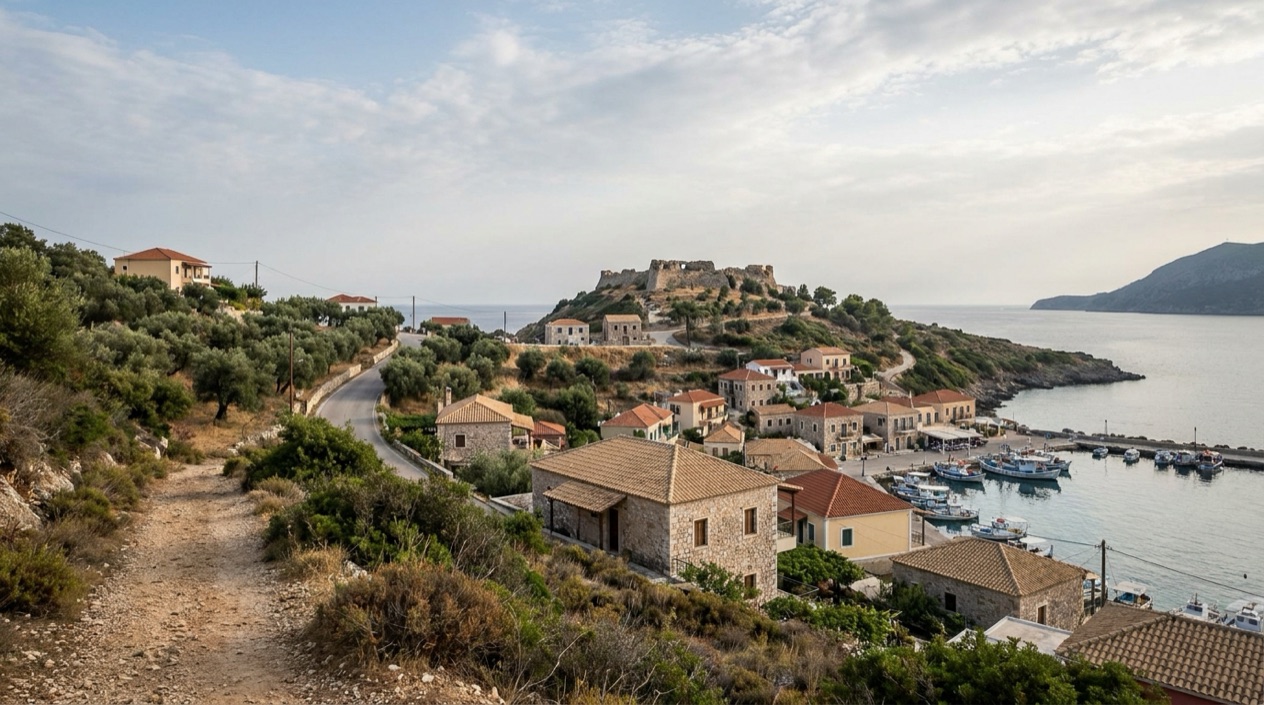
The first glimpse of Assos comes from the road above, where the land drops toward a bay and a small round headland sits in the water like a thumb. Below it, low houses in faded ochre, rose and cream crowd around a little harbor, and boats rock against the quay. Assos is a village visit on Kefalonia, built for strolling, sitting by the water and looking up at the ruined fortress on the hill.
Is visiting Assos worth it?
Yes, if you like a small place where the pleasure is in lingering: a coffee on the waterfront, a plate of fish at a harbor taverna, a look at the headland from every angle. It does not offer a long list of sights. It offers a setting, and travelers who need a checklist may find the village over quickly, while those who enjoy watching a harbor go about its day will find it enough.
What sets Assos apart from the other waterfront villages of Kefalonia is its shape. Most of the island was rebuilt in plain concrete after the 1953 earthquake leveled every town except Fiscardo, and the island’s larger towns show it.
Assos is a village of modest size, tucked onto a narrow neck of land between two arms of the sea, with a fortress rising above its rooftops. The whole place reads as one picture, and you can take it in without a car once you have arrived.
It also makes a natural companion to the rest of the island. Kefalonia is the largest of the Ionian Islands, and it has enough variety (a mountain with its own endemic fir, vineyards on the slopes, an underground lake, a cave, ferry ports for other islands) that Assos works best as one chapter rather than the whole story. Pair it with something bigger and it gives the day a gentler middle.
For couples, for photographers, for anyone who prefers a village lunch to a museum line, Assos is a good fit. Families can enjoy the harbor and the water’s edge. Travelers who want nightlife, large shops or a long beach promenade will find the village too small for that.
What to see at Assos
The village is compact in spirit: a harbor, a waterfront lane, a handful of side streets, a headland. What you see is mostly what you can take in with your eyes, so the visit is about looking carefully rather than ticking off monuments.
The harbor and the waterfront
The harbor is the heart of Assos. Small fishing boats and a few pleasure craft tie up along the quay, and the houses face the water in a loose curve, their shutters painted in soft colors and their balconies hung with plants. Tavernas set tables close to the edge, so a meal here is shared with the sound of ropes and engines.
Walk the waterfront slowly, then turn into the lanes behind it. They are narrow and lined with stone walls, bougainvillea and cats asleep on doorsteps. Small shops sell honey, olive oil, herbs and local sweets, the kind of things that travel well in a suitcase.
A kafenio (the traditional Greek coffeehouse) is the right place to sit once you have looped through. Order a Greek coffee or a cold frappé and let the harbor do the entertaining. The view from the tables is one of the pleasures of the village.
The Venetian fortress on the headland
Above the village rises a hill crowned by the walls of a Venetian fortress, built when Venice ruled the Ionian Islands. From the village you see its long line of ramparts against the sky, a reminder that this coast was once watched for ships. Inside the walls the ground is wild, with scrub, pines and the footprints of old buildings.
What you look for here is the setting rather than a finished monument. From the heights you can follow the coastline in both directions, see the village roofs shrinking below you, and read the way the headland is tied to the mainland by a thin strip of land. Looking down at the water, you can understand why the spot was chosen for defense.
The water and the pebbles
Assos looks over a bay of deep blue and green, and swimmers and sunbathers gather along its edge in summer. Sea shoes and a towel make sense if you plan to get in, and the water is the main reason many people linger past lunch. Conditions change from day to day, so judge the sea as you find it.
Even if you do not swim, the shoreline is pleasant for a walk. Boats sit on the water, small waves tap the stones, and the hill behind the village gives the whole scene a frame of pine and cypress. It is the sort of place where an hour of doing very little feels like enough.
Flavors of the village table
Eating is a sight of its own here. Harbor tavernas serve grilled fish, calamari, salads of tomato and cucumber with feta, and the Kefalonian meat pie, a savory baked dish found across the island. Order a few plates to share, the way Greek meals are meant to be eaten.
Look for Robola on the wine list. The vines that produce this white wine, famous across the island, grow on the slopes of Mount Ainos, and a cold glass goes well with fish. For something stronger there is ouzo, served with water and a small plate of meze, the little dishes that come before a meal or make one.
The island around Assos
Kefalonia rewards a wider look. Melissani underground lake and Drogarati cave are natural attractions on the island, and both sit in the world of limestone and water that shapes this part of the Ionian. Mount Ainos carries the endemic Cephalonian fir on its peaks, a tree found nowhere else.
Fiscardo, the one town that came through the 1953 earthquake standing, is another stop on the island. Its ferry port links to Lefkas and Ithaca. Argostoli, the largest port, has ferries to Zante and Lixouri, and the Argostoli to Lixouri crossing runs every hour and every half-hour in the season.
When to visit Assos
Assos is a place of sea and open air, so the season shapes the visit.
| Month | Average high (°F) | Average low (°F) | Precipitation (inches) | Days with rain |
|---|---|---|---|---|
| January | 58.5 | 46.8 | 4.60 | 12.0 |
| April | 66.6 | 52.2 | 1.60 | 6.4 |
| July | 86.9 | 69.6 | 0.21 | 0.5 |
| October | 74.8 | 61.2 | 4.09 | 8.6 |
July is the month for beach days and long evenings outdoors. Rain is almost absent and the heat is real, so sun protection and a hat belong in the bag, and a swim becomes the natural way to spend the middle of the day. Harbor tables fill with diners, and the village feels its most social.
April brings a milder air, with highs in the mid-60s and some rain days in the mix. The hills are green, and a light layer is useful for the cooler hours.
Rain falls on a good number of days, so a rain jacket belongs in the bag, and the sea still holds some of its summer warmth. Plans can bend around a wet day, with a long lunch at a harbor taverna as a fine answer.
January is the wettest of the four, with rain on many days and cooler air, and warm layers are the sensible packing. The village is a place for coffee and a walk when the sky lets you, and the sea is for looking at. If you want to swim and sit outside at length, aim for the warmer months.
Tips for your visit
Bring comfortable shoes with a good grip. The streets are narrow, the lanes lead up and down, and the ground around the fortress is uneven and rough. A hat and sunscreen are the plain consequence of a hot July, and a rain jacket does the same job for the wetter months.
Bring a swimsuit and a towel if you plan to get into the water, and sea shoes if the pebbles bother your feet. A refillable bottle and a camera complete the kit. The headland and the harbor are the two views most people want to frame, so leave space on your phone.
Combine Assos with other parts of Kefalonia. Melissani underground lake and Drogarati cave sit well in the same trip, as do the wine slopes of Mount Ainos, where the Robola grapes grow. Fiscardo, with its ferry links to Lefkas and Ithaca, adds a second harbor to compare with this one.
For families, the harbor and shoreline give children room to watch boats and look for small fish, and a taverna lunch with several shared plates suits a table with mixed appetites. Strollers will find the old lanes less friendly than the waterfront. Travelers with limited mobility will want to think about the hill to the fortress, which is a climb on uneven ground.
Use the trip to taste the island. A glass of Robola, a slice of meat pie, local honey for the road home: each one is a small way to bring Kefalonia back with you. In a village this size, the best plan is to leave some time unplanned and see where the harbor takes the afternoon.
Good to know before you go
Euros are the money of Greece, and a few coins in your pocket suit a village kafenio or a bakery stop. Use ordinary travel habits in a busy harbor and keep your belongings with you at the table.
Kefalonia is the island with the Ionian’s gentler summers, and a day outside in July calls for water, shade and a hat. Take a moment to enjoy the evenings, when the boats in the harbor settle and the light turns the headland a deeper color.
Sources
- Wikipedia, Assos (https://en.wikipedia.org/wiki/Assos), checked October 12, 2026
- Visit Greece (GNTO), Kefalonia (https://www.visitgreece.gr/islands/ionian-islands/kefalonia/), checked October 12, 2026
- Wikipedia, Kefalonia (https://en.wikipedia.org/wiki/Kefalonia), checked October 12, 2026
- Wikivoyage, Kefalonia (https://en.wikivoyage.org/wiki/Kefalonia), checked October 12, 2026
- Hellenic National Meteorological Service (HNMS), climatological normals 1991-2020 for Kefalonia station (https://www.emy.gr/climatic-data), monthly mean daily maximum and minimum; rain from the ECMWF ERA5 reanalysis, 1991-2020, grid cell of Kefalonia (Open-Meteo), checked October 12, 2026
- ECMWF ERA5 reanalysis 1991-2020, grid cell of Kefalonia (Open-Meteo), checked October 12, 2026
To plan your stay
- Best Time to Visit Greece: September and Late May to Early June
- Arachova: Parnassus Mountain Town, Formaela Cheese, Ski Season and Saint George's Day
- American Airlines Flights to Greece: U.S. Cities, Athens Arrivals and Onward Island Flights
- Greece on a Budget: Cash Machines, Cards, Beaches and Ferries