
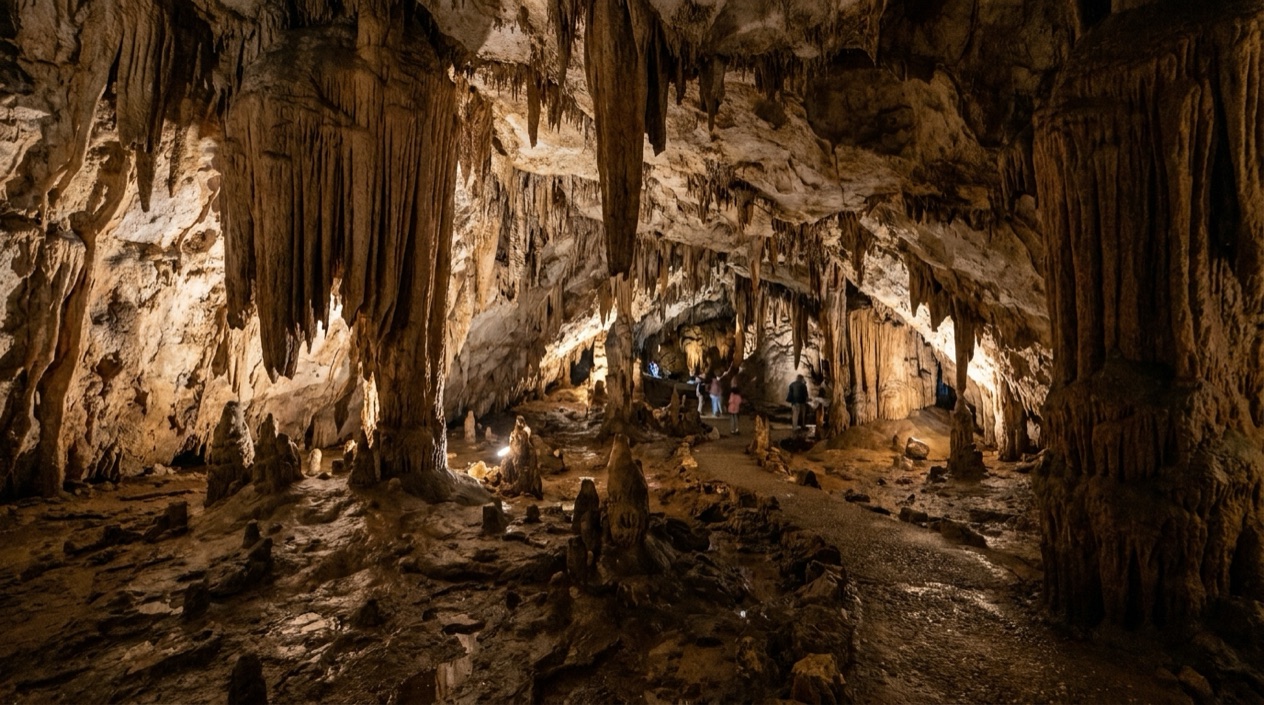
You step out of the Kefalonian light and the air changes at once: cooler, still, with the faint smell of wet stone. Below you the cave opens into a hollow chamber where stalactites hang from the ceiling like frozen curtains. Drogarati is one of the natural attractions that has helped put Kefalonia on the tourist map, and it is a visit for anyone who wants a stretch of the island’s day spent underground.
Is visiting Drogarati Cave worth it?
Yes, if you like natural formations and want one visit on Kefalonia that has nothing to do with beaches or villages. People who dislike enclosed spaces or damp, dim places may prefer to spend the time elsewhere on the island.
What sets it apart from the other places people go to on the island is the setting. Melissani, the underground lake, is the other cave attraction on Kefalonia, and the two are often mentioned in the same breath, but they give different experiences.
Drogarati is a dry-stone world of dripping formations and a large chamber, while Melissani is about water and light. Seeing both gives you two very different faces of the island’s limestone underworld.
Drogarati is also listed among the important natural features of Kefalonia, which is the largest of the Ionian Islands. That matters because the island is better known for its coastline, its mountain of Ainos with the endemic Cephalonian fir and its Robola vineyards. The cave adds a layer beneath all of that.
What to see at Drogarati Cave
The entrance and the descent
The visit begins at the mouth of the cave, where daylight fades behind you and the walls close in with pale, damp rock. As your eyes adjust, the path leads down into the main hall. The temperature shift is the first thing people notice, and the sound of dripping water follows you along the way.
Look at the rock around you on the way in. The surfaces are shaped by water, smooth in some places and rough and crusted in others, and the lighting picks out the colors of the stone, from cream to a warm amber.
Stalactites and stalagmites
The main attraction is the forest of formations. Stalactites grow downward from the ceiling, stalagmites rise from the floor to meet them, and in places the two have joined into columns. Some are thin and delicate, others thick and heavy, and the shapes invite the usual game of seeing faces, animals and draperies in the stone.
They are formed slowly by mineral-rich water, drop by drop, which is why guides and signs along such caves ask visitors not to touch them. Take your time to stand still and look up, because the details are in the textures and the way the lamps catch the wet surfaces.
The great chamber and its sound
At the heart of the cave is a large chamber, and this is where the place feels different from a simple tunnel. The space is open and tall, and its shape is known for the way it carries sound. A quiet voice or a clap echoes strangely, and the dripping of water seems to come from every side.
Pause here and listen. The chamber is the part of the visit that stays with you, more than any single formation, because it gives you a feeling of how large the cave really is beneath the Kefalonian hillside.
Pairing it with Melissani
Melissani underground lake and Drogarati are the two natural attractions of Kefalonia that travelers usually place side by side. Where Drogarati is a chamber of rock, Melissani is a cave with a lake inside it. Seeing the two on the same trip makes a natural comparison, one showing what dripping water builds over time and the other what a flooded cavern looks like.
Hours, tickets and rules
Drogarati is a visitor attraction on Kefalonia, set up for walking through rather than for exploring on your own. You go in on foot, you stay on the route laid out for visitors, and you look rather than touch. The cave’s formations are fragile, and that is the main thing to carry in your mind when you go down.
Opening times and admission change with the season at attractions like this, so they are best taken from the cave’s own current notice at the entrance or from the island’s tourist information. Plan the cave as a single stop in your day, and leave space around it rather than packing the schedule tightly. Expect the usual courtesies of any show cave: stay on the marked path, keep your hands off the rock, and keep your voice and your pace unhurried so everyone gets to enjoy the chamber.
How to get to Drogarati Cave
Everything starts with reaching Kefalonia itself. The island has four main harbours: Sami, Poros, Argostoli and Fiscardo. Sami has links to Patras and Ithaca, Poros has routes to Kyllini, Argostoli, the largest, has ferries to Zante and Lixouri, and Fiscardo connects to Lefkas and Ithaca. Which one suits you depends on where you are coming from.
By air, Kefalonia Island International Airport receives almost every scheduled flight on an Olympic Air route, mainly to and from Athens. In summer the airport also handles several charter flights from all over Europe, which widens the ways of arriving during the warm months.
Inside the island, the ferry between Argostoli and Lixouri goes every hour and every half-hour in the season. That crossing links two sides of the Argostoli gulf, and it is useful to know if you are staying around those towns.
Where you stay shapes the rest. If your base is one of the main harbour towns, you can set out for the cave from there on the island’s roads, and combine it with other places you want to see on the same day, such as Melissani.
When to visit Drogarati Cave
A cave has the advantage that the weather outside matters less than at a beach, so Drogarati works in more months than a swim stop does. Still, the season shapes the rest of your day, since you will spend part of it above ground, driving, walking and eating. The figures for Kefalonia show how different the seasons are.
| Month | Average high (°F) | Average low (°F) | Precipitation (inches) | Days with rain |
|---|---|---|---|---|
| January | 58.5 | 46.8 | 4.60 | 12.0 |
| April | 66.6 | 52.2 | 1.60 | 6.4 |
| July | 86.9 | 69.6 | 0.21 | 0.5 |
| October | 74.8 | 61.2 | 4.09 | 8.6 |
July is hot and almost without rain, so a cool cave can be a welcome break from the afternoon sun. The days around it are likely to be spent at the beach, so the cave fits in as a change of pace. In January the island is wetter and cooler, with rain on a good share of days, and a rain jacket is the sensible companion.
April and October sit in the middle. April has mild temperatures and fewer wet days, which makes it comfortable for moving around the island. October is still warm, with more rain than in spring, so a day built around the cave and other indoor or covered stops copes well when a shower arrives.
Tips for your visit
Bring shoes with a good grip, because cave floors and steps can be damp. A light layer is useful for the cooler air inside, especially if you arrive from a hot summer afternoon. A camera or phone is handy for the formations, but keep your hands free for the path.
Pair the cave with Melissani on the same day, since both are natural attractions on Kefalonia and they make a pleasant contrast. Add a stop for lunch in a village taverna, where you might find dishes such as meat pies, fresh fish or a plate of local cheese, and finish with a glass of Robola, the white wine grown on the slopes of Mount Ainos.
For families, the cave is something children often find memorable, with its dripping ceiling and echoes. Since descents and steps are part of the visit, think about whether everyone in your group is comfortable on stairs and in a dim space. Travelers with mobility needs should find out about the route beforehand from the cave’s own information.
If you are building a wider day, the island offers plenty to combine, from the slopes of Mount Ainos where the endemic Cephalonian fir grows to the harbours of Sami and Fiscardo. The cave is a natural anchor for a day away from the sea.
Good to know before you go
Greece uses the euro, and small attractions and cafés on Kefalonia are often settled at a counter, so it helps to have some cash and a card with you. Most of the island’s towns were leveled in the earthquake of 1953, with only Fiskardo spared, so much of what you pass on the way is functional concrete construction rather than old stone, and that is part of the island’s character.
In summer the afternoon heat is strong, and the cave’s cool air is a welcome change, though a bottle of water for the rest of the day is always useful.
Sources
- Wikipedia, Cephalonia (https://en.wikipedia.org/wiki/Cephalonia), checked October 12, 2026
- Visit Greece (GNTO), Kefalonia (https://www.visitgreece.gr/islands/ionian-islands/kefalonia/), checked October 12, 2026
- Wikipedia, Kefalonia (https://en.wikipedia.org/wiki/Kefalonia), checked October 12, 2026
- Wikivoyage, Kefalonia (https://en.wikivoyage.org/wiki/Kefalonia), checked October 12, 2026
- Hellenic National Meteorological Service (HNMS), climatological normals 1991-2020 for Kefalonia station (https://www.emy.gr/climatic-data), monthly mean daily maximum and minimum; rain from the ECMWF ERA5 reanalysis, 1991-2020, grid cell of Kefalonia (Open-Meteo), checked October 12, 2026
- ECMWF ERA5 reanalysis 1991-2020, grid cell of Kefalonia (Open-Meteo), checked October 12, 2026
To plan your stay
- Best Time to Visit Greece: September and Late May to Early June
- Arachova: Parnassus Mountain Town, Formaela Cheese, Ski Season and Saint George's Day
- American Airlines Flights to Greece: U.S. Cities, Athens Arrivals and Onward Island Flights
- Greece on a Budget: Cash Machines, Cards, Beaches and Ferries