
Epidaurus is the sanctuary of Asklepios, the Greek god of healing, and it sits in a mountain valley in the Argolis region of the Peloponnese. Most visitors come for its ancient theater, where a quiet word spoken at the center carries to the top row. Nafplio, a 30 minute drive away, makes the easiest base. Give the site a few unhurried hours.
What is Epidaurus, and why does it matter?
For centuries the sick traveled here hoping for a cure, and UNESCO calls the sanctuary the earliest organized sanatorium. Ceremonial healing began on the site in the 2nd millennium BCE. The cult of Apollo Maleatas followed in the 8th century BCE, and Asklepios arrived in the 6th. Over the centuries the sanctuary developed into a leading healing center of the ancient world, where the cults of Apollo Maleatas and then Asklepios gave the site its fame. Its history traces a slow shift from belief in divine cures toward the science of medicine, which is why it is often called the cradle of medicine.
By the classical period the sanctuary had buildings for every function of its work, including healing cults and rituals, a library, baths, sports facilities, lodging, a hospital and a theater. UNESCO listed the whole sanctuary as a World Heritage Site in 1988. The setting matters as much as the stones. Mountains ring the valley, and pine-wooded hills surround it. The land around the sanctuary has been protected for decades, so the landscape seen from the ruins is almost entirely preserved.
What will you see at Epidaurus?
From the entrance gate, a shady path leads past the museum and up to the theater.
The Ancient Theater
Stone seats climb the slope of Mount Kynortio in even tiers around a perfectly circular orchestra of beaten earth. The lower section has 34 rows. The upper section, added in a second building phase, has 21 more. Narrow stairways divide the seating into 12 wedges. The theater seats roughly 10,000 to 12,000 people today. Ancient sources credit the design to Polykleitos the Younger, and UNESCO singles out the perfection of its proportions.
Stand at the center of the stage and speak in a quiet voice, and the sound carries clearly up to the top rows. Then climb to the top row yourself for the view over the trees to the mountains.
Since 1955 the theater has hosted the Athens Epidaurus Festival every summer. If your dates line up, an evening of ancient drama here is worth planning around.
The Tholos, the temples and the Abaton
The round Tholos is credited to the same architect. It has 26 Doric columns outside and 14 Corinthian columns within. No ancient writer recorded what it was for, and its purpose is still debated. The building has been under restoration, so expect scaffolding.
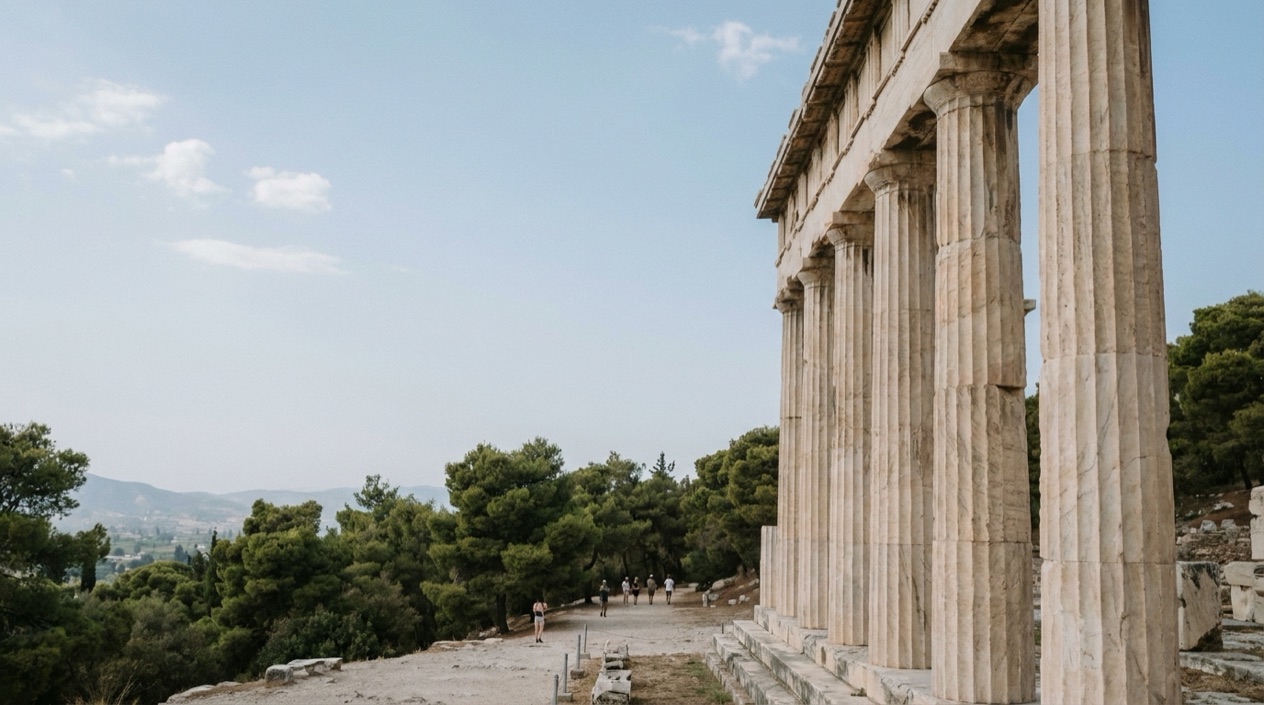
The Temple of Asklepios was the heart of the healing cult. Today it survives as a handful of columns and foundations in a field, and in spring it stands among wildflowers. Nearby is the small, elegant Temple of Artemis. Patients slept in the long columned hall called the Abaton, also known as the Enkoimeterion, hoping Asklepios would visit them in a dream and offer a cure.
The stadium and the museum
The stadium preserves almost 90 percent of its ancient form. You can still run its length, or watch from the restored benches and grassy slopes. The archaeological museum opened in 1909. It holds inscriptions, statues, offerings and architectural fragments from the sanctuary, including inscribed stone slabs, or stelai, that tell the story of its healings.
When should you go, and how long do you need?
Spring and fall tend to be pleasant seasons, with a gentler sun and thinner crowds than in summer. In spring the hills turn green, and on a March afternoon the parking lot can be almost empty. Summer is hot, shade is scarce across the site, and tour buses arrive in waves. In those months, come right at opening or shortly before closing, when far fewer people are around.
A few hours covers the theater and the main ruins. If you want to wander the whole sanctuary and linger in the museum, allow more.
What does it cost, and when is it open?
Epidaurus uses timed entry tickets, like other Greek archaeological sites, with a set number of visitors per time slot. Once inside, you can stay as long as you like. A full ticket covers the theater, the museum and the entire site. Prices and hours change, so confirm them with the site before you go.
In peak season, when large bus groups arrive, buy your ticket online in advance. You can also buy one at the window on arrival, but you may have to wait for an open slot.
Contacts: archaeological site +30 27530 22009 or +30 27530 22666; Athens Epidaurus Festival +30 27530 22026.
What should you wear and bring?
Sturdy shoes come first. The ground is uneven, and centuries of feet have polished the stone steps smooth. Leave the flip-flops behind and wear grippy sneakers or hiking shoes.
Bring a hat, sunglasses, sunscreen and water. There is a cafe and a gift shop, but the cafe is small and gets busy, so pack a picnic. Put gum and all litter in the bins, because discarded food and chewing gum can damage the monument irreparably.
Is Epidaurus wheelchair accessible?
Much of it is. Wheelchair users may drive up to the theater square, and adapted portable toilets are available. Designated routes and ramps give step-free access through much of the site, though the ancient seating tiers themselves are steps.
How do you get to Epidaurus?
A car gives you a lot of freedom, including the chance to arrive early or stay later at the site. Athens Airport has the widest choice of rental cars in the city. From the airport it's about two hours and roughly 103 miles (166 km) to the site's main parking lot, mostly on the Attiki Odos highway, which has good rest stops.
The route from Athens runs as follows:
1. Follow signs for Corinth.
2. Leave the Athens-Corinth Motorway right after the bridge over the Corinth Canal.
3. Keep right, pass under the motorway, and turn left onto the Corinth-Epidaurus road.
4. After about an hour, past Nea Epidavros and Palea Epidavros, turn left at the Lygourio crossroads for the Sanctuary of Asklepios.
From Nafplio, drive through Lygourio and follow signs to the site. The theater parking lot has plenty of room for cars and coaches.
Guided day tours from Athens take care of tickets and round-trip transport, and a certified guide adds the history and myths. Many combine Epidaurus with Mycenae, Nafplio or the Corinth Canal.
Without a car, take a KTEL bus from Kifissos station in Athens to Nafplio, a trip of about 1.5 to 2 hours. From Nafplio, a local KTEL bus runs on to the theater. 2026 prices: Athens to Nafplio costs €15.70 one way, and Nafplio to the theater, listed as Theater Asklipiio (Epidavros), costs €3.50. On festival performance days, a bus leaves Athens for the theater at 17:00 and heads back 30 minutes after the show ends.
Nafplio makes a handy base, about 17 miles (28 km) and 30 minutes from the site by car. It is walkable and full of hotels. The coastal village of Archaia Epidauros, sometimes signed Palea Epidavros, is closer, about 9 miles (15 km) away, and makes a quiet, pleasant place to stay.
What pairs well with Epidaurus?
Mycenae, the Bronze Age citadel, is the classic partner, about 25 minutes from Nafplio. Its ticket covers the archaeological site, the museum and the Treasury of Atreus. Nafplio itself is the first capital of modern Greece, and its Old Town, harbor and three fortresses fill an evening nicely. Archaia Epidauros was the sanctuary's ancient port. Today it has beaches, cafes and tavernas for a swim and a meal.
If you have festival tickets, check whether your show is in the main theater or at the Little Theater of Epidaurus, the festival's other venue, before you set off.
Sources
- UNESCO World Heritage Centre (https://whc.unesco.org/en/list/491/), checked October 18, 2026
- aefestival.gr (https://aefestival.gr/venues/ancient-theatre-of-epidaurus/?lang=en), checked October 18, 2026
- wanderingwagars.com (https://wanderingwagars.com/ancient-epidaurus-greece/), checked October 18, 2026
- tourhq.com (https://www.tourhq.com/greece/epidaurus/tour-guides), checked October 18, 2026
- spotlightsojourns.com (https://spotlightsojourns.com/athens-to-epidaurus-greece/), checked October 18, 2026
- Hellenic Ministry of Culture, Odysseus (http://odysseus.culture.gr/h/1/eh155.jsp?obj_id=3462), checked October 15, 2026
- Hellenic Ministry of Culture, Odysseus (http://odysseus.culture.gr/h/3/eh355.jsp?obj_id=2381), checked October 15, 2026
- ktelargolida.gr (https://www.ktelargolida.gr/en/ticket-prices/), checked October 15, 2026
- Hellenic Ministry of Culture, Odysseus (http://odysseus.culture.gr/h/3/eh355.jsp?obj_id=1604), checked October 15, 2026
- ktelargolida.gr (https://www.ktelargolida.gr/en/athina-isthmos-fichti-mikines-argos-nafplio/), checked October 15, 2026
- Hellenic Ministry of Culture, Odysseus (http://odysseus.culture.gr/h/3/eh355.jsp?obj_id=2573), checked October 15, 2026
- Visit Greece (GNTO) (https://www.visitgreece.gr/en/mainland/peloponnese/nafplio), checked October 15, 2026