
The Corinth Canal is a straight, narrow cut through the Isthmus of Corinth, about 4 miles (6.3 km) long, with rock walls that rise like a stone canyon over a strip of dark blue water.
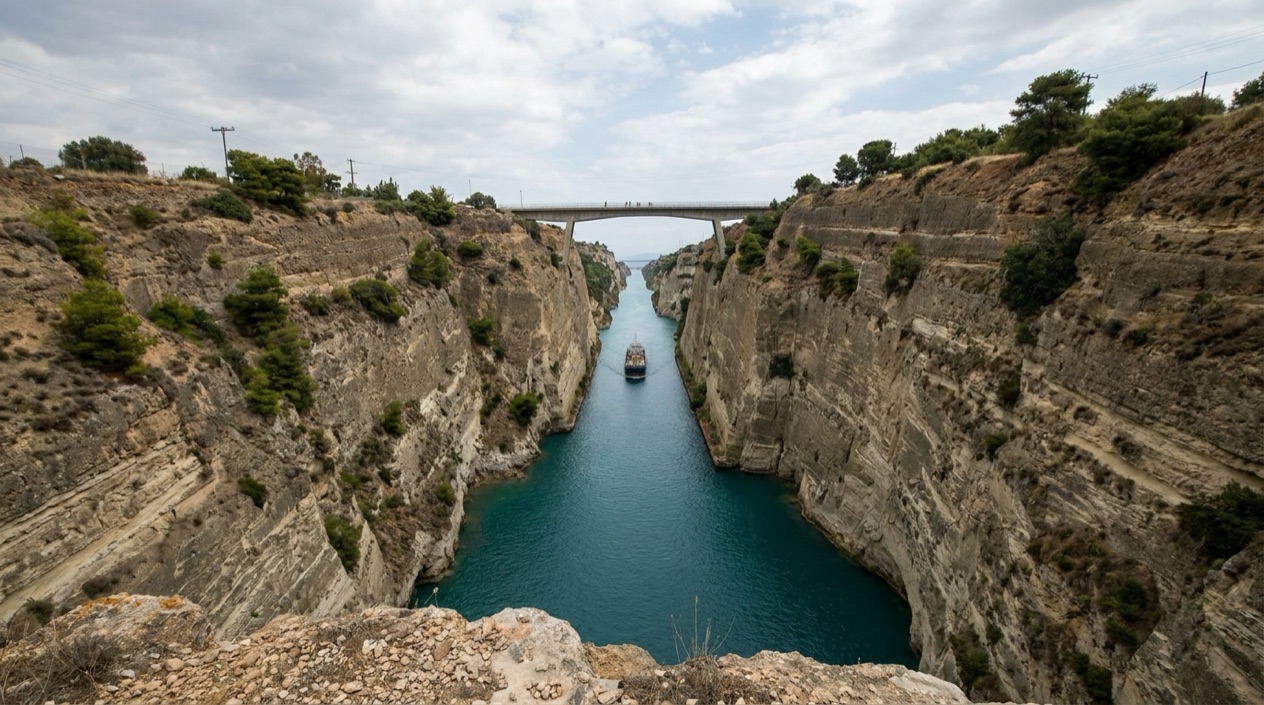
What is the Corinth Canal, and what does it look like?
Stand on the bridge at the northern end and the first thing you feel is height. The rock walls rise straight up, reaching around 300 feet (about 295 feet (90 m)) in places, and the water far below looks like a thin ribbon. The channel measures about 80 feet (24.6 m) across at the surface and about 70 feet (21 m) at the bottom, with a depth of roughly 26 feet (8 m).
Here the Gulf of Corinth meets the Saronic Gulf, and the Ionian and Aegean seas shake hands. The canal separates the Peloponnese from the Greek mainland, and two road bridges and two railway bridges tie them back together. At each end, a submersible bridge sinks into the water to let boats pass. The one at Poseidonia, on the Gulf of Corinth side, sinks below the water's surface to let ships pass.
The canal is too narrow for many large commercial vessels, so much of the traffic is tourist boats, small cruise ships and private sailboats. A traffic light run by the Isthmus Port Authority controls the entrance, and boats move in one direction at a time. When one slides into the channel below, have your camera ready.
Why was it so hard to build?
Hard rock, fear and money stalled the canal for about 2,500 years. Periander, the tyrant of Corinth, considered it in the 7th century B.C. His technicians warned of a level difference between the two gulfs, and an oracle's warning and fear of angering the gods made him give up. He built the Diolkos instead, a paved road where ships were hauled across the isthmus on carriages. Part of it survives west of the canal, its deep ruts still intact.
Demetrius Poliorcetes, Julius Caesar, Caligula and Hadrian all took up the plan and dropped it. Engineers feared that one sea sat higher than the other and that cutting through would flood Aegina, perhaps even Athens. They turned out to be wrong. Nero finally broke ground in A.D. 67, reportedly with a golden spade, and thousands of workers dug. Rebellion in Rome and his death ended the work, but traces of his cutting, about 2 miles (3,300 m) long, remained until recent times.
The Venetians tried in 1687 and quickly hit solid rock. Dynamite, invented by Alfred Nobel in 1867, made the difference. Construction began in 1882 under the Hungarian István Türr, following Nero's line. His company went bankrupt, a Greek company took over in 1890, and the canal opened on July 25, 1893. It cut the sea trip from Piraeus to Italy roughly in half. Sailing between Patras and Piraeus, the route is about 100 nautical miles through the canal versus 295 around the Peloponnese.
Its troubles didn't end there. In 1944, retreating German forces caused landslides that blocked the canal, and it reopened in October 1947 with Marshall Plan money.
How do you get there?
The canal crosses the isthmus between Poseidonia and Isthmia, and the sights nearby are all linked by short drives, so a car makes the day easy. Greek law requires a valid U.S. driver's license, and insurance companies may require an international driver’s permit. Greece has one of the highest traffic fatality rates in the European Union, so drive carefully, and remember that talking or texting on a phone while driving is illegal. Thieves target rental cars, so take passports, valuables and luggage with you when you park.
How do you visit, and how long do you need?
Plan on four to five hours for the canal, Acrocorinth and Ancient Corinth together. The canal is the quick one.
Search "Díolkos" on Google Maps to find it. Free parking is on the eastern side, next to several restaurants, and a footpath runs along both sides of the bridge for looking straight down into the cut.
Can you go through the canal by boat?
Yes, but it takes some planning. With a sailing license you can take your own boat through, and several cruise lines and small-ship bike and boat tours include the passage in their itineraries. Getting through usually takes around thirty minutes, while a huge ship that needs a tow may spend up to ninety minutes in the canal.
The canal charges a passage fee based on ship length, paid at the harbor office on the Saronic Gulf side. Greece also charges a fee on private and professional leisure ships over seven meters in Greek territorial waters, so ask your operator whether both are included in the price. The bridge view satisfies many visitors, though sailing through gives a feeling of the walls closing in around you.
Is there anything else to do at the canal?
Bungee jumping is the big one. The platform sits on the old National Road bridge at the Loutraki exit, and jumpers fall about 262 feet (80 m) between the sheer walls of the isthmus. Book with a certified company. Even if jumping isn't for you, watching someone fall toward that dark water makes good theater.
What should you pair it with nearby?
See the canal first, then Acrocorinth, which closes in mid-afternoon, then Ancient Corinth, which stays open later. Check the odysseus.culture website for current hours and tickets at both sites before you set out.
Acrocorinth
The old acropolis of Corinth crowns the mountain, a 15 minute drive from the modern town, with the last five minutes on a steep paved road. A free car park sits at the top, followed by a five minute walk over slippery stones to the gate. The double wall fortifications are the highlight, part of about 1.2 miles (2 km) of walls that still encircle the site, and the views from around the Frankish Tower are wide. The site is big, so allow close to two hours. Wear shoes with good grip, and postpone the visit if it's raining. There's very little shade, and the slippery climb tends to keep tour groups small.
Ancient Corinth
Below the mountain, ten minutes by car from modern Corinth, lies a big site of mostly overgrown ruins that is still impressive. Look for the Temple of Apollo with its seven Doric columns, the Fountain of Peirene, and the Lechaion Way, the main street of the Roman city. One ticket covers the site and the museum, and the site and museum stay open into the evening in peak season and close a little earlier at other times. Allow one to two hours, museum included. Free parking and restrooms are outside the museum.
What do Americans need to know before going?
U.S. citizens can enter Greece without a visa for stays of up to 90 days, and a passport should have at least three months of validity beyond your planned departure date. A passport reported lost or stolen will not get you in, even if you've found it again.
The U.S. State Department rates Greece as generally safe, but petty crime is common at popular tourist sites, so keep a close eye on bags and wallets. Carry your passport or another photo ID at all times. Strikes and demonstrations can happen with little notice and may disrupt roads, taxis, seaports and airports, so leave slack in your plans.
Bring some cash for medical care: many care providers in Greece accept only cash, and private hospitals often ask for proof of insurance or cash before admitting a patient.
Sources
- corinthcanal.com (https://corinthcanal.com/the-canal/the-history-of-the-canal/?lang=en), checked October 18, 2026
- inselhuepfen.com (https://www.inselhuepfen.com/en/blog/detail/the-corinth-canal), checked October 18, 2026
- travellingtrekker.com (https://www.travellingtrekker.com/post/corinth-greece-travel-guide), checked October 18, 2026
- study.com (https://study.com/academy/lesson/corinth-canal-map-history.html), checked October 18, 2026
- visitpeloponnese.com (https://visitpeloponnese.com/en/prdct/corinth-canal), checked October 18, 2026
- U.S. Department of State (https://travel.state.gov/content/travel/en/international-travel/International-Travel-Country-Information-Pages/Greece.html), checked October 15, 2026
- U.S. Department of State (https://travel.state.gov/content/tsg_aem/us/en/home/international-travel/travel-advisories/destination.grc.html), checked October 15, 2026