
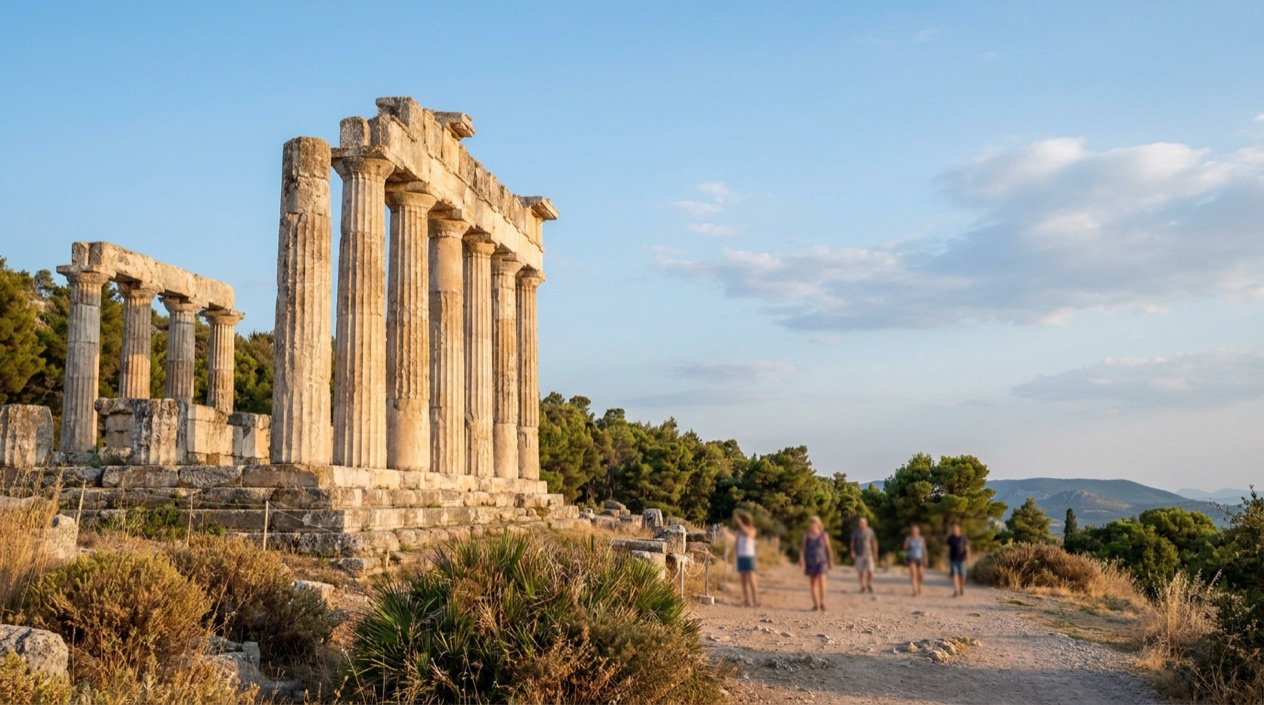
Mycenae is the great Bronze Age citadel of the northeastern Peloponnese. It is a hilltop ringed by colossal stone walls, entered through a gate crowned by two lions, with royal tombs scattered below. Allow two to three hours for the hilltop and museum, plus about 20 minutes for the Treasury of Atreus down the road. Nafplio, about 25 minutes away, is the best base, with good hotels, good dinners and an easy early start. A rental car is the simplest way to reach the site.
What is Mycenae, and why does it matter?
Mycenae gave its name to a whole civilization. The Mycenaean world spread around the Mediterranean between 1600 and 1100 BC and helped shape classical Greek culture. In legend this was the kingdom of Agamemnon, the Greek leader in the Trojan War, and the stage for the myths of his family: Clytemnestra, Iphigenia, Electra and Orestes. Their story inspired Homer and has kept poets, writers and artists busy ever since.
The citadel was placed to control the Argolid Plain. At its peak around 1350 BC, the citadel and lower town held some 30,000 people. Its walls are called Cyclopean because later Greeks credited them to the Cyclopes, mythical giants strong enough to stack such enormous, rough stones. The Mycenaeans also left the earliest written Greek, preserved on Linear B tablets. Together with nearby Tiryns, the site is a UNESCO World Heritage property.
What will you see at Mycenae?
As you walk up the main path, you will find the museum on your left, just ahead of the turn to the Lion Gate. It is compact, and its displays connect directly to what you will walk through above:
- Linear B tablets
- fresco fragments
- pottery
- small finds from the graves and the palace
The gold masks from Grave Circle A are not here, though there is a copy of one. Give it 30 to 45 minutes.
Before passing through the Lion Gate, look to its right for a fine view of the Cyclopean walls, a spot very few visitors visit. The gate itself, built around 1400 to 1300 BC, is the most famous sight at Mycenae.
The lions
two lions flank a central column above the massive lintel. Their heads are missing, but they once faced forward as guardians of the entrance.
The triangle
the open triangle above the lintel is deliberate engineering that diverts weight off the central stone.
The threshold and jambs
the threshold is grooved by centuries of traffic, and the jambs still show the holes where a wooden door bar once fit.
Photos
Standing inside the gate and shooting outward gives you a striking view of the relief. Morning light falls best on the relief.
Just inside, on your right, is Grave Circle A, a royal cemetery of the 16th century BC. It first lay outside the walls and was enclosed when the fortifications were extended in the 13th century BC. Nineteen men, women and children were laid to rest here, along with gold death masks, complete sets of weapons, decorated staffs, jewelry, and cups of gold and silver. Altogether, the grave circle is estimated to have held about 15 kilos of gold. The famous finds, including the so-called Mask of Agamemnon, are now in the National Archaeological Museum in Athens. On site you get replicas and explanatory panels, so walk the perimeter slowly and picture the wealth buried here.
Higher up stands the palace, the main building inside the walls. The palace ruins rise just to ground level, yet you can still make out:
- the great court
- the throne room
- the megaron (the grand reception hall)
- the royal apartments
Faint patches of red paint remain here and there. The palace looks straight out over the plain, a deliberate statement of power.
The North Gate is quieter than the Lion Gate and a better place to study the walls up close. Many of the limestone blocks weigh several tons, and the masons fitted them together with remarkable care. A narrow stairway also drops to an underground cistern cut into the rock, which secured the citadel's water during sieges. This part is optional. The steps can be narrow and slippery, and it is not for anyone with mobility trouble or claustrophobia. Bring a small flashlight.
What are the tombs outside the walls of Mycenae?
Three royal tholos tombs, the beehive-shaped burial chambers, lie outside the walls. After the Lion Gate, they make a memorable part of the visit, and they tend to be calmer than the hilltop.
Tomb of Aegisthus
tour groups tend to peer into it from above and move on, but it is worth walking down inside.
Tomb of Clytemnestra
close by, it was looted under Ottoman rule but is otherwise in excellent condition, with superb masonry.
Both names come from legend. There is no evidence that either figure was buried in these tombs.
The highlight is the Treasury of Atreus, a short way down the road from the main site, with its own entrance. Built between 1350 and 1250 BC, it is the best preserved tholos tomb. Walk the long entrance passage, step inside and look up at the corbelled dome, ring upon ring of precisely cut stone. Soil did not bury it, so it has remained visible through the centuries, and it was robbed in antiquity. Visit it after the main site.
How much are tickets to Mycenae, and when is it open?
2026 prices: a full ticket is €20 and a reduced ticket €10. Either one covers the archaeological site, the museum and the Treasury of Atreus.
October 1 through May 31
both full and reduced tickets are valid. Reductions include EU citizens over 65, with documentary proof.
June 1 through September 30
the full ticket is the one that applies.
Under 25
Admission is free on these days:
- March 6
- April 18
- May 18
- the last weekend of September
- October 28
- the first and third Sunday of each month from November through March
Hours change with the season and on public holidays. Check the Hellenic Ministry of Culture's page for Mycenae or the ticket office notices before you go. The site's office can be reached at +30 27510 76585 or [email protected].
When is the best time to visit Mycenae, and what should you bring?
Arrive at opening time. Tour groups stop at the Lion Gate for a talk, the path from the gate up to the citadel jams, and photos become difficult. The first hour is the quietest at the gate and Grave Circle A. Late in the day is the other good window, and the later the better. Both ends of the day spare you the worst of the summer heat and make parking easier. In warm months, head straight up to the palace and North Gate while it is still cool.
Wear closed shoes with good tread, since the paths are steep and uneven and polished stone can be slick. Shade is scarce, so bring:
- a hat
- sunscreen
- water
- snacks, since food on site is limited and seasonal
You will find restrooms and a small shop near the entrance and the museum. Wheelchair access is very limited, and the museum and lower areas are easier to manage than the upper citadel.
How do you get to Mycenae from Athens or Nafplio?
By car
The drive from Athens via the Corinth Canal takes about 1.5 hours, the trip from Nafplio is around 25 minutes, and signs guide you in as you near the site. Parking is next to the entrance, but the lot is often full of tour buses. At busy times you may have to hunt for a space along the road.
By bus
start at the Kifissos KTEL station in Athens. From the airport, the X93 bus goes there. KTEL buses from Athens run to Fichti (Mikines), Argos and Nafplio. The ride between Athens and Nafplio takes roughly 1.5 to 2 hours.
Getting off at Fichti still leaves you 3.5 km (about 2.2 miles) from Mikines, the village by the site. From Nafplio, a bus ticket to Mikines costs €3.50. Local connections are limited and timetables change, so check current times, and exactly where the bus stops, before you rely on them.
What else can you see near Mycenae?
Tiryns
the other half of the UNESCO listing, just outside Nafplio. Its walls use stones even larger than those at Mycenae, and they reach up to 8 m (26 feet) thick and 43 feet (13 m) high. It fits easily into the same day as Mycenae. The bus from Nafplio to Tiryns (Archaea Tirintha) costs €2.20.
Epidaurus
about 30 minutes from Nafplio, and many organized tours pair it with Mycenae. The theater (Asklipiio) bus costs €3.50.
Palamidi Fortress
above Nafplio, and another easy addition to a Mycenae day.
Tickets
€20 full and €10 reduced from October through May. Usually only the full ticket is valid from June through September.
Closed
January 1, March 25, May 1, Easter Sunday, and December 25 and 26.
Getting up
climb the 999 steps or take a taxi. If you drive, the fortress has its own free lot for visitors.
Sources
- UNESCO World Heritage Centre (https://whc.unesco.org/en/list/941/), checked October 18, 2026
- history.com (https://www.history.com/articles/mycenae), checked October 18, 2026
- travellingtrekker.com (https://www.travellingtrekker.com/post/mycenae-greece-travel-guide), checked October 18, 2026
- takemetoeuropetours.com (https://takemetoeuropetours.com/blog/mycenae-archaeological-site-guide/), checked October 18, 2026
- greeka.com (https://www.greeka.com/peloponnese/mycenae/), checked October 18, 2026
- Hellenic Ministry of Culture, Odysseus (http://odysseus.culture.gr/h/1/eh155.jsp?obj_id=3462), checked October 15, 2026
- Hellenic Ministry of Culture, Odysseus (http://odysseus.culture.gr/h/3/eh355.jsp?obj_id=2381), checked October 15, 2026
- ktelargolida.gr (https://www.ktelargolida.gr/en/ticket-prices/), checked October 15, 2026
- Hellenic Ministry of Culture, Odysseus (http://odysseus.culture.gr/h/3/eh355.jsp?obj_id=1604), checked October 15, 2026
- ktelargolida.gr (https://www.ktelargolida.gr/en/athina-isthmos-fichti-mikines-argos-nafplio/), checked October 15, 2026
- Hellenic Ministry of Culture, Odysseus (http://odysseus.culture.gr/h/3/eh355.jsp?obj_id=2573), checked October 15, 2026
- Visit Greece (GNTO) (https://www.visitgreece.gr/en/mainland/peloponnese/nafplio), checked October 15, 2026
To plan your stay
- Best Time to Visit Greece: September and Late May to Early June
- Arachova: Parnassus Mountain Town, Formaela Cheese, Ski Season and Saint George's Day
- American Airlines Flights to Greece: U.S. Cities, Athens Arrivals and Onward Island Flights
- Greece on a Budget: Cash Machines, Cards, Beaches and Ferries