
Delphi announces itself with the mountain. The village clings to the southwestern slope of Mount Parnassus, with small hotels and tavernas strung along two streets and the sanctuary of Apollo just beside them. Before you arrive it helps to know how entry works for Americans, how the euro behaves in your pocket, what each season brings to a village this close to ancient stones and ski slopes, and how people carry themselves here.
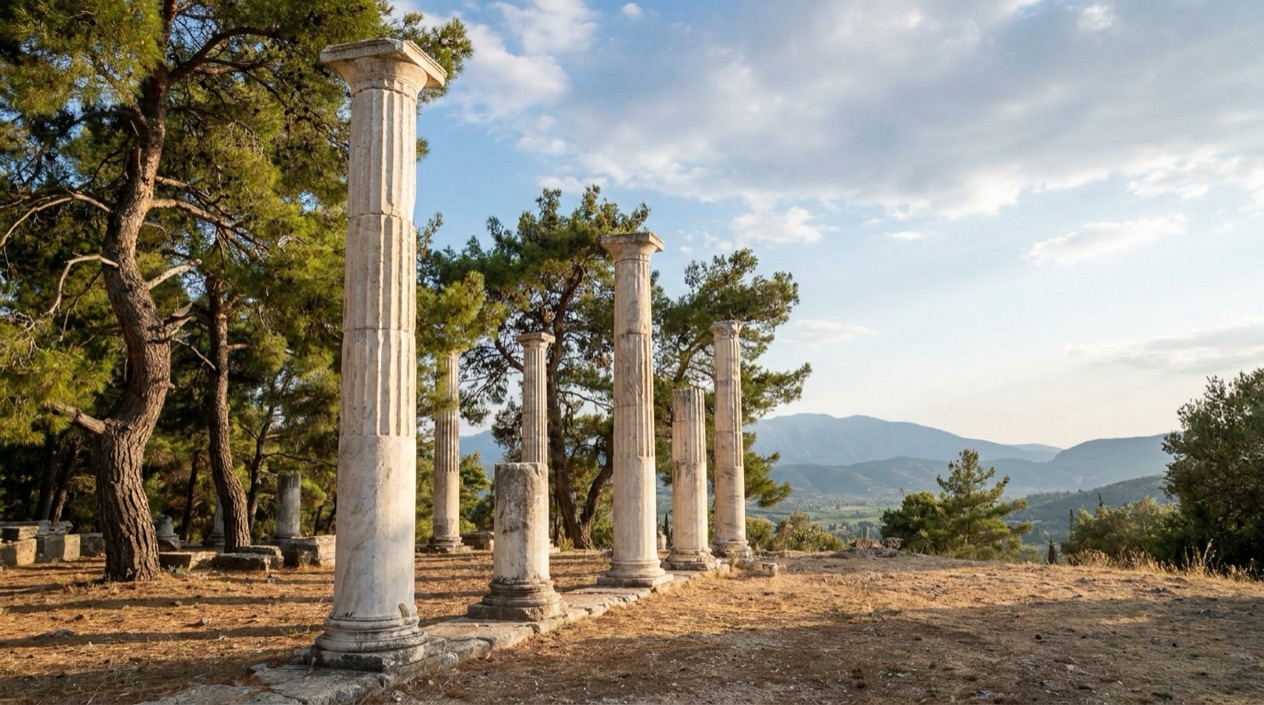
What should you know before visiting Delphi?
Four things matter most: the entry rules for U.S. citizens, the euro and its banknotes, the seasons that shape the village (busy summers and a winter ski crowd), and the habits of a small Greek town built right beside a sacred precinct.
What often surprises first-time visitors is how close everything sits. After an earthquake damaged Kastri, the villagers were offered a brand-new village in exchange for the land, so that the French School at Athens could dig.
You end up eating dinner in a town that was literally built to free the sanctuary. The second surprise is the mix of visitors. In summer the village fills with people who spend a few hours around their visit to the ruins, while in winter the same streets see travelers in ski gear heading for the Parnassos resort. Delphi is an ancient oracle and a mountain base at once, and the village adapts to both.
A third thing is the weight the name carries. In antiquity Delphi was called the navel of the Earth and served as a spiritual meeting place for the Greeks, home to the most important oracle of the ancient country.
The site has been a UNESCO World Heritage Site since 1987, and you enter it for a fee. Knowing that story before you walk the sacred way changes how the hillside looks, so a little reading on the flight pays off.
Entry, customs and paperwork
According to the U.S. State Department, U.S. citizens may enter Greece without a visa for stays of up to 90 days for tourism or business. That covers a visit to Delphi and any wider trip around the country within that window.
The passport is the document that deserves a careful look at home. The State Department recommends at least three months of validity beyond your planned departure date for entry into Greece, although Greek law requires only three months beyond the intended departure date.
A passport that has been reported lost or stolen is a different matter: U.S. citizens traveling on one will not be permitted entry and may be sent back to their original departure point. If a passport has ever been reported missing and then found, it is worth sorting out before you fly.
Two Greek laws are worth knowing as well. Marijuana is illegal in Greece, and photographing military installations is prohibited and may lead to arrest. Neither is likely to touch a visit to a sanctuary and a mountain village, but both are the sort of detail that stays with you when you point a camera at anything unfamiliar.
Money, cards and tipping
Greece uses the euro, and each euro is divided into 100 cents. Banknotes come in denominations of €5, €10, €20, €50, €100, €200 and €500, so a dinner bill in a Delphi taverna is usually settled with a handful of the smaller notes and a few coins.
Getting used to the notes before you arrive is a small pleasure in itself. They are colorful, and the larger ones are rarely needed for the kind of purchases a village like Delphi offers: a coffee, a spinach pie from a bakery, a plate of grilled meat, a small souvenir.
Tipping in a Greek taverna is a gesture rather than a calculation. Many diners leave a little extra on the table when the meal has been good and the table has been looked after, and nobody keeps score. A friendly word of thanks to the people who served you counts for as much as the coins.
Getting around and staying connected
Getting around Delphi starts from the shape of the place. The modern town lies very close to the archaeological site and spreads across two streets lined with traditional small houses, hotels and tavernas, so the village, the sanctuary and your dinner table all share one slope of Mount Parnassus.
That closeness is the main fact for anyone planning a stay. The ancient precinct sits on the southwestern slope of Mount Parnassus in Phocis, in central Greece, and the town was created next to it once buildings were cleared from the sacred ground to allow excavation. When you sleep in Delphi, you wake up beside the place you came to see.
In winter the mountain gives the village a second purpose. The Parnassos ski resort is very close by, and skiers pass through town on the way up the slopes. A visit to the oracle and a day on the snow can belong to the same trip, which makes the village a base for more than one kind of traveler.
Health, water and the weather
The weather in Delphi follows the mountain and the seasons. In summer the village teems with visitors, many of whom spend a few hours around the archaeological site, and the open ground of the sanctuary asks for sun protection and a bottle of water carried in your bag. In winter, travelers come to ski at Parnassos, so the cold season has its own reason to visit, quite different from the ruin-hopping of summer.
The shoulder seasons sit between those two moods. The site itself is the same hillside of stone and trees whenever you come, and it is open to the public for a fee. How the weather feels on that slope is part of the visit, so a layer for the mountain air and good shoes for stone paths suit any month.
For everyday health needs in a village this size, you will be looking for the same things as anywhere: a pharmacy for the usual remedies and plenty of water on walking days. Pack whatever medicines you take regularly, along with sunscreen and a hat for summer days at the sanctuary.
Local customs and etiquette
Greeks tend to greet with warmth. A handshake and a friendly word on entering a shop or a taverna sets the tone, and a smile goes a long way even if your Greek stops at a few words. Learning a simple hello and thank you is noticed and appreciated.
Meals are a social occasion. In a taverna, dishes often arrive in the middle of the table to be shared, from grilled meat and salads to feta, meze (small plates) and fresh bread, and Meals are often leisurely social occasions, with shared dishes and time for conversation.
The ancient precinct deserves a quiet kind of respect. This was once the seat of the most important oracle of the god Apollo, and Visitors can take in the stone paths, old walls and inscriptions that evoke the sanctuary’s former role. Churches and monasteries elsewhere in Greece have their own habits, and the best guide is to watch what people around you do and follow it.
The pace of the day in a small Greek town leans toward the slow. A coffee in a kafenio (the traditional coffeehouse) can last for as long as the conversation does, and the evening walk through the village is part of the day.
Good to know before you go
The U.S. State Department rates Greece Level 1: Exercise Normal Precautions.
The seasons of Delphi are easy to read: a summer packed with visitors around the ruins and a winter given over to skiing on Parnassus. Keep your passport with its validity in order, carry euros, and remember that petty crime is common in Greece, especially in popular tourist locations, so the sanctuary and the village deserve the same attention to your belongings that any busy place does. The last habit worth having is a simple one: leave the hours around the site open and let the village set the pace, with dinner at a taverna on one of its two streets.
Sources
- Visit Greece (GNTO), Delphi (https://www.visitgreece.gr/mainland/central-greece/delphi/), checked October 12, 2026
- Wikipedia, Delphi (https://en.wikipedia.org/wiki/Delphi), checked October 12, 2026
- Wikivoyage, Delphi (https://en.wikivoyage.org/wiki/Delphi), checked October 12, 2026
- U.S. Department of State, Greece travel information, local laws and special circumstances (https://travel.state.gov/content/travel/en/international-travel/International-Travel-Country-Information-Pages/Greece.html), checked October 12, 2026
- Wikipedia, Euro (https://en.wikipedia.org/wiki/Euro), checked October 12, 2026
- Wikivoyage, Greece (https://en.wikivoyage.org/wiki/Greece), checked October 12, 2026
- U.S. Department of State, Greece travel advisory (https://travel.state.gov/content/travel/en/international-travel/International-Travel-Country-Information-Pages/Greece.html), checked October 12, 2026
- U.S. Department of State, Greece travel information, entry and exit requirements (https://travel.state.gov/content/travel/en/international-travel/International-Travel-Country-Information-Pages/Greece.html), checked October 12, 2026