
You step in from the village road into an entrance hall, and the ancient sanctuary begins to take shape in the objects around you. Bronze, marble and carved stone that once stood along the sacred way now stand in rooms of their own. This is the museum of Delphi, where the oracle’s offerings are gathered, and it is a visit for anyone who wants the ruins on the hillside to mean more.
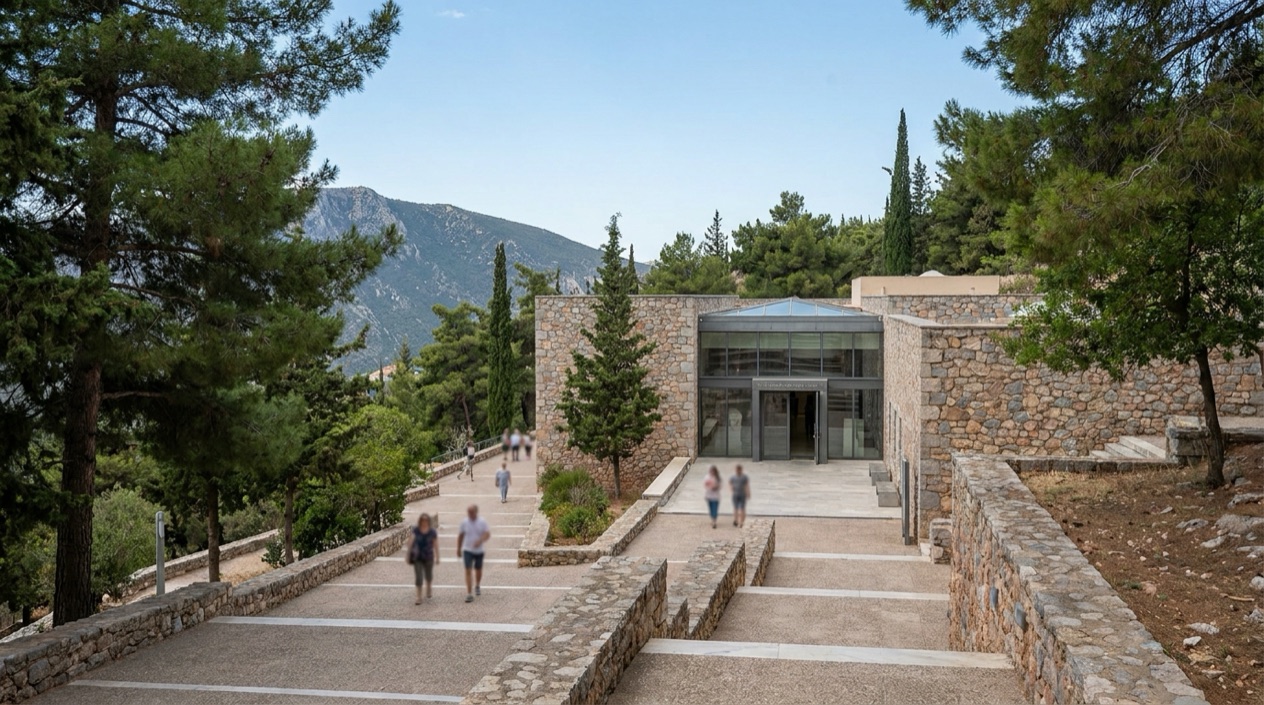
Is visiting the Delphi Archaeological Museum worth it?
The ruins on the slope of Mount Parnassus are foundations, terraces and broken columns. The museum is where the sculpture, the bronzes and the carved reliefs that once filled those terraces can be seen up close.
Delphi was called the navel of the Earth in antiquity, a spiritual meeting place for the Greeks and home to the most important oracle of ancient Greece. Cities and rulers sent gifts here to thank Apollo or to win his favor, and the museum shows what those gifts looked like. It is one of the principal museums of Greece and one of the most visited, which tells you that people do not treat it as an afterthought to the ruins.
What sets it apart from other museums near archaeological sites is the match between the collection and the ground outside. Many of the pieces were found within walking range of the building, so the Charioteer, the frieze and the sphinx connect to places you can see through the windows or from the sanctuary path.
Archaeological museums elsewhere in Greece often hold objects from a whole region. Here the story is about one sacred place and the people who came to consult it.
The layout helps. Fourteen rooms on two levels follow the history of the sanctuary and keep the visit orderly, so you can linger over a single masterpiece or move briskly through the rest. It suits first-time visitors to Greece, students of mythology, photographers of sculpture and anyone with a few spare hours around the ruins.
What to see at the Delphi Archaeological Museum
The Charioteer of Delphi
The Charioteer is the figure visitors come for. It is a bronze young man in a long robe, standing straight, the reins once held in his hand, his face calm after a race. A new hall was built for him during the renovations between 1999 and 2003, so he now has a room that is his own.
Look closely at the details: the folds of the garment, the fingers, the eyes set with inlay, the lashes. The figure was part of a larger group that included a chariot and horses, and what survives reminds you that victory in the games was a matter of pride worth a monument. Stand a little back first, then move in for the face.
The frieze of the Siphnian Treasury
The Treasury of the Siphnians was a small building on the sacred way, built to hold the offerings of one island community. Its carved frieze is among the great pieces of the museum, a band of marble relief crowded with gods, giants and warriors in motion. The figures overlap, turn and strain against each other, so the stone reads almost like a comic strip of myth.
Walk along it slowly and follow the scenes one by one. Some panels show gods in battle, others a gathering of deities watching the fighting below. Even where noses and arms are missing, the carving of hair, drapery and horses is crisp, and you can imagine the colors that once covered it.
The Sphinx of Naxos
The Sphinx of Naxos is a winged creature with a woman’s face and a lion’s body, an offering from the people of Naxos. It once sat high on a tall column, watching over the sanctuary, and in the museum you see how large and heavy it really is, with its curled wings and its fixed smile.
The sphinx belongs to the age of the oracle’s fame, when islands and cities competed to give the grandest gift. Come close to see the carved hair and the plume of the wings, then step back to picture it on its column, far above the pilgrims on the path.
The building and its fourteen rooms
The museum itself has a long story. A first, rather small museum was inaugurated on May 2, 1903, and a new building was accomplished in 1939. War and civil war kept it closed, and it was not reopened until 1952. A new phase of construction was completed in 1958, and the doors opened again in 1961.
The renovations that followed gave it a new facade and the Charioteer’s hall, and the museum opened once more for its centenary. Today the fourteen rooms on two levels are arranged around the finds of the sanctuary, with an entrance hall to begin and a cafeteria and a gift shop for the end.
Hours, tickets and rules
The museum is run by the Greek Ministry of Culture, through the Ephorate of Antiquities of Phocis, the regional body that looks after the antiquities of this part of central Greece. That is the authority behind the rooms, the collection and the care of the objects, and it is also the body behind the sanctuary on the hillside.
The archaeological site of Delphi is publicly accessible for a fee, and travelers combine the site and the museum in the same stay. They are two halves of one story, with the ruins showing the setting and the museum the treasures.
Inside, visitors are looked after by an entrance hall, a cafeteria and a gift shop. The exhibition floor spreads over fourteen rooms on two levels, with storage and conservation rooms kept apart from the galleries, as in any working museum.
The museum’s popularity is old. In 1998 it received more than 300,200 visitors, a sign of how steadily travelers have come to see the Charioteer and the rest. The sanctuary, the museum and the village all sit close together, which makes them easy to see as one visit.
When to visit the Delphi Archaeological Museum
In summer, Delphi teems with visitors who spend a few hours before or after their visit to the archaeological site. That is the busiest part of the year in the village, with the tavernas and the hotels full of people coming from the ruins and from the road.
A museum visit suits any season because it is held indoors. On a day when the weather is not right for the open slope of Mount Parnassus, the rooms give you the heart of Delphi under a roof, with the frieze, the sphinx and the Charioteer all in one place. In the warmer months you can step in from the sun, and in the cooler ones you can put the sanctuary walk and the museum on the same outing.
Think about the order of your day. Some travelers go to the ruins first and see the museum afterward, so that the objects arrive with the places fresh in mind. Others do the reverse, so that the sanctuary feels familiar when they reach it. Both work, because the finds in the rooms were made for the terraces outside.
If you are planning around the village, remember that the modern town lies very close to the site and spreads across two streets lined with small houses, hotels and tavernas. You can stay a night and take the museum and the ruins at an unhurried pace, with a meal in between.
Tips for your visit
Begin with the Charioteer, then work back through the rooms if you want the quiet of the small galleries afterward. Leave time for the frieze of the Siphnian Treasury, since the carving rewards a slow walk from one end to the other. A notebook or a phone with a few photographs of the site helps you match the objects to the places where they stood.
The cafeteria is the place for a coffee between the two levels, and the gift shop carries reminders of the visit. Beyond the museum, the village offers tavernas along its two streets, where a plate of grilled meat, a Greek salad with feta or a dish of moussaka makes a natural pause between the museum and the ruins.
The museum is on two levels, which is worth keeping in mind if anyone in your group prefers to avoid stairs. The rooms are arranged so that you can choose what to see, and the highlights are easy to name: the Charioteer, the frieze and the sphinx.
Pair the museum with the sanctuary itself, which is publicly accessible for a fee and sits on the southwestern slope of Mount Parnassus. Looking at the hillside after seeing the objects makes the place feel inhabited, and the ancient name of the oracle of Apollo reads differently when you have seen what pilgrims left behind.
Good to know before you go
Delphi is a UNESCO World Heritage site, designated in 1987, and the museum is part of what makes that status feel real, since it keeps the objects the ruins have lost. The village around it is small, so meals, coffee and a seat for a rest are close to hand after a morning among bronzes and marble. Bring comfortable shoes for the sanctuary slope and enough curiosity for a collection that rewards looking slowly.
Sources
- Wikipedia, Delphi Archaeological Museum (https://en.wikipedia.org/wiki/Delphi_Archaeological_Museum), checked October 12, 2026
- Visit Greece (GNTO), Delphi (https://www.visitgreece.gr/mainland/central-greece/delphi/), checked October 12, 2026
- Wikivoyage, Delphi (https://en.wikivoyage.org/wiki/Delphi), checked October 12, 2026