
Corinth suits history lovers, Bible-minded travelers following St. Paul, and anyone who enjoys a relaxed Greek coastal town. Many visitors come for the day from Athens. The town rewards an overnight stay, with mostly Roman ruins under a great fortified rock, an engineering marvel of a canal, and a waterfront made for long coffees.
Where should you stay in Corinth?
There are three good bases in the Corinth area, plus a fourth if Corinth is one stop on a longer trip.
Modern Corinth
The town sits near the point where the Corinthian Gulf meets the Saronic Gulf. It's laid out on a grid, with wide streets, big sidewalks, parks, and plenty of cafes and traditional tavernas. Much of the center is closed to cars, and thanks to the grid you can often glimpse the sea even a few blocks inland. The marina runs along the northern edge and the beach along the western side. A large statue of Pegasus stands on the waterfront near the marina. The winged horse appeared on Corinth's coins as early as the 7th century B.C. and is still the town's emblem.
Stay here if you want restaurants and a walk after dinner and don't mind a short drive to the ruins. Ancient Corinth is about 10 minutes away by car.
The village of Ancient Corinth
The ruins rise out of this modern village, so you sleep next to the site. Acrocorinth is ten minutes up the road, and you can hire a taxi in the village to get there.
Loutraki
Head east past the Corinth Canal and you reach Loutraki, a resort town known for its thermal springs and casino. If you want a relaxed beach atmosphere, it makes a better base than Corinth.
Nafplio
Nafplio, a Venetian coastal town 45 minutes from Ancient Corinth, works well if you're continuing into the Peloponnese.
What are the best things to do in Corinth?
Ancient Corinth
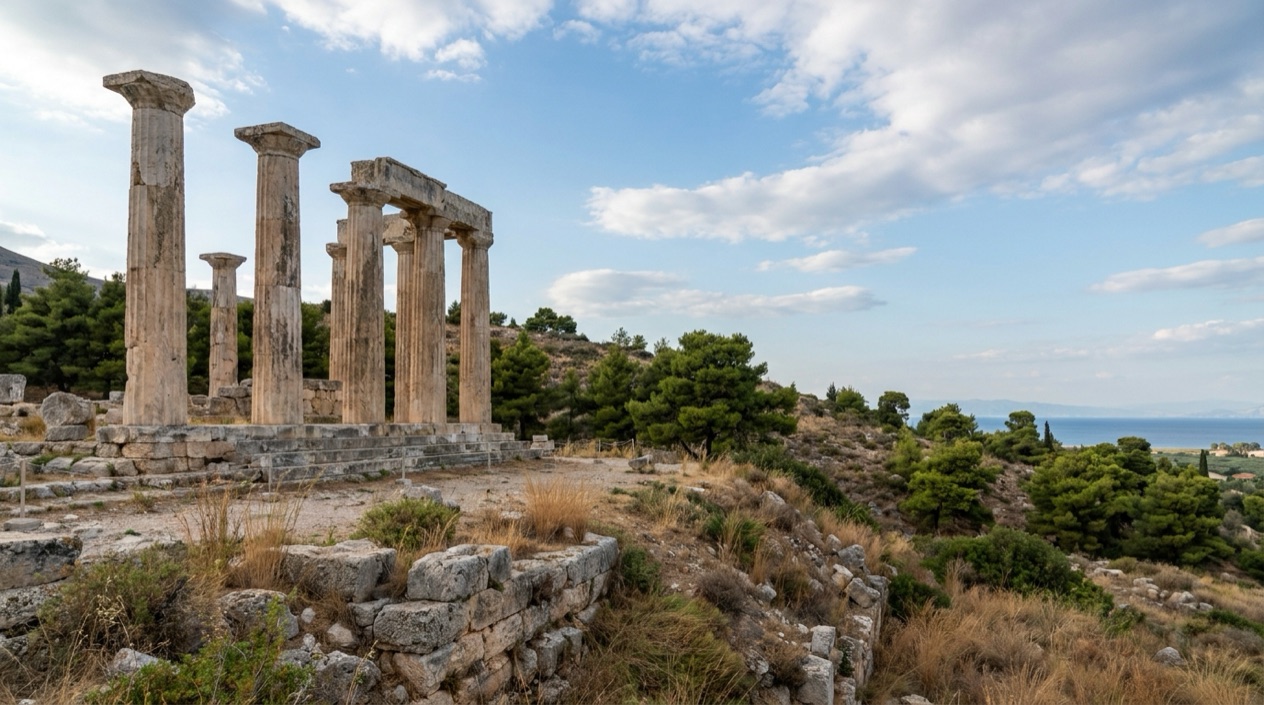
This is the heart of any visit. The ruins of the mostly Roman city are extensive yet compact. The great Greek exception is the Temple of Apollo, built in the mid-6th century B.C. in the Doric style, with seven of its monolithic columns still standing. You can climb up to its platform and walk all the way around it. The temple is long for its width, and its capitals are squat and widely flaring.
South of the temple spreads the agora, a huge open space bordered by the foundations of a very long stoa. Tradition says St. Paul was tried here for illegal preaching, and the platform later became a church. Paul spent about a year and a half in Corinth, and many visitors come for that connection.
The remains of the Julian basilica lie at the eastern end of the agora. Just north is the Lower Peirene fountain, with its six openings. Legend says the nymph Peirene wept so hard over her son that she dissolved into the spring. Excavation is ongoing, and the fountain itself is not open to the public. West of the fountain, steps lead down to the Lechaion Road, once the main route to the port. Along it you'll find the Peribolos of Apollo, a courtyard lined with Ionic columns, and nearby, a public latrine where some of the stone seats remain.
Opposite the site entrance are the fairly ruined ancient theater and the Roman odeion, an indoor theater from the 1st century A.D. The columns of Temple E stand south of the museum.
Begin and end in the museum. Its rooms hold finds from the area, fine Greek and Roman statues, mosaics, figurines and reliefs. A small room displays model body parts left as votive offerings at the nearby Sanctuary of Asklepios, and the pretty courtyard holds reliefs from the old theater. The collection has a story, too. In 1990 burglars stole 285 objects in the largest theft ever from a Greek museum. Nine years later the pieces turned up in Miami, hidden in crates of fresh fish, and came home. The museum now has an alarm system.
Plan on 1 to 2 hours for the site. Visitors with disabilities have access to both the site and the museum.
2026 prices: admission is €15 full price and €8 reduced. Entry is free on March 6, April 18 and May 18, and on the last weekend of September for European Heritage Days. Ancient Corinth, Acrocorinth and the Isthmia museum all close on New Year's Day, March 25, Orthodox Easter Sunday, May Day, and the Christmas holiday. All three open noon to 5:00 p.m. on Good Friday and 8:30 a.m. to 3:30 p.m. on Holy Saturday. In winter, closing times at Ancient Corinth shift with sunset, so check the posted hours before you set out.
Acrocorinth
The great rock above the ruins dominates the skyline, and you'll spot it from the highway long before you arrive. Greeks, Romans, Byzantines, Franks and Ottomans all adapted the fortress, so what you see now is a mix of many eras. Past the gates, paths wind among crumbled buildings and several churches and mosques that have been preserved or restored. A post-Byzantine church stands to the left of the main entrance, and the better preserved Mosque of Sultan Mehmed II sits up the hill to the right.
If you're up for a climb, head to the Frankish Tower on the southern side of the fortress. At the highest point are the foundations of the Sanctuary of Aphrodite. Little of the temple remains, but the views are fantastic.
Allow 1 to 2 hours. Acrocorinth is open every day from 8:30 a.m. to 3:30 p.m., and the hours are the same in winter and summer. It also opens on Easter Monday, Monday of the Holy Spirit, August 15 and October 28. There is no access for disabled visitors. Buses don't go up, so you'll need your own car or a taxi hired in the village of Ancient Corinth.
The Corinth Canal
The canal is a straight cut through the isthmus, completed in 1893. The canal is about 4 miles (6.4 kilometers) long, and in places its rock walls tower high above the water. At about 80 feet (24.6 meters) wide, it is too narrow for many modern boats. Walk along the edge for different views, and watch for the submersible bridges at each end, which sink into the water whenever a boat passes. Adventurous visitors can bungee jump from the bridge. At the northern end you can see a small stretch of the Diolkos, the ancient paved road along which ships were dragged across the isthmus. The canal is 10 to 15 minutes from Ancient Corinth.
Isthmia
About 10 miles (16 kilometers) east of Ancient Corinth, Isthmia usually hosted the Isthmian Games every two years in honor of Poseidon. They were one of the four great Panhellenic festivals, alongside the games at Olympia, Delphi and Nemea. None of the main structures still stand. What remains is an impressive mosaic floor and the foundations of many buildings.
The museum costs €5 full and €3 reduced. A combined ticket that adds the site and the Sanctuary of Poseidon costs the same. It's open 8:30 a.m. to 3:30 p.m. and closed Tuesdays. Entry is free on the same days as Ancient Corinth, plus October 28 and the first and third Sunday of each month in winter. The museum is fully accessible, and the site partly so.
The waterfront path
For an easy walk, follow the path that heads east from the marina along the water.
The Municipal Art Gallery
The Municipal Art Gallery, small and charming, opened after local artist Sotiris Pylarinos donated his collection to the town on the condition that it build a home for the works. It now holds more than 250 pieces dating from 1567 to today, along with temporary shows.
What are the best beaches in Corinth?
Kalamia Beach
Kalamia, the main beach in town, sits close to the center at the end of Georgiou Papandreou Street, which leads down to the sea. It's an organized beach, with fine sand close to shore and mostly pebbles farther out. Beach clubs rent sunbeds, and restaurants face the sand. Locals and visitors of all ages meet here, and it stays lively well beyond summer. The name comes from the reeds, kalamia in Greek, that once covered the area.
Loutraki
The resort town across the canal is a good spot for a swim, especially if you have a car.
What should you eat in Corinth?
Cafes, bars and traditional tavernas serving Greek dishes line the coast, many with water views. After a swim, the seaside tavernas and cafe-bars along Kalamia Beach are the natural choice. With a car, Loutraki makes a good alternative for dinner.
How many days do you need in Corinth?
Two days give you the ruins, the canal, a swim and time at the water. One long day covers the essentials.
Day 1: The ancient city
Head up to Acrocorinth first thing, since it closes at 3:30 p.m. Exploring Acrocorinth and Ancient Corinth together takes about three hours. Eat lunch in the village, then walk the agora, the bema and the Lechaion Road at Ancient Corinth, and finish in the museum. Come down to the marina for dinner by the water.
Day 2: Canal and coast
Start at the Corinth Canal and walk along the edge. Add Isthmia for a quieter hour, remembering that the museum is closed on Tuesdays. Spend the afternoon on Kalamia Beach with a swim, a sunbed and lunch at a taverna facing the sand. Finish with the waterfront path east of the marina. If you're moving on, this is the day to continue to Nafplio.
With just one day, follow Day 1 and catch the canal on the way in or out.
How do you get to Corinth and around?
Corinth lies about 50 miles (80 kilometers) west of Athens. The drive takes roughly an hour, depending on traffic: take the A8/E94 highway toward Corinth, then the Corinth Canal Road (EO8) to the archaeological site. From the Corinth to Patras national road, take the bypass at the Ancient Corinth interchange.
Trains run from Athens to Corinth in about an hour. The station stands on the main road between the modern town and Ancient Corinth, about two miles (three kilometers) from the town center, and a taxi to the ruins takes 10 to 15 minutes. Buses leave from Athens' Kifissos terminal, which the X93 city bus serves from the airport, and the ride takes between 57 minutes and 1 hour 20 minutes. They stop at the KTEL terminal in the center of modern Corinth. A taxi from there to Ancient Corinth takes about 15 minutes. The Corinth to Athens fare is around €10.20 (Kifissos, Terminal A), and the fare from Corinth to the Isthmus of Corinth, near the canal, is around €2.20.
A car gives you more flexibility, since the sights are spread out and public transport between them is limited. Walking from one to the next adds up to more than 12 miles in a day. Guided tours from Athens are the other easy option.
What should Americans know before visiting Corinth?
U.S. citizens can enter Greece without a visa for stays of up to 90 days, with a passport valid for at least three months beyond your planned departure date. If you rent a car, Greek law requires both a valid U.S. license and an international driving permit, even if the rental company doesn't ask for it.
The U.S. State Department rates Greece as generally safe, though petty crime is common in tourist areas. Pickpocketing and purse-snatching happen at busy sites and on public transport, and thieves target rental cars for passports, valuables and luggage. On buses, validate your ticket, since riding without a valid one can bring a fine of up to 60 times the fare. Strikes and demonstrations can disrupt transport with little notice, tremors occur regularly, and summer forest fires sometimes close roads, so keep some slack in your plans. Carry your passport or another photo ID with you while you travel in Greece, and keep valuables out of sight when you park.
Sources
- ascsa.edu.gr (https://www.ascsa.edu.gr/excavations/ancient-corinth/about-the-excavations-1/history-timeline), checked October 18, 2026
- cyark.org (https://www.cyark.org/projects/ancient-corinth/in-depth), checked October 18, 2026
- timetravelturtle.com (https://www.timetravelturtle.com/greece/things-to-do-in-corinth/), checked October 18, 2026
- lonelyplanet.com (https://www.lonelyplanet.com/points-of-interest/ancient-corinth/1018594), checked October 18, 2026
- greeking.me (https://greeking.me/blog/greek-mainland/ancient-corinth), checked October 18, 2026
- U.S. Department of State (https://travel.state.gov/content/travel/en/international-travel/International-Travel-Country-Information-Pages/Greece.html), checked October 15, 2026
- Hellenic Ministry of Culture, Odysseus (http://odysseus.culture.gr/h/1/eh155.jsp?obj_id=3377), checked October 18, 2026
- Visit Greece (GNTO) (https://www.visitgreece.gr/en/blog/travel-tips/uncover-ancient-corinth-and-acrocorinth-in-the-peloponnese), checked October 18, 2026
- Hellenic Ministry of Culture, Odysseus (http://odysseus.culture.gr/h/3/eh355.jsp?obj_id=2388), checked October 15, 2026
- Hellenic Ministry of Culture, Odysseus (http://odysseus.culture.gr/h/3/eh355.jsp?obj_id=15661), checked October 18, 2026
- U.S. Department of State (https://travel.state.gov/content/tsg_aem/us/en/home/international-travel/travel-advisories/destination.grc.html), checked October 15, 2026
- ktelbusesgreece.com (https://ktelbusesgreece.com/corinthia/corinth-to-athens-bus/), checked October 18, 2026