
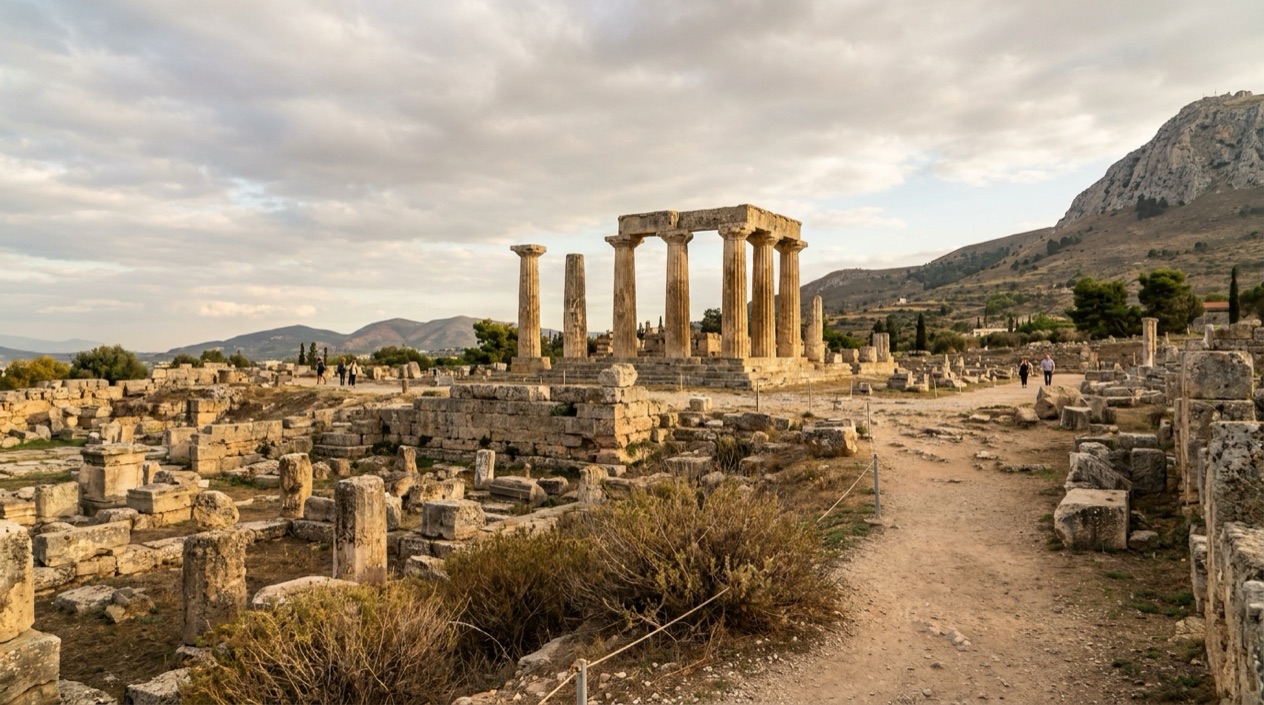
The first thing that rises above the Peloponnesian fields at Ancient Corinth is a handful of weathered Doric columns, standing alone against a huge rock behind them. Around the columns lie the foundations of a city that once controlled the land bridge between two seas. Here you walk through broken stone, olive trees and open sky, with a mountain fortress watching over the whole scene.
Is visiting Ancient Corinth worth it?
Yes, if you like ruins where the story is layered and the landscape explains the history. The site suits travelers on a road trip through the Peloponnese, curious readers of Greek and Roman history, and anyone who wants to understand why this particular patch of ground mattered so much.
Corinth sat on the Isthmus, the narrow neck of land joining the Peloponnese to mainland Greece, roughly halfway between Athens and Sparta. Anything moving by land between the two halves of Greece had to pass nearby, and the city had harbors on two different seas. That position made Corinth a trading power, a name known across the Mediterranean, and a city that other powers wanted to control.
What sets it apart from other ancient sites is how many chapters share one place. Corinth was a city-state in Classical Antiquity, it fell in a battle in 146 BC, it was later rebuilt, and its great rock, Acrocorinth, kept a fortress through the Middle Ages.
Few places let you read so many centuries in a single view. Temples, a theater and a castle on a crag sit within sight of one another, and an archaeological museum holds the objects that came out of the ground.
It also has a long modern story. Systematic excavations by the American School of Classical Studies at Athens began in 1896 and have continued with little interruption until today. A visit therefore feels like walking through a work in progress rather than a closed monument, with each season of digging adding to what is known.
What to see at Ancient Corinth
The ruins spread across a gently rolling terrace below Acrocorinth, so the eye keeps moving between low foundations, standing columns and the rock above. The highlights are the temple, the theater, the museum finds and the fortress on the hill, each telling a different part of the city’s long life.
The Temple of Apollo
The seven surviving columns of the Temple of Apollo are the image people carry away from Ancient Corinth. The temple was built in the Doric order, the plainest and most sturdy of the Greek styles, and originally had 38 columns around it. Today the remaining shafts stand as single blocks of stone, thick and unadorned, and they give the site its silhouette.
Stand near the base and look up at the monolithic shafts, then look past them to the rock behind. The name Corinthian is now attached to a more ornate column style with leafy capitals, but the temple here belongs to the older, sterner Doric tradition.
The ancient theater
The theater of Corinth was first built in the 5th century BC and could seat around 15,000 spectators. That figure tells you something about the city: it was large enough and wealthy enough to gather a crowd of that size for plays, speeches and public events. What survives is the curve of the seating area and the flat ground where the performers once stood.
Take a seat on the stone and imagine the sound carrying across the hollow. Greek theaters were built into slopes so that the audience faced both the stage and the countryside, and the same idea applies here. It is a good place to pause between the temple and the other remains and to think of Corinth as a living city rather than a set of stones.
The Archaeological Museum of Ancient Corinth
Finds from the Corinth excavations are housed in the Archaeological Museum of Ancient Corinth. This is where the site comes alive in small objects, since the museum shows what people made, used and left behind. Corinth was long known for its fine pottery and for the trade that carried it around the Mediterranean, so look for painted vessels and everyday items.
Seeing the museum together with the ruins makes each stronger. The columns tell you about scale and religion, while the museum tells you about daily life, workshops and the people who walked these streets. The excavations that continue on the site keep adding to the collection.
Acrocorinth and the old harbors
Acrocorinth, the acropolis of ancient Corinth, is a monolithic rock that was continuously occupied from archaic times to the early 19th century. It is one of the most important medieval castle sites in Greece, and its walls reflect the many hands that held it. Its story, from a sacred height to a stronghold, runs parallel to the story of the city below.
The city also had two harbors, Lechaeum on the Corinthian Gulf and Cenchreae on the Saronic Gulf. Lechaeum, the principal port, was linked to the city by long walls of about 1.9 miles. Together they show how Corinth worked: a city on the land bridge with a foot in two seas, protected by high walls and a high rock.
How to get to Ancient Corinth
The ruins are not in the modern city. They lie a little outside it, about 3.1 miles southwest of new Corinth, since the modern city lies northeast of the ancient site. That separation matters when you plan, because staying in Corinth does not put you at the ruins.
The site stands on the Isthmus of Corinth, the land bridge between the Peloponnese and mainland Greece, roughly halfway between Athens and Sparta. That puts it on the natural line of travel between the two, and it fits into a journey through the Peloponnese rather than a trip of its own. Corinth, a port town with a population of 37,000, is the base closest to the ruins.
Modern Corinth was rebuilt after the great earthquake of 1858, which explains why it feels like a planned town and not an ancient one. Its pedestrianized center is made for walks, shopping and relaxation, and the town has parks, squares and a harbor.
When to visit Ancient Corinth
Ancient Corinth is an open landscape of stone, grass and sky, so the weather of the day shapes the visit more than any date on the calendar. The ruins and the rock above them are meant to be seen outdoors, and the experience depends on how you feel walking among them.
There is no special festival or seasonal event to plan around. What matters is the setting. On a clear day the Temple of Apollo stands out against Acrocorinth, and the long view across the Isthmus helps you see why the city rose here.
Since the site is mostly open ground, sun protection and a water bottle make sense when the day is hot, and a rain jacket when the sky is dark. Leave room in your plans for the museum, which gives you somewhere to continue if the weather turns.
Tips for your visit
Start with the big picture, then move to the details. Look first at the Temple of Apollo and the surrounding terrace, then go to the theater, then the museum, so that the objects explain what you have just walked through. Keep your eye on Acrocorinth throughout, because it ties the site together.
Comfortable shoes are a good idea, since the ground among the ruins is uneven stone. Bring water and something for the sun. If you travel with children, the theater and the standing columns are the parts they tend to remember, and the story of the two harbors and the long walls gives them a way to picture how the city worked.
Combine the ruins with Acrocorinth, one of the most important medieval castle sites in Greece, and with the modern city. In Corinth, the pedestrianized center is a place for a walk and a meal, and the harbor adds a seaside moment to the day. The battles of 146 BC and 1458 both belong to the city’s story, so you will meet them again in the sites you visit.
Good to know before you go
Think of Ancient Corinth as one stop in a longer journey through the Peloponnese, a place that rewards a slow walk and a bit of reading beforehand. Modern Corinth, with its parks, squares and harbor, makes a pleasant place to eat and wander before or after the ruins. The ancient site and the modern town are separate places, and each is worth its own time.
Sources
- Wikipedia, Ancient Corinth (https://en.wikipedia.org/wiki/Ancient_Corinth), checked October 12, 2026
- Visit Greece (GNTO), Corinth (https://www.visitgreece.gr/mainland/peloponnese/korinthos/), checked October 12, 2026
- Wikipedia, Corinth (https://en.wikipedia.org/wiki/Corinth), checked October 12, 2026
- Wikivoyage, Corinth (https://en.wikivoyage.org/wiki/Corinth), checked October 12, 2026
To plan your stay
- Best Time to Visit Greece: September and Late May to Early June
- Arachova: Parnassus Mountain Town, Formaela Cheese, Ski Season and Saint George's Day
- American Airlines Flights to Greece: U.S. Cities, Athens Arrivals and Onward Island Flights
- Greece on a Budget: Cash Machines, Cards, Beaches and Ferries