
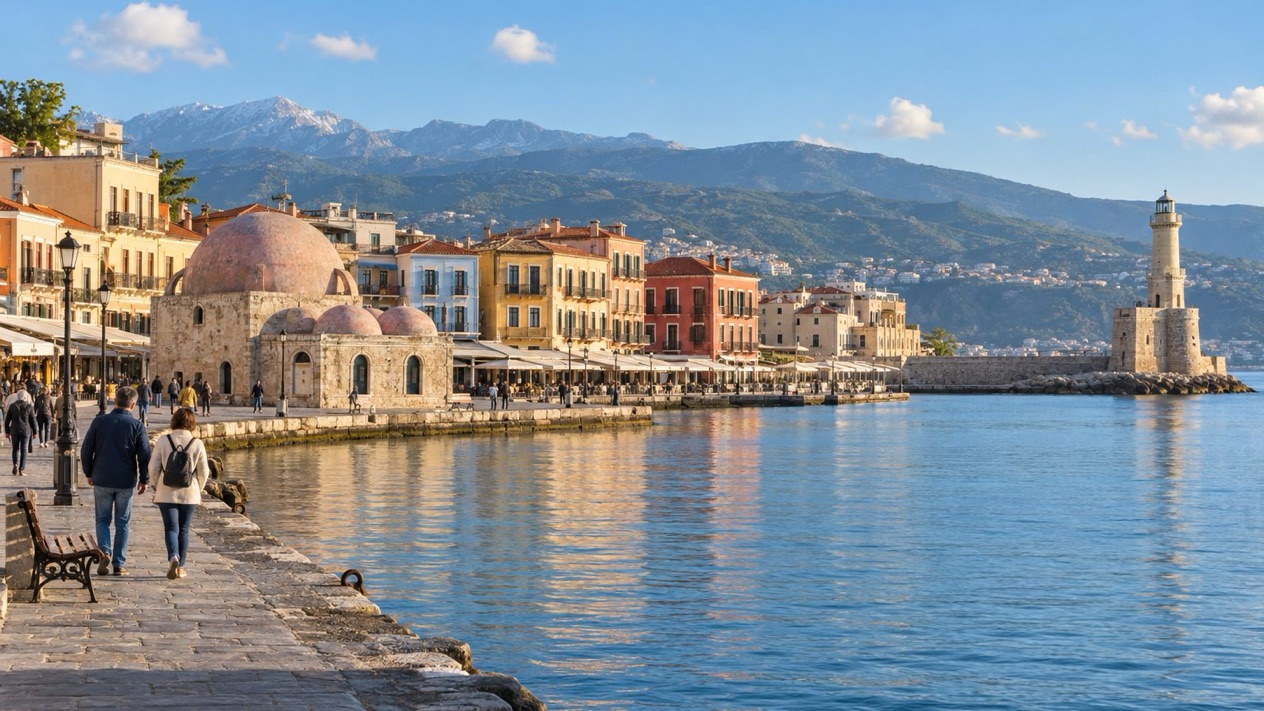
In February, the Venetian harbor of Chania makes a fine setting for a walk between rain showers. Orange and lemon trees hang heavy with fruit in the gardens around town, and Carnival season brings costumes and music to the streets of Greece. It is a month for walking the Old Town, eating well, and seeing Crete in its winter dress.
What is the weather like in Chania in February?
February in Chania is cool and damp rather than cold, with mild afternoons, chilly nights and a good share of wet days.
| Month | Average high (°F) | Average low (°F) | Precipitation (in) | Days with 1 mm or more of precipitation | Daylight on the 15th | Sea (°F) |
|---|---|---|---|---|---|---|
| January | 57.7 | 47.1 | 5.65 | 14.3 | 10 h 00 min | 63.4 |
| February | 58.5 | 46.8 | 4.97 | 13.1 | 10 h 51 min | 61.5 |
| March | 62.4 | 49.6 | 3.34 | 9.9 | 11 h 52 min | 62.1 |
Afternoons in the high 50s mean you can walk the harbor and the lanes of the Old Town with a sweater and a light jacket, and a sunny stretch on a terrace feels like a gift. Lows in the 40s call for warm layers when you go out to dinner, and for a proper coat if you feel the cold.
With rain on well over a third of the days, a waterproof jacket and shoes that handle wet stone belong in the bag. Plan every outing with an indoor alternative in mind, such as a café or a long taverna lunch.
Daylight is growing, and by mid-month the evenings stretch noticeably longer than they did in January. That gives you room for a full day of sightseeing, then a slow dinner after dark.
Can you swim in Chania in February?
Swimming in February is for the bracing-dip crowd, since the sea near Chania sits around 61.5°F. People will be happy to look at the water rather than get into it, and a quick plunge is the realistic ambition.
The coast around Chania is long and varied, from the harbor in town to Souda Bay, where the port lies, and to the villages on the shore such as Maleme. Walking beside the water is a pleasure in this season, even if you never get your feet wet. A shoreline stroll ends naturally at a seaside table with a plate of grilled fish and a glass of local wine.
If you do bring swimwear, bring a big towel and a warm layer for the moment you step out. A hot drink afterward, a tea with honey or a Greek coffee, is the usual reward in a Cretan café.
What to do in Chania in February
February is the month of Carnival in Greece, known as Apokries, the weeks of costumes and parties that lead up to Lent. Celebrations typically include parades, public street parties and other entertainments with a touch of the circus about them. The Patras Carnival, first held in 1829, is the largest event of its kind in Greece, and it sets the tone for how the whole country celebrates.
Carnival also has a table. Traditionally the butter, milk and other animal products in the house were used up during these weeks rather than wasted, which is why this is a season of cheese pies, sausages and generous family meals. In 2027 Clean Monday falls on March 15, so the carnival weeks run through February that year.
The Old Town and the harbor
The Old Town is the natural base for a February visit, and the Kasteli district has been inhabited since the Neolithic Age. You can walk among Venetian and Ottoman buildings, lanes lined with shops selling leather goods and ceramics, and the waterfront where fishing boats and cafés share the quay.
Chania was the site of a Minoan settlement, known from the Linear B tablets of Knossos as Ku-do-ni-ja, and Dorian settlers arrived around 1100 BC to the city then called Cydonia. Layers of history show in the stone of the harbor walls and in the names of the streets. A winter wander through them lets you read the town at your own pace.
When the rain arrives, the covered alleys and cafés are your refuge. Order a Cretan coffee or a glass of raki, the strong grape spirit often poured with a small plate of meze.
Eating Cretan in winter
February food on Crete is warming and green. Look for dakos (barley rusk with tomato and soft cheese), wild greens called horta cooked with olive oil and lemon, snails, lamb stews and boureki, a baked dish of zucchini, potato and cheese. Citrus is in season, and oranges appear in salads and desserts.
Beyond the harbor, the villages around Chania have their own tavernas. Kounoupidiana has Mpourakis restaurant and The Roadhouse Bar & Grill, whose owners speak fluent English, Bulgarian and German. Maleme has Mike’s. Cafés in town serve kalitsounia, small cheese pastries, and bougatsa, a custard-filled phyllo pastry.
Villages, the countryside and the ports
Therisso is closely associated with Eleftherios Venizelos. A country drive through such villages, with stops for coffee and a look at the church squares, suits a gray winter day when the harbor feels a little damp.
Chania also gave Greece Mikis Theodorakis, the composer, and Nana Mouskouri, the singer, and you may hear their songs in cafés and tavernas. The port at Souda, about 4.3 miles east of Chania, has daily ferries to Piraeus, and Kissamos, 25.5 miles west, connects to Kythira, Antikythera and the Peloponnese.
Sports fans may catch the Nautical Club of Chania, known as N.O.X., a regular in the top Greek water polo league. Football fans can follow Chania City F.C. at the Perivolia Municipal Stadium.
A two-day itinerary for Chania in February
Day 1 belongs to the Old Town. Start with a Greek coffee and a pastry at a harbor café, then walk the waterfront and cut into the Kasteli district. The days are short in winter, with just under eleven hours of daylight around mid-month, so keep the sightseeing for the daytime and leave the evening for eating.
Take lunch in a taverna in the lanes behind the harbor, with a plate of horta, a cheese pie and grilled meat or fish. Spend the afternoon among the shops for leather, ceramics and local olive oil, and walk the harbor again as the lights come on. Dinner can be a long meze table with raki.
If rain sets in, stay under the arcades and linger in cafés, and let the afternoon turn into a long lunch. Day 2 leaves town for a drive through the villages around Chania, with lunch at a taverna that is open. Along the way, stop at a village church square for coffee, and see Therisso if the weather holds.
Afterward, drop by Souda to look at the port where the Piraeus ferries dock, then return to Chania for a final evening in the Old Town. If the weather turns, a café with a view of the harbor and a bowl of something hot is a fine plan B.
Is Chania busy in February?
February is a winter month in Chania, and the pace of the place reflects it: the focus shifts from beaches to tables, streets and the local calendar.
Daily ferries link Souda to Piraeus. Chania International Airport (CHQ) sits on the Akrotiri Peninsula.
With cool temperatures and many rainy days, February is a month for town life more than for the coast. Spend your time among Chania’s cafés, bakeries and tavernas, and plan your days around the weather rather than around beach hours.
What to pack for Chania in February
Pack for cool, damp days that are often mild in the afternoon, with plans that mix walking, eating and a few trips by car.
- A waterproof jacket, because rain falls on many days in the month.
- Shoes with a good grip for wet stone lanes in the Old Town.
- A sweater and a warm layer for nights in the 40s.
- An umbrella for the walk between café and taverna.
- Sunglasses, because the sun can still be bright on clear afternoons.
- Swimwear and a towel only if you plan a brave dip in the sea.
Good to know before you go
Rain is frequent in February, so build flexibility into your days and keep a café or a taverna as your fallback. Carnival season sets the mood, with Clean Monday marking the start of Lent. Ferries from Souda run daily to Piraeus, and Kissamos has its own island and Peloponnese connections, which is useful if you are building a longer trip around Crete.
Chania in February vs January and March
Going a month earlier brings a slightly warmer sea and a little more rain, with the shortest days of the winter.
Going a month later brings noticeably more daylight, warmer afternoons and fewer rainy days. March suits those who want to be outdoors more, walking the coast and the countryside, though the sea is still on the cool side.
February sits between the two, and it is the month of Carnival in Greece. Choose it if you want the festive mood, the winter food and a quieter-feeling town. Shift to March if you want longer, brighter days.
Is February a good time to visit Chania?
Yes, February is a good time for travelers who come for the town, the table and the winter mood rather than the beach. Anyone who plans to spend their days on the sand and in the sea should choose another month.
Food lovers will be happy with the season of horta, citrus, cheese pies and long taverna lunches. History lovers have the Old Town, with its Minoan and Dorian beginnings, and photographers have the harbor in its winter light. On arrival, start with a slow walk around the waterfront to get your bearings. What is special in February is the combination of Carnival season and a working Cretan town, where the cafés are full of residents and the orange trees are heavy with fruit.
Sources
- Hellenic National Meteorological Service (HNMS), climatological normals 1991-2020 for Souda station (https://www.emy.gr/climatic-data), monthly mean daily maximum and minimum; rain from the ECMWF ERA5 reanalysis, 1991-2020, grid cell of Chania (Open-Meteo), checked October 12, 2026
- ECMWF ERA5 reanalysis 1991-2020, grid cell of Chania (Open-Meteo), checked October 12, 2026
- Open-Meteo Marine API, mean 2022-2024, checked October 12, 2026
- Computed from the date and the latitude of the place (sunrise equation, solar elevation -0.833 degrees), October 12, 2026
- Wikipedia, Carnival in Greece (https://en.wikipedia.org/wiki/Carnival_in_Greece), checked October 12, 2026
- Computed by the Julian computus used by the Greek Orthodox Church (Meeus algorithm, plus the 13-day Gregorian offset valid from 1900 to 2099); checked against the published 2025 and 2026 dates, October 12, 2026
- Wikipedia, Patras Carnival (https://en.wikipedia.org/wiki/Patras_Carnival), checked October 12, 2026
- Wikipedia, Climate of Greece (https://en.wikipedia.org/wiki/Climate_of_Greece), checked October 12, 2026
- Wikipedia, Geography of Greece (https://en.wikipedia.org/wiki/Geography_of_Greece), checked October 12, 2026
- Wikipedia, Chania, section History (https://en.wikipedia.org/wiki/Chania#History), checked October 12, 2026
- Wikipedia, Chania, section Notable residents (https://en.wikipedia.org/wiki/Chania#Notable_residents), checked October 12, 2026
- Wikipedia, Chania, section Sports (https://en.wikipedia.org/wiki/Chania#Sports), checked October 12, 2026
- Wikipedia, Chania, section Transport (https://en.wikipedia.org/wiki/Chania#Transport), checked October 12, 2026
- Wikivoyage, Chania, section Eat (https://en.wikivoyage.org/wiki/Chania#Eat), checked October 12, 2026