
On Yakushima the forest begins almost where the road ends, and it arrives as a smell first: wet cedar, moss and cool stone. Trunks as wide as a small house stand wrapped in green, and the light comes down in pieces through the branches.
Is visiting hiking on Yakushima worth it?
Yes, if walking through old forest is the reason you are traveling. Yakushima suits hikers who enjoy long days on foot, photographers drawn to moss and mist, and anyone who wants a Japan of trees and mountains rather than temples and train platforms.
What sets the island apart from the other places in southern Kyushu is how completely the landscape is made of forest. Almost all of Yakushima is covered by mountains and woodland, and a good part of it lies inside a national park. The ancient forest has been a natural UNESCO World Heritage Site since 1993, which tells you the island is protected for its trees and not for a monument.
Nearby islands such as Tanegashima are known for other things. Yakushima is where the mountains rise straight out of the East China Sea and hold a forest that feels cut off from everything around it. Hiking here means walking along old logging tracks, crossing streams over stones, and stepping around roots that have been growing for centuries.
It also pairs the forest with other pleasures. There are onsen, the hot springs Japan is known for, where you can soak after a day on the trail. There are beaches where sea turtles come ashore.
What to see at hiking on Yakushima
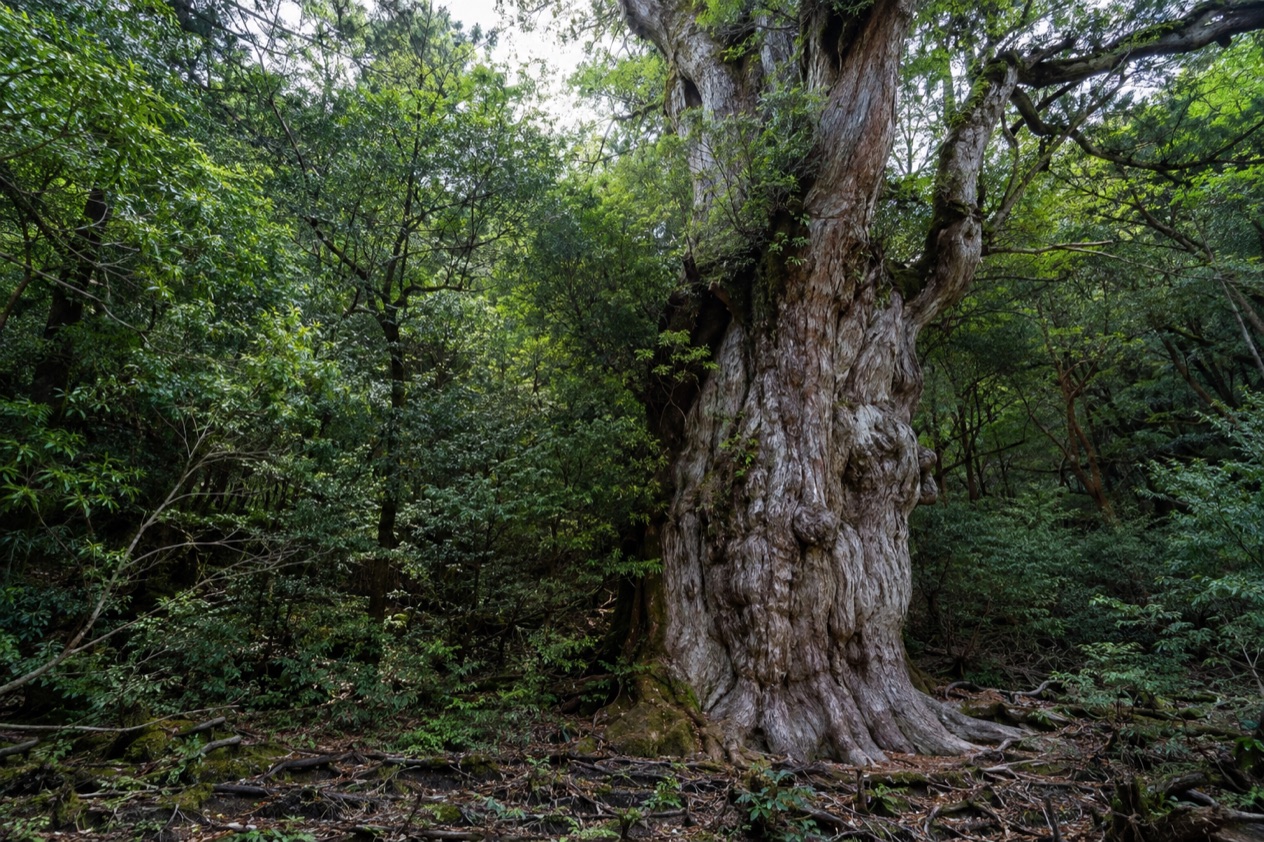
Jomon Sugi, the old cedar
It cannot be reached by road. You get there only on foot, on a hike of four to five hours, which makes arriving feel like an achievement rather than a stop on a bus tour.
The path follows the line of old logging tramways, with rails and wooden sleepers still visible in places, a reminder that these forests were once cut for timber. The tree itself is thick, gnarled and strangely shaped, with a trunk that seems made of several trunks fused together. Look at the bark, the moss on the nearby stones, and the way the surrounding trees seem small beside it.
This outing suits people who are comfortable spending most of a day outdoors in a mountain forest. Bring layers and rain protection, since the forest’s own moisture is part of what makes it look the way it does. Plan to take your time, because the walk is as much of the experience as the tree.
Cedar forests, moss and the Mononoke atmosphere
The cedars of Yakushima are called yakusugi when they pass a great age, and the island is full of them. In the forest areas around the trails you see trunks covered in ferns, bright green moss on every rock, and small streams threading between the roots. It is a landscape that visitors link to the forest of the animated film Princess Mononoke, and the comparison is easy to understand once you are standing in it.
Beyond the headline tree, the smaller walks reward you for looking closely. Watch for the way light falls on moss after rain, the sound of water running somewhere out of sight, and the tight, curling shapes of old roots. Walking slowly here gives more than rushing toward a destination.
Whichever you choose, the pleasure is the same: tall trees, damp air and the feeling of being a long way from any town.
Miyanoura and the high peaks
Mount Miyanoura is the highest mountain in Kyushu, and it rises from the middle of the island. The peaks of Yakushima are a different world from the cedar valleys below. The forest thins, the views open, and the mountain shows its granite bones above the trees.
Climbing here is for experienced hikers with the right gear and a willingness to walk for a long time. The reward is a sense of the island’s scale: layers of green ridges, cloud sweeping across summits, and the sea on every side. In winter the high ground can hold snow, which surprises people who think of the island only as a subtropical place.
If a summit day sounds like too much, the lower slopes give a taste of the mountain’s character. You can walk among the trees, climb to a viewpoint, and see the peaks from a distance. The island’s forest changes with elevation, and noticing that change is half the fun of hiking here.
Loggerhead turtles and the coast
Yakushima is the largest nesting ground for the endangered loggerhead sea turtle in the North Pacific. The forest may be the reason people come, but the shoreline has its own importance. Sandy beaches here are where turtles come to lay eggs, which is why the coast matters as much as the mountains.
Seeing a turtle is a chance, not a promise, and it depends on when you travel and on local rules about the beaches. Treat the shore as a place to look and learn rather than a place to wander freely. It gives a pleasing counterpoint to the forest days: the same island, salt air instead of cedar, and a reminder of how many kinds of life it supports.
Onsen after the trail
Yakushima has several onsen, hot springs that can be used for bathing or as natural spas. After a long day among trees, a hot bath is one of the most welcome things on the island. Soaking tired legs while the forest darkens outside is a pleasure many hikers plan their days around.
Bathing customs are familiar from elsewhere in Japan: you wash before entering the water and the bath itself is for soaking. Each onsen has its own character, so ask where you are staying which one fits your day. It is the natural way to finish a hike, with warm water and a quiet evening.
How to get to hiking on Yakushima
Yakushima is an island, so you reach it by air or by sea. It lies off the south east coast of Kyushu, next to Tanegashima and north of Okinawa, and it sits to the south of Kagoshima, which is the usual gateway for the trip.
By air
Yakushima Airport has direct flights from Kagoshima, Fukuoka and Osaka Itami. From Kagoshima Airport the flight takes approximately 40 minutes, which makes it the shortest way across for anyone starting from southern Kyushu.
Flying suits travelers coming from farther away, because Fukuoka and Osaka Itami both have a direct connection. It means you can plan the island as a trip in its own right, arriving by air and leaving by air, without crossing back to Kagoshima first. Once you land, the forest and the trailheads are on the same island.
By ferry
The island is also served by hydrofoil ferry and by car ferry. A hydrofoil is a fast passenger boat, while the car ferry can carry vehicles, which matters if you want to bring your own. Both link Yakushima with the mainland, and both give you a look at the island’s mountains rising out of the sea as you approach.
Choosing between flying and sailing is a question of what you want from the journey. The sea crossing is part of the experience for some travelers, while others prefer to land and start walking. The schedules, sailing times and fares are not given here, so confirm them with the operators before you plan around a particular crossing.
When to visit hiking on Yakushima
The forest rewards a visit in any month you can reach it, because the trees do not depend on a season in the way cherry blossoms do. What changes is the mood: mist, rain, bright clear spells and the cold of the high ground each give the same trail a different face. Think about what you want to see before picking dates.
Moisture is part of the island’s character. The moss that covers the stones and trunks is there because the air stays damp, so expect wet paths and a green, glistening forest rather than dry ground. Good rain gear is part of any packing list, and a rainy day can make the woods look most dramatic.
The high peaks behave differently from the coast. The mountains can be much colder than the shore, and in winter they can carry snow. If you plan to climb toward Mount Miyanoura, think about the conditions at altitude rather than the weather in the town where you are staying.
If seeing turtles matters to you, the nesting beaches are part of the island’s calendar, and it is worth learning when the nesting happens before you set dates. Timing a trip around the turtles and the forest at once is possible, but it takes a little planning. The turtles are a chance, never a certainty.
The forest asks you to slow down, and a day lost to weather is not a wasted day, since the island has onsen, coastline and villages to fill it. Flexibility is the best thing you can bring.
Tips for your visit
Pack for wet ground and changing weather: sturdy shoes with good grip, a rain jacket, and layers you can add or remove. Moss and stones are slippery, and the forest holds damp even after the rain stops. Bring water, some food for the trail, and a small bag that keeps your camera dry.
Give yourself a gentle evening afterward, ideally with an onsen soak. If you are traveling with family, choose a forest walk that matches the youngest walker’s stamina, and be ready to turn back.
Combine the forest with a stretch on the coast. Yakushima is known for loggerhead turtles, and the shoreline gives a different pace from the mountains. A day among the cedars followed by a day by the sea makes a balanced trip, and the island is large enough that you are unlikely to run out of things to do.
Stay on the paths and treat the forest with care. It is a protected landscape, and part of the island lies inside a national park. Pick up whatever you carry in, keep your distance from the roots of old trees, and leave moss and plants where they are. Those habits are part of why the place looks the way it does.
For mobility and accessibility, remember that the Jomon Sugi is reachable only on foot, so it is a hike for people comfortable with long walking days. Travelers who prefer something gentler can still enjoy the island through its onsen, its coast and the edges of the forest. Ask your lodging about local options on the day.
Good to know before you go
Yakushima is a place where weather decides a great deal, so keep your plans loose and your gear dry. The mountains can turn cold and wet quickly, and storms can disrupt crossings and flights, which is worth remembering when you plan the ends of your trip. Carry some cash for small shops and baths in case a card is not taken, and let someone know your route before a long day on the trail.
The island’s forest is listed on the UNESCO World Heritage List, and walking it carefully is the way to say thank you. Take your time, take photographs rather than souvenirs, and leave the trees as you found them.
Sources
- Wikipedia, Yakushima (https://en.wikipedia.org/wiki/Yakushima), checked October 11, 2026
- Japan National Tourism Organization, Yakushima (https://www.japan.travel/en/destinations/kyushu/kagoshima/yakushima/), checked October 11, 2026
- Wikivoyage, Yakushima (https://en.wikivoyage.org/wiki/Yakushima), checked October 11, 2026