
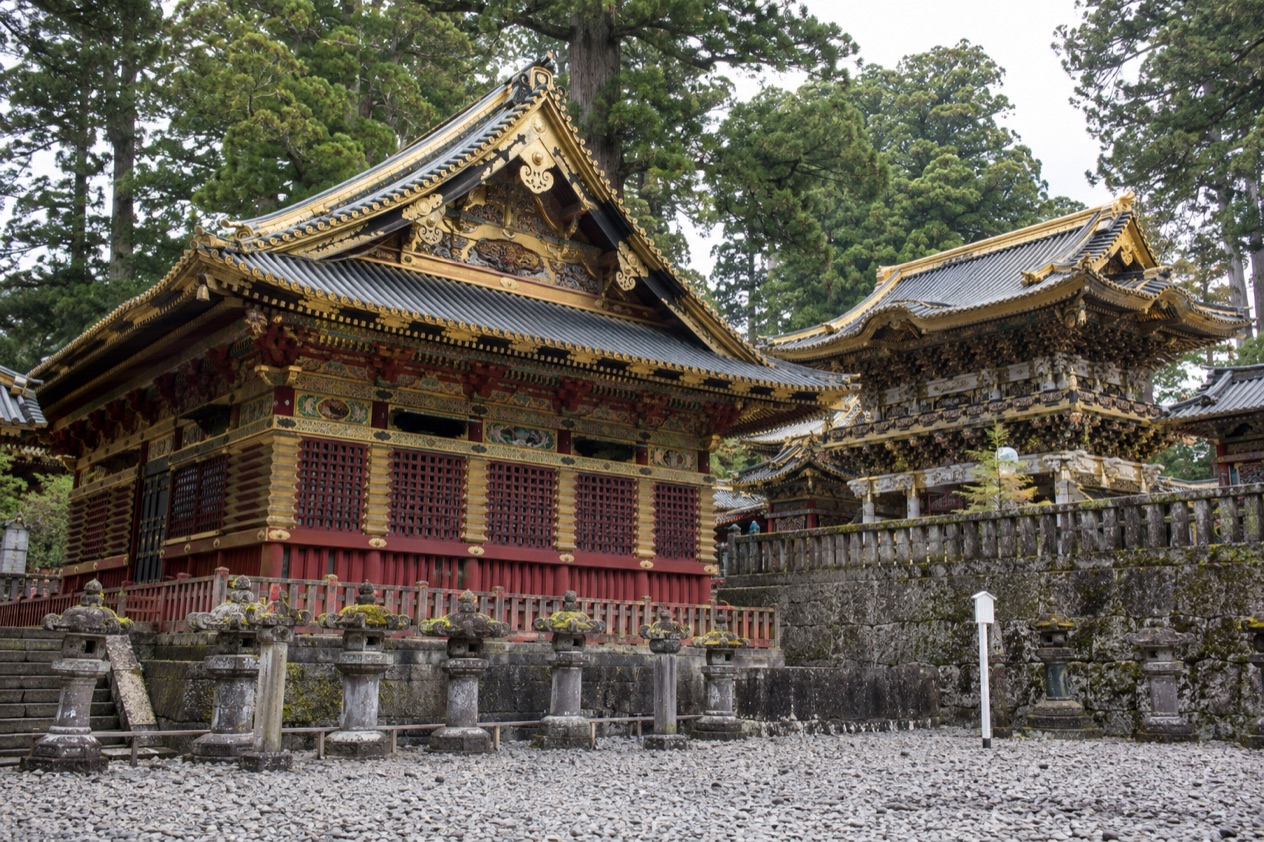
Stone lanterns line the approach, tall cedar trunks rise on every side, and then the color begins: red lacquer, gold leaf, and carved flowers, birds and beasts climbing the gates of Nikko Toshogu. The shrine honors Tokugawa Ieyasu, the first shogun of the Edo period, and it was built to dazzle. A visit here is a slow circuit from gate to gate, looking up at the carvings and across at the courtyards, in a town to the north of Tokyo.
Is visiting Nikko Toshogu worth it?
Yes, if you enjoy craftsmanship, history and small details you can lean in close to study. The shrine rewards people who like to look: the carvers who worked here crowded every beam, panel and gable with figures, and the pleasure is in finding them one by one.
It is also a good fit for travelers who want a day outside Tokyo that feels different from the capital. Nikko is in Tochigi Prefecture, in the Kanto region, and the shrine sits among old cedars, so the day has the feel of a walk in a wooded precinct as much as a sightseeing stop.
What sets Toshogu apart from the other shrines and temples around it is its sheer richness. Nikko Toshogu forms the Shrines and Temples of Nikko World Heritage Site together with Futarasan Shrine and Rinno-ji, and the three are quite different in spirit. Toshogu is the one that surprises you if you expect a Shinto shrine to be a plain wooden hall: here every surface is painted, gilded or carved, in a way that was meant to show the power of the Tokugawa family.
The shrine was first built in 1617, in the Edo period, and the place still carries that confidence. Five of its structures are National Treasures of Japan, and three more are Important Cultural Properties. That is a lot of protected architecture in one precinct, and it explains why a visit feels more like walking through a gallery of buildings than visiting a single hall.
It is less well suited to someone who wants a hands-on or athletic day. The experience is about looking, reading symbols and following the layout of the courtyards, so people who tire of carvings and gates after an hour may prefer to pair it with the lake country higher up, or with the neighboring sites that share its World Heritage listing.
What to see at Nikko Toshogu
The core of the visit is a handful of structures that are easy to name and fun to hunt for. Each one tells a small story, and together they show the range of the carvers’ work, from solemn grandeur to a joke about a sleepy cat. Take them as stops along one long circuit rather than separate trips, and leave room to stand and look at whatever catches your eye between them.
Yomeimon gate
The Yomeimon is the showpiece of the shrine, a gate so densely decorated that it seems to glow against the dark cedars. Its other name, higurashi no mon, means the gate you could look at until sundown without tiring, and the phrase is a fair description. Figures of children at play, mythical animals, flowers and dragons fill nearly every beam and bracket.
Do not rush it. Stand back first to take in the whole facade, then step closer and let your eye follow one band of carving at a time. The white and gold against deep red is especially striking when light filters down through the trees. It is a good place to slow your pace for the rest of the visit.
The sleeping cat near the Karamon
A small woodcarving of a sleepy cat, called Nemuri-neko, is attributed to Hidari Jingoro and sits near the Karamon gate. It is easy to miss, because it is modest in size next to the grand gates around it, and many people walk right past while looking at the larger carvings. That small scale is part of its charm.
The cat is often read as a gentle image of peace, a creature dozing in the middle of a place built to honor a warrior ruler. Look closely at the curled body and the half-shut eyes, then consider how much life the carver gave to a piece of wood. It is a favorite subject for photographs, and children usually like being told to go find it.
The three wise monkeys at the sacred stable
The stable that houses the shrine’s sacred horses carries a carving of the three wise monkeys, the ones who see no evil, hear no evil and speak no evil. The image is a traditional symbol in Japanese culture, and many travelers know the pose even before they arrive. Seeing it here, on the building where it was carved, gives it a setting.
The monkeys are one panel in a larger sequence of carvings on the stable, and the panels are worth reading from one end to the other. The stable also reminds you that a shrine was once a working place with animals and attendants, not only a collection of decorated halls.
The five-story pagoda
The pagoda has a history of loss and replacement. The original was donated by a daimyo, a feudal lord, in 1650, but it burned down and was rebuilt in 1818. What you see today is therefore the later building, and it stands as a tall, layered tower whose tiers narrow toward the top.
A pagoda is a Buddhist form, and its presence next to a Shinto shrine is a clue to how closely the two traditions lived side by side in Japan. Look at the rooflines and the painted details, and compare the restrained structure with the busier gates nearby. It makes a good change of pace between the more crowded carvings.
When to visit Nikko Toshogu
The shrine opens in the morning and closes in the afternoon, so plan the visit as a daytime outing. The closing time moves earlier in winter, which matters if you are coming up from Tokyo and want a full walk. Taiyuin-byo, the neighboring site, keeps the same hours.
| Site | Open April to October | Open November to March |
|---|---|---|
| Toshogu Shrine | 08:00-16:30 | 08:00-15:30 |
| Taiyuin-byo | 08:00-16:30 | 08:00-15:30 |
They show the direction of the year well enough: cold and snowy in winter, cool in spring and fall, mild and wet in summer.
| Month at Oku-Nikko | Average high (°F) | Average low (°F) | Precipitation (inches) | Days with 1 mm or more | Sunshine (hours) |
|---|---|---|---|---|---|
| January | 31.5 | 17.8 | 2.26 | 6.4 | 165 |
| April | 50.2 | 32.4 | 6.08 | 10.7 | 187 |
| July | 71.8 | 58.8 | 11.04 | 16.4 | 110 |
| October | 56.7 | 42.3 | 9.48 | 11.1 | 123 |
January is the cold month, with snow falling on most days up near the lake, and the long, dark cedars make a stark frame for the red and gold of the buildings. Dress for real winter if you go, and expect the shrine to close earlier in the day.
April still brings some snow and sleet on the higher ground, but the air has softened and there is more sun. October is cool and brisk, with an occasional flake or two near the lake and a good deal of rain, so the month suits a walker in a warm layer with a rain jacket.
July is the wettest and stickiest of the four, with rain on more than half the days and high humidity that keeps the cedars dripping. It is also the greenest. If you come then, plan for showers and let the damp, mossy atmosphere become part of the visit rather than a nuisance.
Tips for your visit
Nikko is in Tochigi Prefecture, and the train is how the JNTO describes the way up from the capital: Tobu-Nikko Station is about 2 hours from Asakusa Station and Shinjuku Station in Tokyo. From Oze, buses run to Nikko between mid-spring and mid-autumn, which is useful if you are coming from the Gunma side of the mountains.
Dress in layers. The weather figures show how much the temperature and the rain change from one season to the next, so a waterproof jacket suits summer and fall, while a warm coat, gloves and a hat make sense in winter. Wear shoes that handle damp stone and gravel, since much of the precinct is outdoors under tall trees.
Give the shrine real time. The pleasure is in lingering at the gates, studying one carving after another and following the layout from courtyard to courtyard. A rushed look gives you the colors and little else, and the carvings are what make the place worth the trip.
What to combine with the shrine
The most natural companions are the other parts of the World Heritage site, Futarasan Shrine and Rinno-ji, and the nearby Taiyuin-byo, which shares the shrine’s hours. Visiting them in a single day lets you compare the lavish Toshogu with a Shinto shrine and a Buddhist temple that belong to the same heritage listing.
If you have more time, Oku-Nikko and Lake Chuzenji lie higher in the mountains and give the day a very different mood after the gilded gates.
Families and travelers who like details
Children often enjoy a scavenger-hunt approach. Tell them to look for the sleeping cat, the three monkeys and the children carved on the gate, and the visit becomes a game rather than a lecture. The animals and playful figures give younger visitors something to point at, while adults can read the symbolism behind them.
A camera helps, and so does a little patience. Many of the best details are small and sit high up on a beam, so a zoom lens or simply a slow pace pays off. Keep in mind that the shrine is still a place of worship, and visitors tend to bow slightly at the gates and keep their voices low.
Good to know before you go
Toshogu is a working shrine as well as a landmark, so the usual habits apply: a slight bow at the gates, a lowered voice in the courtyards and a little care around people who have come to pray. Cold weather matters here more than you might expect, since winter brings heavy snow to the mountains above the town, and July brings the most rain of the year. Bring a way to stay dry, and carry some yen for small purchases around the precinct and in town.
Sources
- Wikipedia, Nikkō Tōshō-gū (https://en.wikipedia.org/wiki/Nikk%C5%8D_T%C5%8Dsh%C5%8D-g%C5%AB), checked October 11, 2026
- Japan National Tourism Organization, Nikko (https://www.japan.travel/en/destinations/kanto/tochigi/nikko-area/), checked October 11, 2026
- Wikipedia, Nikkō, Tochigi (https://en.wikipedia.org/wiki/Nikk%C5%8D,_Tochigi), checked October 11, 2026
- Wikivoyage, Nikko (https://en.wikivoyage.org/wiki/Nikko), checked October 11, 2026
- Japan Meteorological Agency (JMA), Normal values 1991-2020, monthly (https://www.data.jma.go.jp/stats/etrn/view/nml_sfc_ym.php?prec_no=41&block_no=47690), station Okunikko, elevation 1292 m, checked October 11, 2026
To plan your stay
- Best Time to Visit Japan: Cherry Blossoms, Autumn Colors, Weather and Festivals
- Where to Stay in Japan: Ryokan, Temple Stays, Capsule Hotels and the Best Cities to Base In
- Sending Luggage from the Airport in Japan: Hands-Free Travel, Hotel Delivery and Coin Lockers
- Know Before You Go to Japan: Entry, Money, Etiquette and Getting Around